
Posted by THREEPIECE.US on Apr 18th 2026
2004-2007 Subaru STI GD Buying Guide: Rally Bred AWD
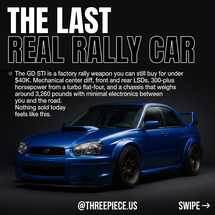
The 2004–2007 Subaru Impreza WRX STI — known as the GD chassis — is the last factory rally car Subaru built before the brand pivoted to crossovers and soft-touch interiors. A mechanical DCCD center differential, front and rear limited-slip differentials, 300+ horsepower from the EJ257 turbo flat-four, and a curb weight of roughly 3,260 pounds with minimal electronic intervention. Nothing in a modern showroom replicates this driving experience, and the market is starting to price that in. Clean examples are sitting between $25K and $40K right now, and the trajectory is obvious. Here's what you need to know before you buy one.
Quick links
- Why the GD STI matters in 2026
- What the driving experience actually feels like
- Tuning ceiling: stock internals to 470 whp
- 2004 vs 2006 vs 2007: which year to buy
- Known failure points and what they cost
- Pre-purchase inspection checklist
- Wheel and tire fitment for the GD STI
- Stop circling — go buy one
Why the GD STI matters in 2026
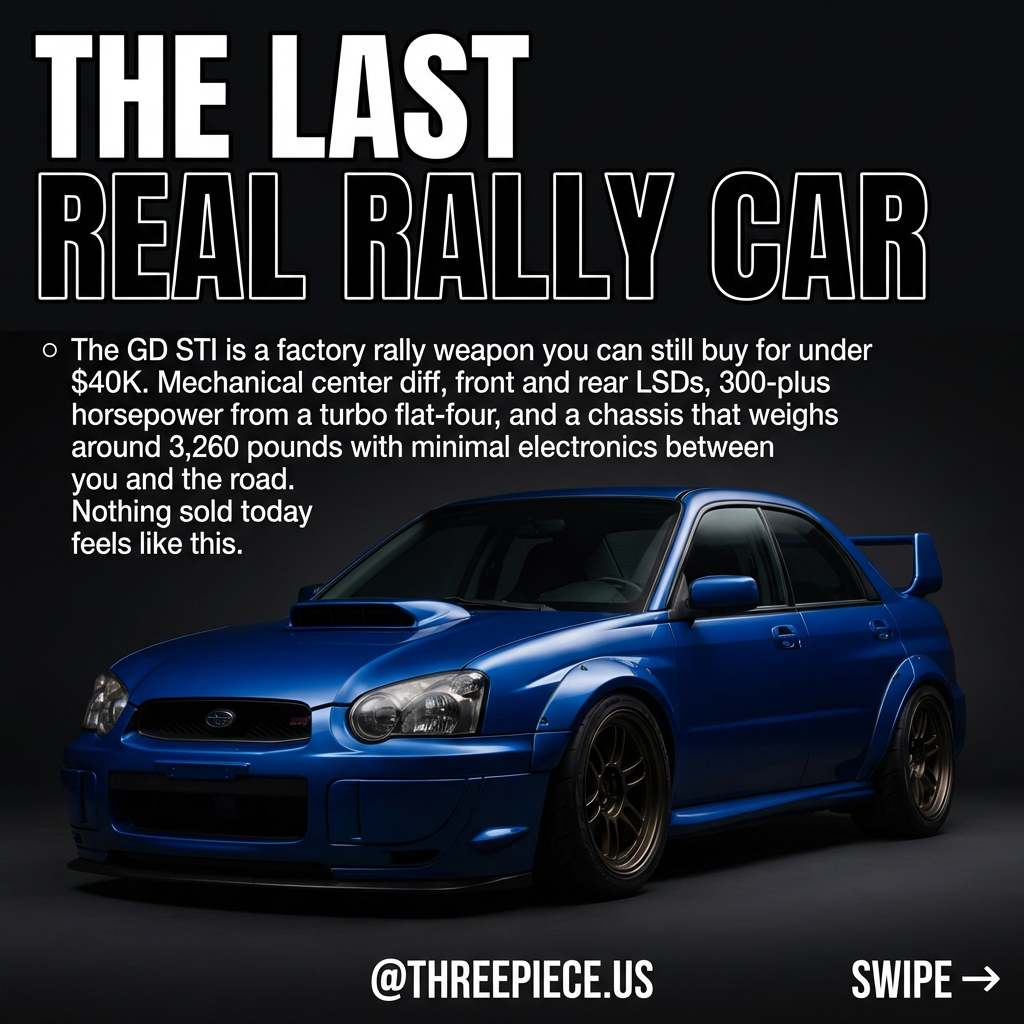
Subaru developed the GD chassis on actual rally stages — not in a focus group. The result is a homologation special that was overbuilt from the factory in ways modern turbo fours simply aren't. The EJ257 is a 2.5-liter turbocharged boxer four that makes 300 hp and 300 lb-ft from the factory, routed through a six-speed manual and the legendary symmetrical AWD system with a driver-adjustable DCCD center differential. Front helical LSD. Rear Torsen LSD. This is adjustable all-wheel-drive grip you can feel working underneath you, not a software-managed torque split that decides for you.
The steering feel alone makes every new WRX feel like it's communicating through a translator. If you've been looking at the Mk7 Golf R or other modern turbo-four AWD cars, the GD STI is the raw, analog counterpoint. It's also the last generation before Subaru started adding weight, complexity, and electronic nannies that diluted the formula. The VA-generation STI that followed is a good car, but it's a different car. The GD is the one with rally DNA you can actually feel.
What the driving experience actually feels like
The GD STI is not a comfortable car. Early Blobeye models (2004–2005) have minimal sound insulation, a stiff ride on the factory Bilsteins, and road noise that reminds you this was designed to be competitive on gravel. That's exactly the point. The chassis is communicative in a way that modern performance cars have engineered out. You feel every surface change through the steering column, and the car rotates on throttle in corners with a predictability that rewards aggressive driving.
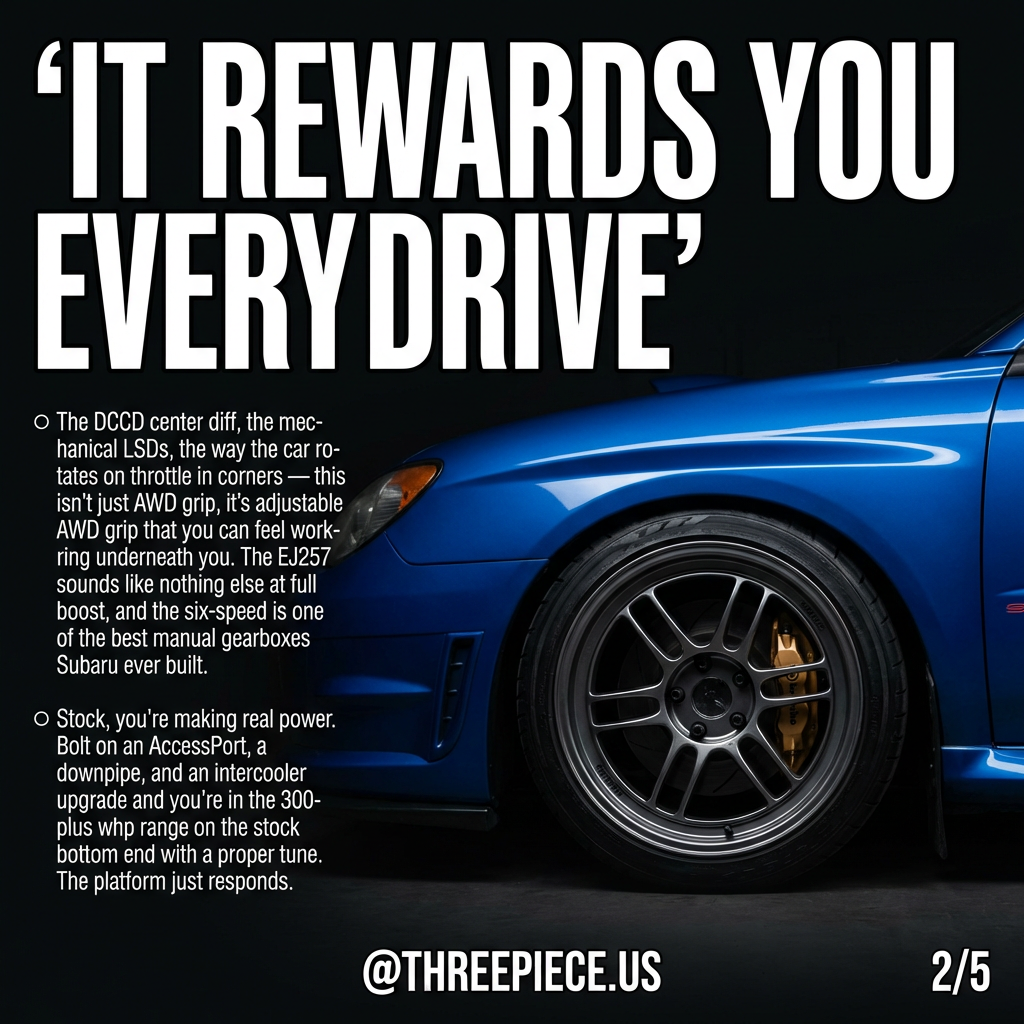
The DCCD system is the secret weapon. In manual mode, you can bias torque distribution from front to rear in real time. On a wet backroad, you can loosen the rear to rotate the car. On a dry track day, you can lock it up for maximum traction. This isn't a party trick — it's a genuine performance tool that makes the car feel different every time you adjust it. Combined with the mechanical LSDs front and rear, the GD STI puts power down in a way that electronic systems still struggle to replicate.
The EJ257 sounds like nothing else at full boost. That boxer rumble through the unequal-length headers is unmistakable, and the VF39 turbo (2004–2006) spools with a character that modern twin-scroll setups can't match. It's laggy by today's standards — you'll wait for boost below 3,500 RPM — but when it hits, the delivery is violent and addictive. If you want the turbo-four experience done right, this is where it started.
Tuning ceiling: stock internals to 470 whp
The GD STI's aftermarket is bottomless. Cobb AccessPort, EcuTek, Link standalone — every level of engine management is supported. The basic bolt-on path is well documented: an AccessPort, a catted downpipe, and a front-mount intercooler upgrade with a proper protune will put you in the 300–320 whp range on the stock bottom end. That's real, usable all-wheel-drive power on a car that weighs 3,260 pounds. For more detail on the exact mod order, our GDB STI EJ257 build guide breaks down every step.
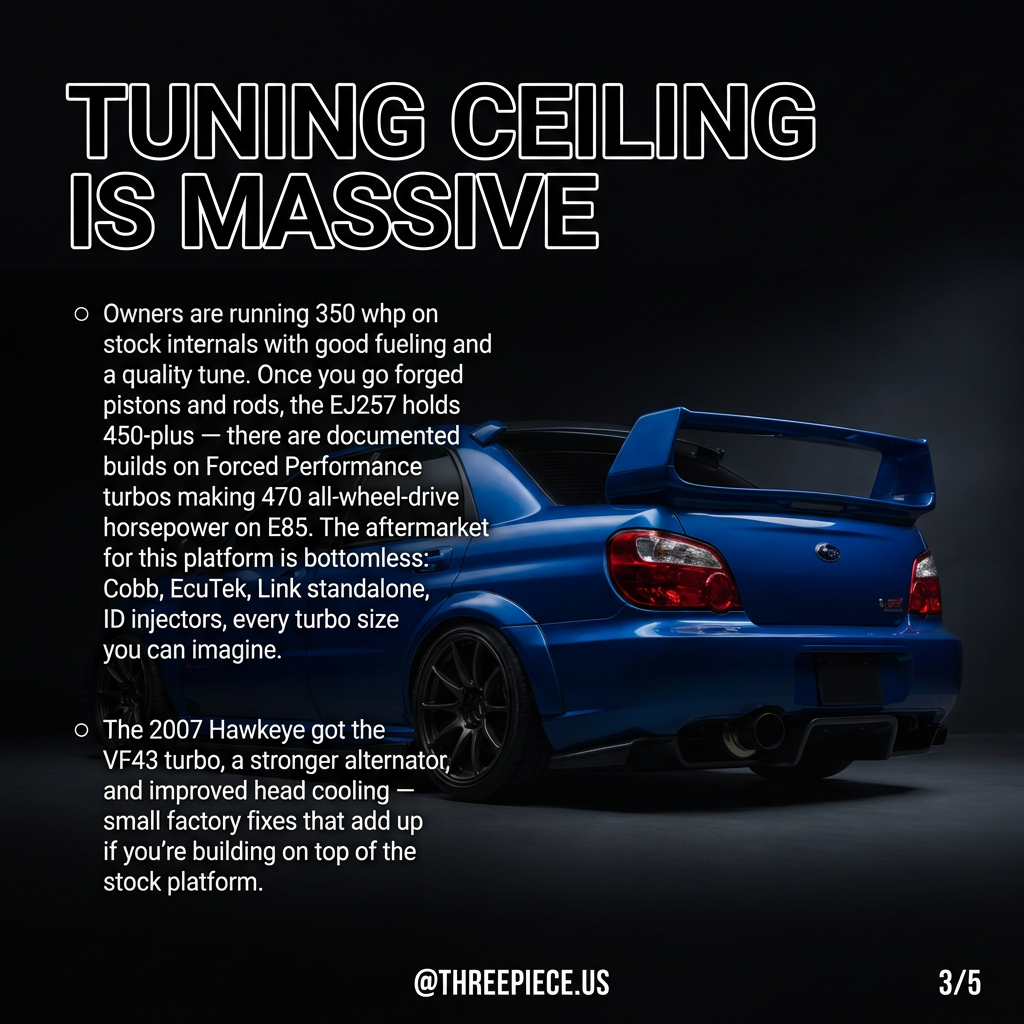
Owners are running 350 whp on stock internals with proper fueling — ID1050x injectors, a Walbro 450 fuel pump, and a quality E85 tune. Once you go forged pistons and rods, the EJ257 holds 450+ whp reliably. There are documented builds on Forced Performance turbos making 470 all-wheel-drive horsepower on E85 with the stock block location. The short-block rebuild with forged internals runs $5,000–$8,000, but it transforms the platform into something that can handle serious power indefinitely.
Be aware of the evolving downpipe inspection landscape — some states are cracking down on aftermarket exhaust components, and catless setups are increasingly risky for street-driven cars. Plan your exhaust path accordingly.
2004 vs 2006 vs 2007: which year to buy
Not all GD STIs are created equal. Subaru made quiet but meaningful improvements across the production run, and knowing the differences will save you money and headaches.
2004–2005 (Blobeye): The rawest version. Less sound insulation, the most analog feel, and the purest rally-car experience. These run the VF39 turbo and have the original EJ257 head design. The trade-off is thinner corrosion protection — rust hits the rear quarters and fender wells hard, especially on cars that saw salt. Radiators and coolant hoses are the oldest in the lineup, so budget for cooling system replacement if it hasn't been done. These are the most affordable GD STIs, and the most rewarding to drive if you don't mind the rough edges.
2006 (Hawkeye, year one): A transitional year. The US spec saw some center diff and oil pump revisions that were later corrected, making 2006 a slightly awkward model year from a mechanical standpoint. Still a great car, but if you're choosing between a 2006 and a 2007, the 2007 is the better buy for the money.
2007 (Hawkeye, refined): The best GD STI from the factory. Subaru upgraded to the VF43 turbo with a revised wastegate actuator, bumped the alternator from 90A to 110A, improved head cooling, and made 2nd, 3rd, and 4th gear ratios taller for better driveability. These small factory fixes add up significantly if you're building on top of the stock platform. The 2007 commands a premium, but it's the most sorted starting point. If you're planning a serious build, compare this to the VA STI build path — the GD is lighter and more engaging, but the VA has a slightly more refined EJ257.
Known failure points and what they cost
The GD STI has a well-documented set of failure modes. None of them are deal-breakers if you budget for them, but all of them will wreck your ownership experience if you ignore them. Here's what breaks, when it breaks, and what it costs to fix.
Ringland failure (cylinder #4): This is the big one. The EJ257's cast pistons are the weak link, and cylinder #4 runs hottest due to its position in the cooling circuit. Symptoms are misfires, compression loss, and blue smoke under load. It tends to happen after 80,000–100,000 miles, especially on cars with aggressive tunes and inadequate fueling. A compression test is non-negotiable before purchase — you want 140–160 PSI across all four cylinders with no more than 10% variance. If cylinder #4 is low, walk away or negotiate a rebuild into the price. A short-block rebuild with forged pistons runs $5,000–$8,000.
Head gasket failure: Subaru's factory head gaskets are weak. Expect coolant loss, white smoke, and overheating, typically after 100,000 miles or after any overheating event. MLS (multi-layer steel) replacement head gaskets are the permanent fix at $1,500–$2,500 installed. If you're doing a short-block rebuild anyway, do the head gaskets at the same time — the labor overlap saves you significantly.
Turbo failure: The VF39 (2004–2006) and VF43 (2007) turbos develop shaft play, oil leaks into the intake, and bearing noise between 70,000 and 120,000 miles. Neglected oil changes accelerate this. OEM replacement runs $1,500–$2,500; an upgraded turbo swap (VF48, Forced Performance, etc.) is $3,000–$5,000 plus tune.
Second-gear synchro wear: The six-speed is strong, but second gear takes abuse from hard launches and aggressive driving. Grinding into second, especially when cold, is a red flag. This can appear as early as 50,000–80,000 miles on hard-driven cars. A transmission rebuild runs $2,000–$3,500; full replacement is $3,000–$4,000. If you're building serious power, an upgraded clutch is essential — the ACT HD/Race Rigid 6-Pad Clutch Kit at $1,213 is built for this exact application, and the ACT release bearing at $72 should be replaced at the same time.
Oil pickup tube / oil pump: The factory oil pickup tube can crack at the weld, causing oil starvation that wrecks rod bearings and turbos. Low oil pressure warnings at startup are the symptom. Replacement is $400–$800 in parts, but if the damage is already done, you're looking at a full engine rebuild at $5,000+. This is a preventive maintenance item — replace it before it fails.
Valve cover gaskets and oil leaks: Common by 70,000–100,000 miles. Oil leaking around valve covers, oil cooler lines, and vacuum fittings. Not catastrophic, but annoying and progressive. Budget $400–$800 for both covers, seals, and gasket kits installed.
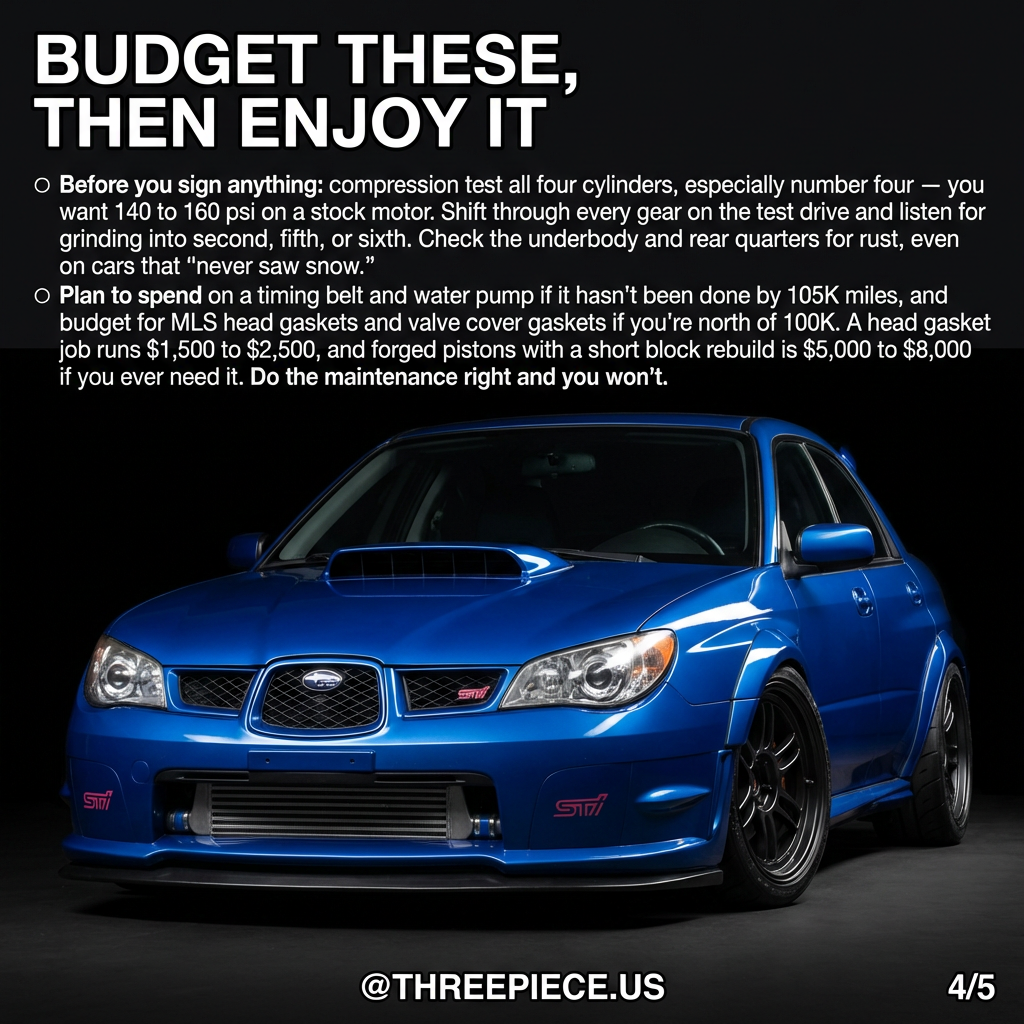
Pre-purchase inspection checklist
The GD STI attracts owners who modify and drive hard. Finding one that hasn't been beaten on by three previous owners is getting harder every year. Here's what to check before you hand over any money.
Compression test: This is the single most important diagnostic. All four cylinders should read 140–160 PSI with no more than 10% variance between them. If the seller won't let you do a compression test, that tells you everything you need to know.
Shift through every gear: On the test drive, shift deliberately into 2nd, 5th, and 6th. Listen for grinding, resistance, or pop-out. Cold shifts into 2nd are the most revealing — if it grinds when the transmission oil is cold, the synchros are on their way out.
Rust inspection: Check the rear quarters, fender wells, and underbody — even on cars that "never saw snow." Blobeye models (2004–2005) are especially vulnerable due to thinner corrosion protection. Structural rust on the rear subframe mounts is a walk-away issue.
Timing belt and water pump: If the car is past 105,000 miles and the timing belt hasn't been done, budget for it immediately. This is an interference engine — if the belt snaps, the valvetrain is finished. A Gates water pump at $240 should be replaced at the same time as the timing belt — it's cheap insurance and the labor is already done.
Brake condition: The GD STI came with Brembo four-piston front calipers from the factory, but rotors wear and warp with track use. The EBC BSD front rotors for the 2005–2007 STI at $491 are a direct-fit upgrade with improved heat dissipation — worth budgeting for if the car has track miles. Check for rotor scoring, pad thickness, and any pulsing under braking during the test drive.
Modification history: Ask for receipts. A car with a Cobb AccessPort, a proper protune from a reputable tuner, and supporting mods (fuel pump, injectors, intercooler) is actually a better buy than a "stock" car with 120,000 miles of deferred maintenance. What you don't want is a car with a downpipe and no tune, or an eBay turbo-back with the stock fuel system. Those are the cars that end up with ringland failure.
Wheel and tire fitment for the GD STI
The GD STI runs a 5x114.3 bolt pattern with a 56.1mm hub bore. Factory wheel size is 17x8 +53 on the 2004–2005 and 17x8 +53 on the 2006–2007, all wrapped in 235/45R17 tires. That's a conservative starting point.
The most popular aftermarket fitment is 18x9.5 +38, which fills the fender wells properly and allows for a 265/35R18 tire. This is the sweet spot for street and track use — enough width for serious grip without requiring fender work on a stock-body car. Browse 18x9.5 wheels in 5x114.3 to see what's available. For a more aggressive look, 18x10 +35 works with minor rolling on the rear fenders.
If you're keeping it at 17 inches for rally-style builds or rougher roads, 17x9 +35 is the move. Pair with 255/40R17 tires for a meatier sidewall that absorbs impacts better. Check out 17x9 wheels in 5x114.3 for options.
The GD STI is one of those platforms where wheel choice defines the entire character of the build. A set of Work Emotion wheels in bronze on World Rally Blue is one of the most iconic combinations in the sport-compact world. If you're considering forged vs cast wheels for this platform, the weight savings matter — the GD STI responds noticeably to unsprung weight reduction. For the full breakdown on whether the investment is justified, read our 3-piece wheels explained guide. And check the ThreePiece vehicle gallery for real-world fitment examples on similar platforms.
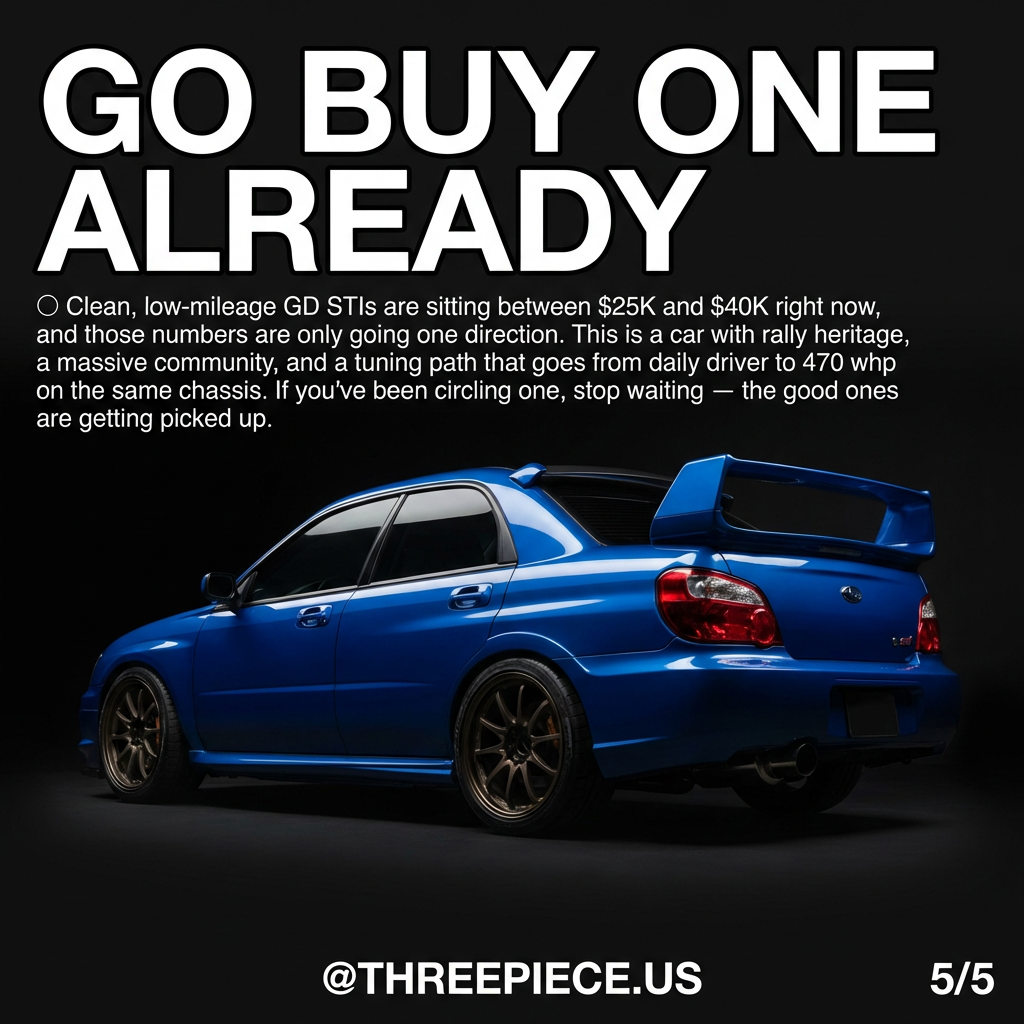
Stop circling — go buy one
Clean, low-mileage GD STIs are sitting between $25K and $40K right now, and those numbers are only going one direction. This is a car with genuine rally heritage, a massive community, and a tuning path that goes from daily driver to 470 whp on the same chassis. The aftermarket is bottomless, the mechanical systems are well-understood, and the known failure points are all manageable if you budget for them upfront.
The good ones are getting picked up. If you've been circling a GD STI for two years, the window on affordable examples is closing. Do the compression test, check for rust, shift through every gear, and if it checks out — stop waiting. Once you own one, start with the GDB EJ257 build guide for the right mod order, grab a set of proper 18-inch wheels in 5x114.3, and build the rally car Subaru intended.