

The 2004-2007 Subaru STI (GDB) remains one of the last turbo AWD platforms where you can build incrementally without needing a standalone ECU or a motorsport budget. The EJ257 responds to bolt-ons better than almost any factory turbo engine from this era — but the order you install parts matters more than the parts themselves. Get it wrong and you're staring at a cooked cylinder 4 ringland. Get it right and you're looking at 350-380 whp on stock internals with a car that already came with Brembos, a 6-speed, and DCCD from the factory. Here's the build path that actually works.

Quick links
- Start With the Tune, Not the Exhaust
- Fuel System: The Ringland Insurance Policy
- Suspension That Actually Works on the Street
- Drivetrain: Mounts, Bushings, and Clutch
- GDB Wheel Fitment: Bolt Pattern, Offset, and Brake Clearance
- The Finished Product
Start With the Tune, Not the Exhaust
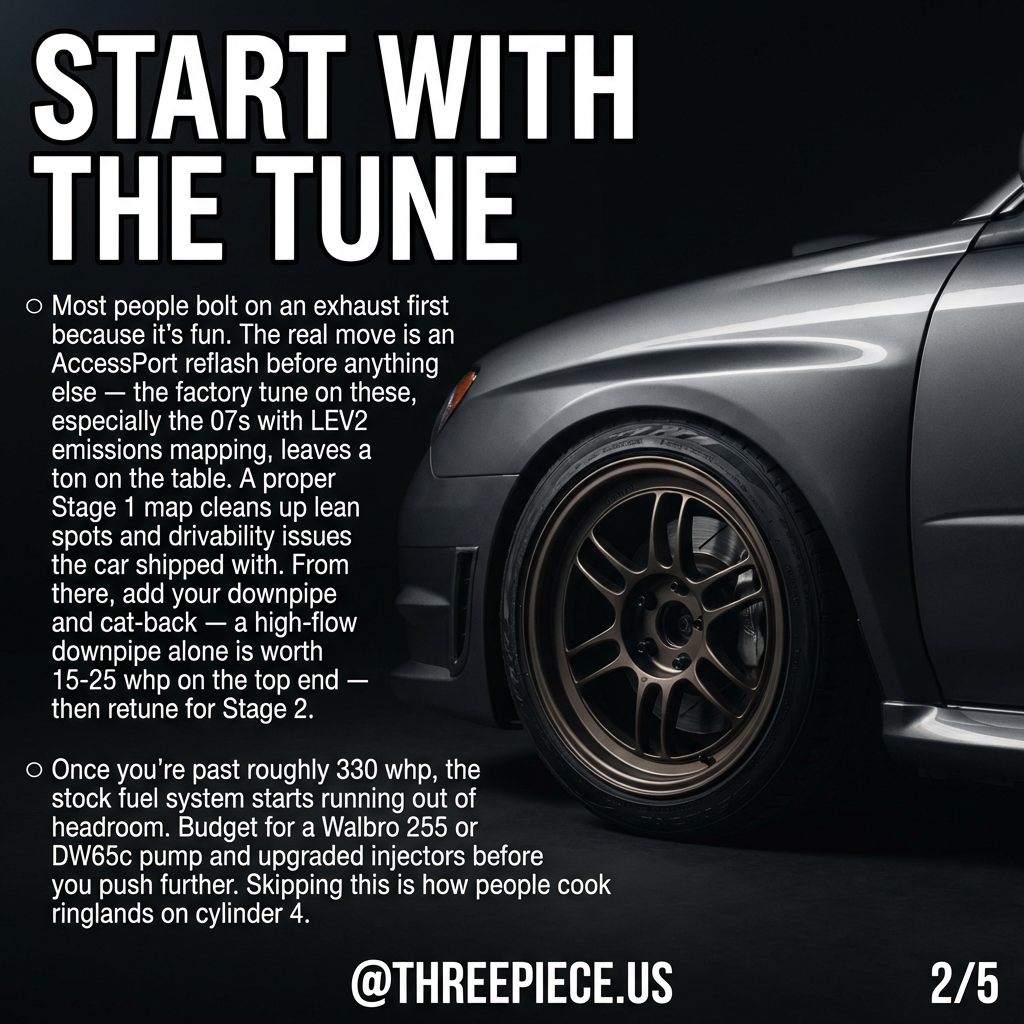
Most GDB owners bolt on a cat-back exhaust first because it sounds good. The real move is a COBB AccessPort reflash before anything else. The factory tune on these cars — especially the 2007 models with LEV2 emissions mapping — leaves a significant amount of power and drivability on the table. A proper Stage 1 map cleans up lean spots the car shipped with from Subaru. This is the single cheapest power and reliability gain you can make on the platform.
From there, add a high-flow downpipe. On the EJ257, a catted or catless downpipe alone is worth 15-25 whp on the top end. Combine it with a cat-back exhaust and retune for Stage 2, and you're in the 320-340 whp range on the stock turbo. If you're weighing the implications of running a downpipe in your state, read our breakdown of state inspection rules banning aftermarket downpipes — it directly applies to WRX and STI builds.
Fuel System: The Ringland Insurance Policy
Once you're past roughly 330 whp, the stock fuel system starts running out of headroom. This is where most GDB builds go sideways. The stock fuel pump and injectors can't support the air-fuel ratio the engine needs under sustained boost, and the result is a lean condition on cylinder 4 that wrecks the ringland. It's the single most common failure mode on the EJ257 and it's almost entirely preventable.
Budget for a Walbro 255 LPH or DeatschWerks DW65c fuel pump and a set of upgraded injectors — ID 1050x injectors are the go-to for builds targeting 400+ whp, but even ID 725cc injectors give you meaningful headroom for a stock-turbo setup. Then get a proper protune from a Subaru-specific tuner, not an off-the-shelf map. The difference between a generic Stage 2 map and a custom protune on these cars is the difference between a reliable daily and a ticking time bomb. If you're coming from the WRX side of the GD platform, our 2002-2005 WRX GD build guide covers the EJ205 mod order — many of the fueling principles overlap.
For builds pushing past the stock VF39 turbo, the proven path is an FP Red or similar bolt-on turbo upgrade, a front-mount intercooler, equal-length headers, and a standalone ECU like the Link G4X or HKS F-Con V-Pro. At that point you're in the 400-500+ whp range, but you're also committing to built internals — Manley forged pistons and rods, ARP 2000 head studs, and proper headwork. That's a different budget conversation entirely.
Suspension That Actually Works on the Street
The GDB's factory suspension geometry is genuinely good. The goal isn't to reinvent it — it's to tighten it up and lower the center of gravity without destroying the ride quality you need for a street car. For a street-driven GDB, 8 kg/mm front and 6 kg/mm rear spring rates are the sweet spot most experienced owners land on. Stiff enough to feel composed through corners, soft enough to live with daily.
Drop it about two inches and leave it there. Going lower eats your suspension travel and creates rubbing problems you don't need — especially with the wider wheel and tire setups we'll cover below. If you're shopping coilovers, check out our breakdown of coilovers vs springs to understand where your money actually goes. The short version: a quality coilover at $1,200+ is worth it on the GDB. Browse our full suspension catalog for options across multiple platforms.
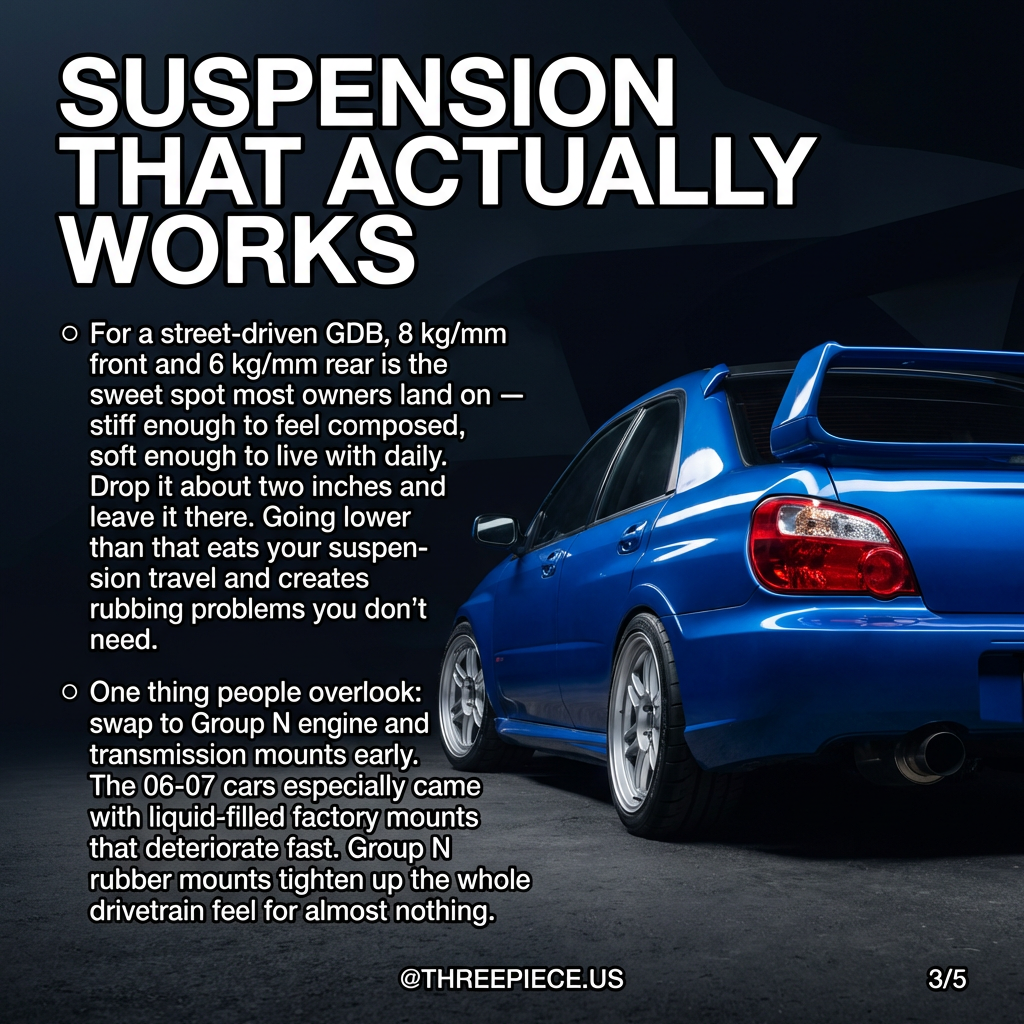
One thing people consistently overlook: swap to Group N engine and transmission mounts early. The 2006-2007 cars especially came with liquid-filled factory mounts that deteriorate fast and introduce slop into the entire drivetrain. Group N rubber mounts tighten up throttle response, shift feel, and overall chassis feedback for almost nothing. Pair those with Whiteline steering rack bushings and Turn-in-Concepts transmission subframe crossmember bushings and the car feels like a completely different platform.
Drivetrain: Mounts, Bushings, and Clutch
The STI's 6-speed transmission is strong enough for 400+ whp in most cases, but the clutch is the weak link. Once you're past Stage 2 power levels, the stock clutch starts slipping under hard acceleration in third and fourth gear. A twin-disc clutch is the correct answer here — it holds the power without the brutal pedal feel of a single-disc puck setup.
The Comp1 Clutch 04-20 Subaru STI 2.5L 240mm Twin Disc Organic Clutch Kit at $1,769 is an excellent option for street-driven builds — the organic disc material gives you a progressive engagement that's livable in traffic while holding significantly more torque than stock. If you're pushing serious power or tracking the car, the Comp1 Twin Disc Ceramic Clutch Kit at $1,819 holds even more but trades some street manners for grip. Either way, pair it with the Comp1 Push Style Bearing Kit Assembly at $217 — don't reuse the factory throwout bearing on a clutch upgrade.
The GDB's DCCD (Driver Controlled Center Differential) is one of the most underappreciated features on the platform. Most owners leave it in auto and never touch it. Learning to use the manual adjustment — locking the center diff for straight-line traction, opening it up for rotation in corners — transforms how the car puts power down. It's a free performance mod that costs nothing but seat time.
GDB Wheel Fitment: Bolt Pattern, Offset, and Brake Clearance
First things first: the 2004 STI is 5x100, the 2005-2007 STIs are 5x114.3. Know which one you have before you buy anything. This is the most common mistake on GDB forums and it's an expensive one to make. Stock offset is +53, which tucks the wheel deep inside the fender. For a clean flush look on coilovers, 17x8.5 in the +35 to +40 range with a 245/40R17 fills the arches without drama. Browse 17x8.5 wheels in 5x114.3 to see what fits.
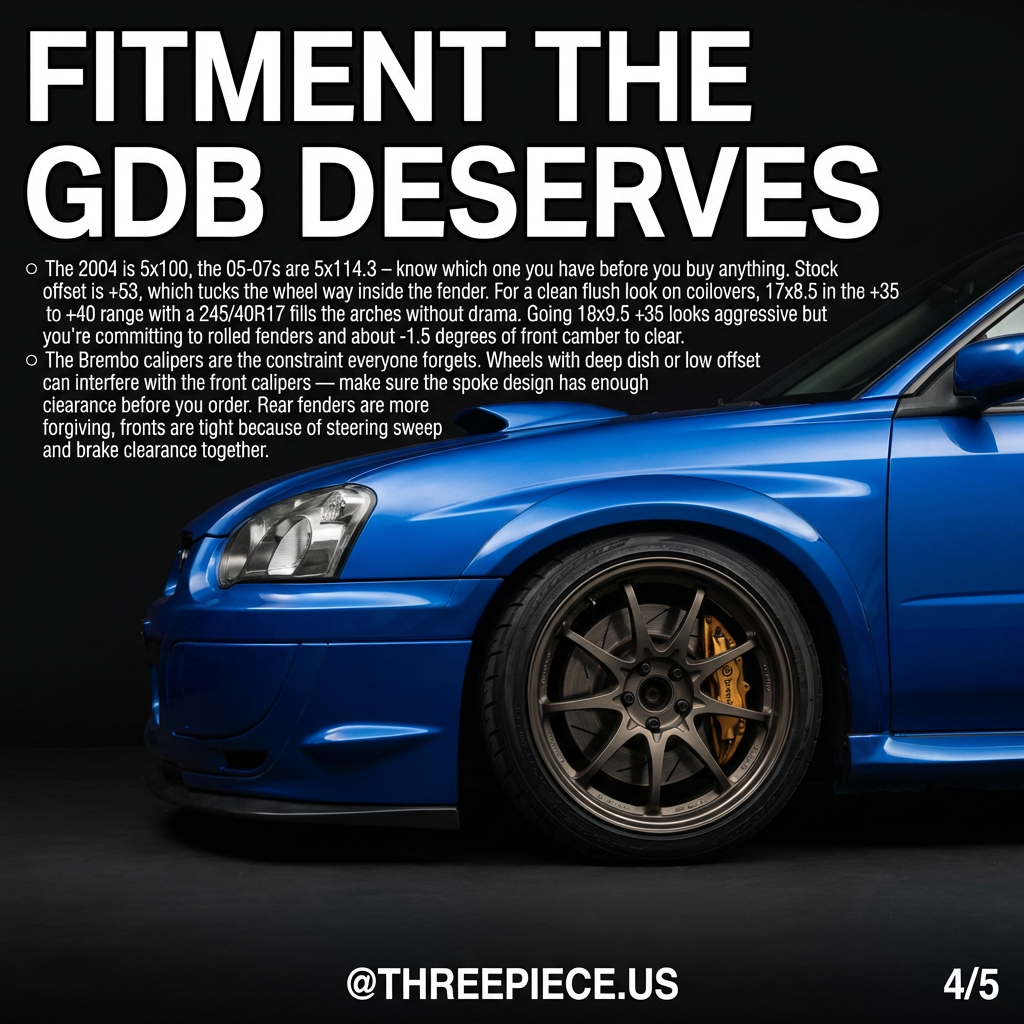
Going 18x9.5 +35 looks aggressive but you're committing to rolled fenders and about -1.5 degrees of front camber to clear. If you go that route, understanding how camber actually works is essential — you're not just eyeballing it for looks, you're managing tire contact patch and wear. For 18-inch setups, check out 18x9.5 wheels in 5x114.3.
The Brembo calipers are the constraint everyone forgets. The STI's factory 4-pot front Brembos are physically large, and wheels with deep dish or aggressive concavity can interfere with the caliper body. Make sure the spoke design has enough clearance before you order — this is especially critical on 17-inch wheels where the margin between spoke and caliper shrinks. Rear fenders are more forgiving, but fronts are tight because of steering sweep and brake clearance combined. If you want to understand the relationship between disc types and caliper clearance on multi-piece wheels, our 3-piece wheels explained guide breaks it down in detail.
For tire sizing, 245/40R17 is the go-to on 17-inch setups. On 18s, 255/35R18 fills the fender properly and gives you a wider contact patch. The Work Emotion series and Work Equip line both have designs that clear Brembo calipers in the right specs — they're among the most popular choices on built GDBs for a reason. If you're considering whether forged wheels are worth the investment on a platform like this, our cast vs forged wheels breakdown covers the real-world differences.
If you're running spacers to push the stock wheels out temporarily, read our wheel spacer safety guide first — there are right and wrong ways to do it on a car with this much torque going through all four corners.
The Finished Product
A bolt-on GDB with intake, downpipe, exhaust, upgraded fuel pump, and a proper protune puts you in the 350-380 whp range on a chassis that was already sorted from the factory. Add proper coilovers, Group N mounts, a Comp1 twin-disc clutch, and a set of wheels that actually fit, and you've got a street car that feels like it was built by someone who understands the platform — because it was.
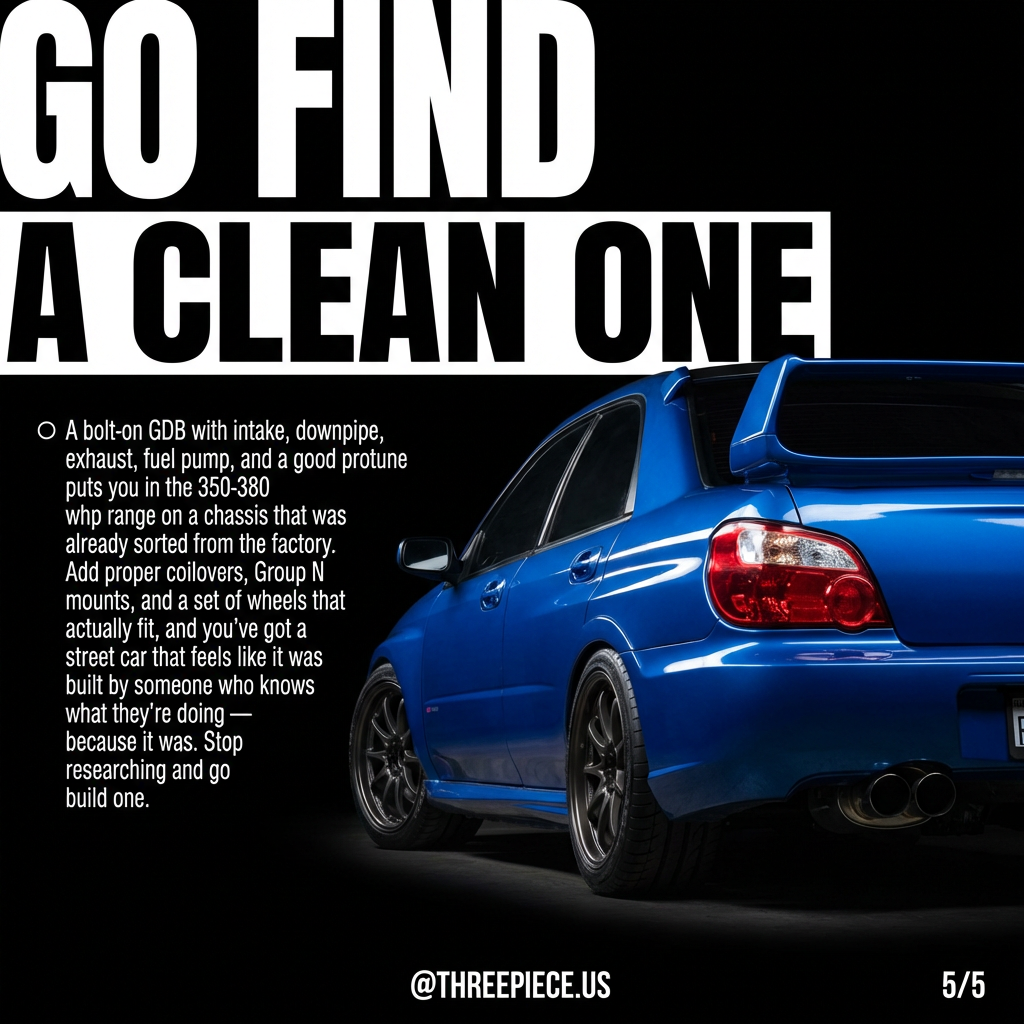
These cars are climbing in value. Clean, unmodified GDBs are getting harder to find every year, and even well-built examples are commanding premiums. If you're still searching for a shell, the hawkeye (2006-2007) models tend to bring the highest prices, but the blobeye (2004-2005) is mechanically identical and often $5-10K cheaper for a comparable example. Either way, having a build plan before you start spending is the difference between a cohesive car and a parts-bin disaster.
Browse our full wheel catalog and vehicle gallery for GDB fitment inspiration, and stop researching — go build one.