
Posted by THREEPIECE.US on Apr 17th 2026
VW Golf R Mk7 Buying Guide: Best Performance Value in 2026
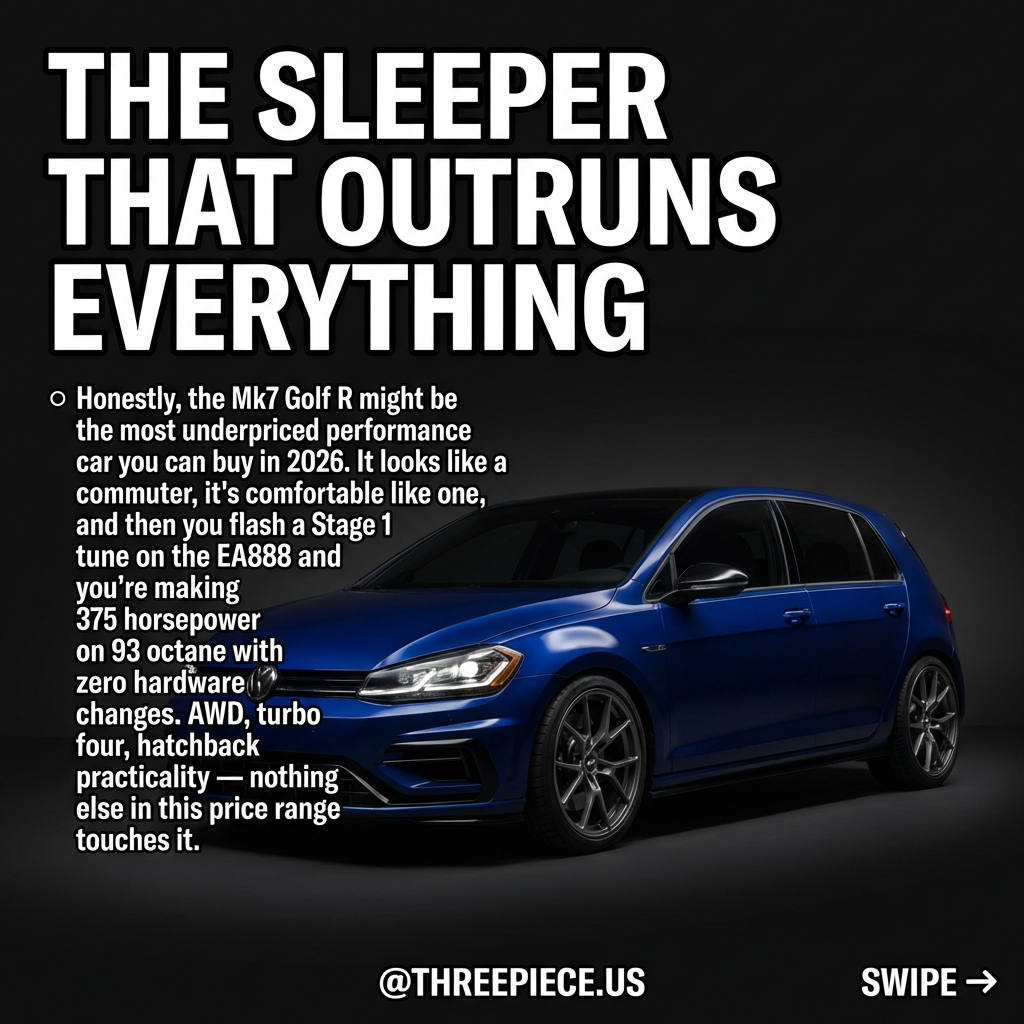
The 2015-2019 Volkswagen Golf R Mk7 might be the most underpriced performance car you can buy in 2026. Clean examples are settling into the $25,000-$32,000 range, and for that money you're getting a 292 hp turbocharged AWD hatchback with one of the deepest tuning ecosystems ever built around a single engine platform. Nothing else in this price bracket offers the same combination of daily usability, stealth factor, and outright speed potential. If you've been circling one, here's everything you need to know before signing.
Quick links
- Why the Mk7 Golf R punches above its weight
- EA888 tuning ecosystem: Stage 1 through big turbo
- Known failure points and what to budget
- DSG vs 6MT: which transmission to buy
- Wheel and tire fitment for the Mk7 R
- Pre-purchase checklist: what to inspect
- Final verdict: stop waiting
Why the Mk7 Golf R Punches Above Its Weight
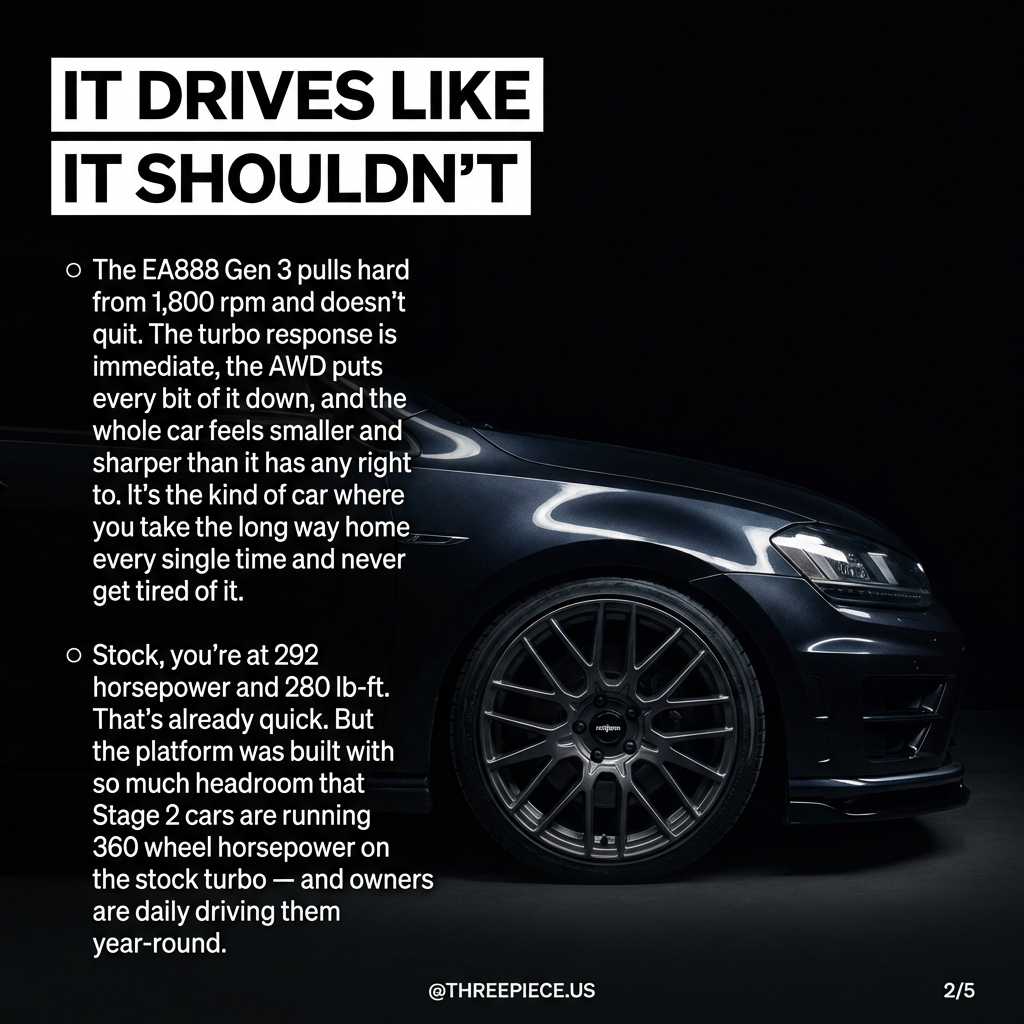
The Golf R was already underpriced when it was new. A 2.0L EA888 Gen 3 turbo four making 292 hp and 280 lb-ft, Haldex AWD, an interior that didn't scream boy racer, and a chassis that could embarrass cars costing twice as much on a back road. It's the kind of car where you take the long way home every single time and never get tired of it. The turbo response is immediate from 1,800 rpm, the AWD puts every bit of power down, and the whole car feels smaller and sharper than it has any right to.
What separates the Golf R from its competitors — the WRX STI, the GR Corolla, even the FK8 Type R — is the blend of refinement and headroom. The STI was rawer but stuck on the aging EJ257. The Type R is faster stock but FWD and visually aggressive. The Golf R is the one you can park at a client meeting and then gap a Mustang GT on the way home. That duality is exactly why these are getting snapped up.
EA888 Tuning Ecosystem: Stage 1 Through Big Turbo
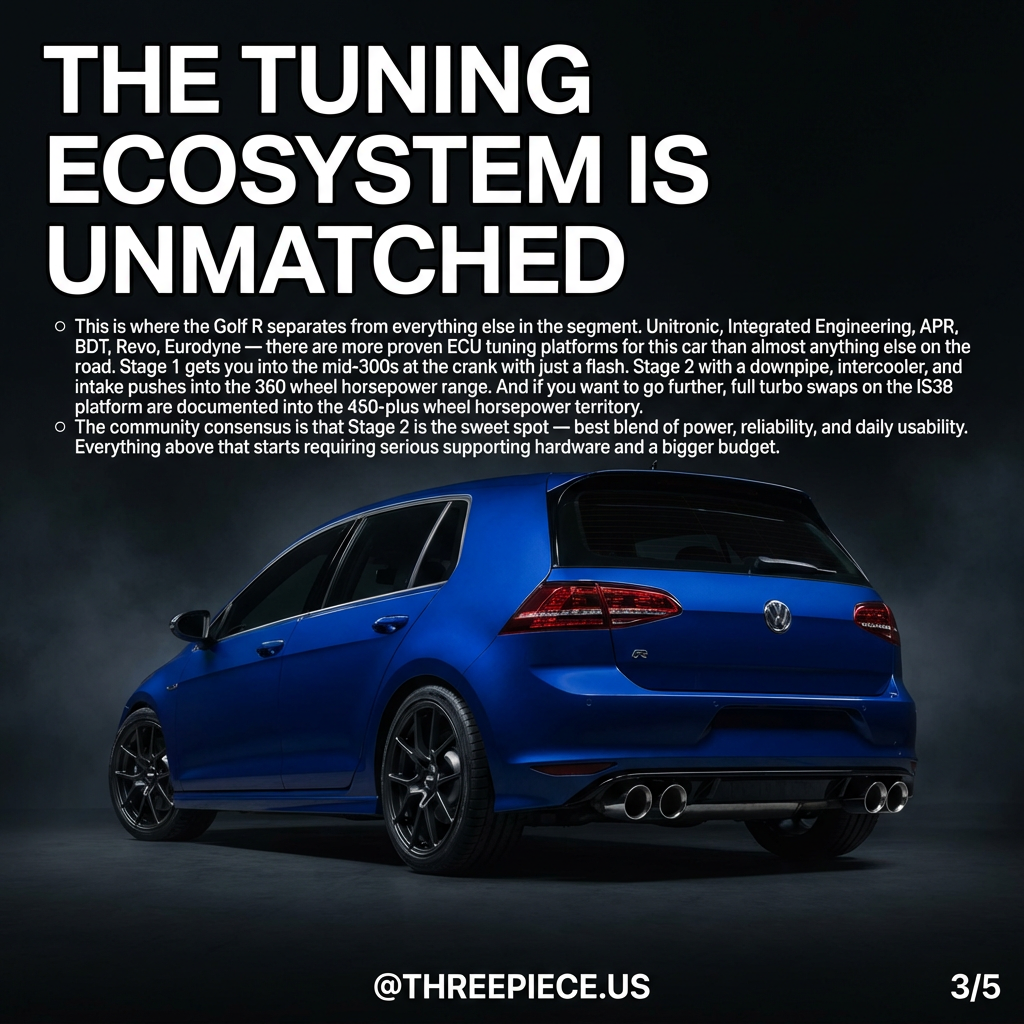
This is where the Golf R separates from everything else in the segment. Unitronic, Integrated Engineering, APR, BDT, Revo, Eurodyne — there are more proven ECU tuning platforms for the EA888 than almost anything else on the road. The aftermarket depth here is comparable to what the LS platform has for V8 builds, and the community has been refining these tunes for nearly a decade.
Stage 1 is a simple ECU flash — no hardware changes — and gets you into the mid-350s at the crank on 93 octane. That's roughly 315-325 whp with zero reliability concerns on a stock motor. Stage 2 adds a downpipe, intercooler, and intake, pushing into the 360 whp range on the stock IS38 turbo. The community consensus is that Stage 2 is the sweet spot — best blend of power, reliability, and daily usability. If you're considering a downpipe upgrade, check your state's inspection rules first — enforcement is tightening.
Beyond Stage 2, full turbo swaps on the IS38 platform are documented into the 450+ whp territory, but everything above Stage 2 starts requiring serious supporting hardware and a bigger budget. For most owners, the stock turbo's ceiling is more than enough. The ECU lockdown trend hitting newer GM and Ford platforms makes the Mk7 R even more attractive — this generation is still fully tunable with off-the-shelf solutions.
Known Failure Points and What to Budget
Every platform has weak points. The Golf R's are well-documented, and more importantly, they're all solvable. Here's what actually breaks and what it costs:
IS38 Turbo Failures: Earlier cars (2015-2016 specifically) had turbo units where the shaft could break or the compressor wheel would contact the Teflon insert. Symptoms include sudden boost loss, audible whine, and no power at higher RPMs. This was more common on tuned cars, but some stock units failed too. Replacement runs $1,500-$2,500. The good news: if you're buying a 2015-2016 in 2026, this has almost certainly already been addressed or would have shown symptoms by now. Later production years used improved units.
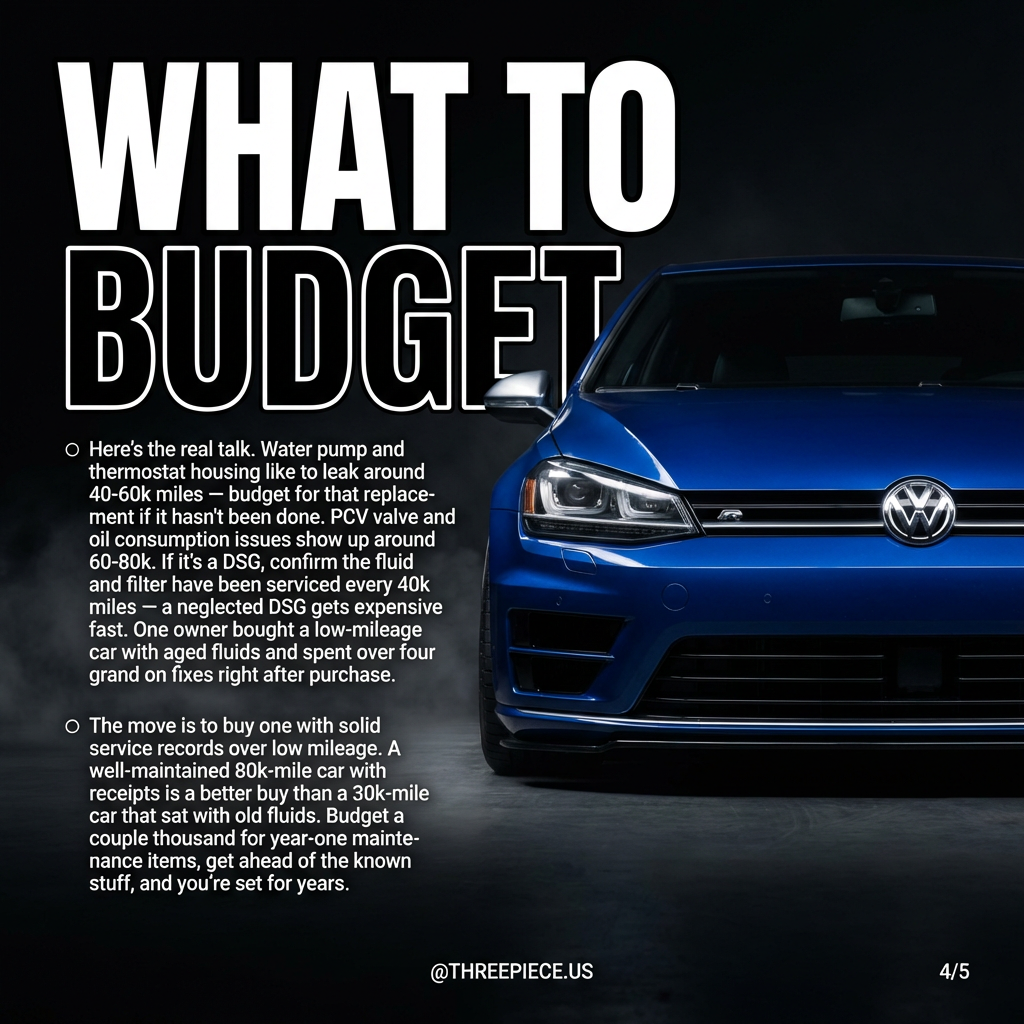
Water Pump and Thermostat Housing: The OEM plastic thermostat module likes to crack, typically around 40,000-60,000 miles. You'll see coolant leaks, overheating warnings, or coolant loss. Budget $600-$1,200 for a proper OEM or upgraded replacement. If the car you're looking at hasn't had this done, assume you'll be doing it.
PCV Valve and Oil Consumption: Around 60,000-80,000 miles, the PCV system starts causing vacuum issues, and oil consumption between changes becomes noticeable. Sometimes you'll see blue smoke under load. OEM PCV replacement runs $150-$400; a quality catch can slows recurrence. Valve cover and timing cover leaks often accompany this — expect $600-$1,200 with labor if you're doing gaskets at the same time.
Timing Chain Tensioner: This one usually shows up past 100,000 miles, though poor oil quality or missed maintenance can accelerate it. Rattling on cold start and misfire codes are the giveaways. A full timing set with tensioner and guides runs $3,000-$4,000 at a dealer. This is the big-ticket item — but it's also the one most likely to be years away on a car you buy today.
For context on how these maintenance demands compare to other turbocharged platforms, the FA20DIT in the WRX has its own carbon buildup issues, and the N55 in the E90 335i has a similar water pump and thermostat reputation. The EA888's problems are well-understood and well-solved — that's the advantage of buying into a mature platform.
DSG vs 6MT: Which Transmission to Buy
The DQ250 DSG in the Golf R is one of the best dual-clutch units ever put in a production car. It shifts faster than you can, it handles power well, and it makes the car feel relentless in daily driving. But it's not without its quirks.
Mechatronic unit faults are the big one. Between 60,000-100,000 miles, DSG-equipped cars can develop flashing transmission lights, limp mode, jerky shifts, or clutch slipping. A mechatronic rebuild or replacement runs $2,000-$5,000 depending on whether clutch packs and fluid are included. 5th gear bearing noise is another documented issue — a whirring or whining that requires transmission removal and costs $1,500-$3,000.
The critical maintenance item: DSG fluid and filter service every 40,000 miles. A neglected DSG gets expensive fast. One owner bought a low-mileage car with aged fluids and spent over $4,000 on fixes right after purchase. If you're going past Stage 1, a TCU tune is nearly mandatory — the stock transmission calibration gets confused above 350 whp and shift behavior gets lazy.
DSG overheating is also real on track or in aggressive driving. Solutions include upgraded DSG cooler kits and more frequent fluid changes. Cooling mods run around $500-$1,200. If you want to improve the chassis dynamics alongside the drivetrain, the H&R 28mm Adjustable Front Sway Bar for MK7 at $475 is one of the best single handling upgrades you can bolt on — it sharpens turn-in dramatically and reduces understeer without destroying ride quality. Before you invest in coilovers, read our take on whether coilovers are overrated — springs and sway bars go a long way on the MQB platform.
The 6-speed manual is the simpler, lower-maintenance option. It doesn't shift as fast, and it doesn't handle power as seamlessly, but it also doesn't have a $5,000 mechatronic failure lurking. If you want the engagement factor and don't care about quarter-mile times, the manual is the move. If you want the fastest possible daily driver, DSG — but only with confirmed service records.
Wheel and Tire Fitment for the Mk7 R
The Mk7 Golf R runs a 5x112 bolt pattern with a 57.1mm center bore. Stock wheels are 18x7.5 ET51 on the base and 19x8 ET50 on the Pretorias. Both offsets are conservative — there's room to go wider and more aggressive without fender work.
The community sweet spot for a daily/performance setup is 18x8.5 ET45. This fills the fenders properly on a lowered car without rubbing, and it opens up a huge range of tire options. Browse 18x8.5 wheels in 5x112 to see what's currently available. Pair them with 245/40R18 tires — that's the go-to size for grip without sacrificing ride quality.
If you're going 19s, 19x8.5 ET45 is the standard move. You'll want 235/35R19 or 245/35R19 tires depending on how aggressive you want the sidewall. The 19" setup looks sharper but rides stiffer — most track-focused owners stick with 18s for the extra sidewall and lighter weight.
If you're considering premium wheels for the build, understanding the difference between cast and forged matters here. The Golf R is light enough that unsprung weight savings from forged wheels translate directly into sharper turn-in and better ride quality over rough pavement. The Work Emotion series is a popular choice in the Euro scene — lightweight, aggressive designs that suit the Mk7's clean lines. For a more classic JDM look, the Work Meister in 18" is a statement piece that competes directly with the TE37 for build-quality credibility. Make sure you're running hubcentric rings if your chosen wheel doesn't match the 57.1mm center bore — VWs are sensitive to hub-centric fitment and you'll feel vibration without them.
Pre-Purchase Checklist: What to Inspect
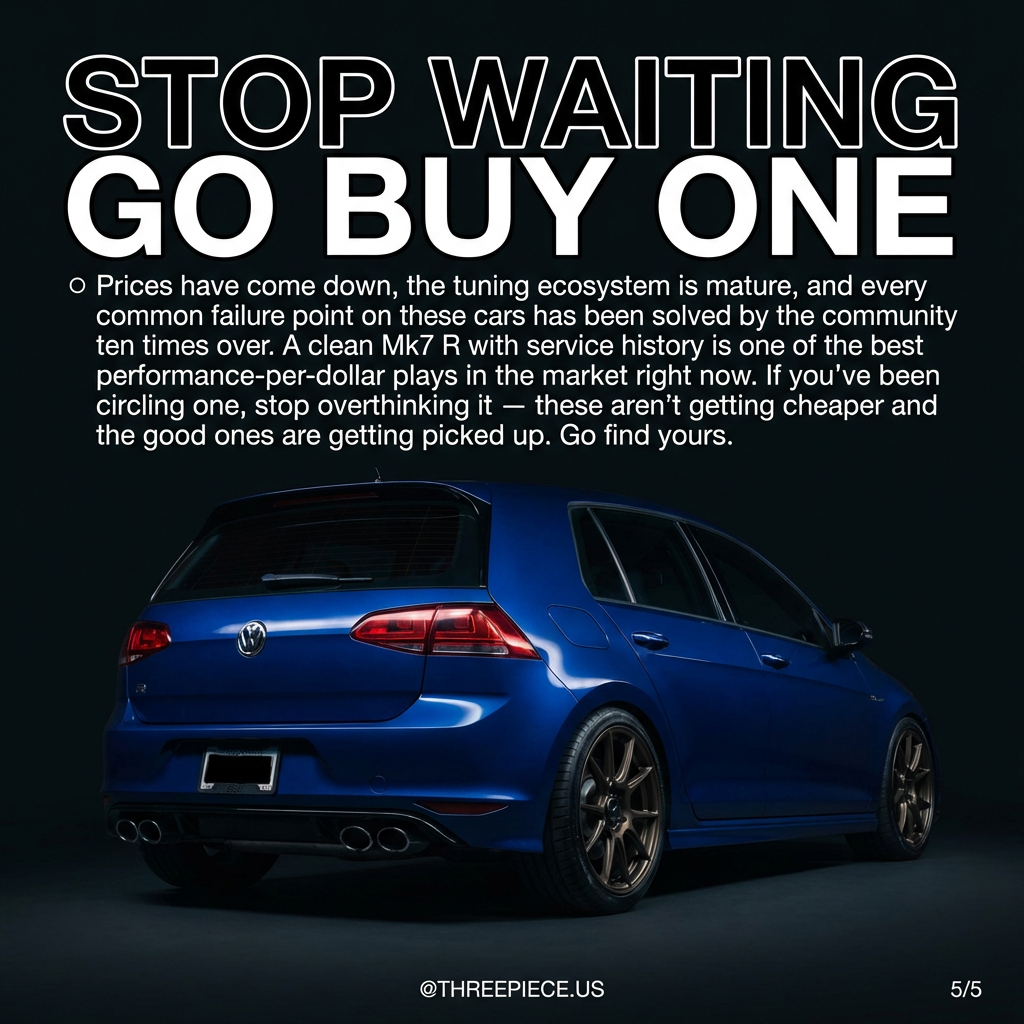
If you're evaluating a used 2015-2019 Golf R in 2026, use this checklist. A well-maintained 80,000-mile car with receipts is a better buy than a 30,000-mile car that sat with old fluids. Prioritize service history over odometer reading.
- Full service history — especially DSG fluid/filter records and any cooling system work. No records on a DSG car is a walk-away.
- Turbo health — ask if the owner experienced boost loss or whine. Request a boost log if possible. On 2015-2016 cars, ask if the turbo has been replaced.
- Oil leaks — inspect under the car around timing covers, cam magnet seals, rear main seal, and the plastic oil pan. The pan is a known weak point and cracks easily.
- PCV system — check the oil separator, hoses, and cap. If there's an aftermarket turbo inlet, it can sometimes worsen PCV behavior.
- Coolant system — look for seepage around the thermostat housing and water pump. If these haven't been replaced on a car over 60k miles, budget for it immediately.
- Interior condition — cloth interiors wear faster, especially near bolsters. Leather trims hold up better long-term.
- Tune history — a tuned car isn't necessarily bad, but you want to know what was done and by whom. A reputable Stage 1 from APR or Unitronic with supporting maintenance is fine. A random eBay tune with no records is a red flag.
Budget $2,000-$3,000 for year-one maintenance items on any used Golf R. Get ahead of the known stuff — water pump, PCV, fluid services — and you're set for years. Check our vehicle gallery for build inspiration once you've locked down your car.
Stop Waiting — Go Buy One
Prices have come down, the tuning ecosystem is mature, and every common failure point on the Mk7 R has been solved by the community ten times over. A clean example with service history is one of the best performance-per-dollar plays in the market right now. The underrated performance car window is closing — the good ones are getting picked up by people who did their homework.
The Mk7 Golf R sits in a rare category: it's fast enough to embarrass sports cars, refined enough to daily year-round, and supported deeply enough that you'll never be stuck looking for parts or tuning solutions. The Mk7 platform's handling credentials are well-documented, and with the right wheel and suspension setup, it transforms into something that feels bespoke.
If you've been circling one, stop overthinking it. Find a clean example, verify the service records, budget for the known maintenance items, and start building. Browse wheels, suspension, and wheel accessories at ThreePiece.us to start planning the build before the car even hits your driveway.