

FA20DIT Carbon Buildup: Why Subaru WRX Intake Valves Fail
The FA20DIT in your 2015+ Subaru WRX is quietly choking itself. Every mile you drive, carbon deposits are accumulating on the intake valves — reducing airflow, wrecking valve seats, and stealing power you'll never notice until it's too late. This isn't a hypothetical failure mode. It's an engineered inevitability of Subaru's direct injection boxer, and most owners are running 30%+ airflow deficits without realizing it. If you own an FA20DIT WRX, this is the maintenance reality nobody warned you about.

Quick links
- How direct injection creates carbon buildup
- Why the FA20DIT is worse than other DI engines
- How carbon buildup wrecks your power
- Band-aid fixes that don't actually work
- What actually fixes FA20DIT carbon buildup
- WRX build priorities: maintenance before mods
How direct injection creates carbon buildup
Port injection engines spray fuel directly onto the back of the intake valves. That fuel acts as a solvent — it washes away oil residue, combustion byproducts, and carbon deposits before they can accumulate. It's an unintentional but extremely effective cleaning mechanism that kept older engines running clean for hundreds of thousands of miles.
Direct injection changes everything. The FA20DIT sprays fuel directly into the combustion chamber through high-pressure injectors, bypassing the intake valves entirely. Those valves now sit exposed to hot oil vapor from the PCV system, exhaust gas recirculation residue, and blowby gases — with zero fuel washing to clean them. Over time, this bakes into a rock-hard carbon layer that physically restricts airflow into the cylinders. If you've been reading about FA20 red flags on modified WRXs, carbon buildup should be at the top of your checklist.
Why the FA20DIT is worse than other DI engines
Every direct injection engine has this problem — the VW EA888, BMW N55, Ford EcoBoost — but the FA20DIT has three compounding factors that make it significantly worse than the competition.
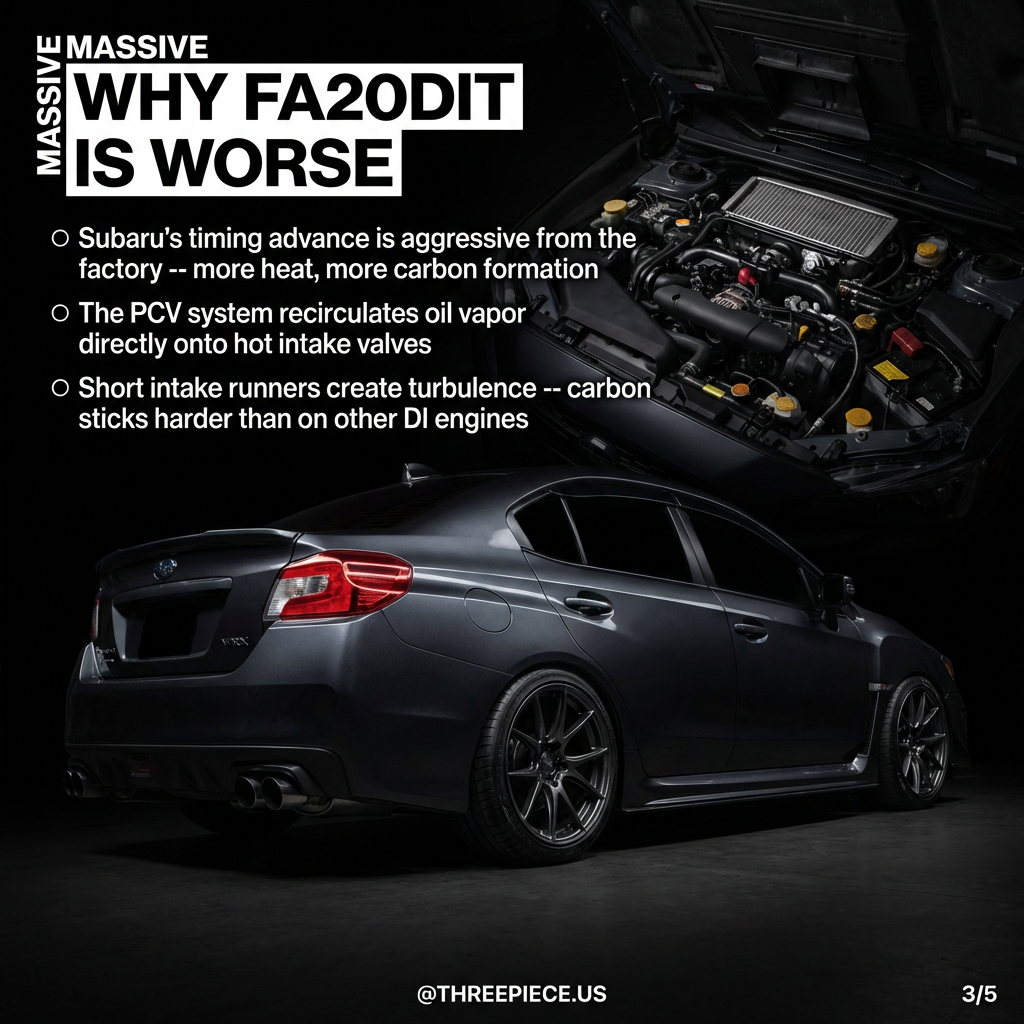
Aggressive timing advance from the factory. Subaru runs the FA20DIT with more ignition advance than comparable turbo-fours, which generates more combustion heat. Higher intake valve temperatures mean carbon deposits bake harder and faster. Where a GTI Mk7's EA888 might show moderate carbon at 60k miles, the FA20DIT can be severely coked at 40k.
PCV routing dumps oil vapor directly onto hot intake valves. Subaru's PCV system recirculates crankcase vapors — loaded with atomized oil — straight into the intake manifold. That oil vapor hits the scorching intake valves and carbonizes on contact. It's a design decision that prioritizes emissions compliance over long-term engine health. The SR20DET oil control guide covers similar PCV issues — oil vapor management is critical on any boosted engine.
Short intake runners create turbulence. The FA20DIT's compact boxer layout forces short intake runners that generate turbulent airflow. That turbulence causes carbon particles to impact valve faces at steeper angles, making deposits stick harder than on inline engines with longer, smoother intake paths. The combination of all three factors creates a perfect storm for accelerated carbon accumulation.
How carbon buildup wrecks your power
Carbon buildup on the FA20DIT doesn't announce itself with a check engine light or obvious misfire — at least not until it's severe. It's a gradual, invisible power thief. Here's the progression:
Stage 1 (15k-30k miles): A thin carbon layer coats the intake valve tulips. No noticeable symptoms. Your WRX makes rated power and you have no idea anything is wrong.
Stage 2 (30k-60k miles): Carbon builds to 1-2mm thickness, restricting airflow by 15-20%. You might notice slightly sluggish throttle response or a few PSI less boost than expected. Most owners blame the tune or altitude.
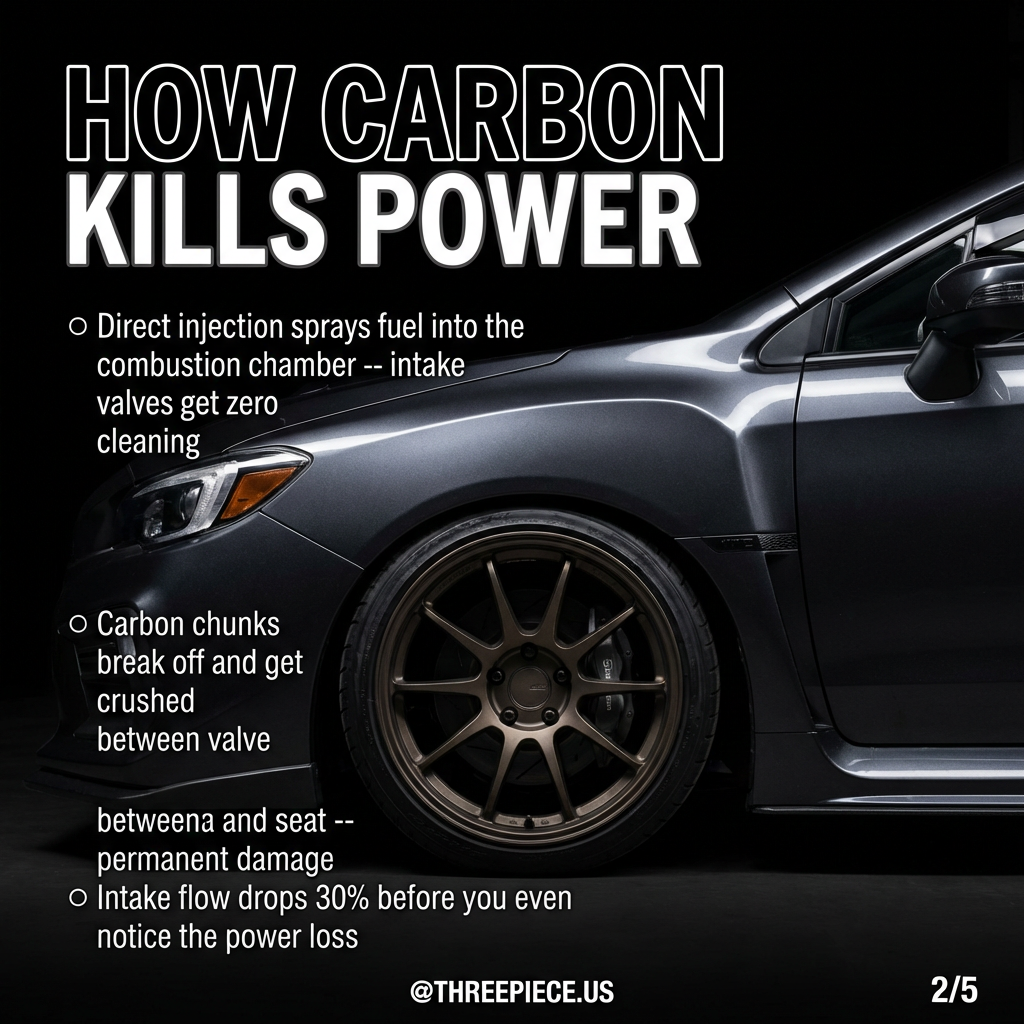
Stage 3 (60k+ miles): Deposits exceed 2-3mm. Intake flow drops 30%+. Carbon chunks break off and get crushed between the valve face and valve seat — this causes permanent pitting damage that no amount of cleaning can fix. You're now looking at a valve job or head replacement. If your WRX is making mysterious power loss on the dyno, carbon is almost certainly the culprit. This is the same type of invisible reliability issue covered in our FA20/FA24 reliability mods guide — the fixes nobody talks about until it's too late.
Band-aid fixes that don't actually work
The internet is full of cheap "solutions" for FA20DIT carbon buildup. Most of them range from marginally helpful to actively harmful.
Catch cans: A catch can intercepts oil vapor before it reaches the intake manifold. This helps reduce the rate of carbon accumulation, but it doesn't stop it. You're still generating combustion byproducts and EGR residue that carbonize on valve faces. A catch can is a worthwhile preventive measure — not a fix. Think of it as extending the interval between walnut blasts, not eliminating the need.
"Carbon cleaning" fuel additives: Products marketed as intake valve cleaners that you pour into the gas tank or spray into the intake are borderline useless on DI engines. The whole problem is that fuel never touches the intake valves. An additive in the fuel can't clean a surface the fuel never reaches. This is pure marketing.
Seafoam and Italian tune-ups: Revving the engine hard or running Seafoam through the intake generates more heat — which bakes existing deposits harder. You might loosen a few surface-level particles, but you're more likely to break off a carbon chunk that damages a valve seat. Don't do it.

What actually fixes FA20DIT carbon buildup
There are exactly three approaches that produce real results on the FA20DIT. Everything else is noise.
Walnut blasting every 30k miles. Media blasting with crushed walnut shells is the gold standard for carbon removal on direct injection engines. A shop pulls the intake manifold, seals off the cylinders, and blasts each intake port with walnut media at controlled pressure. It strips carbon deposits down to bare metal without damaging valve seats or port surfaces. Expect to pay $300-$500 at a Subaru-specialist shop. At 30k intervals, you're spending roughly $1,000-$1,500 over 100k miles — cheap insurance against a $3,000+ valve job. This is non-negotiable maintenance on any FA20DIT, and it should be the first thing you budget for before any power mods.
Port injection kit. Crawford Performance and other Subaru specialists offer auxiliary port injection kits that add traditional fuel injectors to the intake manifold. These spray fuel onto the intake valves — replicating the cleaning effect that DI eliminated. A properly calibrated port injection setup paired with a pro tune essentially solves the carbon problem permanently. Kits run $800-$1,200 plus tuning, but the long-term savings on walnut blasting and the power consistency make it the best solution for high-mileage or heavily modified FA20DIT builds. If you're already running an aftermarket tune and aftermarket downpipe, adding port injection during the same build phase is a no-brainer.
Aggressive oil change intervals. Fresh oil produces less volatile crankcase vapor. Keeping oil changes under 5,000 miles — or even 3,000-4,000 miles on a tuned car — reduces the amount of contaminated vapor the PCV system feeds into the intake. This won't stop carbon buildup, but combined with a catch can, it meaningfully slows the accumulation rate. Use a quality full-synthetic 5W-30 and don't push intervals just because the oil life monitor says you can.

WRX build priorities: maintenance before mods
Here's the uncomfortable truth most FA20DIT owners ignore: if you haven't addressed carbon buildup, every bolt-on mod you've installed is underperforming. That intake, downpipe, and e-tune you spent $2,500+ on? They're making power against 30% restricted airflow if your valves haven't been cleaned. A walnut blast on a 60k-mile WRX routinely recovers 15-25 whp that carbon stole — for a fraction of what you spent chasing power with parts.
The smart build order for any FA20DIT WRX is: walnut blast, catch can, quality tires, then suspension — then power mods. Speaking of tires, they're the single most impactful mod you can make on any platform. Our breakdown of why tires beat cold air intakes every time applies directly here. For the WRX's 5x114.3 bolt pattern, browse 18" wheels in 5x114.3 for a setup that transforms the car's handling. Pair them with 245/40R18 tires for the ideal balance of grip and sidewall compliance.
If you're shopping for wheels to finish a WRX build, the Work Emotion lineup is a proven choice on the VA-chassis platform — lightweight forged construction that actually reduces unsprung mass. For those considering whether premium wheels are worth the investment, our cast vs forged wheel breakdown covers the real engineering differences. And if you're building a 3-piece setup, quality valve stems and proper hubcentric rings are the details that separate a clean build from a sloppy one. Don't overlook a 90 Degree Valve Stem at $3.80 for deep-dish setups where straight stems won't clear.
The FA20DIT is a capable engine — 268 hp stock with serious headroom for power — but only if you maintain the one thing Subaru's engineers couldn't design around. Budget for walnut blasting the same way you budget for oil changes. It's not optional. It's the cost of owning a direct injection turbo boxer. Handle the maintenance, then build the car. Check out the ThreePiece vehicle gallery for WRX builds done right — where the engine work matches the wheel game.