
GTI Mk7 vs Civic Type R FK7: Which Handles Better After Mods?
The VW GTI Mk7 vs Civic Type R FK7 debate never ends on forums — but it fundamentally changes once you bolt on coilovers and a big brake kit. Stock, the Type R is the faster car and nobody argues otherwise. But after $8K in suspension and braking upgrades, the GTI transforms so dramatically that the comparison gets genuinely interesting. The Type R refines. The GTI reinvents itself. Which philosophy actually wins on track day?
Quick links
- Same power, different philosophy
- GTI Mk7 after coilovers and BBK
- Type R FK7 after coilovers and BBK
- Track day reality: fun vs fast
- Wheel and tire fitment for both platforms
- The verdict: pick your poison
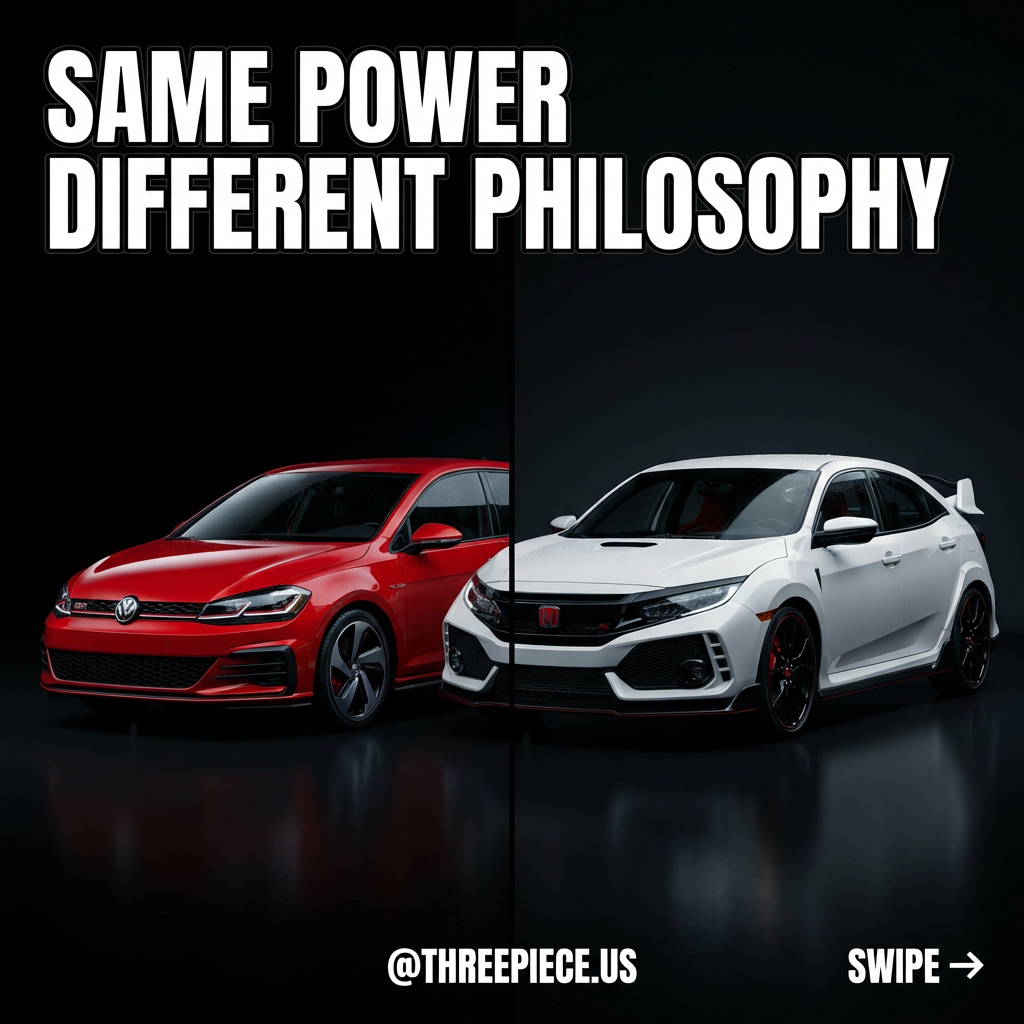
Same Power, Different Philosophy
Both cars sit in the 220–306 HP FWD hot hatch bracket, but the engineering approach couldn't be more different. The GTI Mk7 leans on its electronically controlled VAQ limited-slip differential, adaptive dampers (on DCC-equipped cars), and sophisticated traction management to mask the inherent limitations of a front-drive platform. It's a car designed to feel composed and approachable — even when you're pushing it.
The Type R FK7 goes the opposite direction: mechanical grip, a helical LSD, adaptive dampers tuned for aggression, and a chassis geometry that Honda spent years refining on the Nürburgring. It's rawer from the factory, more communicative, and frankly more intimidating at the limit. The K20C1 makes 306 HP and the car weighs 3,117 lbs — the power-to-weight ratio advantage is real. If you're curious about the FK8 generation's quirks, our FK8 Civic Type R buying guide covers the K20C1 platform in depth.
The GTI's EA888 makes 228 HP stock (or 245 HP in the Performance Pack), and the car weighs around 3,100 lbs. The power deficit is significant, but the GTI's real weakness isn't horsepower — it's the factory suspension tune that prioritizes comfort over rotation. That's exactly what mods fix.
GTI Mk7 After Coilovers and BBK
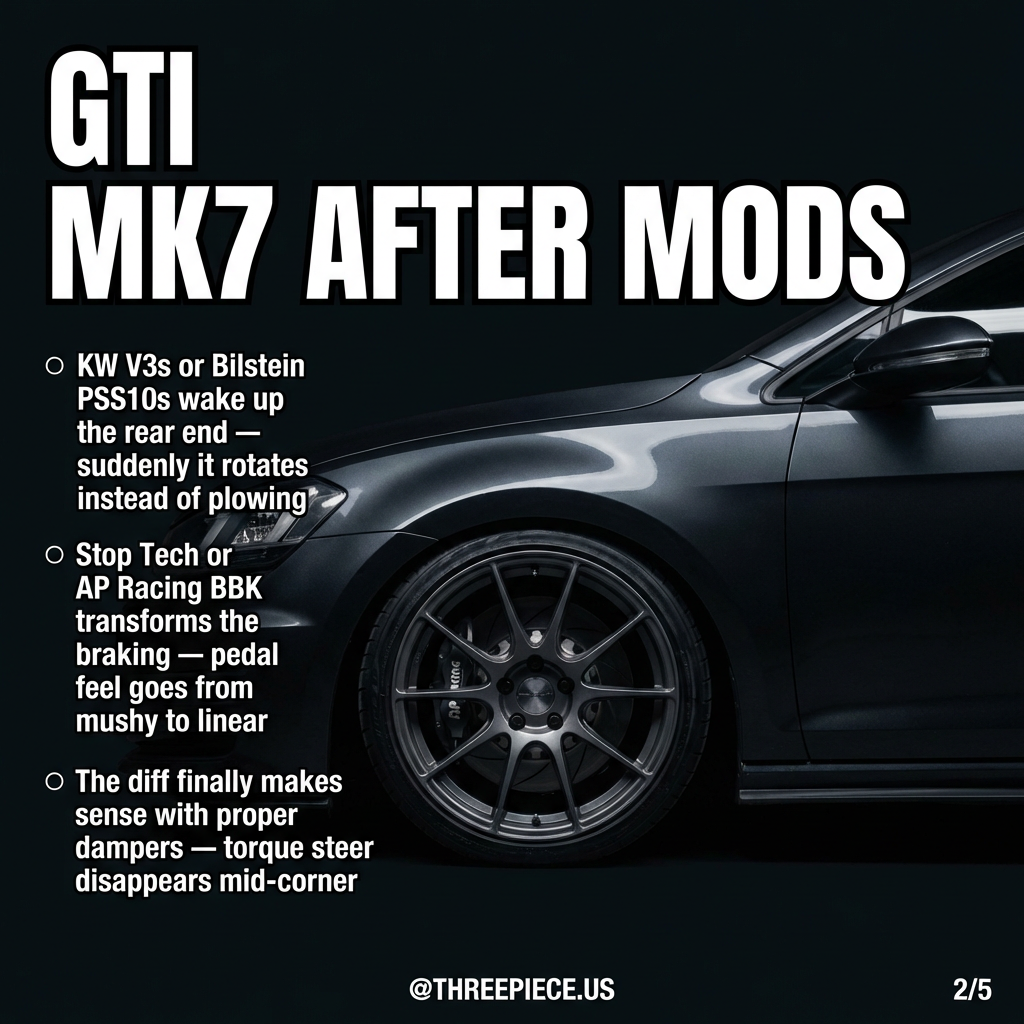
This is where the GTI becomes a completely different car. The stock suspension's biggest sin is the rear end — it's too soft, too compliant, and it refuses to rotate. Bolt on KW V3 coilovers or Bilstein PSS10s and suddenly the rear actually participates in cornering. The car goes from chronic understeer to a balanced, adjustable platform that rewards trail braking and aggressive turn-in. If you're weighing your coilover options carefully, our breakdown of when coilovers are actually worth it versus quality springs is essential reading — on the GTI specifically, the answer is definitively coilovers.
The braking transformation is equally dramatic. Stock GTI brakes are adequate for street driving but completely cooked after two hard laps. A StopTech or AP Racing big brake kit with 355mm rotors transforms pedal feel from mushy and inconsistent to linear and predictable. You can actually trail-brake into corners without worrying about fade. For reference, the EBC Racing Apollo-4 BBK with 330mm rotors at $1,979 gives you a sense of the price point for quality big brake upgrades — BBK pricing for the GTI platform falls in a similar range.
Here's the part nobody talks about enough: the VAQ differential finally makes sense once you have proper dampers underneath the car. Stock, the diff fights the soft suspension — it's trying to put power down while the chassis is still wallowing through weight transfer. With stiff, well-damped coilovers, the diff can actually do its job. Torque steer mid-corner essentially disappears. The aFe VW GTI Turbocharger Inlet Pipe at $210 is a worthwhile supporting mod here — better turbo response means more predictable power delivery when you're managing traction out of corners.
If you're considering air suspension instead of traditional coilovers for a street/show dual-purpose GTI build, the Air Lift Performance front kit for 07-14 Golf/GTI at $890 paired with the matching rear kit at $1,036 covers the Mk5/Mk6 generation — check compatibility carefully for Mk7 MQB applications.
Type R FK7 After Coilovers and BBK
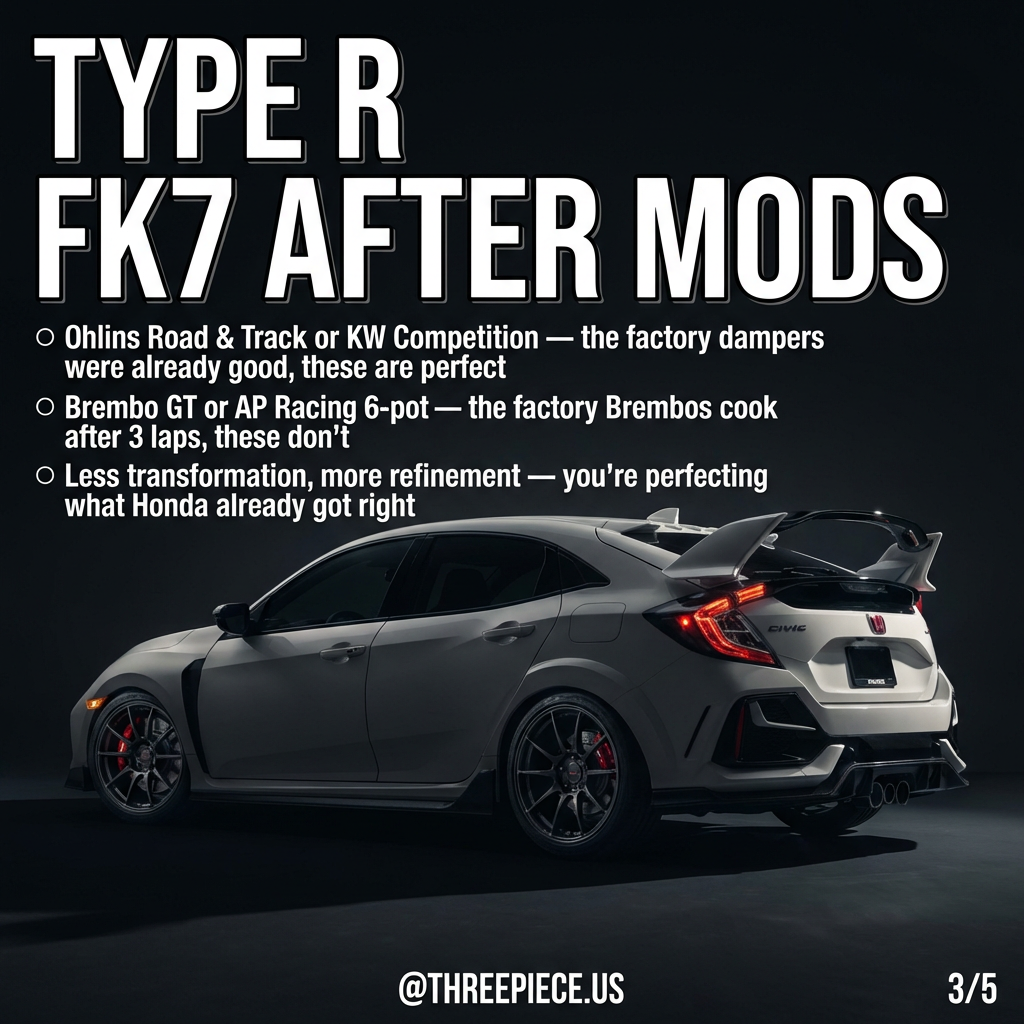
The Type R's mod story is less about transformation and more about refinement. Honda already got the chassis 90% right from the factory. The adaptive dampers are genuinely good — most owners who swap to aftermarket coilovers are chasing the last 10% of adjustability and consistency, not fixing a fundamental flaw.
Öhlins Road & Track or KW Competition coilovers on the Type R don't change the car's character — they perfect it. Corner entry becomes more predictable. The rear end, which Honda already tuned to rotate beautifully, gains even more precision. You can fine-tune compression and rebound for specific tracks instead of relying on Honda's three-mode compromise. Our guide to underrated suspension upgrades beyond coilovers covers the supporting mods (sway bars, end links, bushings) that make the biggest difference on a car that's already well-sorted from the factory.
The big brake situation is where the Type R actually needs help. Yes, the factory Brembos look impressive on paper, but they're undersized for sustained track abuse. After 3 hard laps, pedal feel degrades noticeably. A Brembo GT or AP Racing 6-piston kit with 380mm rotors fixes this completely — you get consistent braking performance through an entire 20-minute session. The factory rotors simply don't have the thermal mass for repeated heavy braking zones.
The key insight: modding the Type R is less emotionally rewarding because the delta is smaller. You're going from a 9/10 car to a 10/10 car. The improvement is measurable on a data logger but harder to feel through the seat of your pants. That's not a knock on the Type R — it's a testament to how good Honda's engineers are.
Track Day Reality: Fun vs Fast
Here's where the internet arguments fall apart and lap times tell the real story. A properly modded Type R is faster. Period. That chassis was born for track work, and good coilovers simply unlock what was already there. The mechanical LSD, the superior power-to-weight ratio, and Honda's obsessive suspension geometry mean the Type R carries more speed through corners with less drama.
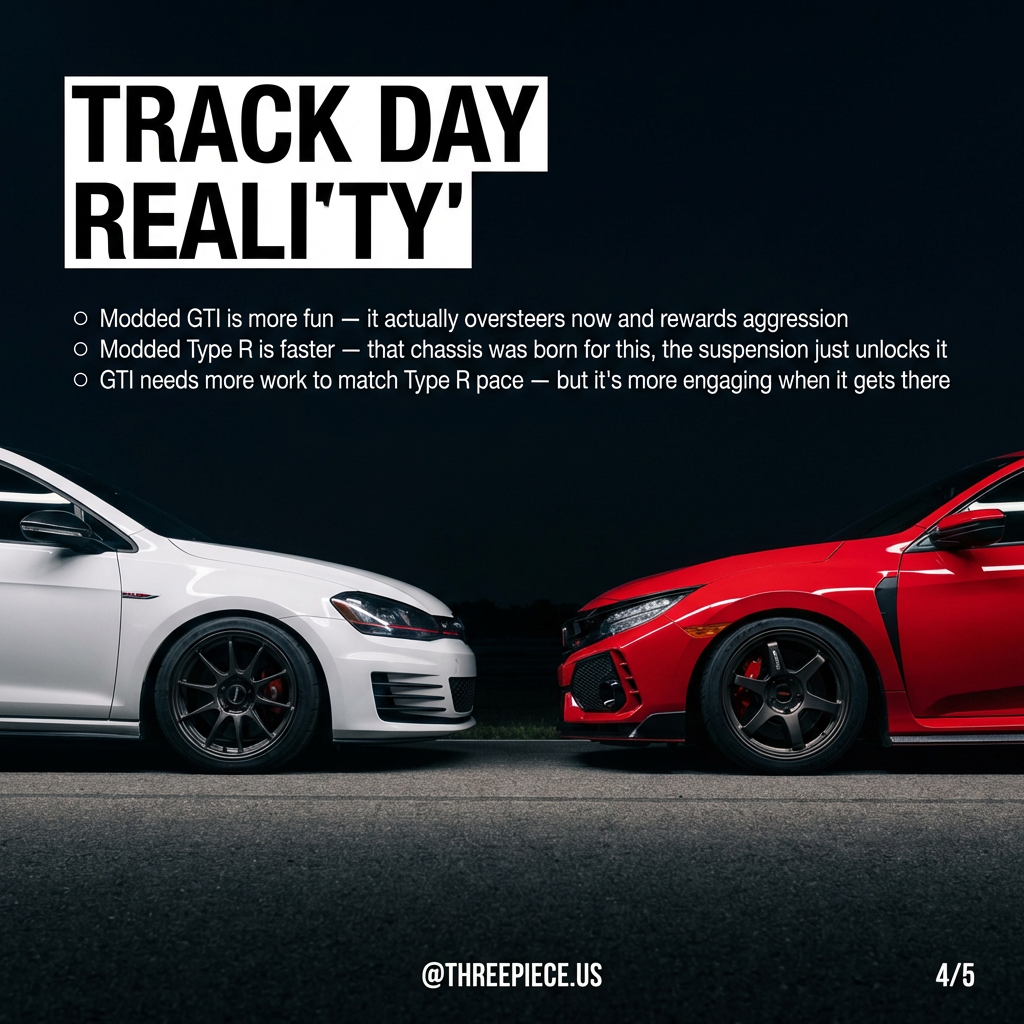
But the modded GTI is more fun. And that's not a consolation prize — it's a legitimate reason to choose it. Once you've sorted the suspension, the GTI actually oversteers on corner entry. It rewards aggression, trail braking, and driver input in a way the stock car never does. You're constantly managing the car, adjusting your inputs, working the chassis. The Type R, by contrast, is so composed that it can feel clinical. You point it and it goes. Faster, yes. More engaging? That's debatable.
The GTI needs more work to match Type R pace — probably $2-3K more in supporting mods like a downpipe, tune, and rear sway bar to close the gap. But when it gets there, the driving experience is more rewarding because you built it. You transformed a comfortable daily driver into something genuinely sharp. Speaking of which, if you're considering downpipe mods on the GTI, be aware of state inspection rules that specifically target GTI downpipes — this directly affects your build path. And our hot hatch mod priority guide makes the case that tires should come before intake mods on both these platforms.
Wheel and Tire Fitment for Both Platforms
Neither car reaches its potential without proper wheels and tires — and both platforms have specific fitment considerations that matter for track use.
The GTI Mk7 runs a 5x112 bolt pattern with a 57.1mm hub bore. The sweet spot for a track-oriented setup is 18x8.5 ET45 — this clears most big brake kits while keeping the scrub radius reasonable. Browse 18x8.5 wheels in 5x112 for options that fit the GTI. Pair them with 245/40R18 tires — check 245/40R18 tires for available options. Going wider than 255 on the front of a FWD car adds rotating mass without meaningful grip gains.
The Type R FK7 runs a 5x120 bolt pattern with a 64.1mm hub bore. Factory wheels are 20x8.5, but most track-focused owners drop to 18x9.5 ET38 for reduced unsprung weight and better tire selection. Search 18x9.5 wheels in 5x120 for fitment options. The ideal tire is 265/35R18 — browse 265/35R18 tires for available sizes. Our Civic Type R wheel fitment guide covers the FL5 generation in detail, and much of the 5x120 sizing guidance applies to the FK7/FK8 as well.
For both platforms, lightweight forged wheels make a noticeable difference in turn-in response and braking performance. If you're debating the investment, read our breakdown of cast vs forged wheels and what actually matters for performance. On a car you're already spending $8K on suspension and brakes, skimping on wheels undermines the entire build. The Work Emotion series offers lightweight forged options that clear most BBK setups. If you want to understand the full spectrum of wheel construction, our 3-piece wheels explained article covers why multi-piece construction matters for serious builds. And make sure your fitment is dialed with hubcentric rings — they eliminate vibration and ensure the wheel is properly centered on the hub.
The Verdict: Pick Your Poison
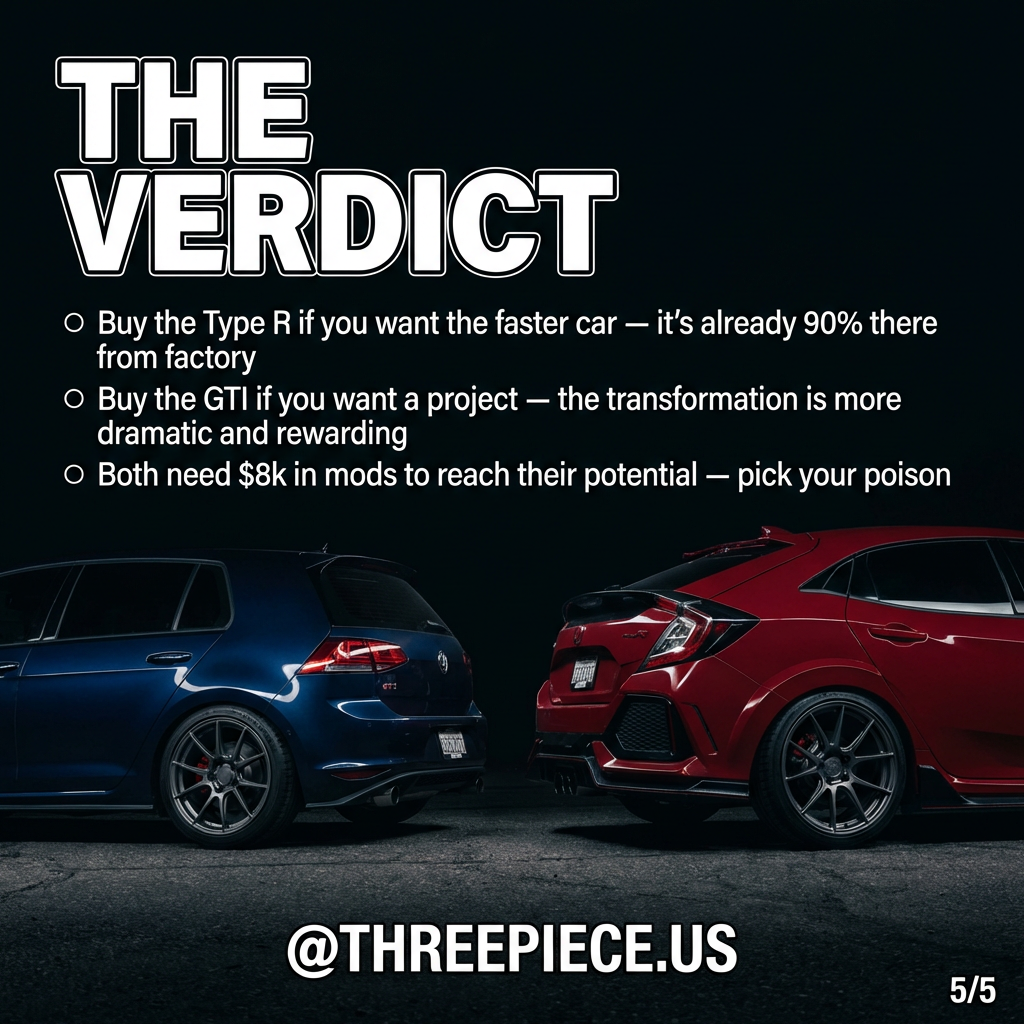
Buy the Type R if you want the faster car. It's already 90% there from the factory. Coilovers and a BBK perfect what Honda built. You'll be faster sooner, with less troubleshooting and fewer compromises. The total spend to reach the car's full potential is around $8K — coilovers, BBK, lightweight 18" wheels, and sticky tires.
Buy the GTI if you want a project. The transformation from plowing understeer machine to balanced track weapon is one of the most dramatic in the hot hatch world. You'll spend the same $8K, but the emotional payoff is bigger because the car changes so fundamentally. It's also a better daily driver in stock form, which matters if this is your only car.
Both platforms deserve proper wheels to complete the build. Browse the full wheel catalog at ThreePiece.us for forged options that match the performance level of your suspension and brake upgrades — and check the vehicle gallery for real-world fitment inspiration on both platforms. Whether you're building a GTI that finally rotates or a Type R that never fades, the right wheels tie the entire package together.