

Posted by THREEPIECE.US on Apr 16th 2026
BMW E90 335i N55 6MT Buying Guide: Best Value Sedan in 2026
The BMW E90 335i with the N55 engine and a six-speed manual is one of the most compelling sport sedan purchases you can make in 2026. Around 300 horsepower, a twin-scroll turbo inline-six, hydraulic steering, and a proper clutch pedal — all for less than a new Civic Si. The N55 quietly fixed the worst reliability issues that ruined the N54's reputation, and the manual transmission E90s are getting harder to find every single month. This is the window, and it's closing fast.

Quick links
- Why the E90 335i still matters in 2026
- The N55 fixed the N54 — here's exactly how
- Known failure points: what actually breaks
- Manual transmission weaknesses you need to know
- Realistic ownership budget: year one and beyond
- What to check before you hand over cash
- Wheel fitment and setup for the E90
- Stop waiting — go buy one
Why the E90 335i Still Matters in 2026
Owners don't keep these because of the spec sheet. They keep them because the N55 spools fast, pulls smooth to redline, and pairs with one of the best hydraulic steering racks BMW ever put in a sedan. The E90 chassis still embarrasses newer 3-Series on a back road — no fake engine noise piped through speakers, no numb electric steering, no 47 drive modes you'll never use. Just boost, a clutch pedal, and one of the best straight-sixes ever bolted into a car.
Add a Stage 1 MHD or JB4 flash with bolt-ons and you're looking at 330 to 360 wheel horsepower on pump gas — and it still feels composed doing it. Go further with a Pure Stage 2 turbo, front-mount intercooler, catless downpipe, and a custom tune and owners are reporting 400 to 500 wheel horsepower. That's serious power from a platform that still rides like a proper BMW. If you're curious how the E90's bigger sibling builds out, our E92 M3 Competition 6MT build guide covers the S65 side of the equation — but the N55 335i gets you 80% of the experience for a fraction of the cost.

The N55 Fixed the N54 — Here's Exactly How
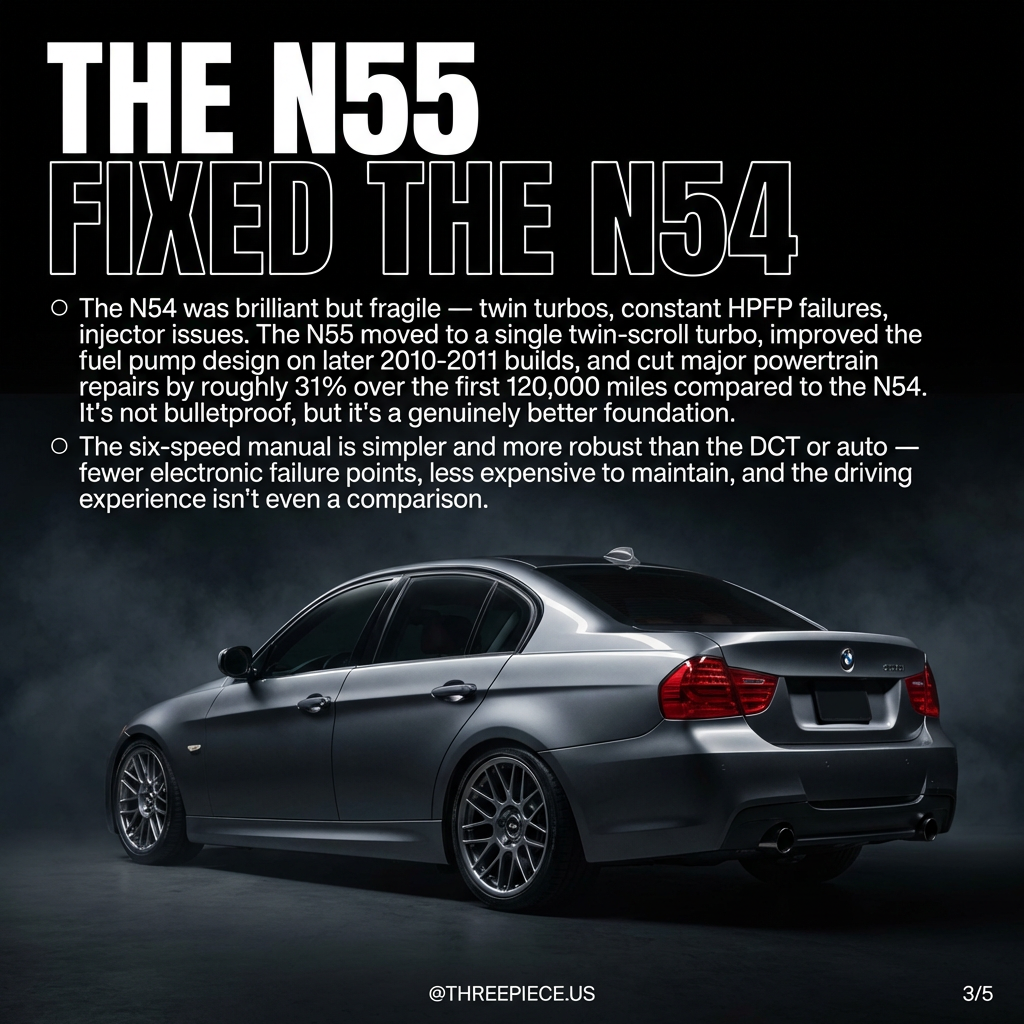
The N54 was brilliant but fragile — twin turbos with wastegate rattle, constant HPFP failures, injector issues that left owners stranded. The N55 moved to a single twin-scroll turbo, improved the fuel pump design on later 2010–2011 builds, and cut major powertrain repairs by roughly 31% over the first 120,000 miles compared to the N54. It's not bulletproof, but it's a genuinely better foundation.
The six-speed manual is simpler and more robust than the DCT or automatic — fewer electronic failure points, less expensive to maintain, and the driving experience isn't even a comparison. If you're weighing other turbo platforms in this price range, our breakdown of SR20DET vs K24 vs 2JZ puts the N55's balance of power and reliability into perspective against the Japanese competition. The N55 doesn't make the headlines, but it makes the power — and it keeps making it at 120k miles when the N54 is on its third set of injectors.
Known Failure Points: What Actually Breaks
Here's the real talk. The N55 is more reliable than the N54, but it still has a list of documented weak points that every buyer needs to understand before signing anything.
Oil Filter Housing Gasket (OFHG) — This is the big one. When this gasket leaks, oil drips onto the serpentine belt and can shred it. Worse: when the OFHG is changed and not primed properly, air bubbles stay in the oiling system and can cause rod bearing damage. Parts run $300–$500, but labor is substantial since the cover and housing have to come off. Skipping proper priming after this job is how engines get wrecked.
Valve Cover Gasket (VCG) — The plastic-rubber components crack with heat cycles, typically around 60,000–80,000 miles. You'll see oil seepage onto the exhaust or intake plenum, sometimes visible smoke or a burning smell. Budget $800–$1,200 for parts and labor. This is a "when, not if" item.
Rod Bearing Wear — Several owners report spun rod bearings as low as ~28,000 miles on stock engines with standard oil change intervals. Symptoms include knocking at idle, misfires, and metallic flakes in the oil filter. If caught early, bearings can be replaced — but if a crank journal cracks, you're looking at $10,000–$15,000 for the full repair. Oil changes every 5,000–7,500 miles are non-negotiable preventative maintenance. For context on how oiling system neglect compounds into catastrophic failure, our SR20DET oil control guide covers the same principle on a different platform.
High Pressure Fuel Pump (HPFP) — Early N55s (2010 and early 2011 builds) used an HPFP similar to the defective N54 design. Codes like "fuel high pressure too low" during sustained WOT pulls are the telltale sign. Later builds improved this, so build date matters — engines built after late 2011/mid-2012 tend to have better HPFPs and updated bearing materials.
Water Pump & Cooling System — The electric water pump usually fails around 60,000–80,000 miles. Replacement often comes alongside a new thermostat, radiator hoses, and coolant reservoir. Budget this as part of your year-one refresh. If you're comparing maintenance intensity across platforms, our Infiniti G37 Sport 6MT buying guide covers a naturally aspirated alternative with fewer cooling system headaches — but less power potential.
Manual Transmission Weaknesses You Need to Know
The GS6-45BZ six-speed manual is the reason you're buying this car instead of the automatic. But it has one documented weak point that can turn into a very expensive problem.
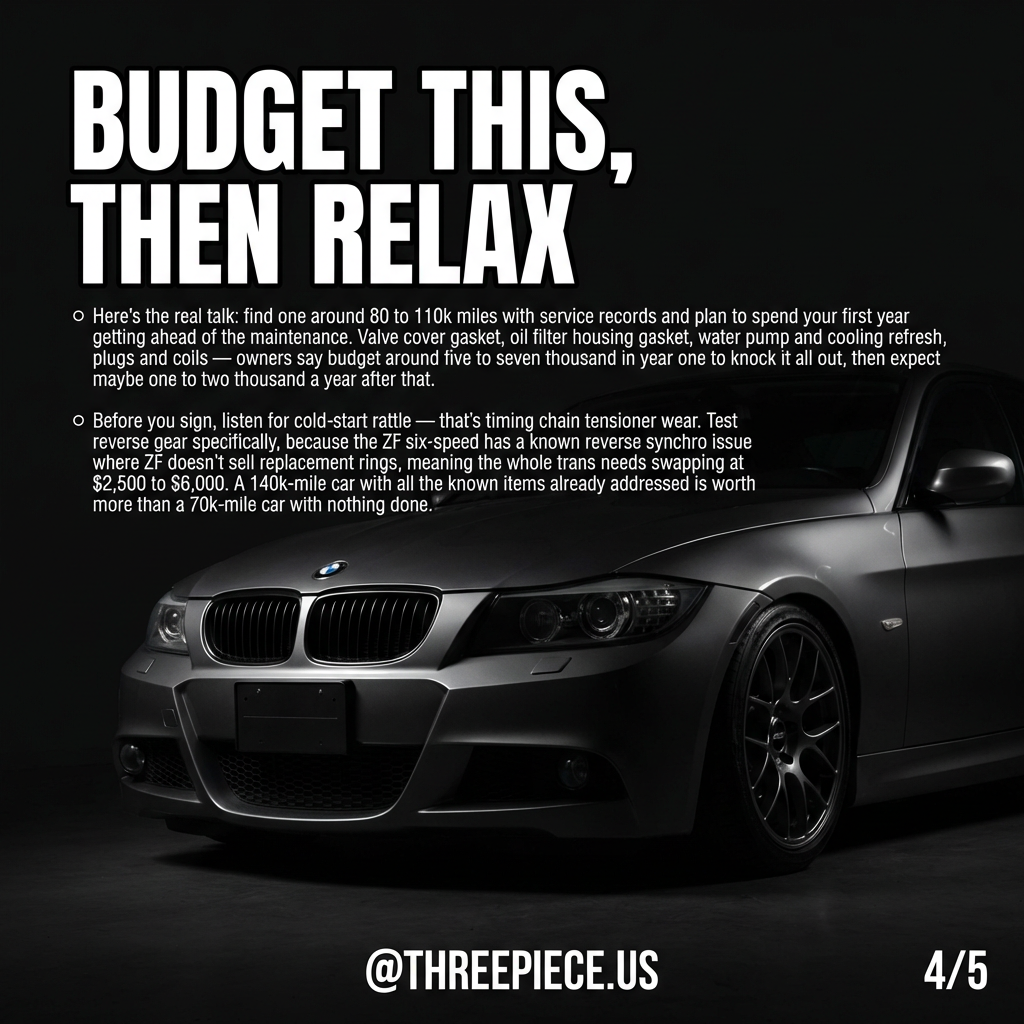
Reverse gear synchro failure is the known issue. When it goes, reverse gear simply won't engage — you'll get grinding or nothing at all. The problem is that ZF doesn't sell replacement synchro rings for this unit, meaning the entire transmission needs to be swapped. Used units run $2,500–$3,500, remanufactured units push $6,000+ before labor. This typically shows up around 70,000–100,000 miles, but some owners report it earlier. During any test drive, specifically test reverse engagement — cold and warm. If it grinds or hesitates, walk away or negotiate accordingly.
Clutch wear is the other consideration. With Stage 1 or Stage 2 tuning pushing 330–500 whp, the stock clutch and flywheel get cooked. Many owners are replacing the clutch by 80,000–100,000 miles even on stock power. If the car you're looking at has been tuned, ask about clutch history. Our guide on suspension upgrades that actually matter applies the same "spend money where it counts" logic — a fresh clutch on a tuned N55 is mandatory, not optional.
Realistic Ownership Budget: Year One and Beyond
Find one around 80,000–110,000 miles with service records and plan to spend your first year getting ahead of the maintenance. Here's what owners actually report spending:
Year one refresh (budget $5,000–$7,000):
- Valve cover gasket: $800–$1,200
- Oil filter housing gasket (with proper priming): $600–$900 installed
- Water pump, thermostat, coolant hoses, reservoir: $1,200–$1,800
- Spark plugs (NGK) and ignition coils: $300–$500
- Oil pan gasket if leaking: $500–$800
After year one: Expect $1,000–$2,000 per year for ongoing maintenance — brakes, fluids, the occasional sensor. That's real BMW ownership money, but it's predictable once the big items are handled.
Here's the key insight most buyers miss: a 140,000-mile car with all the known items already addressed is worth more than a 70,000-mile car with nothing done. The 70k car still has every single gasket failure, water pump failure, and potential reverse synchro issue ahead of it. The 140k car with receipts has already been through the gauntlet. For a similar "buy the well-maintained higher-mileage example" philosophy, our Pontiac G8 GXP buying guide applies the same logic to another undervalued sport sedan.
What to Check Before You Hand Over Cash
Beyond the standard PPI, here's your E90 N55 6MT-specific checklist:
- Cold-start rattle: Listen for it on the first start of the day. That's timing chain tensioner wear — expensive and progressive.
- Reverse gear engagement: Test it cold and warm. Grinding or hesitation means a $2,500–$6,000 transmission swap is in your future.
- Oil change records: Every 5,000–7,500 miles is the standard. BMW's factory 15k interval is too long for this engine. If the seller followed the factory schedule, budget for an oil analysis immediately.
- Build date: Later 2011 builds have improved HPFPs and updated bearing materials. Check the door jamb sticker.
- Boost leaks under load: Drive it hard. Misfires, stuttering, or power loss under sustained WOT indicate charge pipe cracks, HPFP issues, or worn coils.
- Oil leaks: Get under the car. Look at the OFHG area, valve cover, and oil pan. Some seepage is normal at 80k+ miles — active dripping is a negotiation point.
If you're weighing the E90 against other manual sport sedans in this price range, our underrated project cars under $20K roundup covers a few alternatives — but none of them have the N55's combination of power, tunability, and chassis balance.
Wheel Fitment and Setup for the E90
The E90 335i runs a 5x120 bolt pattern with a 72.56mm center bore. Stock wheel sizes range from 17" to 18" depending on the option package, but the aftermarket sweet spot for this chassis is 18x8.5 ET35 to ET38 square, or a staggered 18x8.5 front / 18x9.5 rear setup for a more aggressive look with proper fender fill.
For a square setup, 18x8.5 wheels in 5x120 paired with 245/40R18 tires is the go-to. If you're running staggered, 18x9.5 rears in 5x120 with 275/35R18 tires fills the rear arches perfectly. Make sure you're running hubcentric rings if your wheels aren't BMW-specific bore — the E90 is sensitive to vibration at highway speeds without them.
If you're considering going 3-piece on this platform, our breakdown of why 3-piece wheels cost $4K+ and whether they're worth it covers the engineering behind the price. The Work Emotion series and Work Meister line both look exceptional on E90s — the Meister S1 in particular has become a go-to for clean E9x builds. For the finishing touch, Work VS reproduction center caps at $50 complete the look without hunting down discontinued OEM caps. And don't overlook proper 90-degree valve stems at $3.80 each — they make air pressure checks possible on deep-dish setups where straight stems are blocked by brake calipers.
Before you commit to a wheel setup, read our guide on whether wheel spacers are actually safe — the E90 community uses them frequently, but there are real engineering limits. Check out the ThreePiece vehicle gallery for build inspiration across platforms.

Stop Waiting — Go Buy One
If you find a clean N55 six-speed with documented oil changes every 5,000–7,500 miles and the big gasket and cooling items already handled, that's the one. Manual E90 335is are only getting rarer, prices aren't softening, and the aftermarket support from MHD to Pure Turbos to VRSF is as mature as it's ever going to get.
This is one of the best values in the used sport sedan world. Around 300 horsepower stock, 400+ whp with bolt-ons and a tune, hydraulic steering, a real manual gearbox, and a chassis that still embarrasses cars costing three times as much. The known failure points are well-documented, the fixes are well-understood, and the community support is deep. The only thing working against you is time — every month, another clean 6MT gets snapped up by someone who stopped waiting.
Go drive one this weekend. Browse wheels and suspension at ThreePiece.us to start planning the build before you even pick up the keys.