
E92 M3 Competition 6MT Build Guide: S65 Mod Order
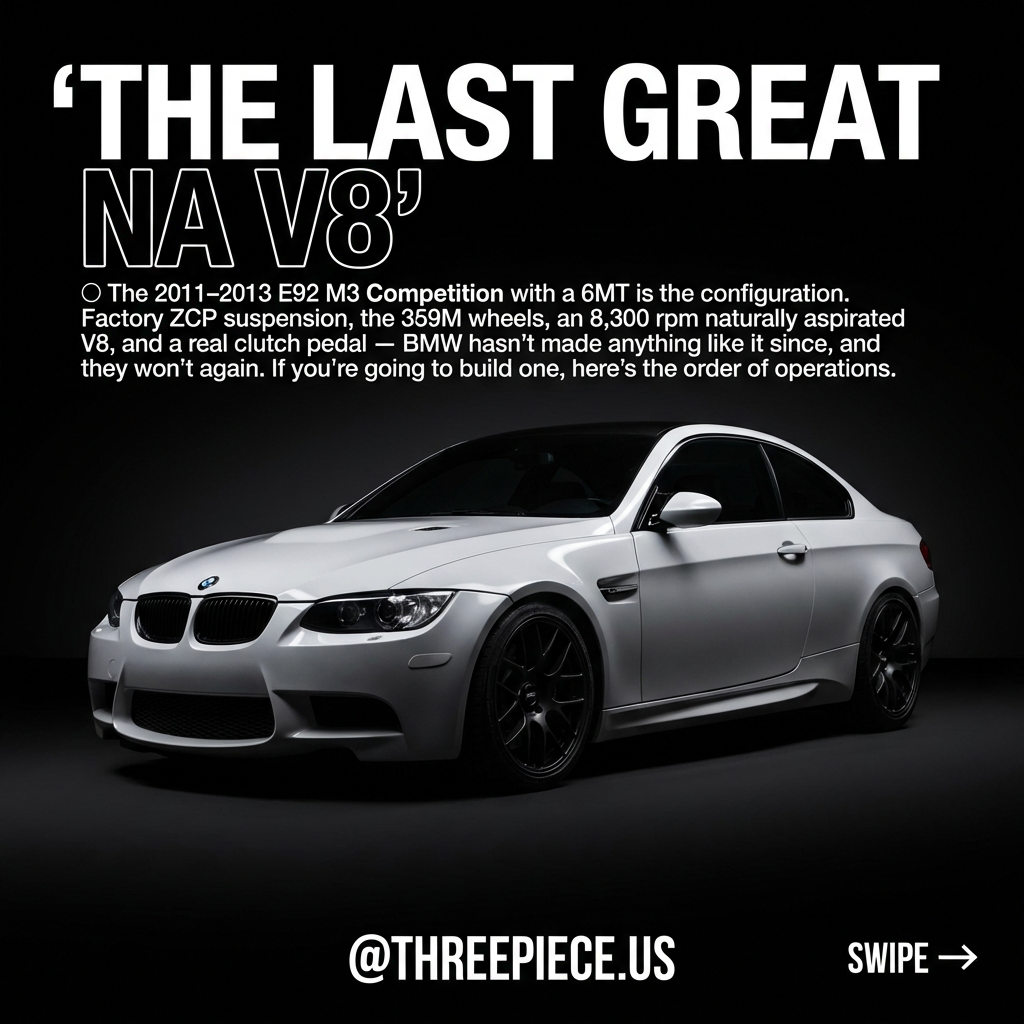
The 2011-2013 BMW E92 M3 Competition with a 6-speed manual is the configuration that matters. Factory ZCP suspension, 359M wheels, an 8,300 rpm naturally aspirated V8, and a real clutch pedal — BMW hasn't made anything like it since, and they won't again. But building one of these cars correctly means understanding the S65's failure modes before you ever think about bolt-ons. Here's the exact order of operations, from preventive maintenance through wheels and suspension, that separates a properly built E92 M3 from a clapped-out money pit.
Quick links
- Fix the S65 first — rod bearings, cooling, throttle actuators
- Test pipes, tune, then intake — the correct power path
- Wheels and suspension that actually work on a lowered Competition
- Budget breakdown and final build philosophy
Fix the S65 First — Rod Bearings, Cooling, Throttle Actuators
Every single E92 M3 build thread worth reading says the same thing: maintenance first, power second. The S65 V8 is one of the most rewarding engines BMW has ever produced, but it has documented weak points that will wreck your build if you ignore them. If you're coming from a platform like the VQ35DE with its own reliability concerns, the S65 demands a similar inspection-first approach — except the stakes are higher.
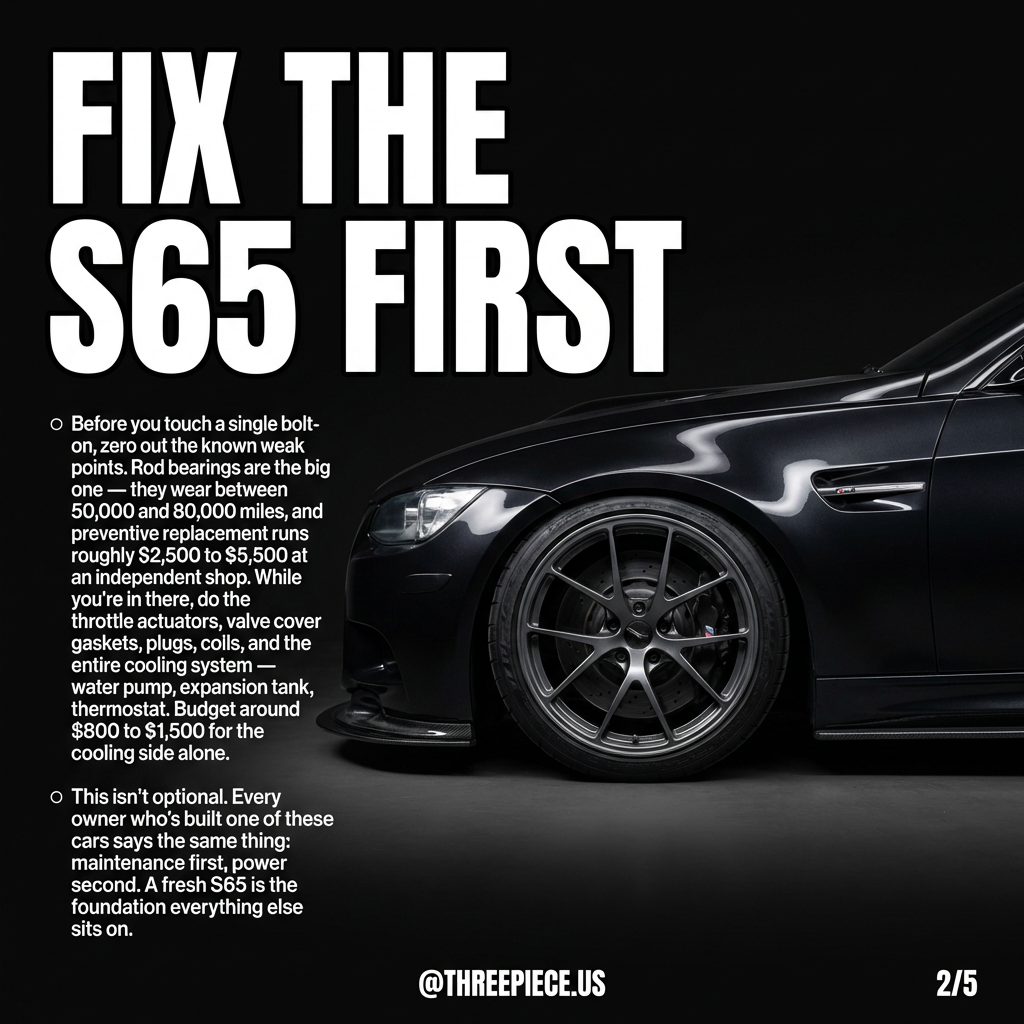
Rod bearings are the big one. They wear between 50,000 and 80,000 miles, and symptoms range from ticking and knock to metal in the oil to catastrophic failure — rod through block, motor destroyed. Preventive replacement runs roughly $2,500 to $5,500 at an independent shop depending on whether you use OEM or aftermarket bearings like BE Bearings or ACL. Some owners are now also inspecting #1 main bearing during the rod bearing service, since reports of main bearing chatter and out-of-round journals have surfaced around the 70-80k mile mark. If the motor is already out, the marginal cost to inspect mains is minimal.
While you're in there, do the throttle actuators (AC-DL units). These fail on the individual throttle bodies, especially under sustained high temps, causing surge, fault codes, and loss of throttle response. Replacement runs $800-$900 per side. Add valve cover gaskets, plugs, and coils to the list.
Then there's the entire cooling system. The S65 shares BMW's tradition of weak water pumps, plastic expansion tanks, and fragile radiator end-tanks. Budget $800 to $1,500 for a full cooling refresh — water pump, expansion tank, thermostat, and flush. This isn't the kind of failure you can ignore; if you've read about how carbon buildup quietly wrecks FA20DIT engines, the S65's cooling failures are the BMW equivalent — silent until they're not.
Test Pipes, Tune, Then Intake — The Correct Power Path
The power path on the S65 is straightforward, but sequence matters. Test pipes and a cat-back exhaust paired with a Stage 2 flash from a tuner like Turner or Weistec gets you roughly 30-40 whp over stock. Owners are reporting 445 to 460 whp at the flywheel with that combo — on a naturally aspirated V8, that's serious output. Add a carbon plenum intake on top and you're picking up another 5-10 whp with noticeably better throttle response under 5,000 rpm.
This is where the E92 M3 separates itself from most modern performance cars. You're not chasing boost thresholds or fighting OEM ECU locks like GM and Ford have implemented on 2022+ vehicles. The S65's DME is well-understood by the tuning community, and flash tuning is the dominant path — no standalone ECU needed. That said, be aware of state inspection rules around aftermarket downpipes and test pipes if you're in a strict emissions state.
Cooling has to come with the power. A CSF 8025 oil cooler replaces the factory unit and roughly doubles capacity. If you're driving the car hard at all — track days, spirited canyon runs, even aggressive street driving in summer — the oil cooler isn't a luxury, it's what keeps the tune safe. For a universal option, the Chase Bays 19 Row Oil Cooler at $205 is a solid supplemental cooler that many builders pair with the CSF for maximum thermal headroom. You'll also want a sandwich plate adapter (starting at $215) to plumb the secondary cooler — though you'll need to confirm fitment for the S65's oil filter housing specifically.

Wheels and Suspension That Actually Work on a Lowered Competition
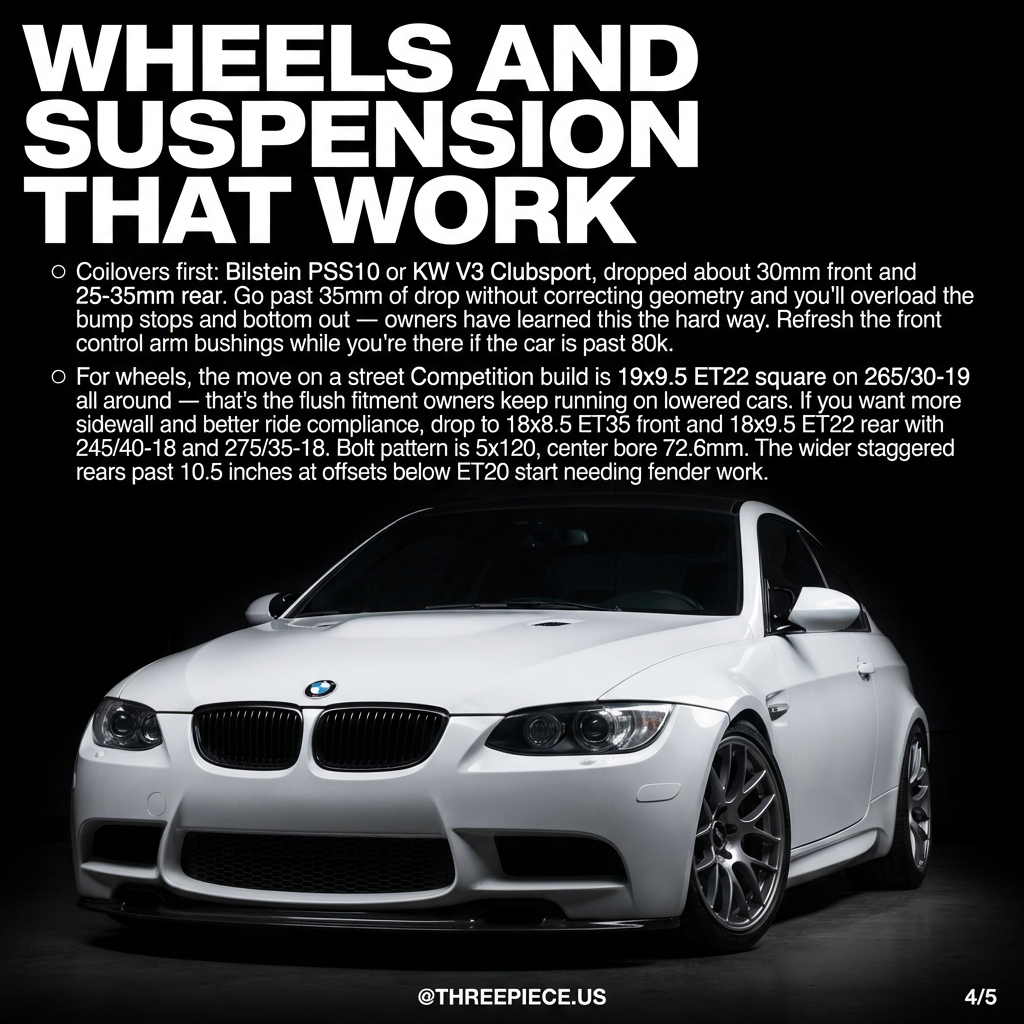
The ZCP Competition Package already comes with upgraded suspension — stiffer springs, recalibrated dampers, and the 359M wheels. But most owners building these cars long-term replace the factory setup with proper coilovers. The two names that keep appearing in build threads: Bilstein PSS10 and KW V3 Clubsport. Drop about 30mm front and 25-35mm rear. Go past 35mm of drop without correcting geometry and you'll overload the bump stops and bottom out — owners have learned this the hard way. Refresh the front control arm bushings while you're there if the car is past 80k miles.
If you're weighing whether coilovers are the right move for your specific use case, our breakdown of when springs actually beat cheap coilovers is worth reading. On the E92 M3 specifically, the ZCP springs are good enough that a budget coilover is a lateral move at best. If you're spending money here, spend it on quality units. For additional suspension upgrades that complement coilovers, check out our guide on underrated suspension upgrades most people skip. Browse our full suspension catalog for coilover and damper options.
For wheels, the E92 M3 runs a 5x120 bolt pattern with a 72.6mm center bore. The move on a street Competition build is 19x9.5 ET22 square on 265/30-19 all around — that's the flush fitment owners keep running on lowered cars. Browse 19x9.5 wheels in 5x120 to see what's available in that spec. Pair them with 265/30R19 tires for the aggressive look.
If you want more sidewall and better ride compliance — which matters if you're actually driving the car hard — drop to 18x8.5 ET35 front and 18x9.5 ET22 rear with 245/40-18 and 275/35-18. This is the setup that gives you real tire budget flexibility and significantly better impact absorption over rough surfaces. Search 18x9.5 wheels in 5x120 for the rear, and 275/35R18 tires for the rear rubber. The wider staggered rears past 10.5 inches at offsets below ET20 start needing fender work — don't go there on a street car unless you're committed to rolling or pulling.
For wheel choice, the E92 M3 is one of the few European platforms where Japanese 3-piece wheels look absolutely correct. The Work Meister series is the classic choice — if you want to understand why, read our comparison of Volk TE37 vs Work Meister and which is worth the money. The Work Emotion lineup offers a more aggressive, modern spoke design that pairs well with the Competition's factory aero. If you're considering forged vs cast for this build, our guide on cast vs forged wheels breaks down where the weight savings actually matter — and on a 3,700 lb car with an 8,300 rpm V8, unsprung weight reduction is one of the most impactful changes you can make.
Finish any 3-piece wheel build with proper hardware. Grab 90-degree valve stems at $3.80 each for easy tire pressure checks behind deep-dish lips, and browse our center cap selection to complete the look.
Budget Breakdown and Final Build Philosophy
Here's what the full build looks like financially:
- Preventive rod bearing service: $2,500 – $5,500
- Throttle actuators: $1,600 – $1,800 (both sides)
- Full cooling system refresh: $800 – $1,500
- Test pipes + cat-back exhaust + Stage 2 tune: $3,000 – $5,000
- Carbon plenum intake: $500 – $800
- Oil cooler upgrade: $400 – $700
- Quality coilovers (Bilstein PSS10 / KW V3): $2,000 – $3,500
- Wheels and tires: $3,000 – $8,000+ depending on brand
Total investment on top of the car itself: roughly $14,000 to $27,000. That's real money. But the finished product is a 450+ horsepower naturally aspirated V8 with a manual gearbox, proper coilovers, and fitment that actually looks right. Nothing else on the road sounds like an S65 at 8,000 rpm.
Too many of these cars get wrecked by owners who skip maintenance and go straight to mods. The S65 rewards patience and proper build order more than almost any engine out there. If you've read about how OEM performance option markups inflate factory pricing, the Competition Package is one of the rare cases where the factory upgrades were genuinely worth the premium — the ZCP suspension and brakes give you a better starting point than any base E92 M3.
For inspiration on how other owners are fitting wheels to performance builds, browse our vehicle gallery. And if you're exploring the full range of 3-piece forged options for this platform, our explainer on why 3-piece wheels cost $4K+ and whether they're worth it covers exactly what you're paying for.
Go find a clean 6MT Competition and start the maintenance. The build takes care of itself from there.
