
Posted by THREEPIECE.US on Apr 9th 2026
What Is Camber and How Does It Actually Work? Track Setup Guide
Most people think negative camber is just for stance tax, but physics tells a different story. When you corner hard, your car's body roll tilts the contact patch of your outside tires — negative camber pre-compensates for this, keeping more rubber on the ground when you need it most. F1 cars run -3.5 degrees front because they corner at 4g, while your -2 degrees is actually conservative for track use.

Quick links
- How camber actually works
- Track cars vs street cars
- Where people screw up
- Actual useful specs
- Setup and alignment tips
How camber actually works
Negative camber tilts the top of the tire inward — measured in degrees from vertical. Under cornering load, the chassis rolls and the tire leans outward. Camber keeps the tire flat against the road surface, maximizing the contact patch at the limit. More contact patch equals more grip because the tire shoulder doesn't roll over onto its sidewall.
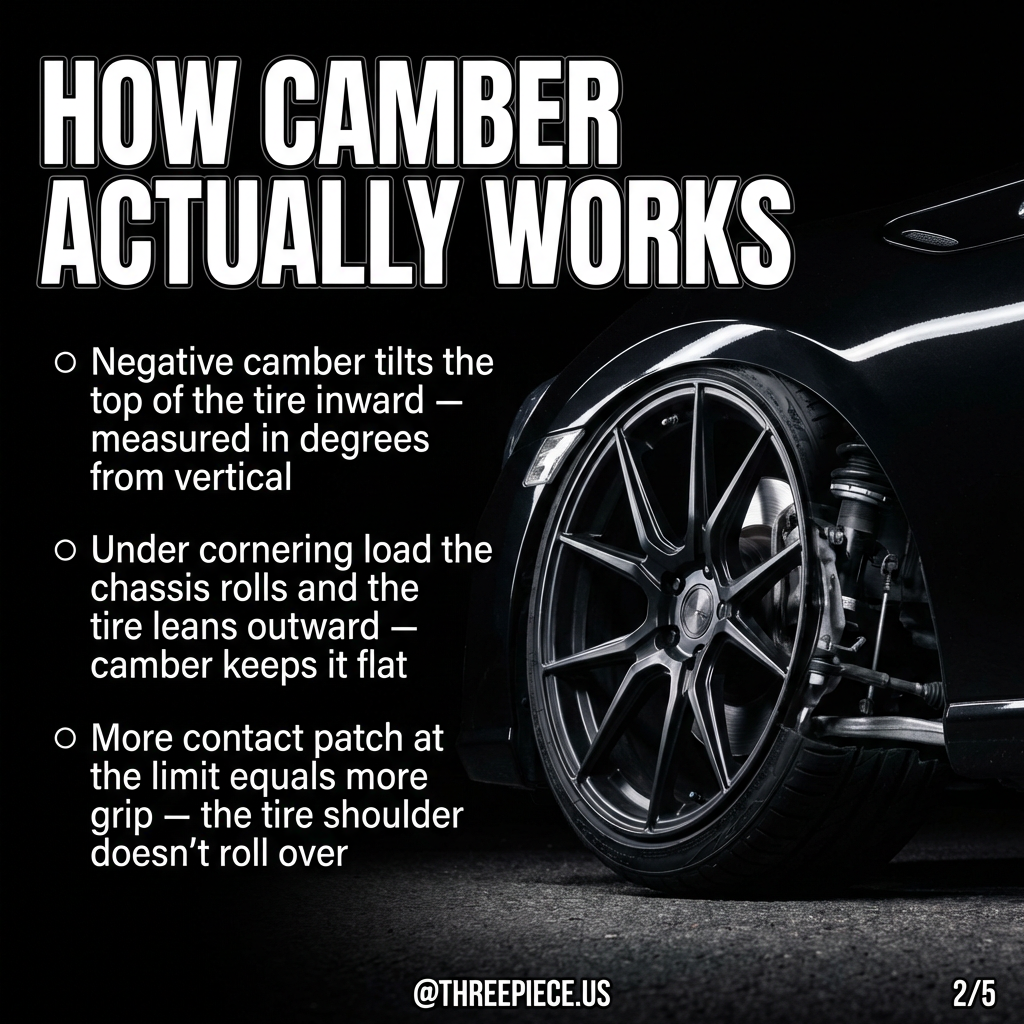
This is why race engineers figured out decades ago that pre-tilting the wheel inward compensates for suspension geometry and body roll. When you hit 1.2g cornering forces on track, that outside tire wants to fold over. Proper camber settings keep the tire's contact patch square to the road surface where it belongs.
For suspension components that let you dial in precise camber settings, check out the BBK Mustang caster camber plate kit at $287 or the Eibach Pro-Alignment front camber kit for $471. These allow precise adjustment that cheap coilover camber plates simply can't match.
Why track cars need more camber
Street driving generates maybe 0.5g cornering forces during spirited driving. Track days hit 1.2g or higher consistently. At 1g, the outside tire loads up and wants to roll onto its shoulder — exactly what camber prevents.

The difference in cornering forces explains why track cars run -2 to -2.8 degrees front camber while street cars stay around -1 to -1.5 degrees. Your alignment shop might think -2.5 degrees is excessive, but it's actually conservative compared to what serious track cars need.
For Honda and Acura owners looking to dial in track-ready alignment, the Eibach Pro-Alignment kit for TSX and Accord at $264 provides the adjustability you need. BMW E46 owners should consider the Eibach rear camber arm kit for $435 to properly balance front and rear grip.
Our comprehensive wheel alignment settings guide covers the complete picture of camber, toe, and caster relationships for both street and track use.
Where people screw up camber
Running -4 degrees on the street eats inner tire edges in 8,000 miles. That's not performance — that's throwing money away on tire replacements. Too much rear camber destroys launch grip because the tire can't put power down evenly across its contact patch.

Mismatched left-right camber makes the car pull to one side and creates uneven tire wear patterns. Your alignment tech should match camber side-to-side within 0.2 degrees — anything more creates handling imbalances that no amount of toe adjustment can fix.
Another common mistake is ignoring rear camber entirely. Front-wheel-drive cars still need proper rear camber for stability under braking and cornering. The SPC rear adjustable camber arms for Mini Cooper at $577 solve this problem for one of the most camber-challenged platforms.
Check out our underrated suspension upgrades guide for more alignment-related improvements that actually matter for performance.
Actual useful camber specs
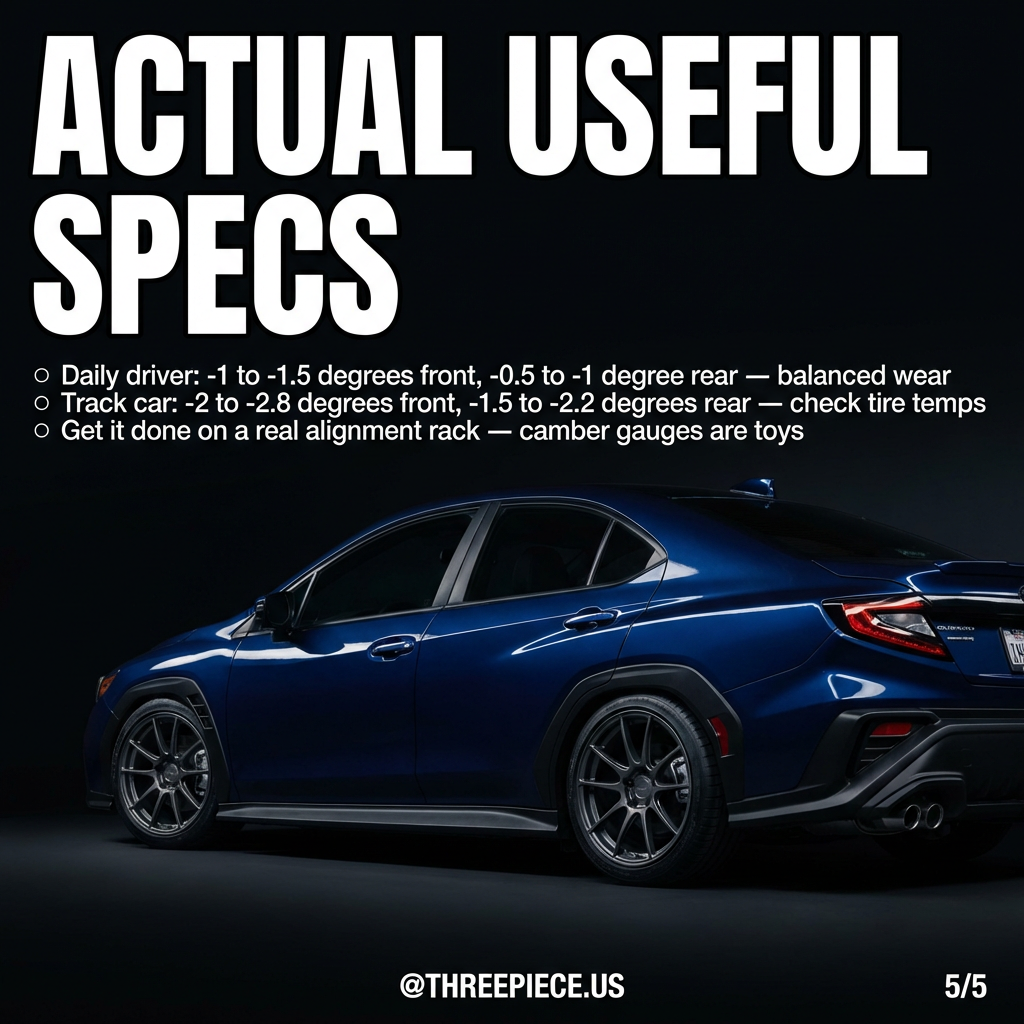
Daily driver setup: -1 to -1.5 degrees front, -0.5 to -1 degree rear for balanced tire wear. Track car setup: -2 to -2.8 degrees front, -1.5 to -2.2 degrees rear — but check tire temperatures to dial it in properly.
These numbers assume you're running proper performance tires and suspension. If you're still on all-seasons or blown stock struts, fix those first before worrying about camber settings. The Eibach Pro-Alignment kit for 4Runner and FJ Cruiser at $713 handles the unique needs of lifted trucks and SUVs.
For Mustang owners, the Eibach Pro-Alignment kit for S197 Mustang at $364 provides the adjustability needed for both street and track use on Ford's solid rear axle platform.
Setup and alignment tips
Get your alignment done on a real alignment rack — camber gauges are toys that give inconsistent readings. A proper shop will check camber under load conditions and account for suspension settling. Tell them your intended use so they can set toe and caster appropriately for your camber settings.
Temperature monitoring is critical for track cars. Use tire pyrometer readings across the tread to fine-tune camber settings. If the inside edge runs 20°F hotter than the outside, you need less negative camber. Equal temperatures across the tread means you've found the sweet spot.
Don't forget about wheel accessories that complement your alignment setup. Proper 90-degree valve stems at $3.80 make tire pressure checks easier with aggressive camber, while quality assembly bolts at $10 ensure your 3-piece wheels stay properly torqued under track conditions.
For more technical alignment information, read our detailed breakdown of tire and suspension priorities that covers why alignment matters more than bolt-on power mods.
The bottom line on camber
Camber isn't stance tax — it's a legitimate performance modification when done correctly. Street cars need conservative settings for tire life, track cars need aggressive settings for grip. The key is matching your setup to your actual use case and getting it done properly at a shop that understands performance alignment.
Browse our selection of performance wheels and suspension components to complete your setup. Check out our vehicle gallery for real-world examples of proper camber setups on different platforms.