

Posted by THREEPIECE.US on Apr 7th 2026
OEM ECU Locks: How GM & Ford Block Tuning on 2022+ Vehicles
Your $60,000 Corvette just became untunable. GM and Ford rolled out encrypted ECU firmware starting in 2022 that permanently blocks HP Tuners, Hondata, and every aftermarket tuning solution. What manufacturers call "security updates" are actually ownership lockdowns — turning your legally-purchased performance car into a brick for modification purposes.

Quick links
- The ECU Lockdown Rollout
- Why It Destroys Performance Builds
- The Real Financial Damage
- What Tuners Are Doing Now
- Buying Strategy for 2025
The ECU Lockdown Rollout
Starting with 2022 model year GM trucks and Corvettes, the PCM now ships with encrypted firmware that can't be cracked by traditional methods. Ford followed suit with the 2021+ F-150 and Mustang using similar digital signature verification. Even reflashing to stock doesn't work — the ECU checks cryptographic signatures before accepting any code changes.
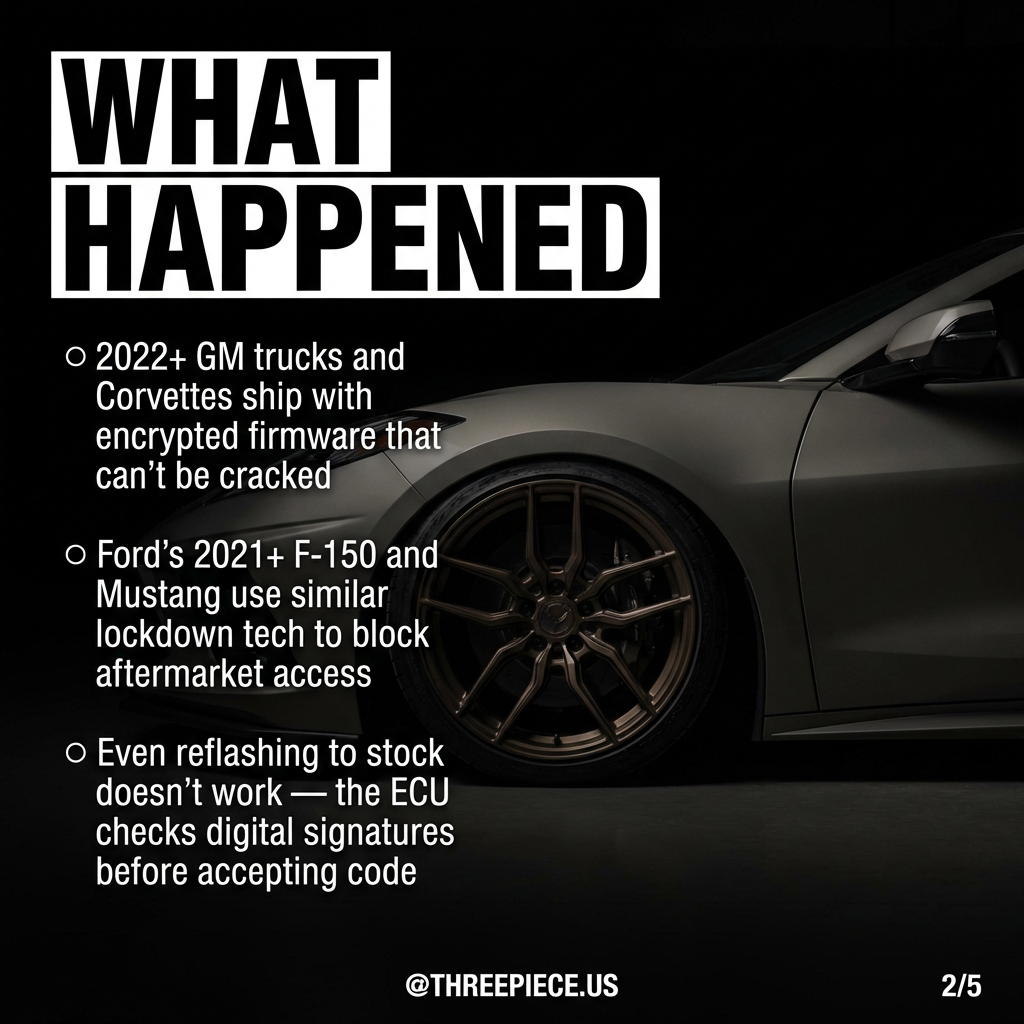
The encryption targets the PCM's bootloader level, making it impossible for tools like HP Tuners or standalone systems to gain write access. This isn't just a software update — it's a fundamental architecture change designed to lock out aftermarket access permanently. Unlike previous anti-tamper measures that could be bypassed with clever programming, these systems use hardware-level encryption that would require physical modification to defeat.
For context on how this affects performance builds, check our guide on 2016-2021 Camaro SS builds — those are the last tunable LT1 cars before the lockdown hit.
Why It Destroys Performance Builds
Your $80,000 Silverado is now stuck with 87 octane tuning forever. No E85 conversion, no header optimization, no transmission shift points — nothing. The ECU lockdown doesn't just block power modifications; it prevents any calibration changes that could improve drivability or reliability.
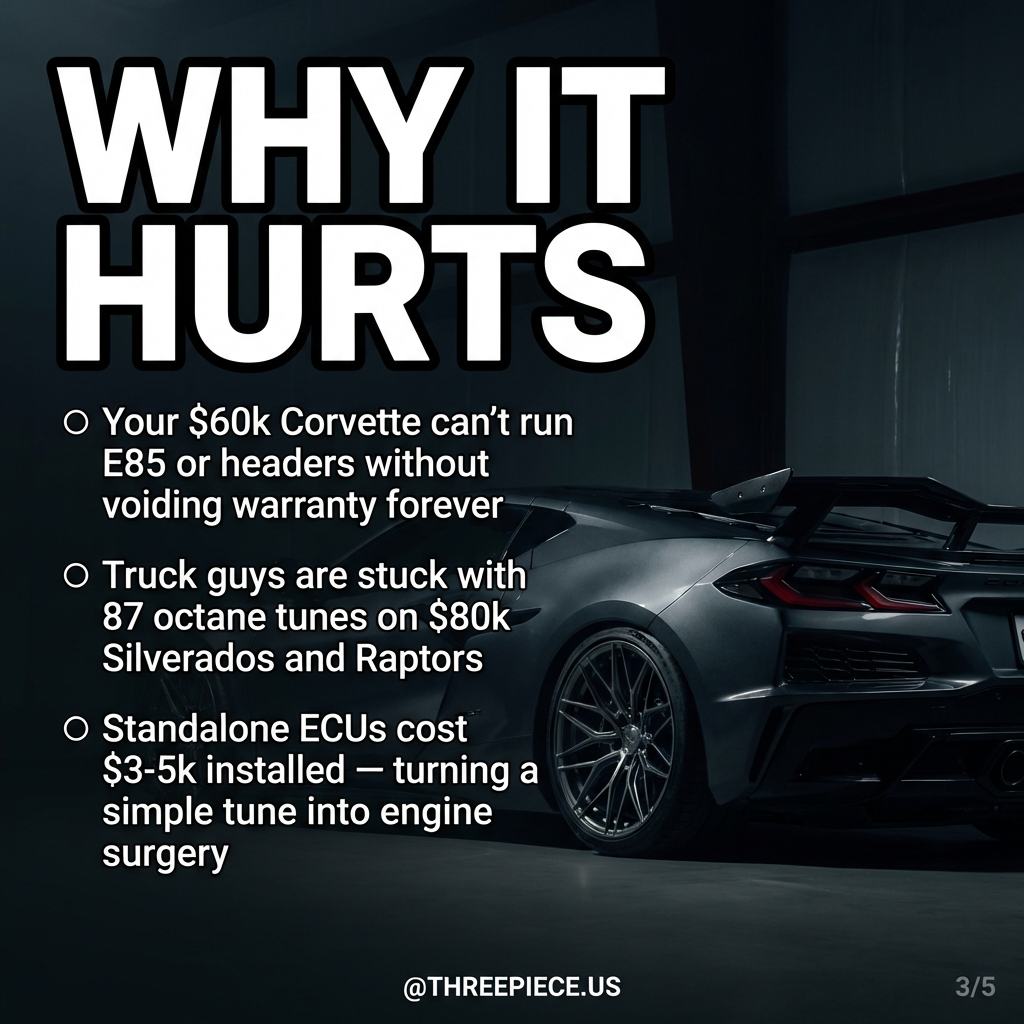
This creates absurd situations where installing BBK headers for $536 or Kooks longtube headers for $2,338 on a new Camaro SS requires voiding the warranty forever. Without ECU access, these bolt-on modifications actually hurt performance because the factory tune can't compensate for increased airflow.
The warranty implications are particularly brutal. Even if you could find a workaround, any modification attempt gets logged in the PCM's tamper detection system. Unlike older cars where you could flash back to stock before service, these systems maintain permanent records that dealers can access during any warranty claim.
The Real Financial Damage
HP Tuners lost 60% of their GM business overnight when encryption rolled out. The aftermarket response has been brutal — standalone ECU swaps now cost $4,000-5,000 installed minimum. What used to be a $600 tune is now engine surgery requiring custom harnesses, sensor relocations, and complete recalibration.
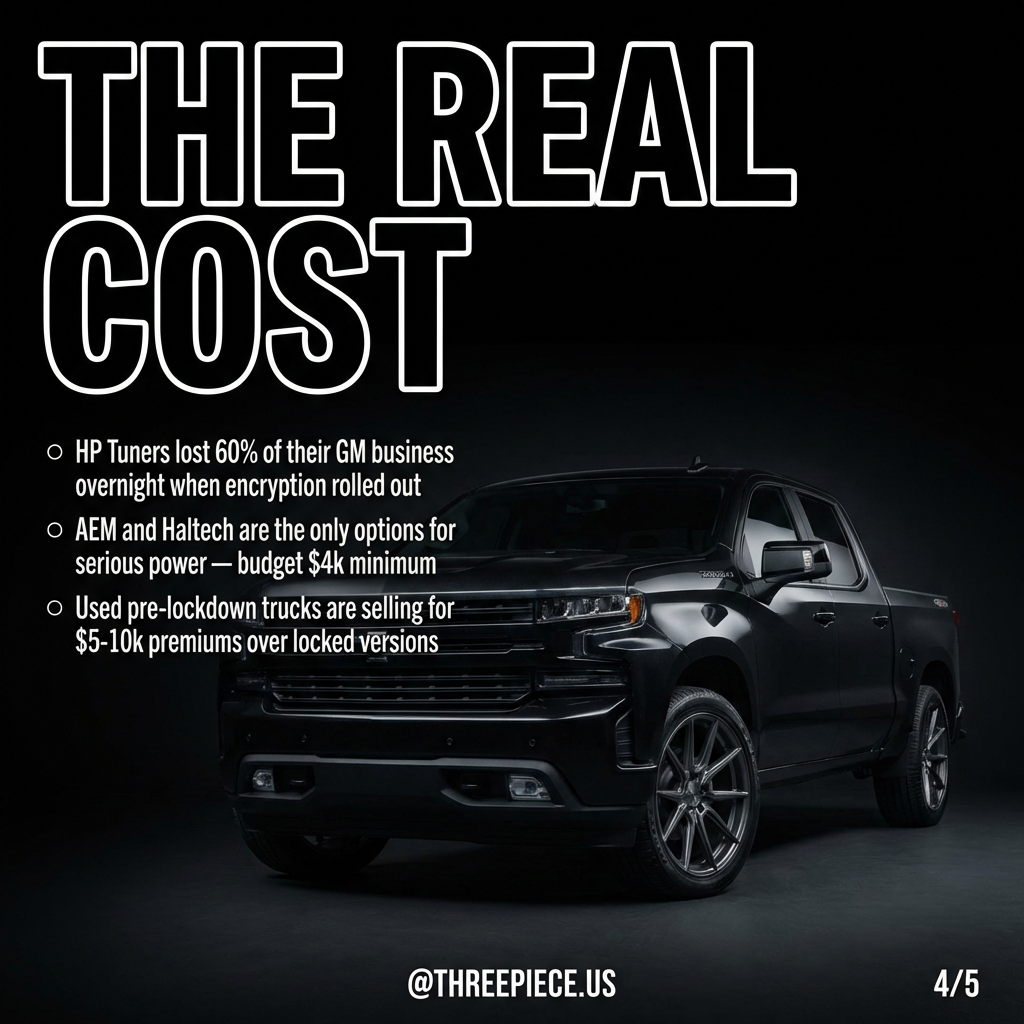
Used pre-lockdown trucks are commanding $5,000-10,000 premiums over identical locked versions. A 2021 Silverado with the tuneable PCM sells for significantly more than a 2022 with identical mileage and options. This price gap is only widening as enthusiasts realize the modification implications.
For serious builds, AEM and Haltech standalone systems like the AEM CD-7 Carbon Dash for $1,618 become mandatory. Combined with installation, tuning, and supporting modifications, what used to be bolt-on performance now requires a $8,000-12,000 commitment before you even touch the engine.
The ripple effects extend beyond tuning. Simple modifications like E85-compatible fuel pumps for $134 become useless without ECU access to adjust fuel maps. Even basic sensors like the AEM 3.5 BAR MAP sensor for $77 can't be properly calibrated without standalone management.
What Tuners Are Doing Now
The aftermarket is fighting back through reverse engineering, but it's a years-long battle. Some tuners are focusing on pre-OBD communication protocols, while others are developing hardware-level bypasses. None of these solutions are ready for consumer use, and when they arrive, expect premium pricing.
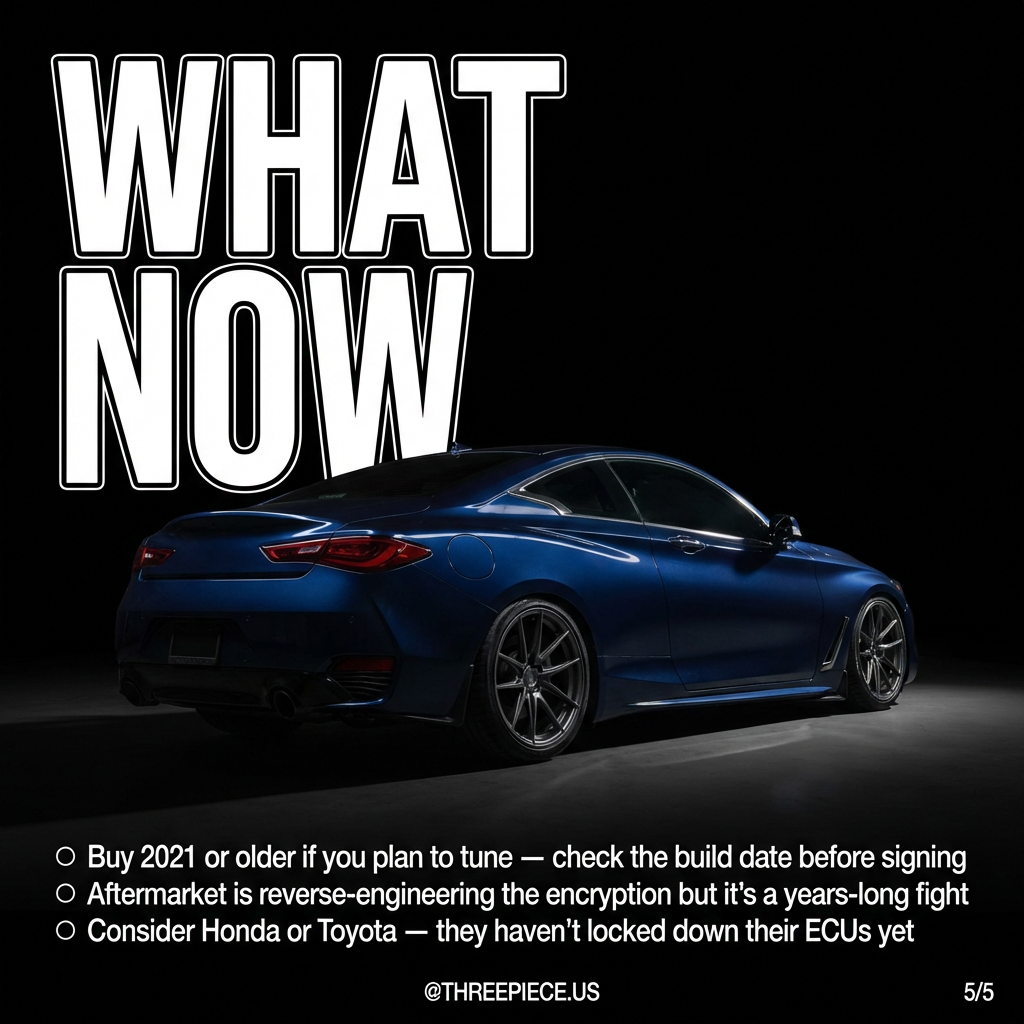
The most viable current approach is standalone ECU conversion. Companies like AEM, Haltech, and MoTeC are seeing massive demand for plug-and-play solutions. However, these systems require extensive custom work and lose integration with factory systems like traction control, stability management, and emissions compliance.
Interestingly, Honda and Toyota haven't implemented similar lockdowns yet. The 2023+ Civic Type R and GR Corolla remain fully tuneable through traditional methods. This creates a significant competitive advantage for Japanese manufacturers in the enthusiast market.
Some tuners are pivoting to piggyback systems that intercept sensor signals rather than modifying ECU code directly. While limited compared to full ECU access, these solutions can provide basic fuel and timing adjustments without triggering encryption protocols.
Buying Strategy for 2025
If you plan to modify, buy 2021 or older — and verify the build date before signing. Some early 2022 models shipped with old firmware, but it's a gamble. Check the PCM part number and software version before purchase, because dealers can't downgrade encrypted units even if they wanted to.
Consider switching brands entirely. Honda's FK8 Civic Type R and Toyota's GR lineup remain modification-friendly. Even Dodge hasn't implemented encryption on Hellcat platforms yet, making them attractive alternatives for serious builds.
For truck buyers, the implications are particularly severe. Modern diesel tuning relies heavily on ECU access for emissions compliance and power delivery. Locked ECUs make clean diesel modifications nearly impossible, forcing buyers toward older platforms or alternative brands.
The used car market is already reflecting these changes. Pre-lockdown performance cars are appreciating faster than locked equivalents, creating a two-tier pricing structure that will only intensify. If you're building a project car, factor ECU accessibility into your platform choice — it may determine whether your build is possible at all.
This isn't just about performance anymore. It's about ownership rights and the fundamental question of whether you can modify what you legally purchased. When manufacturers can remotely disable modification capabilities through "security updates," the concept of automotive ownership becomes increasingly hollow. Choose your next build platform accordingly.