
Posted by THREEPIECE.US on Apr 8th 2026
3-Piece Wheels Explained: Why They Cost $4K+ and If They're Worth It
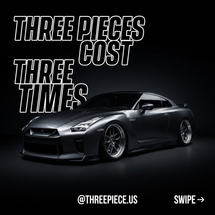
Three-piece wheels aren't expensive because of markup — they're expensive because each wheel requires triple the manufacturing complexity of a one-piece design. When you're looking at $4,000+ sets, you're paying for modular construction that offers fitment precision and repairability that cast wheels simply can't match.
Quick links
- How 3-Piece Wheels Are Made
- Why Multi-Piece Construction Matters
- Breaking Down the $4K Price Tag
- When 3-Piece Wheels Are Worth It
How 3-Piece Wheels Are Made
The fundamental difference between 3-piece and one-piece wheels is manufacturing complexity. Each wheel consists of three separate components: a forged center, an outer barrel, and an inner lip. The center is forged from billet aluminum — a process that creates stronger, lighter material than cast construction. This forging process alone costs significantly more than casting a complete wheel.
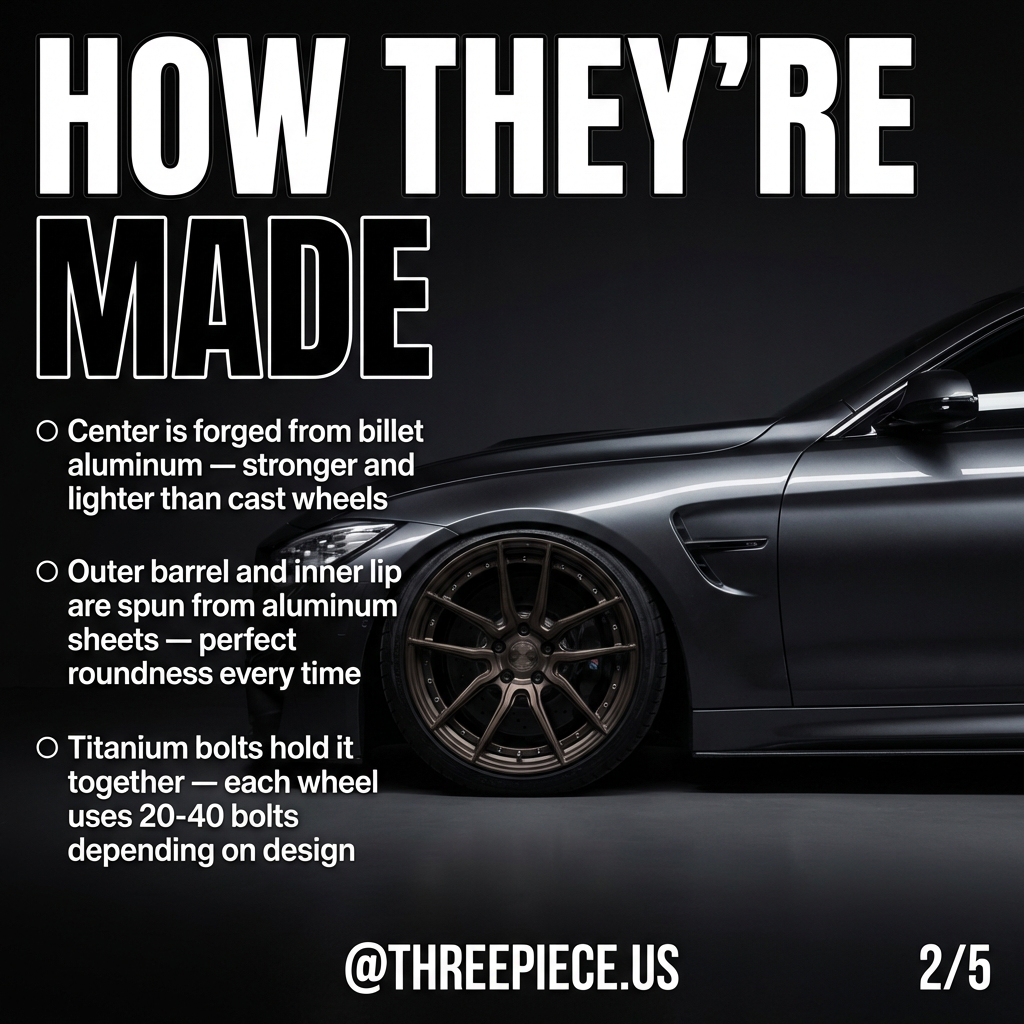
The outer barrel and inner lip are spun from aluminum sheets, ensuring perfect roundness every time. This spinning process creates consistent wall thickness and eliminates the imperfections common in cast barrels. Assembly requires 20-40 titanium bolts depending on the design — and yes, titanium costs significantly more than steel. You can find quality assembly bolts starting at $10 each, but premium titanium hardware can cost $15-25 per bolt.
For comparison, our Volk TE37 vs Work Meister comparison breaks down why forged one-piece wheels cost less than multi-piece designs despite similar material quality.
Why Multi-Piece Construction Matters
The modular design offers three key advantages that justify the cost premium. First, you can rebuild bent barrels instead of replacing entire wheels. Crash damage that would total a cast wheel set only requires barrel replacement on 3-piece wheels — a $300-500 repair versus $1,200+ replacement.

Second, custom offsets don't require custom tooling. You can swap barrels to change width and offset without ordering completely new wheels. This flexibility is crucial for cars with aggressive fitment requirements or owners who change setups frequently. The Work Wheels catalog demonstrates this perfectly — the same center can accommodate multiple barrel widths and offsets.
Third, weight savings matter more than most people realize. Quality 3-piece wheels save 5-8 pounds per wheel over equivalent cast designs. That's 20-32 pounds of unsprung weight reduction, which improves acceleration, braking, and suspension response. Our suspension upgrades guide explains why unsprung weight reduction is often more valuable than coilover upgrades.
For assembly and maintenance, you'll need proper hardware. Check out our selection of M7x32 socket cap bolts at $10 each or upgrade to 24k gold-plated hardware at $15 per bolt for show builds.
Breaking Down the $4K Price Tag
Understanding where your money goes helps justify the investment. Forged centers start at $400 each before any machining or finishing — that's $1,600 for a set of centers alone. Add custom machining for bolt patterns, center bores, and spoke profiles, and you're looking at another $200-300 per wheel.
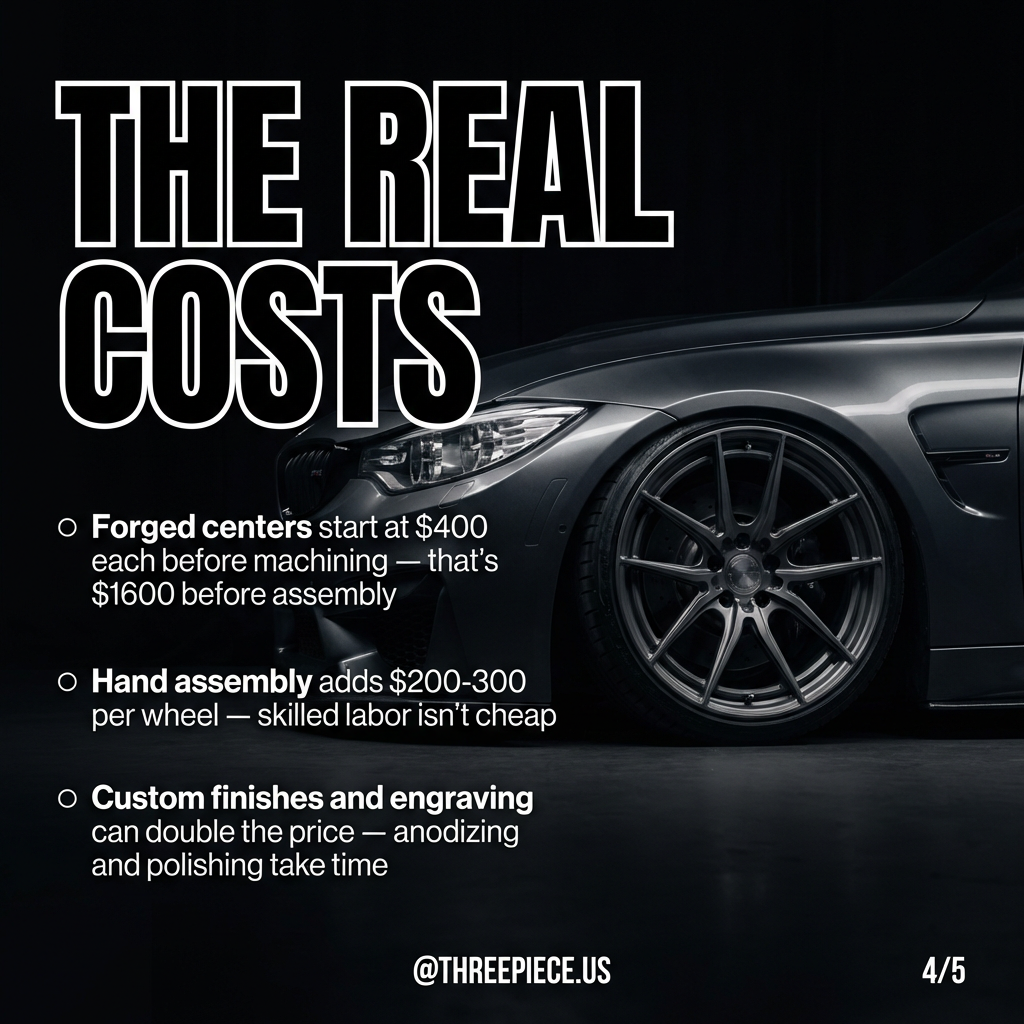
Hand assembly adds $200-300 per wheel in labor costs. Unlike cast wheels that pop out of molds, 3-piece wheels require skilled technicians to properly torque and seal each assembly. This isn't automated manufacturing — it's precision craftsmanship that takes time and expertise.
Custom finishes and engraving can double the base price. Anodizing, polishing, and custom center cap work require additional time and specialized equipment. Premium brands like Work Emotion and Work VS offer extensive customization options that justify their price premiums.
Don't forget the supporting components. Quality Work VS center caps cost $50 each, and proper 90-degree valve stems at $3.80 each ensure proper tire pressure monitoring on low-profile setups.
When 3-Piece Wheels Are Worth It
Three-piece wheels make financial sense in specific scenarios. If you're building a show car or serious track machine, the performance benefits justify the cost. The combination of weight savings, custom fitment, and repairability pays dividends over time.
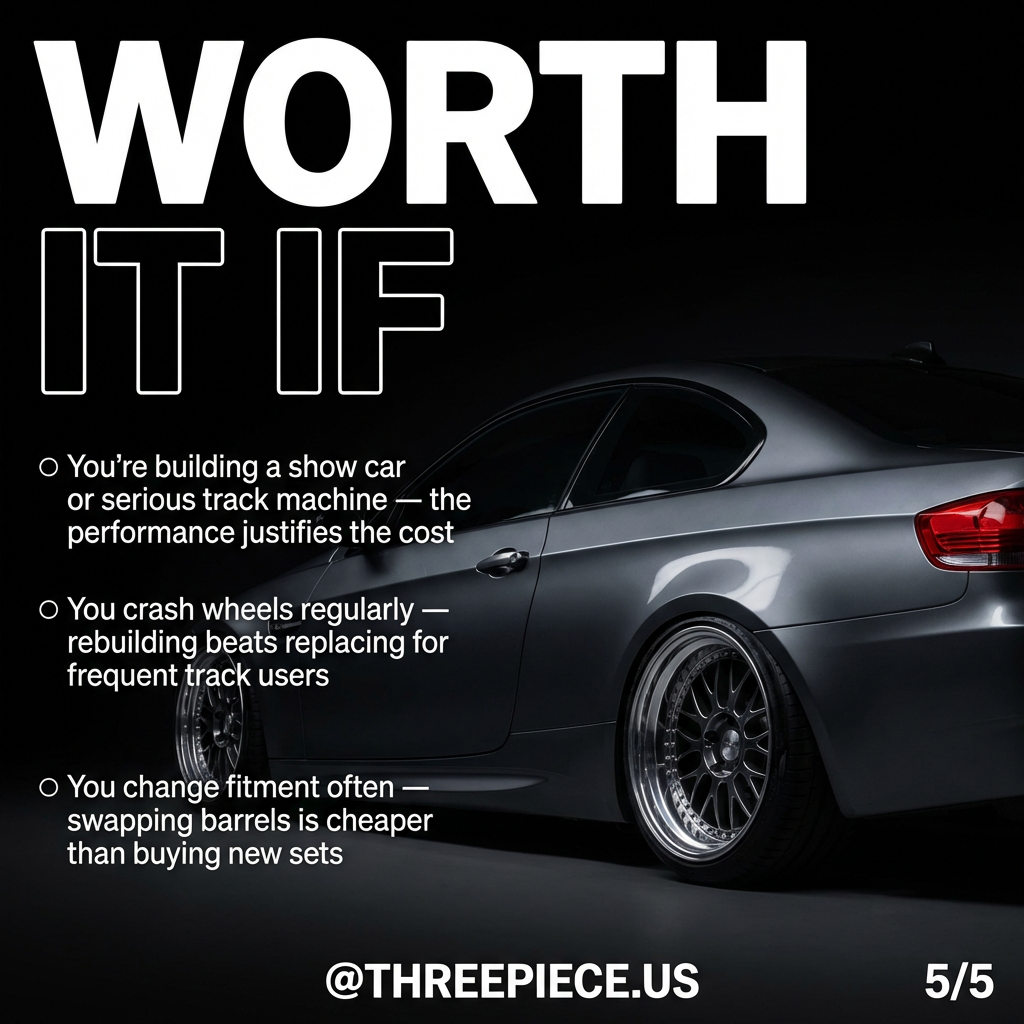
Track enthusiasts who crash wheels regularly find that rebuilding beats replacing. A bent barrel replacement costs $300-500 versus $1,200+ for new cast wheels. After two or three incidents, the modular design pays for itself. Check our ultimate track combo guide for more performance wheel recommendations.
Owners who change fitment often also benefit from the modular design. Swapping barrels costs less than buying complete new sets, making 3-piece wheels cost-effective for enthusiasts who experiment with different setups. The vehicle gallery showcases builds that have evolved through multiple fitment changes.
However, 3-piece wheels aren't worth it for everyone. Daily drivers that see minimal performance use don't benefit enough from the advantages to justify the cost. Quality cast or flow-formed wheels offer better value for street-focused builds. Our replica vs authentic wheels guide explains when cheaper alternatives make sense.
The bottom line: 3-piece wheels are expensive because they're fundamentally different products. You're not paying for brand markup — you're paying for engineering, materials, and manufacturing complexity that delivers real performance benefits. Whether that's worth $4,000+ depends on your build goals and how you use your car.