
Posted by THREEPIECE.US on Mar 27th 2026
Buying a Modified 2015-2020 Subaru WRX: FA20 Red Flags & Checklist
The FA20 in the 2015-2020 Subaru WRX is simultaneously the best and worst engine Subaru ever built. Unlike the bulletproof EJ257, this 2.0L direct-injection turbo responds incredibly well to proper modifications but punishes owners who cut corners. One poorly executed Stage 2 flash and you're looking at $8,000 in rebuild costs.

Quick links
- Why FA20 Engines Self-Destruct
- What the FA20 Does Right
- Modifications That Kill Motors
- Smart Modification Path
- Pre-Purchase Inspection Checklist
Why FA20 Engines Self-Destruct
The FA20 earned its reputation for ringland failure because most owners approach it like the old EJ257. Cobb Stage 2 with no supporting modifications destroys ringlands by 60,000 miles — but the tune isn't the problem, it's what's missing. The stock top-mount intercooler becomes a heat soak nightmare under sustained load, pushing intake air temperatures past 140°F and creating knock conditions that cook pistons.
Direct injection compounds the problem. Unlike port injection engines that wash intake valves with fuel, the FA20 relies entirely on proper air-fuel ratios for cooling. When heat soak pushes the ECU into protection mode, it pulls timing aggressively — but by then, the damage is done. This is why you'll see builds with catted downpipes lasting longer than catless setups on pump gas.
If you're shopping for suspension upgrades, the Air Lift Performance WRX front kit at $1,115 transforms the chassis dynamics. For clutch upgrades on modified cars, the Clutch Masters FX400 8-puck kit at $654 handles 400 ft-lbs reliably.
What the FA20 Does Right
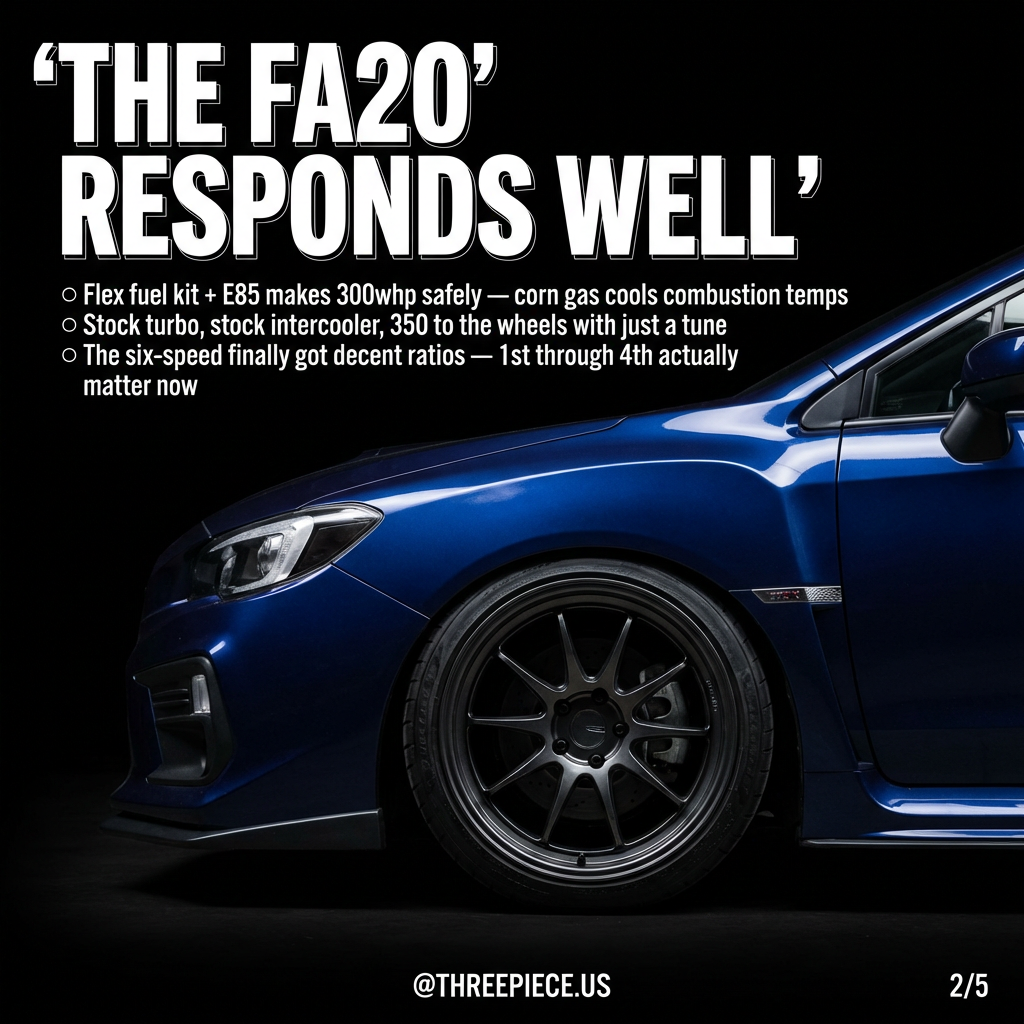
When built properly, the FA20 is a revelation. Flex fuel kit plus E85 makes 300 wheel horsepower safely — corn gas drops combustion temperatures by 200°F compared to 91 octane. The stock turbo flows enough for 350 wheel horsepower with supporting modifications, and the six-speed finally got decent ratios where first through fourth gears actually matter for canyon driving.
The FA20's direct injection system responds better to proper intake upgrades than most turbo engines. Unlike older Subarus that barely benefit from cold air intakes, the FA20 picks up 15-20 horsepower with a quality setup — but only when paired with MAF scaling and a proper tune.
For wheel fitment on your WRX build, check our comprehensive WRX wheel fitment guide covering every generation. The 2015+ cars run 5x114.3 bolt pattern and clear 18x9.5 +38 without fender modifications.
Modifications That Kill Motors
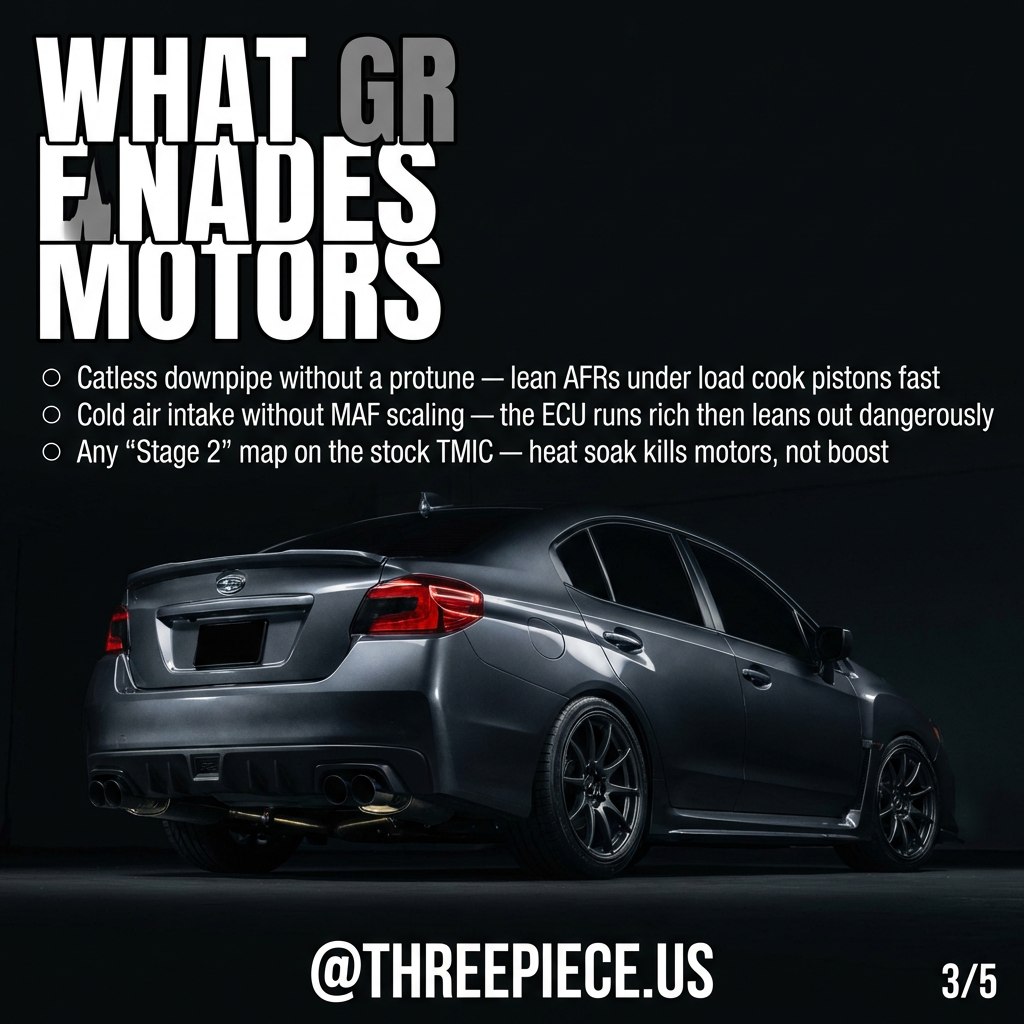
Three modifications account for 80% of FA20 failures: catless downpipe without a protune, cold air intake without MAF scaling, and any Stage 2 map on the stock top-mount intercooler. Each creates lean air-fuel ratios under load that cook pistons within 10,000 miles of installation.
The catless downpipe trap is especially dangerous. Without high-flow cats, the ECU sees dramatically different exhaust gas temperatures and oxygen sensor readings. Most off-the-shelf tunes compensate by running rich at idle and cruise — but lean out dangerously under wide-open throttle. This is why catted downpipes make more sense for street cars.
Cold air intakes without MAF scaling create similar problems. The larger intake tube changes airflow characteristics past the mass airflow sensor, causing the ECU to miscalculate fuel delivery. Initially, the engine runs rich as the ECU overcompensates — but as the adaptive learning pulls fuel, it swings too far lean under boost.
Heat soak from the stock top-mount intercooler kills more FA20s than any other single factor. Any Stage 2 map pushing 18+ PSI through the factory TMIC creates intake air temperatures exceeding 150°F on hot days. At those temperatures, pump gas octane drops below 87 effective rating, triggering knock that destroys ringlands.
Smart Modification Path
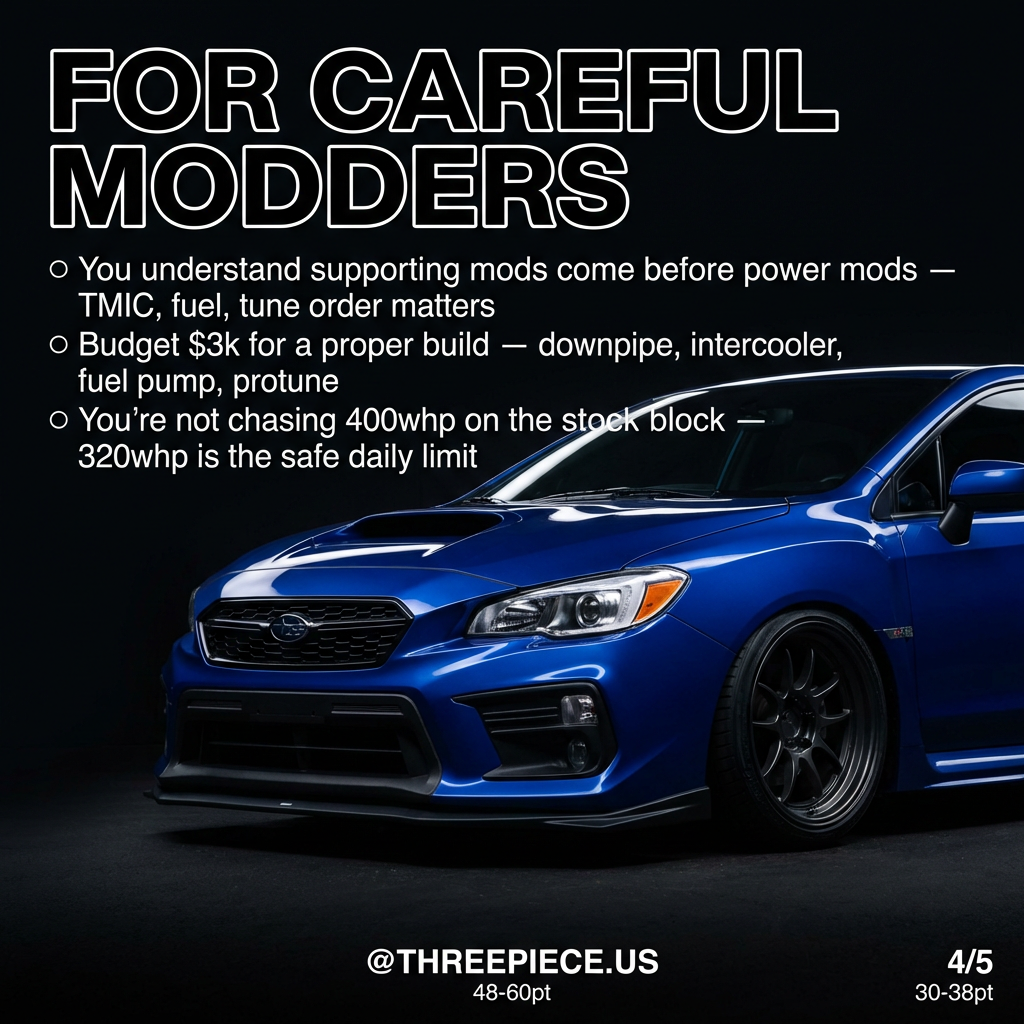
Successful FA20 builds follow a specific order: supporting modifications before power modifications. Budget $3,000 minimum for a proper setup — downpipe, front-mount intercooler, fuel pump internals, and professional tune. Trying to do it cheaper usually means cutting corners that destroy motors.
The smart path starts with heat management. A quality front-mount intercooler keeps intake air temperatures below 100°F even on track days. Follow that with a high-flow catted downpipe — the 3-inch diameter flows enough for 400 wheel horsepower while maintaining emissions compliance in most states.
Fuel system upgrades matter more than most owners realize. The stock fuel pump flows enough for 300 wheel horsepower, but the injectors max out around 280 wheel horsepower on E85. Upgraded injectors and pump internals support 350+ wheel horsepower safely.
Professional tuning is non-negotiable. A proper dyno tune costs $600-800 but prevents the lean conditions that destroy motors. E85 tuning adds another $200-300 but drops exhaust gas temperatures by 150°F and adds 50+ wheel horsepower over pump gas.
Remember that 320 wheel horsepower is the safe daily limit on the stock block. Chasing 400+ wheel horsepower requires forged internals, and at that point you're looking at $8,000-12,000 in engine work. For most street builds, focus on suspension and handling — check out our vehicle gallery for inspiration on balanced WRX builds.
Pre-Purchase Inspection Checklist
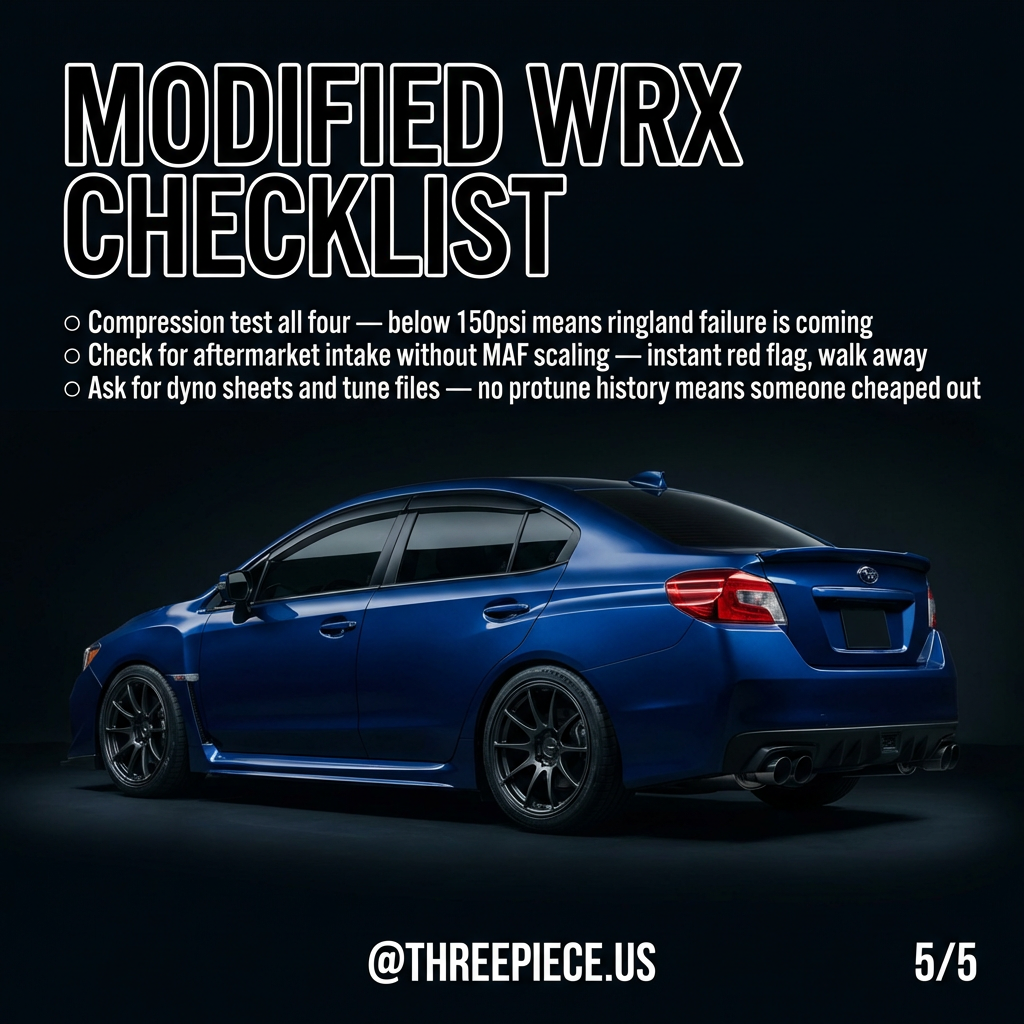
Modified WRX shopping requires specific checks beyond typical used car inspection. Start with a compression test on all four cylinders — anything below 150 PSI indicates ringland failure is imminent. Healthy FA20s should show 165-175 PSI across all cylinders with less than 10 PSI variation.
Check for aftermarket intake without MAF scaling — this is an instant red flag to walk away. Look for larger intake tubes paired with stock ECU tuning, especially on cars with other modifications. The combination creates lean conditions that destroy motors within months.
Ask for dyno sheets and tune files from any modified car. No protune history means the previous owner cheaped out on the most critical component. Cobb Accessport maps are fine for bone stock cars, but any car with intake, exhaust, or boost modifications needs custom tuning.
Inspect the intercooler setup carefully. Stock top-mount intercoolers on Stage 2+ cars indicate heat soak problems. Look for front-mount intercooler upgrades — they're essential for reliability above 280 wheel horsepower. Quality setups from Process West or Mishimoto cost $800-1,200 new.
Check maintenance records obsessively. The FA20 requires synthetic oil changes every 3,000 miles under performance driving. Look for consistent oil analysis reports and quality filters. Cheap maintenance on a modified FA20 is a recipe for disaster.
For wheels and tires, browse 18-inch wheels in 5x114.3 for proper WRX fitment. The platform looks great with 18x9.5 +38 wheels wrapped in 255/35R18 tires for aggressive street setup.
Finally, drive the car hard during inspection. The FA20 should pull smoothly to redline without knock or hesitation. Any stumbling under boost indicates tune issues or mechanical problems. A healthy modified FA20 feels explosive compared to stock — if it doesn't, something's wrong.
Smart WRX shopping means understanding the FA20's strengths and weaknesses. Buy from owners who respected the platform's limits, and you'll get a reliable 300+ horsepower daily driver. Buy from someone who cut corners, and you're looking at immediate engine work. The difference is usually obvious once you know what to look for.