
Posted by THREEPIECE.US on Feb 28th 2026
Why Wheel Weight Matters More Than Size: 2 Pounds = 8 Pounds Physics
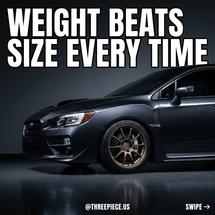
Your 20-inch wheels might be killing your car's performance more than you think. Most enthusiasts obsess over diameter and forget the most important spec on the wheel box: rotational mass. Every pound at the rim fights acceleration twice — once to move forward, once to spin up. Your engine works 4x harder to spin heavy wheels than to carry static weight.

Quick links
- Why Rotational Mass Is Different
- Where You Feel the Difference
- The Numbers That Actually Matter
- How to Choose Wheels Correctly
Why Rotational Mass Is Different
Physics doesn't care about your Instagram feed. Dropping 2 pounds of wheel weight feels like removing 8 pounds from your car because rotational mass affects performance exponentially. Every pound at the rim fights acceleration twice — once to move the car forward, once to spin the wheel up to speed.

This is why lightweight 18-inch wheels will always outperform heavy 19s in real-world driving. Your engine works harder to overcome rotational inertia than static weight. A 5-pound difference per corner equals 160 pounds of effective weight reduction across the entire car.
Understanding this principle changes how you shop for wheels entirely. Check out our guide on 17-inch vs 18-inch wheels to see why bigger often kills street performance. The physics are unforgiving.
Where You Feel the Difference
First gear pulls harder with light wheels because there's less rotational mass to overcome. This isn't theoretical — it's measurable in every acceleration run. Braking distances shrink because there's less rotational inertia to stop. Steering response sharpens due to reduced gyroscopic effect from spinning mass.

The difference is most noticeable in stop-and-go driving, autocross, and canyon carving where you're constantly accelerating and decelerating. Heavy wheels kill the car's ability to change direction quickly. This is why serious track builds prioritize wheel weight over everything else, including looks.
For track-focused builds, read our analysis of Enkei RPF1 vs Konig Hypergram to understand the performance difference between lightweight options. Weight matters more than brand prestige.
The Numbers That Actually Matter
Volk TE37s weigh 17 pounds in 18x9.5 — most cast wheels are 25+ pounds in the same size. Enkei RPF1s at 15 pounds beat any 20-inch wheel for performance, even forged options. The math is simple: lighter always wins for acceleration and handling.

Real-world examples prove the point. A BMW E92 335i with 18x9 RPF1s at 16 pounds each will outaccelerate the same car on 19x9 cast wheels at 28 pounds each. The 48-pound total difference equals 192 pounds of effective weight reduction.
For BMW fitment specifically, our E92 335i square vs staggered guide explains why 18x9 all around beats staggered setups. The Work Wheels catalog includes several lightweight forged options perfect for this platform.
Check actual weight specs before buying. Marketing lies but the scale doesn't. Most wheel manufacturers hide weight specs because their cast wheels are embarrassingly heavy. Demand real numbers or shop elsewhere.
How to Choose Wheels Correctly
Forged beats cast every time for weight savings. Volk, BBS, and Enkei understand physics better than Instagram influencers. Stay smaller and lighter over bigger and heavier — 17s often outperform 19s in every meaningful metric except curb appeal.

Priority order for performance builds: weight first, then size, then offset, then looks. Most people do this backwards and wonder why their car feels slower after a wheel upgrade. Physics doesn't compromise.
For forged options, browse the Work Emotion series or Work Equip line for proven lightweight designs. Both series prioritize performance over aesthetics. Complete your setup with proper Work center caps starting at $50.
Understanding cast vs forged manufacturing differences helps explain why forged wheels cost more but perform better. The manufacturing process creates stronger, lighter wheels that transform how your car drives.
Don't forget proper installation hardware. Quality M8x32 assembly bolts at $10 and matching M8 assembly nuts at $3.80 ensure your lightweight wheels stay properly secured.
Save this before you drop $3K on wheels that slow you down. Physics wins every time, regardless of how good they look in photos.