
Posted by THREEPIECE.US on Feb 28th 2026
Why Proper Alignment Beats 275-Wide Tires on Stock Suspension
Running 275-wide tires on stock suspension is like putting racing slicks on a grocery cart. You're throwing money at the wrong problem while making your car slower and less predictable. Proper alignment with -2.5 degrees negative camber on narrower rubber will consistently outperform wide tires on factory geometry.

Quick links
- Width Doesn't Equal Grip
- The Case for Alignment
- Why Wide Tires Fail on Stock Suspension
- What People Miss About Setup
- Do Alignment First
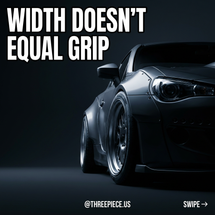
Width Doesn't Equal Grip
Contact patch matters more than tire width. A 245/40R18 with proper camber settings keeps more rubber on the ground through corners than 275/35R18 rubber rolling over onto sidewalls. Stock suspension geometry wasn't designed for wide tires — the camber curves, roll centers, and scrub radius all work against you.

The math is simple: 2.5 degrees negative camber beats 30mm extra width every time. When your car leans in corners, that negative camber keeps the tire flat against the road surface. Wide tires on stock geometry just give you more sidewall to flex.
If you're serious about setup, start with understanding how negative camber actually improves grip before throwing money at tire width. The physics don't lie.
The Case for Alignment
Toe adjustments control how your car enters corners — dial out understeer without buying new tires. Corner weighting fixes the real problem: weight transfer, not contact patch size. A proper alignment shop that knows your platform can transform your car's behavior for $200 instead of $1,200 in wide rubber.

Most enthusiasts skip alignment because it's not Instagram-worthy. But proper suspension setup matters more than any wheel or tire upgrade. Get your geometry right first.
Consider upgrading to adjustable components like the Eibach Pro-Alignment Rear Camber Arm Kit for $435 on E46 BMWs, or the SPL Parts Rear Camber Links at $421 for precise adjustment capability.
Why Wide Tires Fail on Stock Suspension
Stock suspension can't keep 275s flat in corners — you're riding on the sidewalls instead of the tread. More tire just amplifies the suspension's flaws. Understeer gets worse, not better, because the front tires can't match the rear's theoretical grip.

Scrub radius changes with wider wheels affect steering precision. Your car feels heavier and less connected because the contact patch moves further from the suspension pickup points. This is why bigger wheels often kill street performance — geometry matters more than size.
For proper suspension upgrades, look at coilover systems like the F2 Function & Form Type 1 Coilovers that offer adjustable camber plates. Even budget options beat stock geometry when set up correctly.
What People Miss About Setup
Tire pressure becomes critical with wide rubber — 2psi difference kills the advantage completely. Heat cycling happens faster on stock shocks because they can't control the extra tire mass. Wide tires overheat and fall off quicker than narrower rubber with proper damping.

You're fixing the symptom, not the cause. Bad suspension geometry doesn't care about tire width. A Whiteline Universal Camber Gauge at $255 will teach you more about your car's setup than any tire upgrade.
Read our guide on tire pressure for autocross to understand how pressure changes affect grip. The fundamentals matter more than width specs.
Do Alignment First
Spend the tire money on coilovers with adjustable camber plates — they solve the real problem. 245/40R18 on proper suspension beats 275/35R18 on stock geometry every single time. Physics doesn't lie, and neither do lap timers.
Get corner balanced at a shop that knows your platform. Alignment sheets don't tell the whole story — you need someone who understands how suspension geometry affects tire contact patches through the full range of motion.
For comprehensive suspension upgrades, consider systems like the Eibach Pro-Alignment Front Kit at $713 for 4Runners, or platform-specific options like the Eibach Pro-Alignment Camber Kit for $264 on TSX/Accord platforms.
Stop throwing money at tire width and start investing in proper suspension geometry. Your lap times will thank you, and so will your wallet. Check out our vehicle gallery to see how proper alignment transforms real builds, then browse our suspension category to find the right components for your platform.