
Posted by THREEPIECE.US on Feb 28th 2026
Square vs Staggered on RWD Coupes: Why Wider Rears Kill Corner Grip
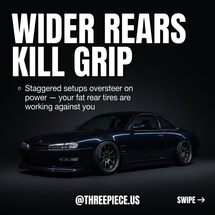
Most RWD coupe owners run staggered setups thinking wider rear tires equal faster lap times. The physics say otherwise. When your rear contact patch significantly outgrips the front, you're creating an imbalance that kills rotation and hurts corner exit speed. 255 square often beats 275/315 staggered on track—here's why.

Quick links
The Physics Are Backwards
Staggered setups create a grip imbalance that fights corner exit acceleration. Your 275 or 315 rear tires hook initially, but when they break loose, they snap without warning. Square setups balance grip front to rear—both ends slide together predictably, letting you catch and control the slide.

Contact patch matters more than width. A properly sized 255 square setup often delivers better lap times than 275/315 staggered because the balanced grip lets you maintain momentum through corner sequences. The wider rears in staggered setups oversteer on power, working against you when you need progressive breakaway.
For wheel sizing on popular RWD coupes, check our E92 335i square vs staggered analysis for real-world data. The results consistently favor square setups for anything beyond straight-line acceleration.
When Staggered Actually Works
Staggered isn't always wrong—it depends on your mission. Drag racing and highway pulls benefit from the extra rear grip since straight-line traction is all that matters. Heavy GT cars like the BMW M6 or Mercedes AMG models fight natural understeer with staggered setups, using the grip imbalance to balance the chassis.

Show builds prioritize aesthetics over performance—315 rears fill the wheel wells better and create that aggressive stance. If Instagram likes matter more than lap times, stagger away. Just understand you're accepting a handling compromise for the visual impact.
The Work Emotion series offers excellent staggered options for show builds, while their VS series provides classic square setups for track-focused builds.
Why Square Setups Win
Real-world testing proves square superiority for track driving. A 350Z on 255 square consistently runs faster lap times than the same car with 275/315 staggered. The balanced grip lets you rotate the car mid-corner and apply power earlier on exit.

Tire rotation doubles your tread life—staggered setups waste the fronts while the rears still have meat left. Progressive breakaway lets you catch slides before they become tank-slappers. Staggered setups snap without warning when the rears finally let go.
For tire selection, browse 255/40R17 options for 17-inch square setups or 255/35R18 tires for 18-inch applications. Our 300TW tire guide explains why these compounds work better than 200TW for street-driven track cars.
Consider 17x9 wheels in 5x114.3 for Nissan applications or 18x9 wheels in 5x120 for BMW fitments. Complete your setup with Work VS center caps at $50 for the authentic look.
Choose Your Mission
Track days and canyon runs demand square setups—prioritize balance over peak grip. The predictable breakaway and tire rotation benefits make square the obvious choice for performance driving. Daily driving also benefits from square setups since they're safer and cheaper to maintain.

Instagram and car shows favor staggered for the aesthetic impact. Accept the handling compromise if visual appeal matters more than corner speed. The wider rears create that aggressive stance that photographs well, even if they hurt your lap times.
For assembly hardware, grab M8x32 chrome assembly bolts at $10 each or M7x32 24k bolt/nut combos at $15 for premium builds. Don't forget 90-degree valve stems at $3.80 for low-profile setups.
The choice comes down to mission: square for speed, staggered for show. Most enthusiasts building track-focused RWD coupes should go square and enjoy the balanced handling, tire rotation benefits, and faster lap times. Save the staggered setups for drag strips and photo shoots where straight-line grip and aesthetics matter more than corner speed.