
Posted by THREEPIECE.US on Mar 6th 2026
Should You Buy a Mazda RX-7 FD? 255HP Rotary Reality Check
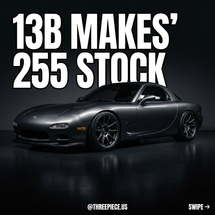
The Mazda RX-7 FD produces 255 horsepower at the wheels stock — not at the crank like Mazda claimed. That's roughly 290-300 crank horsepower from the 13B-REW twin-turbo rotary, making it one of the most underrated sports cars of the '90s. But before you start shopping for an FD, understand this: you're not buying a car, you're joining a cult. The rotary engine will either consume your life or break your bank — sometimes both.
Quick links
- 13B Power Reality
- Apex Seal Death Sentence
- True Ownership Costs
- Pre-Purchase Inspection
- Should You Buy One?
13B Power Reality: More Than Advertised
Mazda's 255hp rating was conservative marketing — dyno sheets consistently show 255hp at the wheels on stock FDs. The 13B-REW twin-turbo rotary revs to 8000rpm and sounds like a Formula 1 car doing it. Perfect 50/50 weight distribution comes from mounting the engine behind the front axle centerline, creating handling that embarrasses modern sports cars.
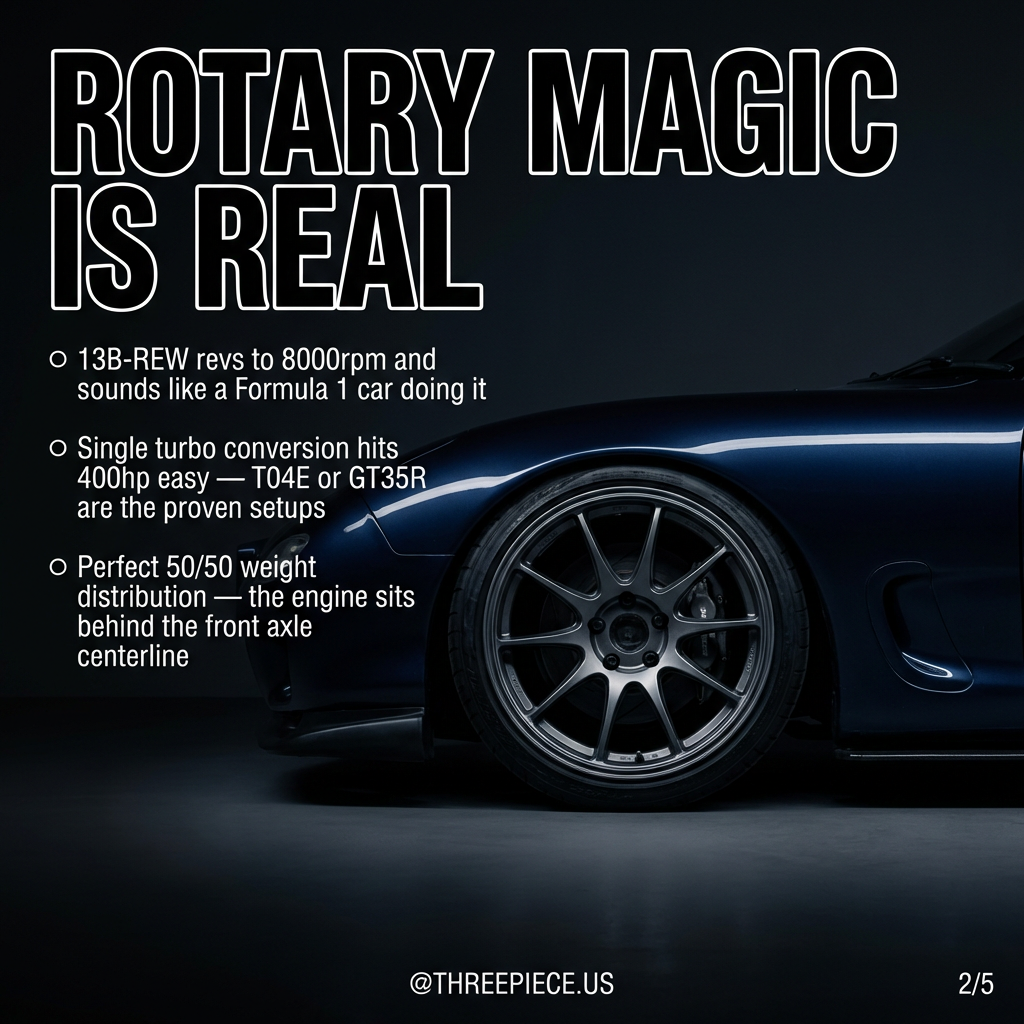
Single turbo conversions unlock the 13B's real potential. A T04E or GT35R setup easily hits 400hp with supporting mods. The rotary's lack of valvetrain means it can handle boost levels that would grenade a piston engine. But here's where the FD separates enthusiasts from casual buyers — this power comes with a price.
For wheel fitment on the FD, 17x9 +35 front and 17x10 +38 rear is the proven setup. Browse our 17x9 wheels in 5x114.3 for front options, and pair them with 17x10 wheels for the rear. The Work Emotion series was practically designed for FD3S builds.
Apex Seal Death Sentence: The Rotary's Achilles Heel
Apex seals fail every 80-100k miles on well-maintained FDs. These carbon strips seal the combustion chambers as the rotors spin, and when they go, compression drops across all chambers. Rebuild costs run $5-8k at a rotary specialist — assuming you can find one within driving distance.
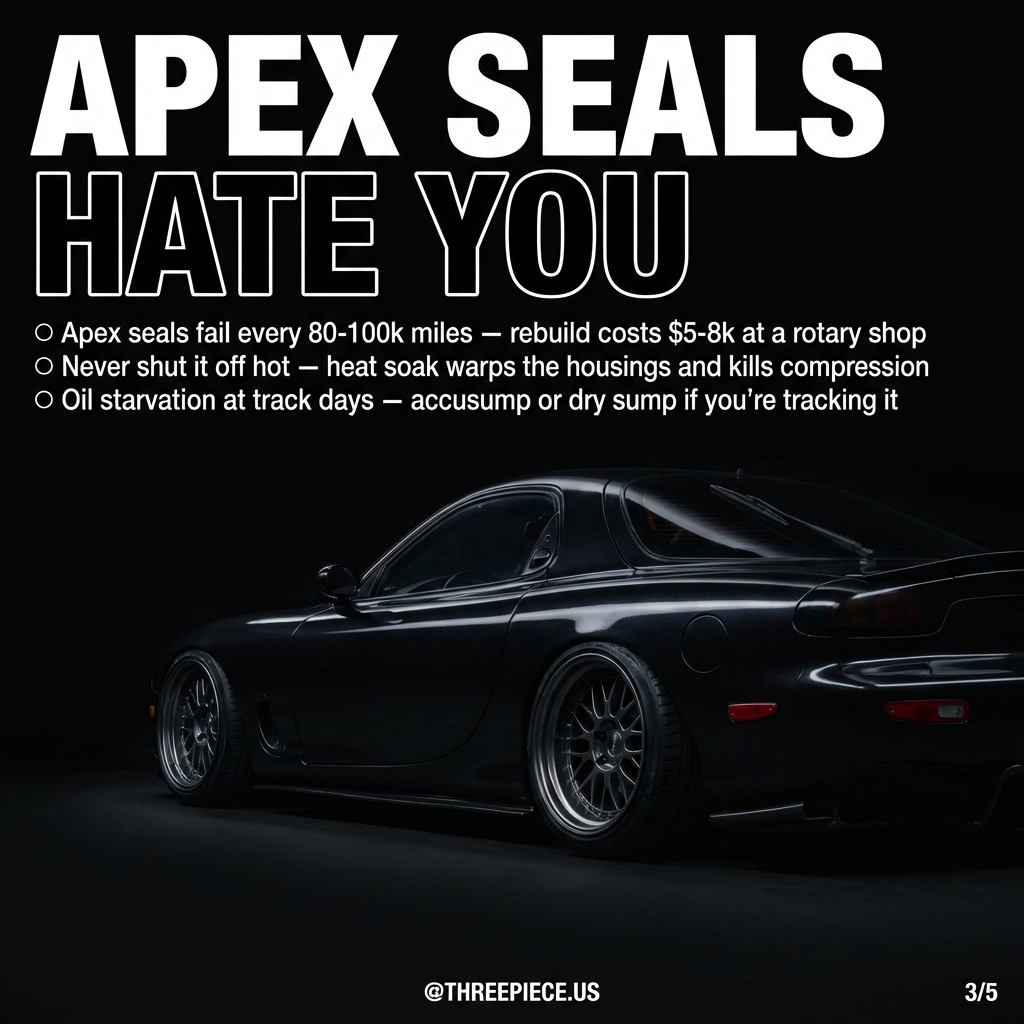
Heat soak kills rotaries faster than anything else. Never shut off a hot 13B — heat soak warps the housings and destroys compression. Oil starvation at track days is another killer. If you're tracking an FD, budget for an accusump or dry sump system immediately.
The rotary burns oil by design, consuming roughly 1 quart every 1000 miles. This isn't a problem — it's normal operation. What kills engines is owners who don't understand rotary-specific maintenance. Regular shops won't touch rotary rebuilds, and the few specialists charge premium rates.
Performance upgrades for FDs require rotary expertise. The ACT XT/Perf Street Sprung Clutch Kit at $642 handles single turbo power reliably. For exhaust, the Revel Medallion Touring-S Catback at $662 preserves the rotary's unique sound while adding flow.
True Ownership Costs: $3K Annual Reality
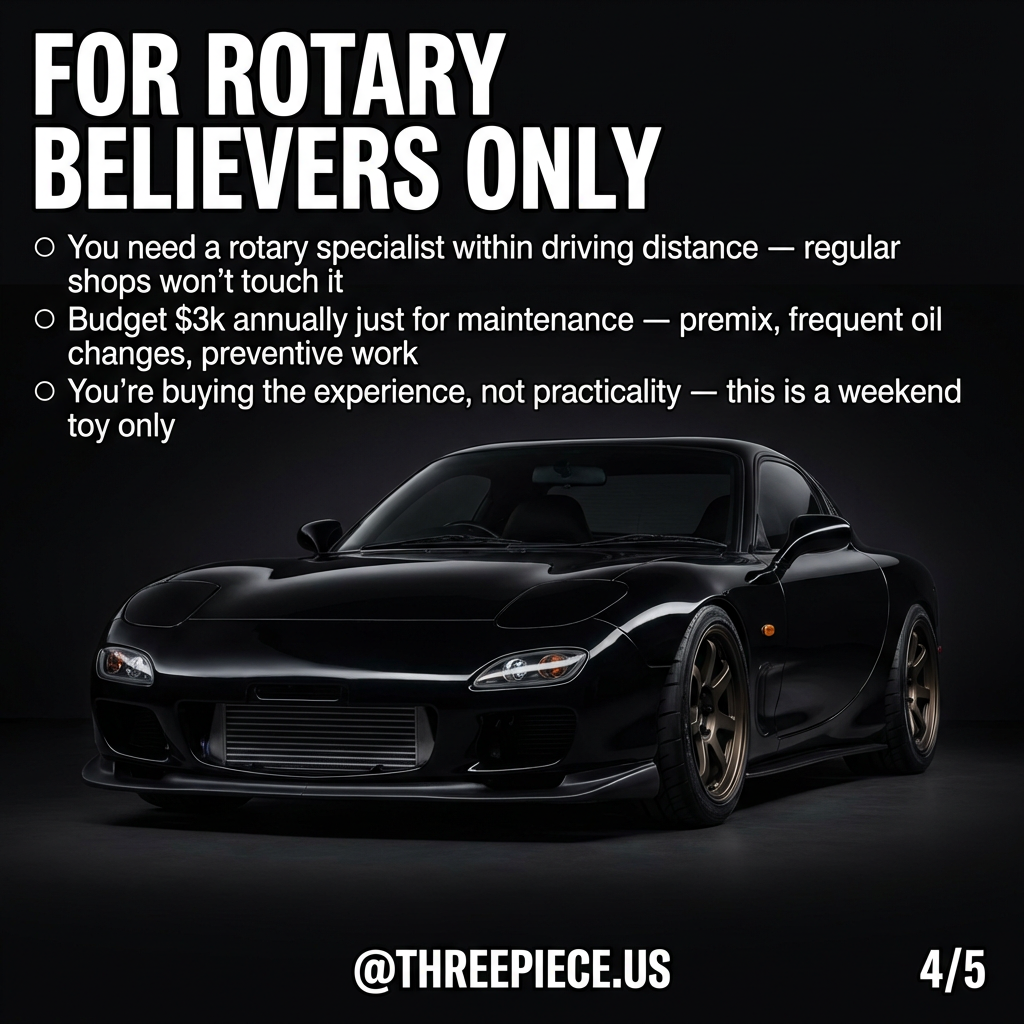
Budget $3000 annually just for maintenance on a driven FD. This includes frequent oil changes, premix (two-stroke oil added to fuel), spark plugs every 15k miles, and preventive work. You need a rotary specialist within driving distance — this isn't a car for areas without rotary support.
Brake maintenance runs higher than typical sports cars due to the FD's track-focused design. StopTech PowerSlot front rotors start at $177 each, with rear rotors at $139 each. The FD's Brembo-sourced brakes are excellent but expensive to maintain.
You're buying the experience, not practicality. This is a weekend toy only — the rotary's quirks make daily driving frustrating. Flooding issues, cold-start problems, and fuel consumption averaging 12-15mpg combined make the FD unsuitable for commuting.
Insurance costs reflect the FD's collectible status and crash history. Clean examples now command $35-50k, with pristine low-mileage cars breaking $60k. The appreciation curve mirrors the Acura TL Type-S trajectory — undervalued for years, now rapidly appreciating.
Pre-Purchase Inspection: Compression Test Everything
Hot compression testing is non-negotiable on any FD purchase. All six chambers should read above 6.5kg/cm² — anything below means rebuild time. Cold compression tests are worthless on rotaries; the engine must be at operating temperature.
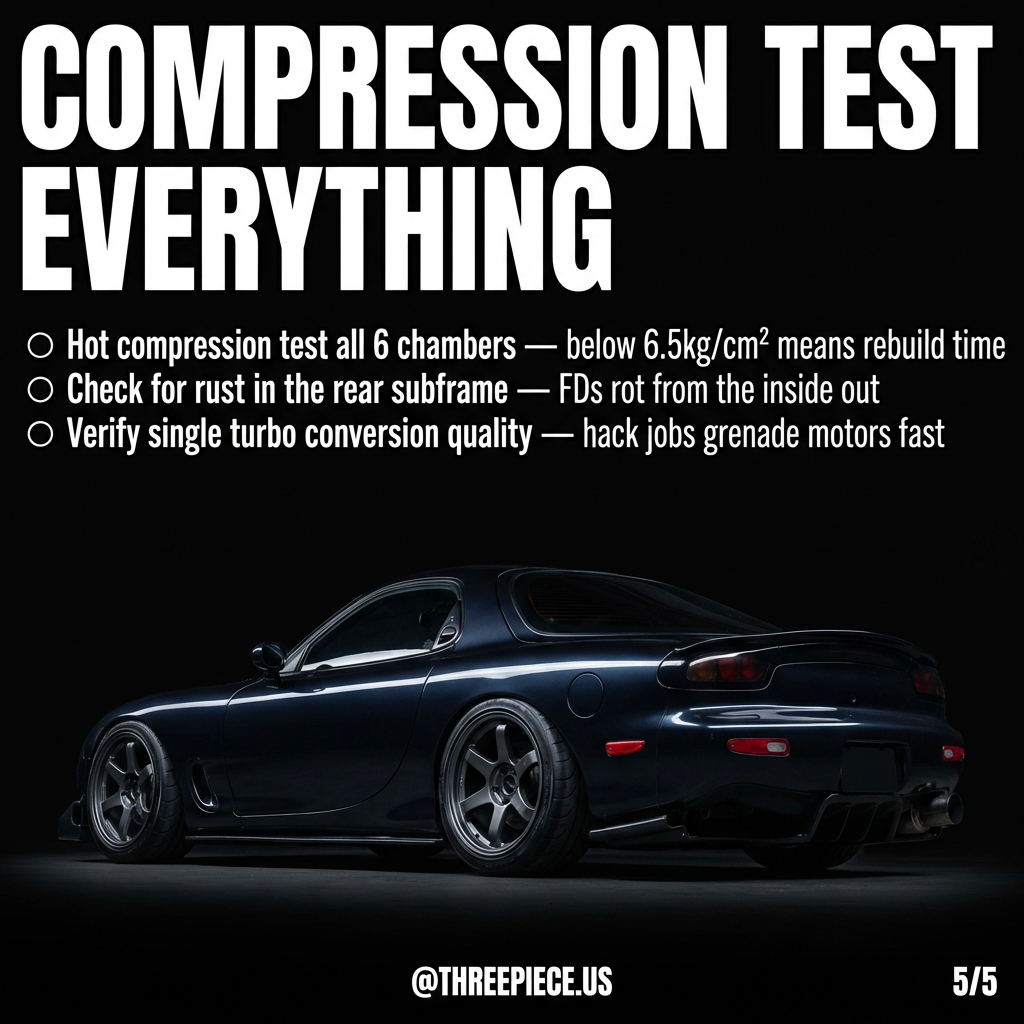
Check for rust in the rear subframe — FDs rot from the inside out. The rear suspension pickup points are particularly vulnerable. Surface rust is manageable, but structural rust means walking away.
Verify single turbo conversion quality if the car has been modified. Hack jobs grenade motors fast. Look for proper tuning, quality components, and documentation. A well-executed single turbo FD is worth the premium over a sketchy twin-turbo delete.
Examine the cooling system thoroughly. The FD's complex cooling setup includes multiple thermostats and bypass circuits. Overheating kills rotaries faster than anything else. Budget for a full cooling system refresh on any high-mileage example.
Documentation matters more on FDs than most cars. Maintenance records, compression test history, and modification details separate good cars from projects. The rotary community is small — reputation follows cars through multiple owners.
Should You Buy One? For Rotary Believers Only
The FD RX-7 rewards commitment and punishes casual ownership. If you understand rotary maintenance, have access to specialists, and can budget $3k annually for upkeep, the FD delivers an experience no piston car can match. The sound, the balance, the way it builds power to 8000rpm — it's genuinely addictive.
But this isn't a car for everyone. The rotary engine's quirks, maintenance requirements, and rebuild intervals make it unsuitable for casual enthusiasts. You're not buying transportation — you're joining a cult that worships apex seals and premix ratios.
Clean FDs are appreciating assets now, but only if properly maintained. A neglected FD becomes a $15k rebuild project quickly. If you're not prepared for rotary life, consider alternatives like the Nissan 350Z or BMW E36 M3 that offer similar performance without rotary complexity.
Ready to join the rotary cult? Start with our vehicle gallery for FD inspiration, then browse Work Wheels for the perfect fitment. The FD deserves nothing less than authentic Japanese wheels — check out our Work center caps to complete the look.