
Posted by THREEPIECE.US on Mar 3rd 2026
K20C1 VTEC + VTC Tuning: Why FK8 Type R Bolt-Ons Need Custom Maps
The FK8 Type R's K20C1 is the most misunderstood turbo Honda engine when it comes to modifications. Everyone thinks more boost equals more power, but Honda's VTEC + VTC system creates timing conflicts that fight against traditional bolt-on approaches. The result? Tons of FK8s making less power than they should, leaving owners frustrated with underwhelming dyno numbers despite expensive parts.

Quick links
- VTEC Fights Boost Pressure
- How VTEC + VTC Works Together
- Why Bolt-Ons Struggle
- Common Tuning Mistakes
- The Right Sequential Approach
VTEC Fights Boost Pressure
Unlike naturally aspirated Honda engines where VTEC activation creates a linear power increase, the turbocharged K20C1 in the FK8 Type R experiences timing conflicts when VTEC engages under boost. The aggressive cam profile change disrupts the carefully calibrated boost pressure curve, creating inconsistent power delivery that confuses both the ECU and drivers.

This is fundamentally different from older Honda turbo builds where enthusiasts could simply add boost and see linear gains. The FK8's factory tune is specifically calibrated around the VTEC + VTC interaction — change one variable without accounting for the other, and you're leaving power on the table. Many FK8 owners discover this the hard way after installing a basic tune that ignores cam timing optimization.
If you're planning modifications, start by understanding your baseline. Check out our FK8 vs FK7 build comparison to see how the Type R's complexity affects modification approaches compared to the simpler Si platform.
How VTEC + VTC Works Together
VTC (Variable Timing Control) advances intake cam timing under load, which directly affects when VTEC switches over to the aggressive cam profile. This creates a moving target — VTEC activation isn't at a fixed RPM like older Honda engines. Instead, it varies based on VTC position, load, and boost pressure.
The ECU can't predict optimal timing with basic bolt-ons because the airflow characteristics change while VTC timing remains stock. This mismatch creates a scenario where the engine is breathing differently than the cam timing expects, resulting in suboptimal power delivery and potential knock under boost.
Understanding this interaction is crucial for any serious FK8 build. The 10th gen Civic platform shares some characteristics, but the Type R's forced induction adds complexity that requires specialized tuning knowledge.
Why Bolt-Ons Struggle
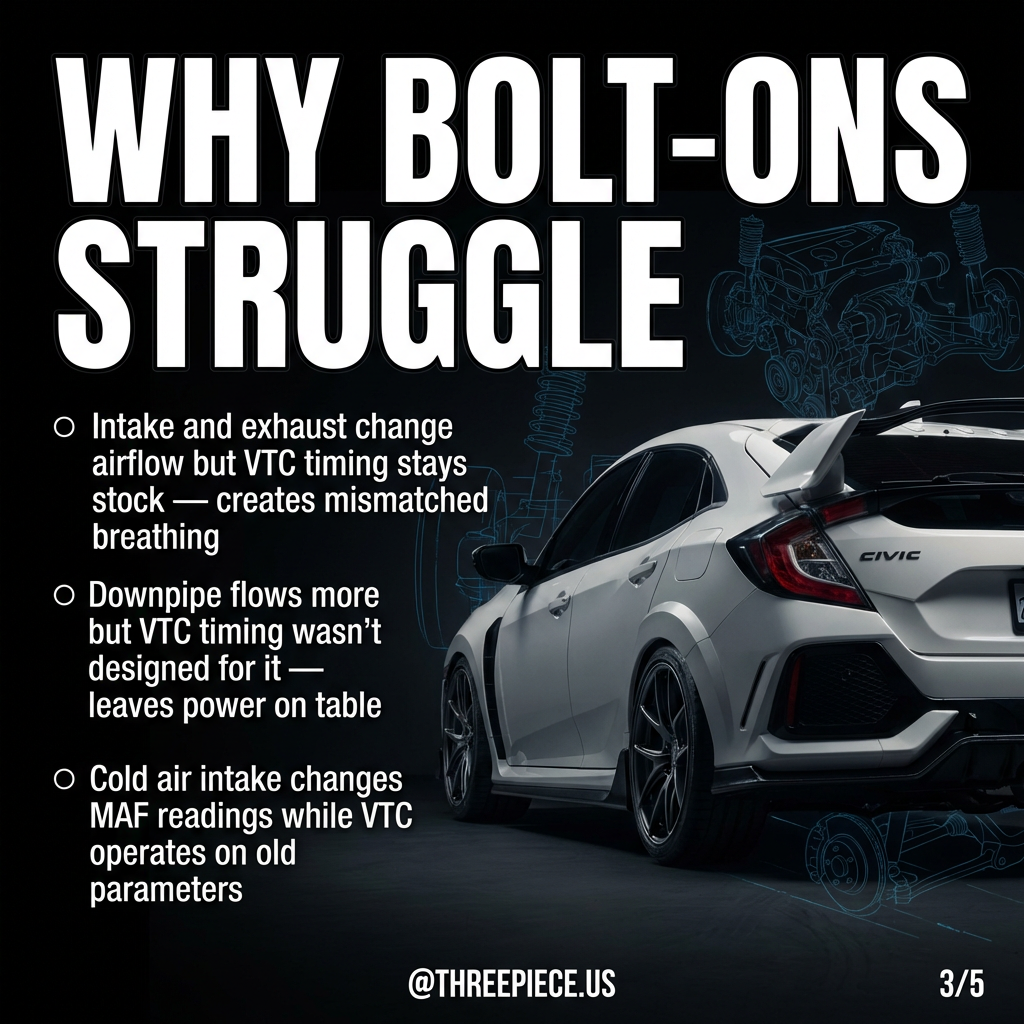
Traditional bolt-on modifications like intakes and exhausts change airflow characteristics, but VTC timing stays locked to stock parameters. This creates mismatched breathing where the engine flows more air than the cam timing was designed for, leaving significant power unrealized.

A cold air intake changes MAF readings while VTC operates on old parameters designed for the restrictive stock airbox. For FK8 builds, consider the AEM cold air intake systems starting at $435 — but remember that any intake modification requires VTC recalibration to realize the full benefit.
Similarly, a downpipe flows significantly more exhaust than the stock restrictive piece, but VTC timing wasn't designed for this increased flow. The result is a timing mismatch that can actually hurt mid-range torque despite the improved exhaust flow. This is why many FK8 owners see disappointing dyno results after bolt-on installations without proper tuning.
The key difference between FK8 tuning and older Honda platforms is the interconnected nature of the systems. Unlike the straightforward approach covered in our Toyota 2GR-FE VVT-i guide, the K20C1 requires simultaneous VTEC and VTC optimization.
Common Tuning Mistakes
The biggest mistake is running Hondata FlashPro without VTC tables properly dialed in. Many tuners focus only on fuel and ignition maps while leaving VTC timing stock, essentially tuning only half the equation. This approach works on naturally aspirated Honda engines but fails spectacularly on the turbocharged K20C1.

Another common error is advancing base timing without adjusting VTC maps, which creates knock under boost conditions. The K20C1's knock sensors are sensitive, and improper timing coordination between VTEC and VTC triggers protective measures that kill power output.
Installing bolt-on parts without considering cam timing overlap destroys mid-range torque — the FK8's strongest performance characteristic. This is particularly problematic because many owners expect linear power gains similar to other turbocharged platforms, but the K20C1's variable cam timing creates a completely different tuning requirement.
For comparison, the direct injection issues covered in our FA20DIT carbon buildup guide are straightforward mechanical problems, while FK8 tuning challenges are entirely software-based timing coordination issues.
The Right Sequential Approach
Ktuner or Hondata with VTC control is mandatory for proper FK8 tuning. Both platforms allow cam timing adjustment alongside traditional fuel and ignition maps, enabling the coordinated approach the K20C1 requires. Expect to pay $600-800 for the hardware plus professional tuning.
Start with intake modifications and tune before adding exhaust components. This sequential approach allows VTC timing to adapt to each airflow change rather than trying to compensate for multiple modifications simultaneously. The aFe Takeda exhaust systems at $1,540 work well for FK8 builds, but only after intake and VTC tuning is optimized.
Most importantly, find a tuner who understands both VTEC and VTC systems. Many shops excel at one or the other but lack experience coordinating both systems under boost conditions. This specialized knowledge is what separates successful FK8 builds from disappointing ones.
The FK8's complexity makes it more challenging than other hot hatches covered in our Veloster N buying guide, but the reward is a uniquely responsive turbocharged Honda that maintains the brand's legendary high-rev character while delivering modern forced induction torque.
For wheel and tire upgrades that complement your tuned FK8, browse our vehicle gallery for inspiration, or check out our FK8 tire recommendations to maximize your newfound power.