
Posted by THREEPIECE.US on Mar 11th 2026
K20 vs SR20DET S13 Swap: Daily Drift Build Reality Check
The K20 vs SR20DET debate in S13 240SX builds isn't about peak power—both engines hit 300hp reliably. It's about choosing your pain points: Honda reliability with custom everything, or Nissan OEM support with turbo headaches. After watching countless builds and talking to owners who daily their drift cars, the choice comes down to budget versus long-term usability.
Quick links
- Same Power, Different Problems
- K20 Swap Reality: $8K Before the Engine
- SR20DET Strengths: Bolt-In Boost
- Daily Driving Reality Check
- The Verdict: Pick Your Priority
Same Power, Different Problems
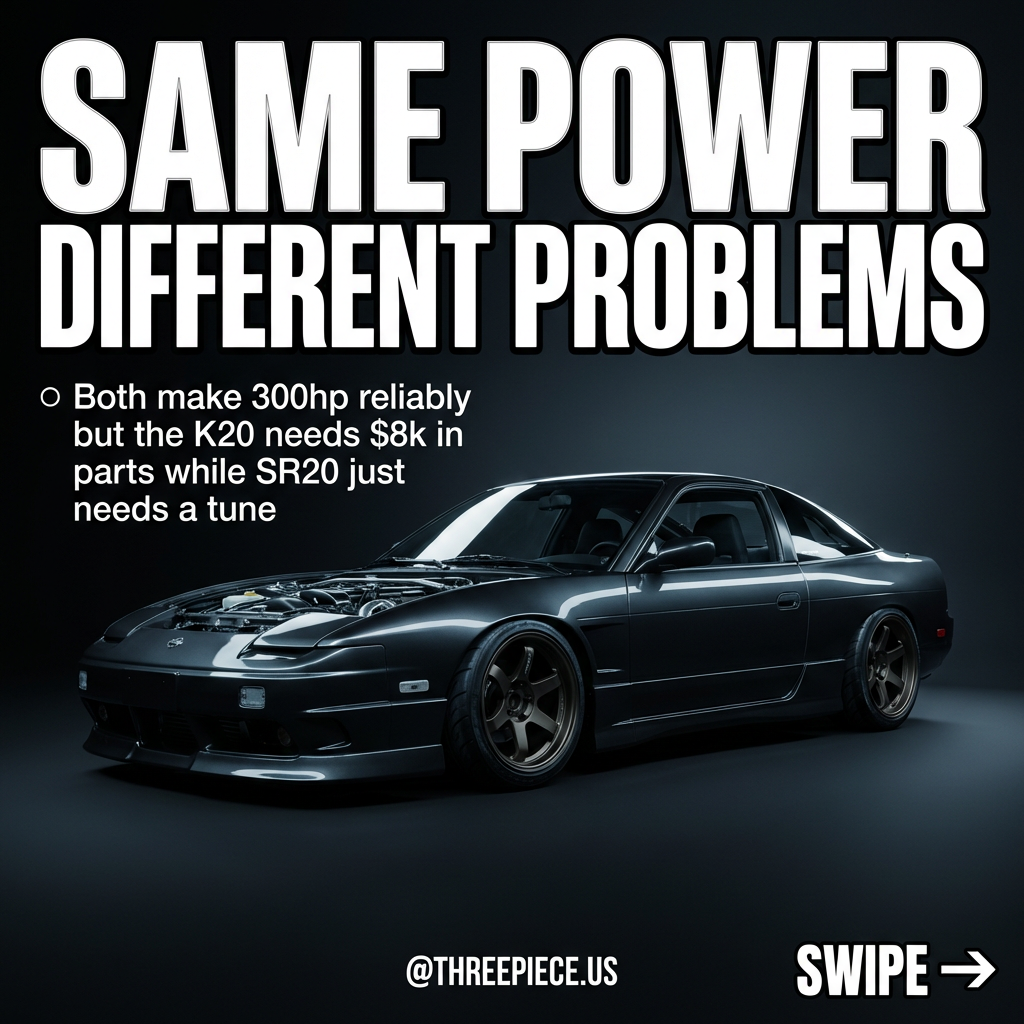
Both the K20 and SR20DET make 300hp reliably, but they get there through completely different philosophies. The K20 needs $8,000 in supporting modifications before you even buy the engine, while the SR20DET just needs a tune and basic bolt-ons for $1,500 total. This fundamental cost difference shapes everything else about these swaps.
The SR20DET's advantage lies in its factory turbo setup—it was designed for boost from day one. Meanwhile, the K20 relies on naturally aspirated precision, requiring custom fabrication for nearly every component. If you're building on a tight budget, this difference alone might make your decision. Check out our breakdown of K-series donor cars under $8K to understand your engine options.
K20 Swap Reality: $8K Before the Engine
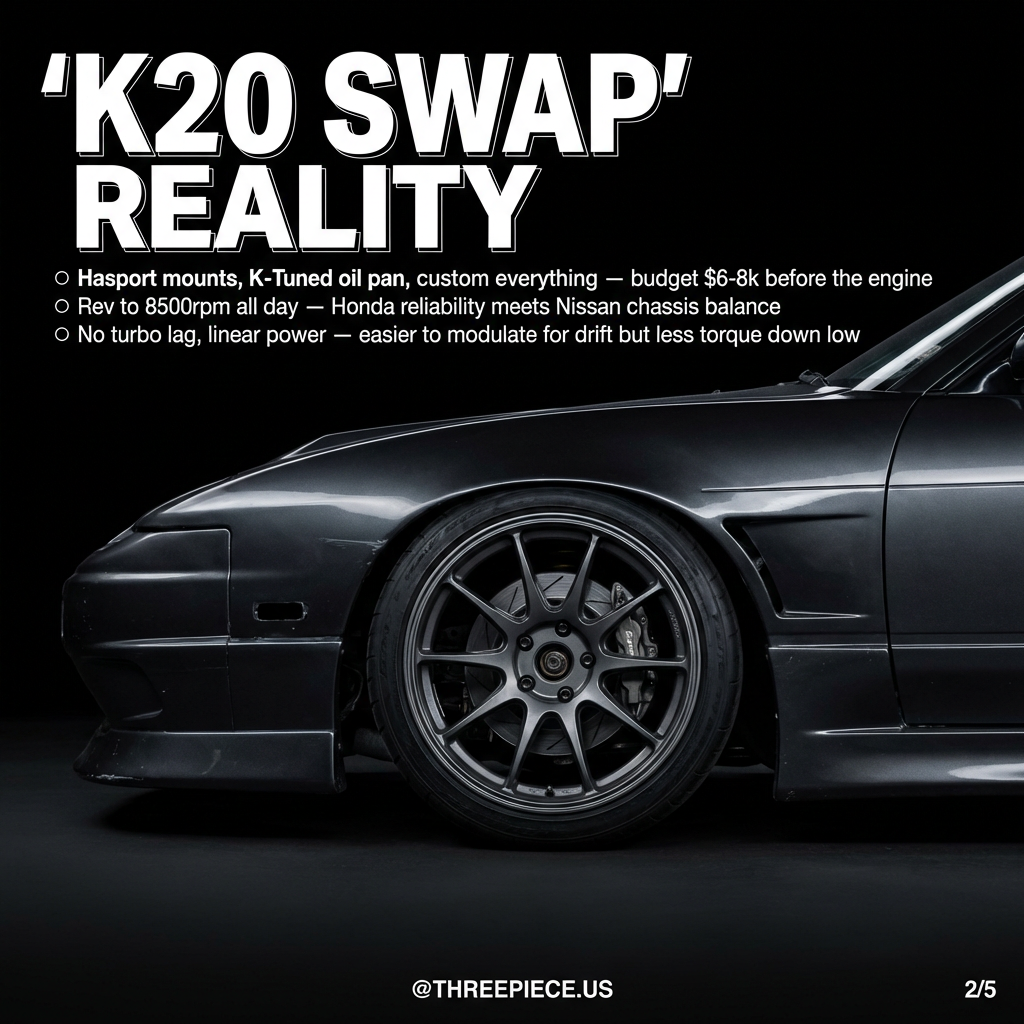
The K20 swap requires Hasport mounts, K-Tuned oil pan, custom wiring, and fabricated everything. Budget $6,000-$8,000 before you even source the engine. But once it's done, you get an engine that revs to 8,500rpm all day with Honda reliability meeting Nissan chassis balance.
The K20's linear power delivery eliminates turbo lag completely, making it easier to modulate for drift initiation but providing less low-end torque for wall rides. This naturally aspirated character changes how the car behaves in transitions—smoother but requiring more commitment to maintain angle. For wheel fitment on your drift build, browse 17-inch wheels in 4x114.3 for that authentic S13 look.
The fabrication reality means finding a shop that understands both Honda drivetrains and Nissan chassis dynamics. Most shops excel at one or the other, not both. Factor in 20-40 hours of custom work beyond basic installation. Our guide to why V8 swaps kill S-chassis balance explains why the K20's weight distribution actually improves handling.
SR20DET Strengths: Bolt-In Boost
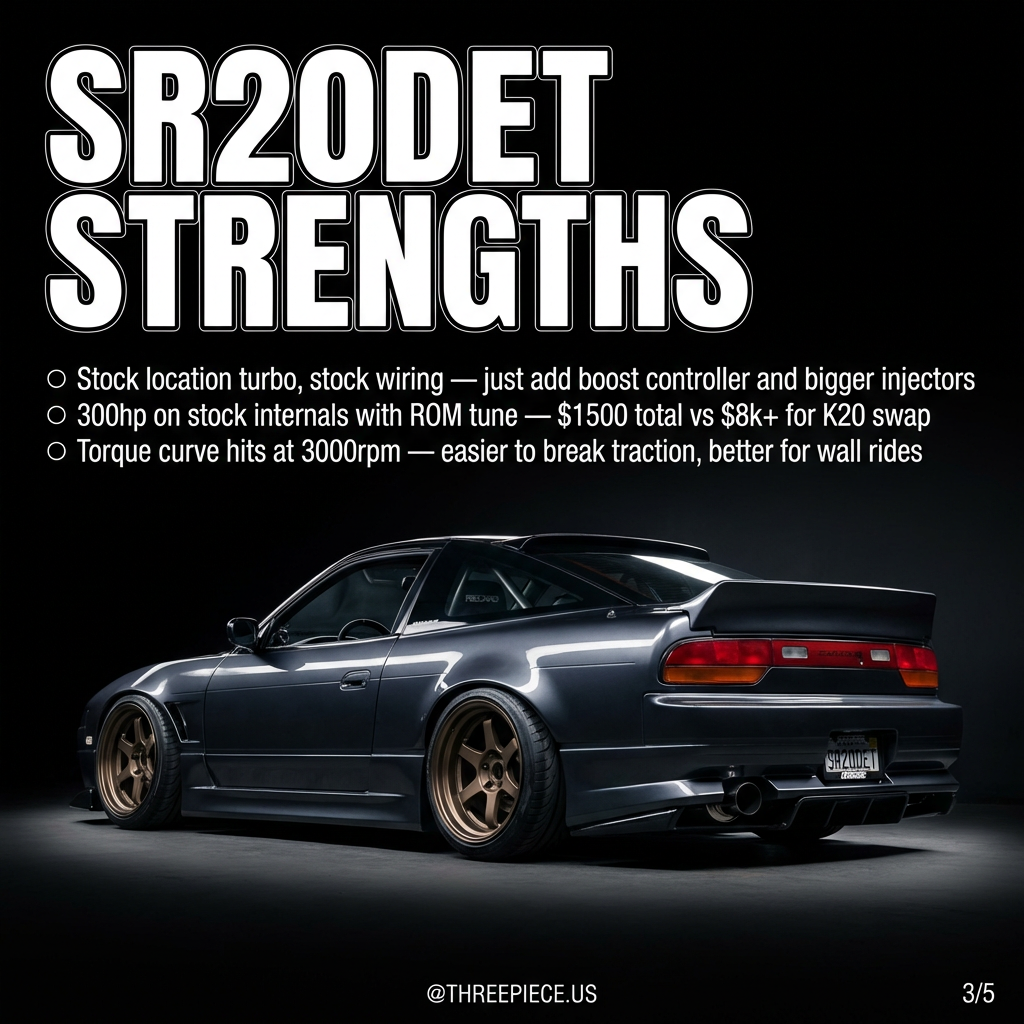
The SR20DET keeps the stock turbo location, stock wiring, and factory engineering. Add a boost controller, bigger injectors, and a ROM tune for $1,500 total versus the K20's $8,000+ requirement. The torque curve hits at 3,000rpm, making it easier to break traction and better for sustained wall rides.

This low-end torque advantage transforms drift technique. Where the K20 requires precise throttle control and momentum management, the SR20DET lets you power through mistakes with boost. The turbo's on-off power delivery actually helps with quick transitions, even if it's less refined than naturally aspirated response.
Parts availability favors the SR20DET for basic maintenance—oil filters, gaskets, and wear items are still available through Nissan. Performance parts ship from Japan but the aftermarket support runs deep. Companies like JWT, Garrett, and Tomei have decades of SR20 development. For suspension to match your engine choice, check our coilover spring rates guide for street versus drift setups.
Daily Driving Reality Check
Daily driving reveals the biggest differences between these swaps. The K20 gets 28mpg highway while the SR20DET struggles to hit 22mpg with any real tune. Honda parts are available at AutoZone, while SR20DET components ship from Japan or require custom machining.

The K20 idles smooth and handles traffic without turbo heat soak issues. The SR20DET runs rich and hot in stop-and-go conditions, requiring constant attention to cooling system maintenance. This isn't just comfort—it's reliability in real-world conditions where most builds fail.
Insurance companies understand Honda engines better than JDM turbo swaps. The K20 swap often qualifies for agreed-value policies, while SR20DET swaps trigger exotic modification clauses. Resale value follows the same pattern—K20 swaps hold value better because buyers understand the reliability story. Consider quality valve stems starting at $3.80 for any wheel setup on your build.
Maintenance intervals differ dramatically. The K20 follows Honda's 7,500-mile oil change schedule even under drift abuse, while turbocharged SR20DETs need 3,000-mile intervals to prevent bearing failure. Over five years of ownership, this maintenance difference adds up to thousands in costs and dozens of hours in downtime.
The Verdict: Pick Your Priority
Keep the SR20DET if you're broke—it's genuinely the better drift motor for less money. The turbo torque, parts availability, and lower entry cost make it the logical choice for budget builds focused purely on sideways action. K20 swap if daily driving matters—reliability and fuel economy win long term for cars that see street duty.
Both engines work, but they serve different priorities. The SR20DET drifts better with more torque and easier power delivery. The K20 commutes better with Honda reliability and naturally aspirated smoothness. Choose based on how you actually plan to use the car, not theoretical performance numbers.
For either swap, proper wheel fitment matters. Browse our Work Wheels collection for authentic JDM options that complement both engine choices. The Work Emotion series particularly suits S13 proportions. Complete your build with Work center caps starting at $50 and proper assembly hardware for safety.
The engine choice affects everything from insurance to resale value. Make it based on your actual priorities, not forum hype. Visit our vehicle gallery to see both swaps in action across different build philosophies.