
Posted by THREEPIECE.US on Feb 28th 2026
Hub-Centric Rings Save Wheel Bearings: Why Lug-Centric Kills Your Hubs
Most enthusiasts think hub-centric rings are just about eliminating vibration, but they're actually preventing thousands in wheel bearing damage. When you mount wheels lug-centric — without proper centering rings — your wheel studs become the primary centering mechanism, creating uneven load distribution that destroys bearings 50% faster than properly centered wheels.

Quick links
- How Hub-Centric Actually Works
- Why Lug-Centric Kills Bearings
- The $800 vs $20 Reality
- Installation Mistakes That Kill Fitment
- Measuring and Installing Correctly
How Hub-Centric Actually Works
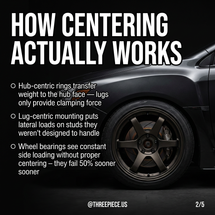
Hub-centric mounting transfers the vehicle's weight directly to the hub face through machined contact surfaces. The wheel studs only provide clamping force to secure the wheel — they're not designed to handle lateral loads or centering duties. When properly centered, the wheel bore sits flush against the hub pilot, creating even load distribution across the entire mounting surface.

Lug-centric mounting forces the wheel studs to handle both clamping and centering forces. This creates point loads on studs that were engineered only for axial tension, not lateral stress. The result is uneven contact between wheel and hub, leading to micro-movements that compound into serious bearing wear.
For proper wheel assembly, browse our selection of assembly bolts designed for 3-piece wheel construction. Quality hardware matters when centering is critical.
Why Lug-Centric Kills Bearings
Wheel bearings are precision components designed to handle radial loads with minimal side loading. Without proper centering, even 0.1mm of runout creates harmonic vibrations that translate into constant lateral forces on the bearing assembly. This side loading causes the bearing races to wear unevenly, leading to premature failure.

The physics are simple: when a wheel isn't perfectly centered, it creates an eccentric load that changes direction with every revolution. At highway speeds, this means your bearings are fighting thousands of load reversals per minute instead of the steady radial load they're designed for.
This is why proper alignment matters more than tire width — even perfect alignment can't save bearings from improper wheel centering. The bearing damage compounds over time, starting with increased noise and progressing to complete failure.
The $800 vs $20 Reality
Wheel bearings cost $300-800 each depending on your platform, while quality hub-centric rings cost around $20 for a set. On performance cars with expensive hub assemblies — think BMW, Audi, or any car with integrated ABS sensors — bearing replacement often requires special tools and dealer-level diagnostics.
The math is brutal: replacing one front wheel bearing on a modern performance car often costs more than buying rings for your entire wheel set. Factor in labor costs for bearing replacement (typically 2-4 hours per corner) and you're looking at a $1000+ repair that could have been prevented with a $20 part.
For wheel accessories that actually matter, check out our wheel parts section. Quality components prevent expensive failures down the road.
Installation Mistakes That Kill Fitment
The biggest mistake is using universal plastic rings instead of machined aluminum rings sized for your exact hub diameter. Plastic rings compress under load, creating the same centering issues they're supposed to solve. Quality rings from brands like Spigot Pro or H&R are machined to proper tolerances — eBay rings aren't.

Another common error is installing rings on the wheel instead of the hub. Rings should sit on the car's hub pilot first, then the wheel slides over them. This ensures proper seating and prevents the rings from falling out during wheel removal.
Most aftermarket wheels use a 73.1mm center bore to fit the widest range of vehicles, but your hub might be 67.1mm (Honda/Acura), 66.1mm (Toyota/Lexus), or 72.6mm (BMW). Assuming your car matches the wheel bore is a recipe for vibration and bearing damage.
For proper wheel installation, consider upgrading to quality 90-degree valve stems at $3.80 each — they make tire pressure checks easier on deep-dish wheels. Small details matter in a proper setup.
Measuring and Installing Correctly
Measure your hub diameter with calipers — don't guess based on make and model. Hub sizes can vary between years and trim levels, especially on cars with different brake packages. The measurement should be taken from the hub pilot, not the lug pattern circle.
Quality rings fit snug with no play but shouldn't require force to install. If you're hammering rings onto the hub, they're too small. If they slide around loosely, they're too large. The fit should be precise enough that the ring stays in place when you remove the wheel.
Install rings on the hub first, then mount the wheel. The wheel should slide over the rings smoothly without binding. If you feel resistance, stop and check your measurements — forcing a wheel onto incorrect rings can damage both the wheel and hub.
For complete wheel setups, browse our Work Wheels collection. Work wheels are hub-centric from the factory when ordered for specific applications, eliminating guesswork.
Save Your Bearings, Use Proper Rings
Hub-centric rings aren't an optional upgrade — they're mandatory for any aftermarket wheel installation. The $20 investment in quality rings prevents thousands in bearing replacement costs and eliminates the vibration that ruins highway driving.
Don't cheap out on universal plastic rings or skip them entirely. Your wheel bearings will thank you, and your wallet will too. For complete wheel setups with proper centering, check our hub-centric rings selection and match them to your exact hub diameter.