
Posted by THREEPIECE.US on Feb 28th 2026
Flow-Formed vs Forged Wheels: Why Most Street Cars Don't Need $4K Wheels
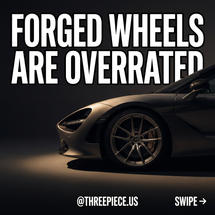
Flow-formed wheels deliver 90% of forged performance at 40% of the cost — yet most enthusiasts still chase the forged hype. Unless you're pushing 600+ horsepower or tracking weekly, you're paying premium prices for bragging rights that don't translate to street performance.

Quick links
- The Forged Marketing Machine
- Street Driving Reality Check
- Why Flow-Formed Dominates
- When Forged Actually Matters
- Smart Money Allocation
The Forged Marketing Machine
The forged wheel industry runs on three selling points: ultimate weight savings, unbreakable strength, and prestige factor. BBS, HRE, and Volk command serious street cred in the scene — but most buyers never use the capabilities they're paying for.

True forged wheels start around $2,500 per set and climb to $6,000+ for premium brands. The manufacturing process involves heating aluminum billets to 900°F and pressing them under 10,000 tons of pressure. This creates the strongest possible grain structure — but it's overkill for most applications.
What most buyers don't realize: many "forged" wheels under $1,500 are actually flow-formed with marketing spin. Check out our manufacturing differences breakdown to understand what you're actually buying.
Street Driving Reality Check
Your 400hp daily driver doesn't generate the forces that justify $4,000 wheels. Flow-formed construction handles the power fine, and the weight difference is 2-3 pounds per wheel — imperceptible on the street.

Most enthusiasts can't feel a 10-pound total weight reduction in daily driving. The difference becomes noticeable only during hard acceleration, braking, and cornering — scenarios that happen maybe 5% of your driving time. For the other 95%, you're paying premium prices for no tangible benefit.
Consider the F2 Function & Form Genesis Coupe coilovers — they'll transform your car's handling far more than wheel weight savings ever could. The same budget gets you adjustable damping, proper spring rates, and corner balance that actually matters.
Flow-formed wheels use similar manufacturing principles to lower-end "forged" options. The barrel gets spun under pressure while heated, stretching the aluminum and aligning the grain structure. It's not full forging, but it's far superior to casting — and 60% cheaper than true forged options.
Why Flow-Formed Dominates
The Enkei RPF1 and Konig Hypergram prove flow-formed strength at $200-300 per wheel. These wheels survive 1000+ horsepower builds, track abuse, and pothole encounters that would crack cast wheels.
Flow-formed construction creates 30% stronger barrels than casting while maintaining 80% of forged strength. The manufacturing process spins the wheel under pressure, work-hardening the aluminum and creating directional grain flow. It's the same principle used in "entry-level" forged wheels that cost $800+ per corner.
Smart builders choose flow-formed and spend the $2,000+ savings on modifications that actually improve performance. That budget covers quality coilovers, bigger brakes, or forced induction upgrades that transform how your car drives. Browse our Work Wheels collection to see flow-formed options that handle serious power.
The Work VS reproduction center caps at $50 show how even premium brands offer affordable options. You get the look without the premium pricing — perfect for builds focused on performance over prestige.
When Forged Actually Matters
600+ horsepower builds with sticky tires generate forces that justify forged construction. Drag radials, 315-section rear tires, and 4,000-pound launches create stress levels where forged strength matters.
Dedicated track cars benefit from every pound of unsprung weight reduction. When you're chasing tenth-second lap improvements, 8-10 pounds of rotating mass actually matters. The reduced gyroscopic effect helps the suspension work more effectively through direction changes.
Show builds with unlimited budgets can justify forged wheels for the prestige factor. When your build budget exceeds $50,000, wheel choice becomes about completing the aesthetic rather than maximizing performance per dollar.
But for 95% of enthusiast builds, flow-formed delivers the performance without the premium. The RPF1 vs Hypergram comparison shows how even within flow-formed options, you can optimize for your specific needs.
Smart Money Allocation
A $2,000 wheel budget gets you quality flow-formed wheels with $1,200 left for performance modifications. That remaining budget covers the ACT Focus RS flywheel at $713 for better throttle response, or the AEM BMW 228i charge pipe kit at $416 for actual power gains.
Flow-formed wheels let you buy better tires — the modification that actually improves grip, braking, and handling. $800 in tire upgrades transforms your car more than $2,000 in wheel weight savings. Check our 300TW tire guide for street-focused rubber that maximizes your setup.
The enthusiast community increasingly recognizes flow-formed value. Forum builds showcase RPF1s on 500+ horsepower cars without failures. YouTube builders choose Konig Hypergrams for $1,200 sets and spend the savings on engine modifications that actually increase performance.
Don't fall for forged marketing unless your build genuinely needs the ultimate strength. Flow-formed wheels deliver the performance you'll actually use at prices that leave budget for modifications that matter. Visit our vehicle gallery to see real builds that prioritize smart spending over brand prestige.