
Posted by THREEPIECE.US on Mar 16th 2026
FA20 Connecting Rods: Why BRZ/FR-S Bottom End Fails at 350WHP
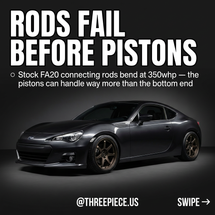
The FA20 connecting rods are made of powder metal and bend at 350whp — long before the pistons give up. Most BRZ and FR-S builds fail because owners chase power without addressing the real weak points: bottom end internals and oiling system design flaws that kill bearings under sustained load.
Quick links
- Why Stock Rods Fail First
- The Real FA20 Weak Points
- Why Oiling Matters More Than Pistons
- The Correct Upgrade Path
- Build Order That Actually Works
Why Stock Rods Fail First
Stock FA20 connecting rods are powder metal construction — a cost-cutting measure that works fine for naturally aspirated applications but becomes the limiting factor under boost. At 18+ psi, these rods start to bend and eventually snap, taking the entire bottom end with them.
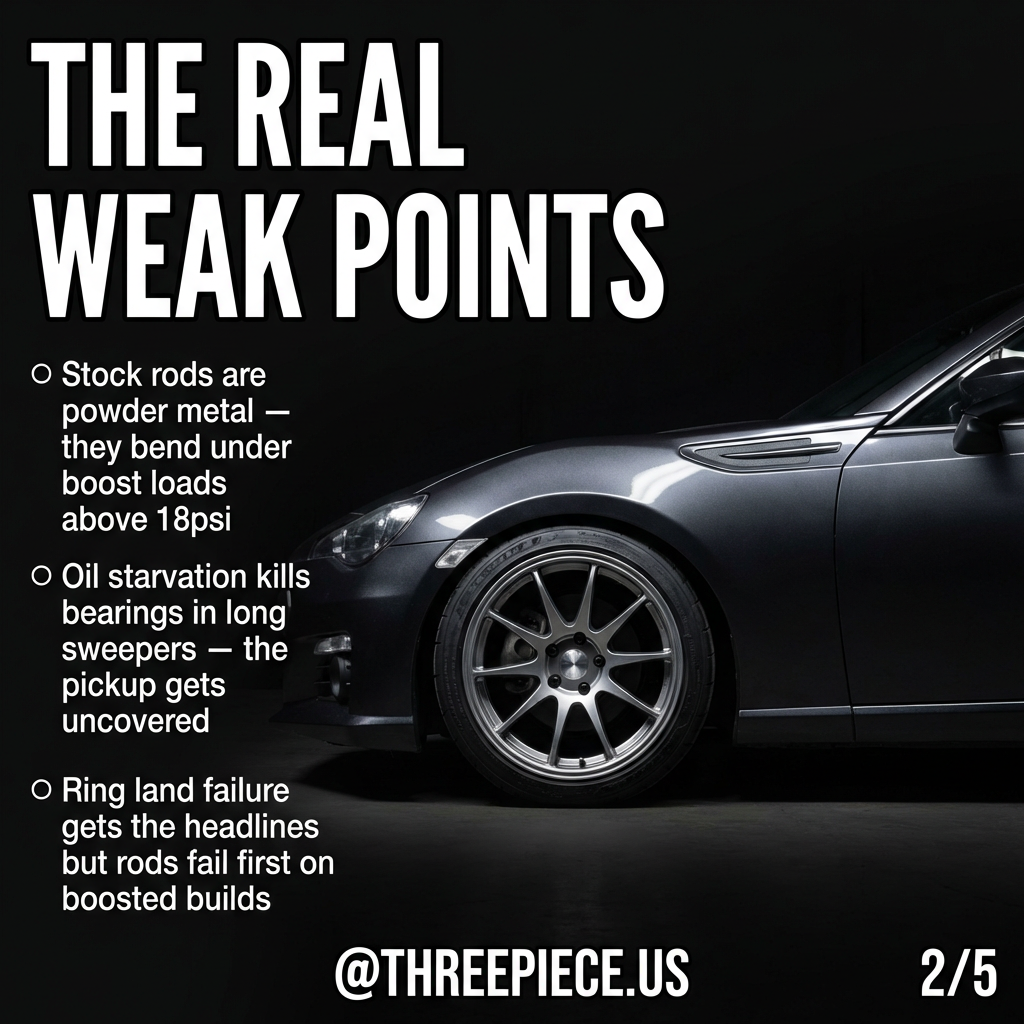
The pistons can actually handle significantly more power than the rods. While everyone obsesses over ringland failure, the connecting rods are bending and creating clearance issues that lead to bearing damage. This is why so many BRZ turbo builds grenade around the 320-350whp mark — it's not detonation, it's mechanical failure of the bottom end.
For proper wheel fitment on your build, check our BRZ FA20 buying guide for sizing recommendations that work with lowered setups.
The Real FA20 Weak Points
Ring land failure gets all the attention, but it's actually the third most common failure mode on boosted FA20 builds. The real killers are:
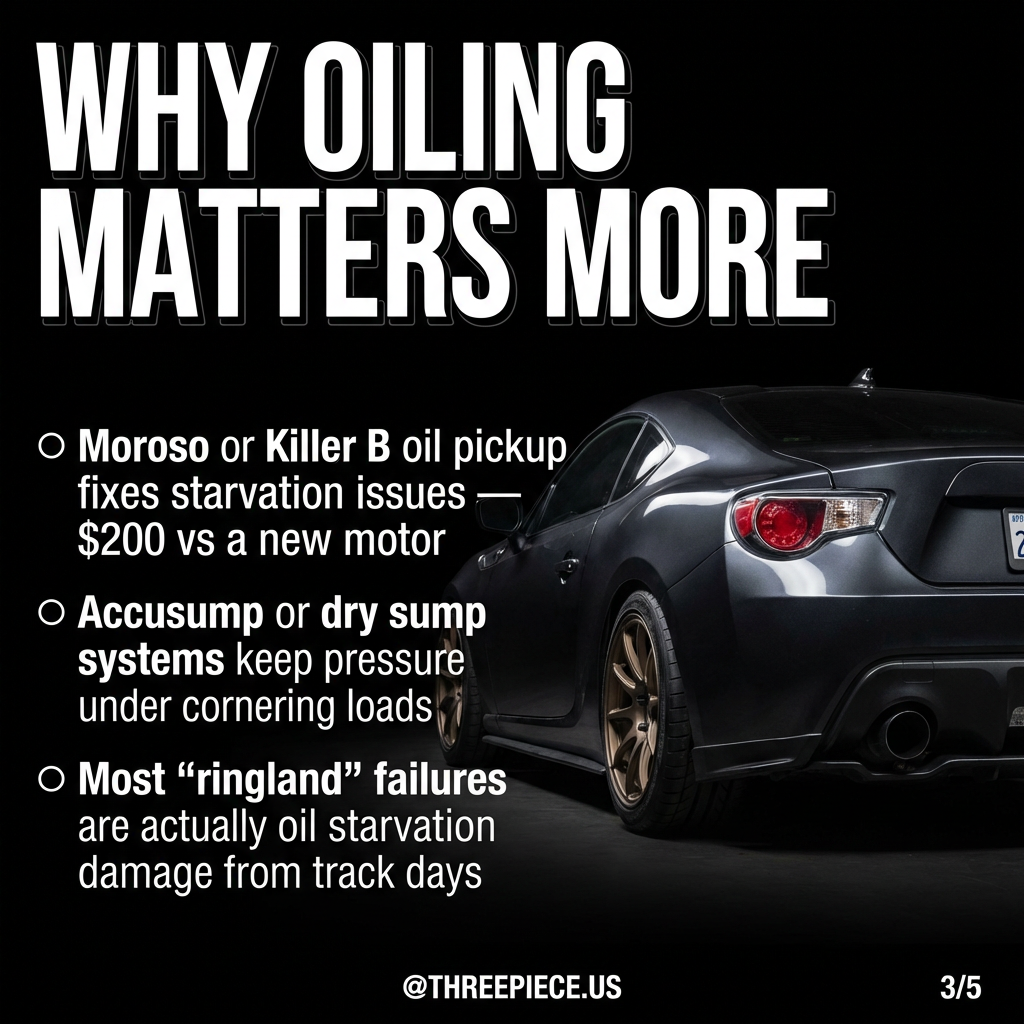
Connecting rod failure happens first. The powder metal construction can't handle the side loads from boost pressure above 18 psi. They bend, create clearance issues, and eventually snap.
Oil starvation kills more FA20s than detonation. The oil pickup gets uncovered in long sweepers, starving the bearings of lubrication. Most "ringland" failures are actually oil starvation damage that gets misdiagnosed.
The oil pump itself is undersized for high-RPM, high-load applications. It can't maintain pressure under sustained cornering loads, especially with a lowered oil level from blow-by or minor leaks.
If you're planning suspension mods alongside your engine build, read our guide on coilover spring rates to get the setup right for track use.
Why Oiling Matters More Than Pistons
A Moroso or Killer B oil pickup costs around $200 and prevents the oil starvation that kills most FA20 builds. Compare that to a $8,000 engine rebuild and the math is obvious.
Accusump systems or dry sump setups maintain oil pressure under cornering loads. Most track day failures happen in long, sustained corners where the pickup gets uncovered for more than a few seconds.
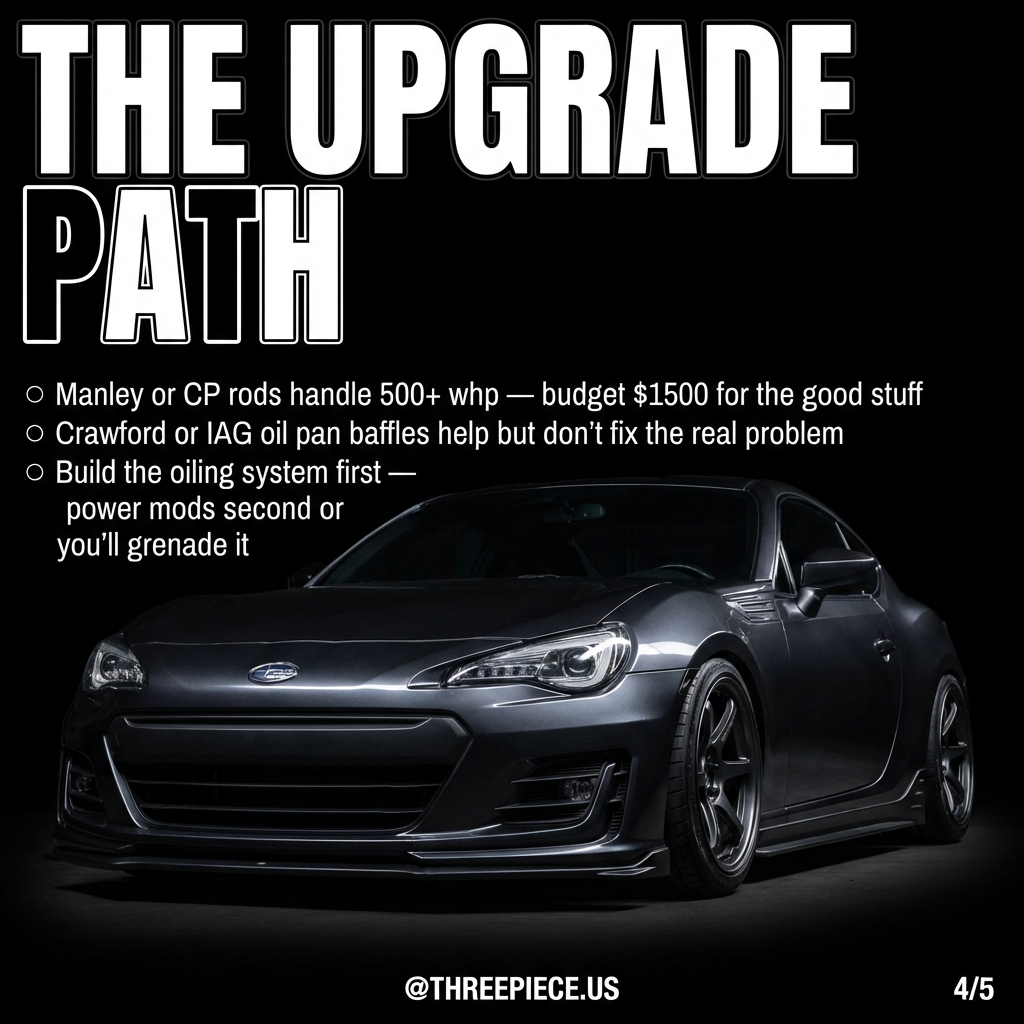
Crawford and IAG oil pan baffles help with slosh but don't address the fundamental problem: the pickup location and oil pump capacity. They're better than nothing but not a complete solution.
What most people call "ringland failure" is actually oil starvation damage. The rings lose lubrication, seize in the grooves, and then break when the piston expands. Fix the oiling and you prevent most of these failures.
For wheel setup that handles track abuse, browse our Work Emotion series — these wheels are built for the punishment that comes with serious track use.
The Correct Upgrade Path
Manley or CP connecting rods handle 500+ whp reliably. Budget around $1,500 for a quality set that will outlast everything else in the engine. Don't cheap out here — rod failure takes out the entire bottom end.
Address the oiling system first. A proper pickup, accusump, and oil cooler setup costs less than $1,000 and prevents the failures that kill stock motors. This should be the first mod on any boosted FA20 build.
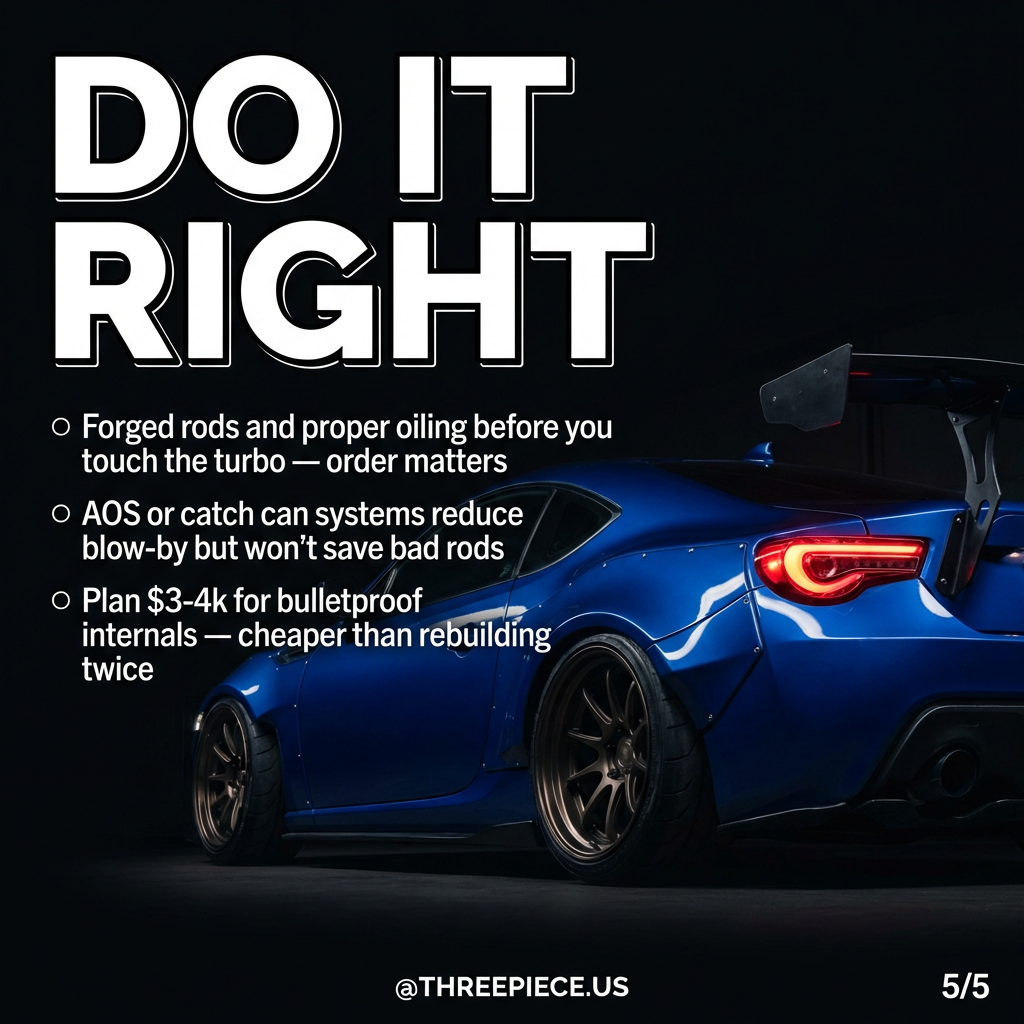
AOS (Air Oil Separator) and catch can systems reduce blow-by but won't save rods that are already bending. They're maintenance items, not power-enabling modifications.
Plan $3,000-4,000 for bulletproof internals: forged rods, proper pistons, and oiling system upgrades. It's expensive upfront but cheaper than rebuilding the engine twice.
For supporting modifications, check out our downpipe guide to understand why high-flow cats make more sense than going catless on a street-driven build.
Build Order That Actually Works
Build the oiling system first, then internals, then power modifications. Most people do this backwards and wonder why they're buying a new engine every season.
Step 1: Oil pickup, accusump, oil cooler. This prevents the failures that kill stock engines and should be done before any power modifications.
Step 2: Forged connecting rods and proper pistons. Don't boost a stock bottom end past 300whp — the rods will bend and take everything with them.
Step 3: Turbo, tuning, and supporting modifications. Only after the engine can handle the power you're planning to make.
This order matters because each step enables the next. You can't safely make 400whp without forged internals, and you can't reliably run forged internals without proper oiling.
For wheel fitment on your finished build, our vehicle gallery shows real-world setups that work with various suspension and power modifications.
The FA20 wasn't designed for boost — it was designed for efficiency. Respect those limitations and build accordingly, or plan on buying engines in bulk. Want quality wheel accessories for your build? Check out our 90 degree valve stems at $3.80 and M8x32 assembly bolts at $10 for proper 3-piece wheel maintenance.