

Posted by THREEPIECE.US on Mar 19th 2026
Coyote 5.0 vs LT1 6.2: Which V8 Wins for Single-Turbo Street Builds?
The Ford Coyote 5.0 versus Chevy LT1 6.2 debate finally has a clear winner — and it's not about peak power. Both engines handle serious boost, but when you factor in real build costs and aftermarket support, the Coyote dominates for budget-conscious builders chasing 700-900hp street setups.

Quick links
Coyote 5.0 Advantages: Factory Forged Internals Save Big
Ford's biggest advantage is the factory forged pistons in every Coyote 5.0. This means stock internals handle 25psi all day without expensive machine work. Budget builders can bolt on a turbo kit and immediately chase 800hp without touching the bottom end — a massive cost savings that GM can't match.
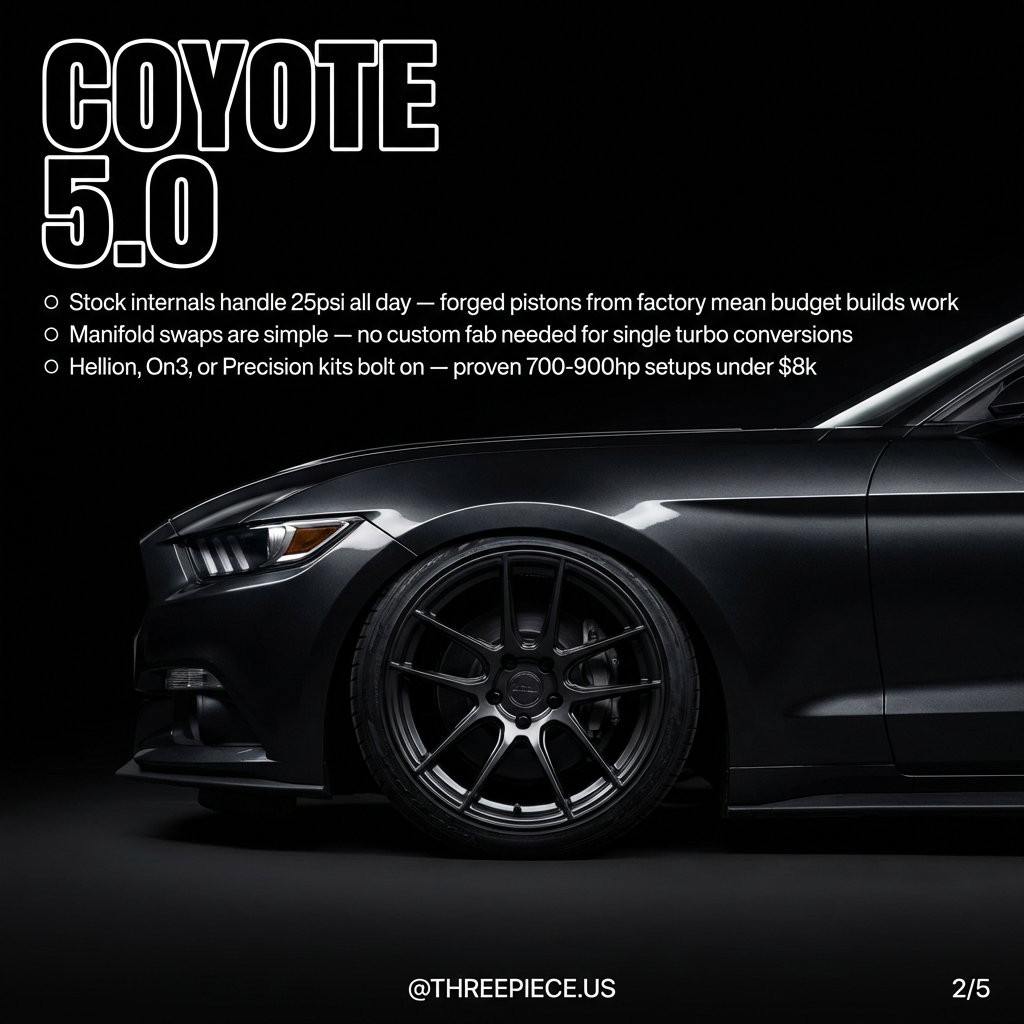
Manifold swaps are also dead simple on the Coyote platform. No custom fabrication needed for single turbo conversions. Companies like Hellion, On3, and Precision offer proven bolt-on kits that deliver 700-900hp for under $8k. The aftermarket maturity means less troubleshooting and more driving.
For Mustang GT builds, check out our S550 Mustang GT build guide for naturally aspirated setups, then scale up with boost. The platform's proven reliability at high power levels makes it ideal for daily-driven builds.
LT1 6.2 Advantages: Direct Injection and Displacement
The LT1's direct injection system allows more aggressive timing on pump gas compared to the Coyote's port injection. This translates to safer power without race fuel requirements — a significant advantage for street builds where pump gas availability matters.
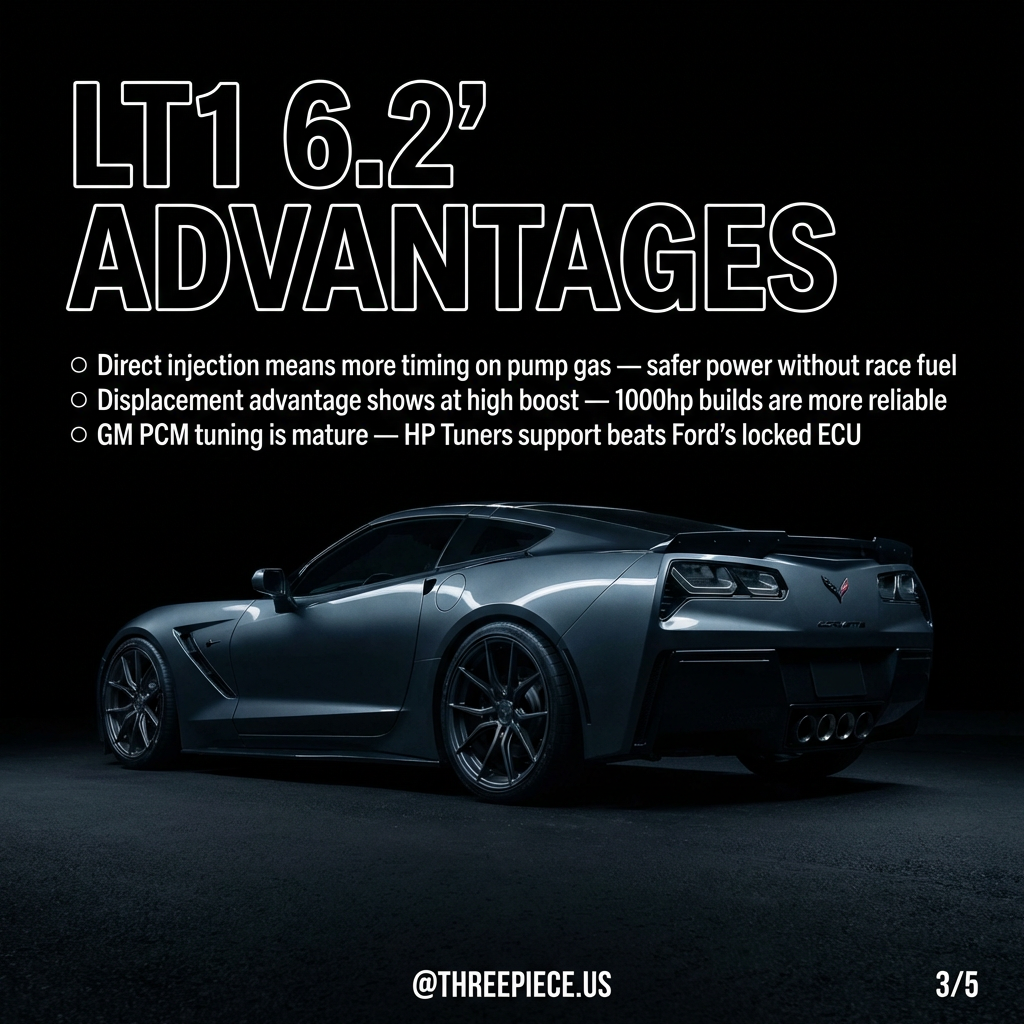
Displacement also favors the LT1 at high boost levels. The extra 1.2 liters means 1000hp builds are more reliable on the GM platform. When you're chasing four-digit power, the LT1's larger displacement reduces stress per cylinder compared to the smaller Ford engine.
GM's PCM tuning ecosystem is also more mature. HP Tuners support for LT1 platforms beats Ford's increasingly locked ECU situation. For serious tuners, this flexibility matters when chasing peak numbers.
Our Camaro SS 1LE buying guide covers the naturally aspirated LT1 platform in detail, showing why it's a solid foundation before adding boost.
Real World Build Costs: Where Budgets Get Reality Checked
Here's where the Coyote wins decisively. A Coyote hits 800hp for $12k total — turbo kit plus fuel system covers it. The factory forged internals mean no machine work, no piston upgrades, no connecting rod concerns at reasonable boost levels.
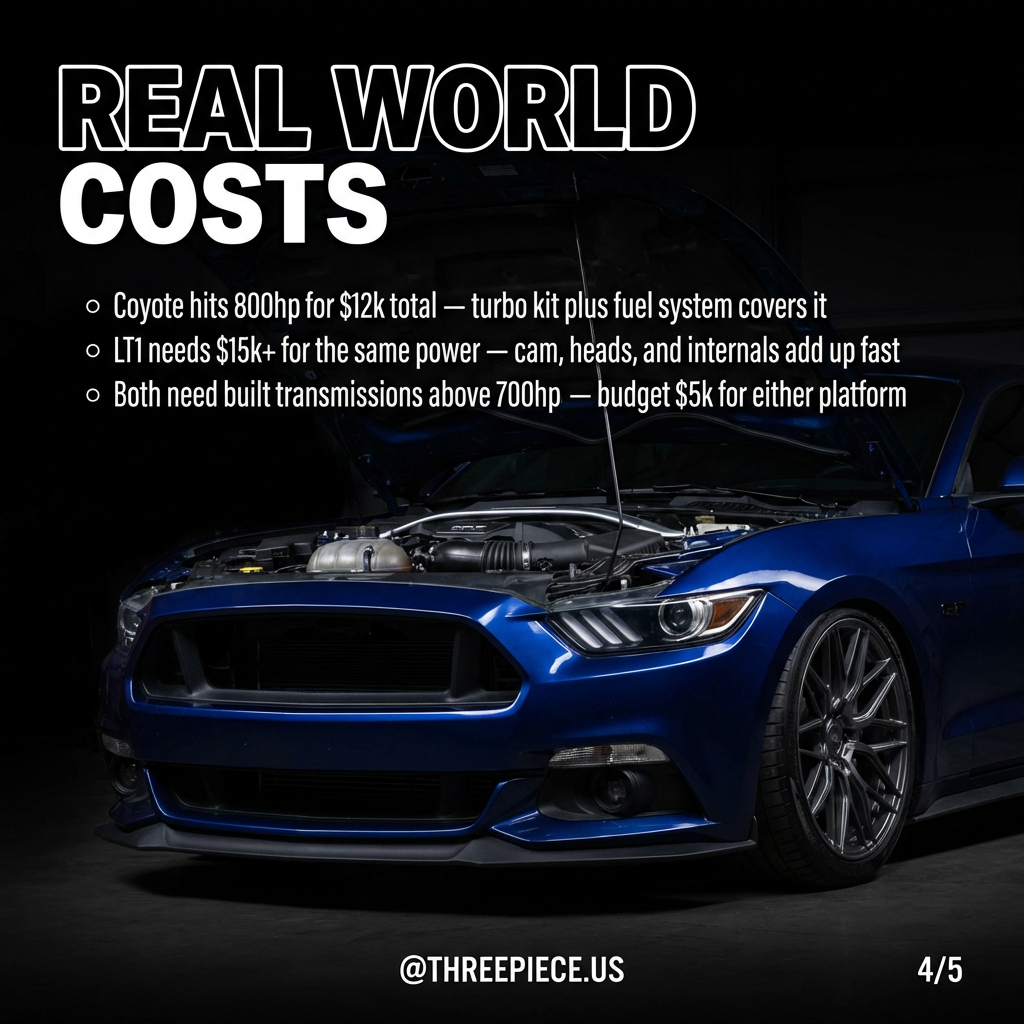
The LT1 needs $15k+ for the same power level. Despite the stronger factory bottom end, you're still looking at cam upgrades, head work, and internal modifications to safely reach 800hp. The cost difference adds up fast when you factor in machine work and assembly.
Both platforms need built transmissions above 700hp — budget $5k for either the 6R80 or 8L90. This is where many budget builds get derailed, but it's unavoidable on both platforms at serious power levels.
For wheel and tire upgrades to handle the extra power, browse our wheel selection or check out 19-inch wheels in 5x114.3 for Mustang applications. Proper wheel and tire setups become critical when you're putting down 800+ horsepower to the pavement.
The Verdict: Coyote Takes the Crown
Ford's factory forged pistons save $3k in machine work upfront — money that goes directly toward boost-making hardware instead of internal prep. Proven turbo kits mean less custom fabrication, less troubleshooting, and more time actually driving your build.
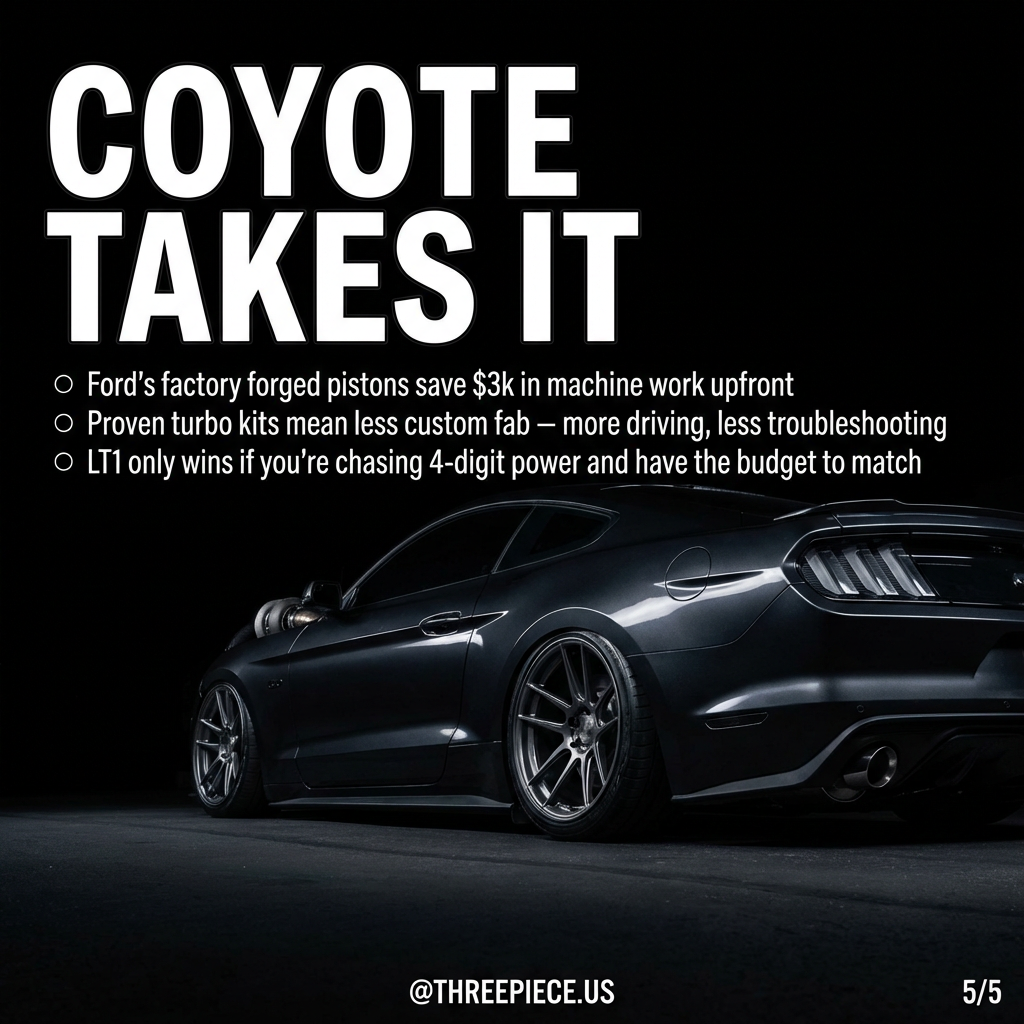
The LT1 only wins if you're chasing four-digit power and have the budget to match. For most enthusiasts building street-driven cars in the 700-900hp range, the Coyote's combination of factory strength, aftermarket support, and lower entry costs makes it the clear winner.
Both engines can make serious power, but the Coyote gets you there faster and cheaper. When you're working with real-world budgets, that $15k+ difference between platforms matters more than theoretical peak output numbers.
For build inspiration, check out our vehicle gallery to see how other enthusiasts are handling high-power V8 builds. Whether you go Coyote or LT1, proper wheel fitment becomes crucial — our Mustang GT vs Challenger comparison covers platform-specific considerations for serious builds.