

Posted by THREEPIECE.US on Mar 10th 2026
Coilover Spring Rates Explained: How to Pick the Right Setup for Street vs Track
Most people pick coilover spring rates based on what their favorite influencer runs — and wonder why their car feels terrible. Spring rates determine how your suspension responds to bumps, body roll, and weight transfer. Get them wrong and you'll have a car that either bounces like a pogo stick or feels like driving a shopping cart over broken pavement.

Quick links
- How Spring Rates Actually Work
- Why Spring Rate Balance Matters More Than Stiffness
- Common Spring Rate Mistakes That Kill Performance
- How to Pick the Right Spring Rate Setup
- Best Coilover Options by Use Case
How Spring Rates Actually Work
Spring rates are measured in pounds per inch (lb/in) or kilograms per millimeter (kg/mm). A 8k front spring is literally twice as stiff as a 4k front spring. When you compress an 8k spring one inch, it pushes back with 8,000 pounds of force. This isn't just numbers on paper — it directly affects how your car handles weight transfer, road imperfections, and cornering loads.
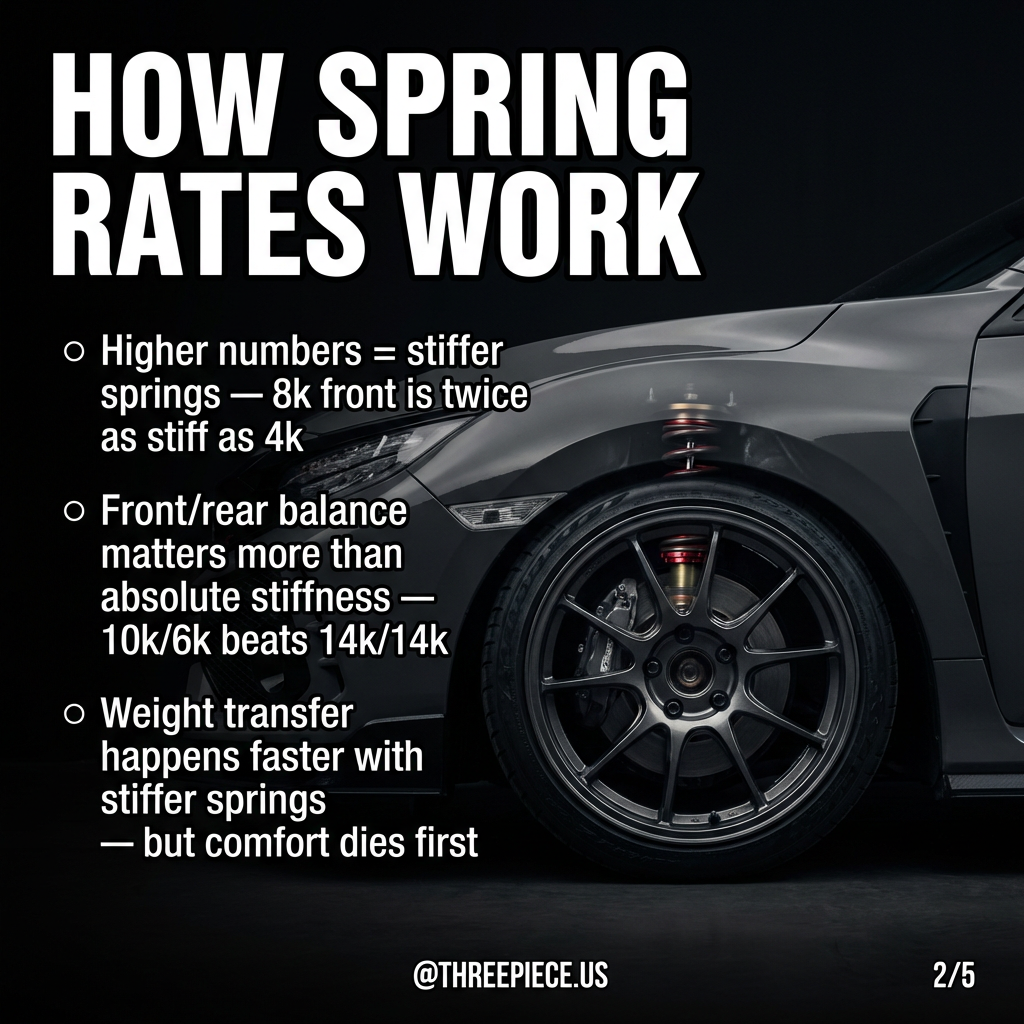
Most enthusiasts obsess over absolute stiffness when front-to-rear balance matters infinitely more. A 10k front, 6k rear setup will handle better than 14k front, 14k rear on most platforms because it maintains proper weight transfer characteristics. Stiffer springs make weight transfer happen faster, but comfort dies first — and on the street, you need compliance to maintain grip over imperfect surfaces.
If you're considering upgrading your suspension, check out our guide on whether coilovers are actually worth it for street builds. For those ready to invest in quality suspension, the F2 Function & Form Honda Accord coilovers offer adjustable spring rates for dialing in the perfect setup.
Why Spring Rate Balance Matters More Than Stiffness
Wrong spring rates don't just hurt comfort — they kill grip. Run springs too stiff for the street and your tires can't follow road imperfections. The tire skips and hops instead of maintaining contact, destroying traction when you need it most. This is why 6k front, 4k rear gives you real performance gains without breaking your spine on daily drives.
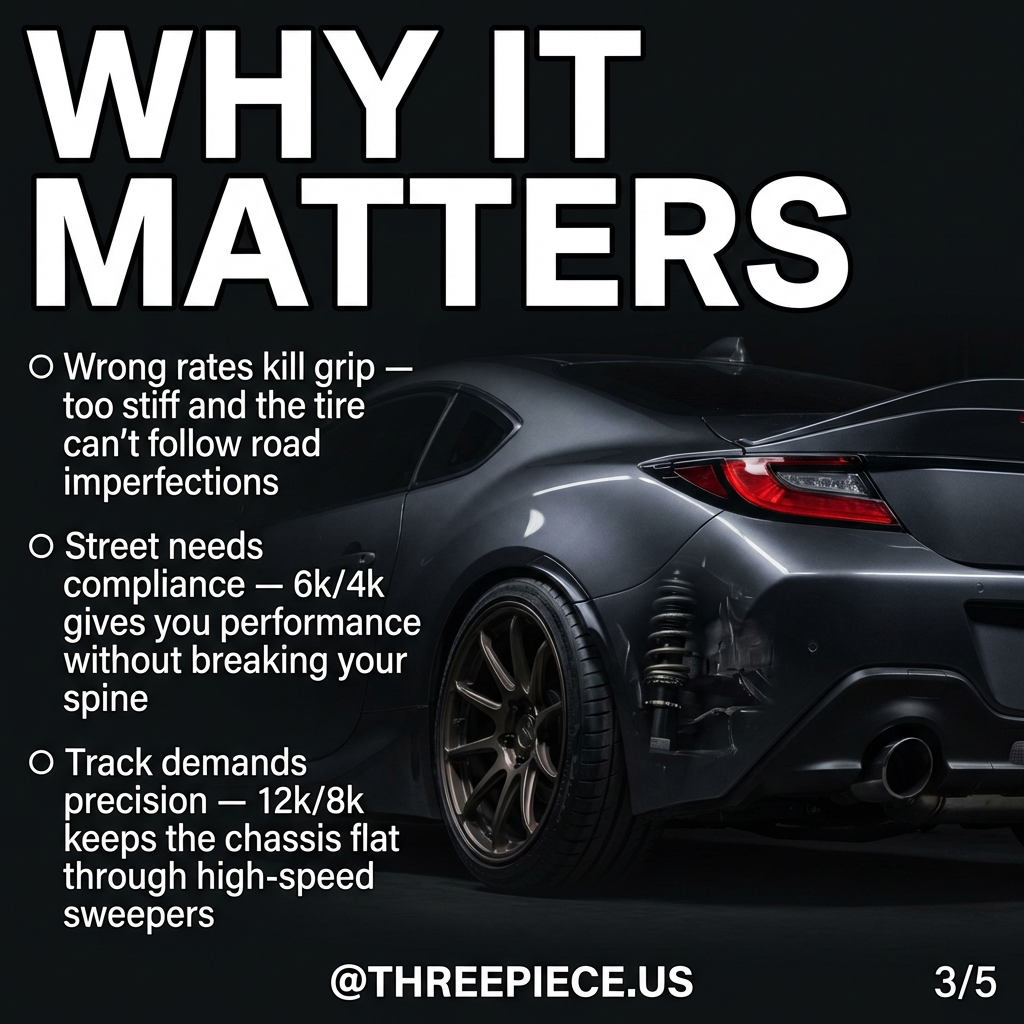
Track environments flip the script entirely. Smooth surfaces allow you to run 12k front, 8k rear rates that would be unbearable on public roads. The increased spring rate keeps the chassis flat through high-speed sweepers and prevents excessive body roll during rapid direction changes. But your commute isn't Laguna Seca — what works on track will make your street car undriveable.
Vehicle weight distribution changes everything. A nose-heavy FWD car like a 10th gen Civic needs different rates than a balanced RWD platform. The F2 Function & Form Golf R coilovers account for the Golf's front-heavy layout with appropriately biased spring rates.
Common Spring Rate Mistakes That Kill Performance
The biggest mistake is copying track setups for street use. Instagram builds running 12k/8k rates look aggressive, but they're optimized for smooth track surfaces and dedicated tire compounds. Transfer that setup to pothole-riddled streets and you'll get a car that feels like a paint mixer and loses grip constantly.

Ignoring weight distribution is the second killer. A 50/50 balanced car like an FA20 BRZ needs different front-to-rear bias than a nose-heavy platform. Most enthusiasts run equal front and rear rates, creating understeer on platforms that need rear bias to rotate properly.
The third mistake is buying coilovers with non-adjustable spring rates. Quality systems like the F2 Function & Form Genesis Coupe setup allow you to swap springs as your needs change. Street rates for daily driving, track rates for weekend warrior duty.
For more context on suspension tuning, read our breakdown of why wheel weight affects suspension performance — lighter wheels reduce unsprung mass and let your springs work more effectively.
How to Pick the Right Spring Rate Setup
Daily drivers need 6k front, 4k rear as the sweet spot — enough stiffness for real performance gains without destroying ride quality. This gives you body roll control, improved turn-in response, and maintains compliance over broken pavement. It's the setup that works for 90% of street-driven enthusiast cars.
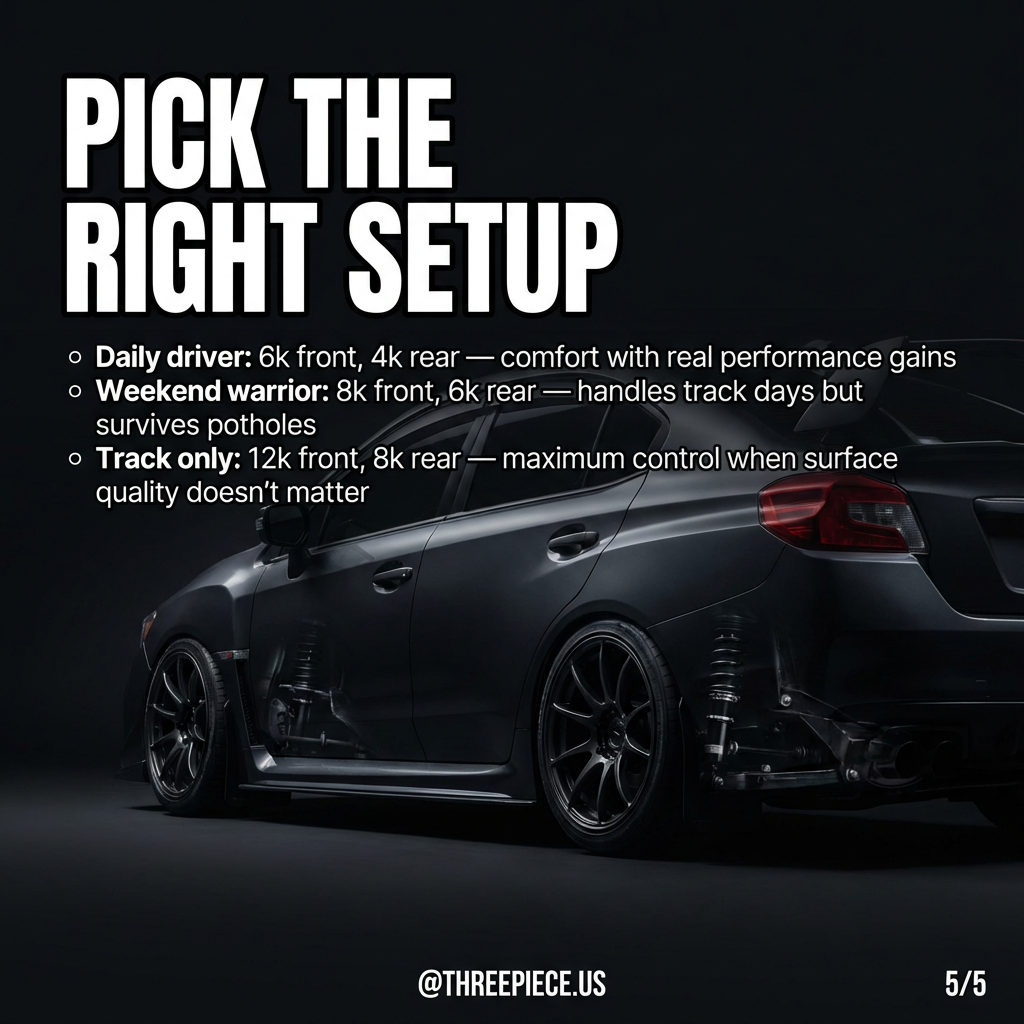
Weekend warriors running occasional track days should target 8k front, 6k rear. This handles track duty without making street driving unbearable. You'll feel every expansion joint, but the car will survive potholes and maintain reasonable comfort for longer drives. It's the compromise setup that actually works for dual-duty builds.
Track-only cars can run 12k front, 8k rear or stiffer, depending on aero loads and tire compound. Maximum control when surface quality doesn't matter and comfort is irrelevant. But understand — this setup will be miserable on public roads and potentially damage components over rough surfaces.
Platform-specific considerations matter more than generic formulas. An Infiniti G37 with its heavy VQ37VHR engine needs different front bias than a lightweight 350Z with the VQ35DE. Weight distribution, suspension geometry, and intended use all factor into the equation.
Best Coilover Options by Use Case
For Honda platforms, the F2 Function & Form Accord coilovers offer the adjustability needed to dial in proper spring rates. These systems let you start conservative and increase rates as your driving evolves — critical for finding the sweet spot between performance and livability.
German car owners should consider the F2 Function & Form Audi TT setup for platforms that need careful spring rate selection. The TT's rear-engine bias requires specific front-to-rear balance that generic coilovers often get wrong.
Don't forget supporting modifications. Proper spring rates work best with quality wheel accessories like appropriate valve stems at $3.80 for maintaining tire pressure consistency. Even small details matter when you're optimizing suspension performance.
Remember: spring rates are just one piece of the suspension puzzle. Damper tuning, anti-roll bar selection, and alignment settings all work together. But get the spring rates wrong, and no amount of tuning will fix a fundamentally flawed setup. Start with appropriate rates for your use case, then fine-tune from there.
For more suspension insights, check out our analysis of why wheel size affects suspension performance and browse our complete suspension category for quality components that work with properly chosen spring rates.