
Posted by THREEPIECE.US on Feb 28th 2026
Forged Wheels Are Overrated for Street Cars — Cast Strength is Fine
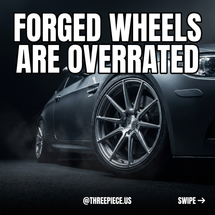
The wheel industry has convinced everyone that forged equals premium and cast equals cheap, but here's the reality most shops won't tell you: unless you're actually tracking your car hard or running slicks in competition, you're probably wasting money on forged wheels. Modern cast and flow-formed wheels handle 99% of street driving perfectly while saving you $2,000+ that could go toward suspension, tires, or anything that actually transforms your driving experience.

Quick links
- The Marketing Myth That Costs You Money
- Cast Wheels Are Plenty Strong for Street Use
- Better Cast and Flow-Formed Alternatives
- When Forged Actually Matters
- Smart Wheel Spending for Street Cars
The Marketing Myth That Costs You Money
The "forged or nothing" narrative exists because margins are massive on forged wheels. A set that costs $4,000 to you might have material costs under $800. Meanwhile, quality cast wheels like the Enkei RPF1 or Konig Hypergram deliver 90% of the performance at half the price.

Social media builds amplify this problem. Instagram features cars with $6,000 wheel setups because they photograph well, not because they perform better on your daily commute. The reality? Your OEM wheels already pass the same impact and fatigue tests that aftermarket cast wheels meet.
If you're building a street car, read our breakdown of cast vs forged manufacturing differences to understand what you're actually paying for. Spoiler: it's not always performance.
Cast Wheels Are Plenty Strong for Street Use
Modern cast wheels pass the same JWL and VIA impact tests as your factory wheels. Street potholes and parking lots don't generate the repeated lateral forces that separate cast from forged performance. Flow-forming technology gives you forged-level strength at cast prices — the Enkei RPF1 has proven this formula for decades.

Flow-formed wheels like the RPF1 use a casting process followed by flow-forming the barrel, which work-hardens the aluminum and reduces weight. This hybrid approach delivers 80% of forged wheel benefits at 40% of the cost. Unless you're generating serious lateral Gs in competition, you won't feel the difference.
For more technical details, check our flow-formed vs forged comparison — the manufacturing differences matter less than the wheel industry wants you to believe.
Better Cast and Flow-Formed Alternatives
Instead of dropping $4,000 on forged wheels, consider these proven alternatives that deliver real performance at reasonable prices:

Enkei RPF1 or PF01: Flow-formed construction, motorsport pedigree, half the price of equivalent forged wheels. The RPF1 has won more races than most forged options.
Konig Hypergram: Rotary-forged strength starting around $200 per wheel. Available in aggressive fitments that work on most sport compacts.
OZ Ultraleggera: Motorsport heritage without the Instagram tax. These wheels have actual racing provenance, not just marketing claims.
Browse our selection of Work wheels for premium options that split the difference between cast and full forged pricing. The Work Emotion series offers forged-level quality with more reasonable pricing than boutique brands.
When Forged Actually Matters
Forged wheels make sense in specific scenarios where the performance difference is measurable:

You're actually tracking the car hard: Repeated heat cycles from heavy braking and sustained high-G cornering stress wheels beyond street limits. Track rats putting in 20+ track days per year see real benefits from forged construction.
You're running slicks in competition: 200TW and slick tires generate lateral forces that can stress cast wheels. If you're running actual R-compounds in competition, forged makes sense.
Money isn't a factor: If you want the absolute lightest option and cost doesn't matter, forged wheels can save 2-4 pounds per wheel. For most street builds, that money goes further on quality suspension components.
Our wheel weight physics guide explains why those 2 pounds matter more than you think — but only if you're actually using that performance.
Smart Wheel Spending for Street Cars
That extra $2,000 you save by choosing quality cast over forged wheels transforms your car more than marginally lighter wheels ever will. Put it toward quality coilovers, summer tires, or chassis reinforcement that you'll feel every time you drive.
For wheel accessories that actually matter, grab some 90-degree valve stems at $3.80 for easier tire pressure checks, or upgrade your assembly bolts to chrome at $10 each for a clean look on 3-piece setups.
Remember: wheels are one component in your car's performance equation. Unless you're actually using that forged wheel performance advantage on track, you're paying Instagram tax for bragging rights. Save the money and build a car that drives better instead of one that looks expensive.
Check out our vehicle gallery to see real builds using proven wheel combinations that prioritize performance over price tags.