
Posted by THREEPIECE.US on Feb 28th 2026
Are Wheel Spacers Safe? The Real Answer from Professional Builds
The wheel spacer debate needs to end — they're not death traps when done right. Every car forum has that guy claiming spacers will send your wheels flying into traffic, while half the grid at IMSA runs them without issue. The truth? Like most car mods, execution matters more than the part itself.

Quick links
- How Hub-Centric Spacers Actually Work
- Why the Internet Panics About Spacers
- Common Install Mistakes That Cause Problems
- Doing It Right: Quality Parts & Torque Specs
- The Real Verdict on Spacer Safety
How Hub-Centric Spacers Actually Work
Hub-centric spacers transfer load through the hub — not the studs like cheap slip-ons. Proper spacers are machined to OEM tolerances using the same aluminum as your wheel centers. Extended studs carry identical load as stock hardware — physics doesn't change with 20mm of spacing.

The key difference from aftermarket wheels is simple: quality spacers maintain the hub-centric mounting system your car was designed around. When you bolt on Work Wheels or any aftermarket setup, you're already changing the load path — spacers just extend it slightly. The MUTEKI 20mm spacers for 5x114.3 at $165 use the same 6061-T6 aluminum as premium wheel centers.
For comparison, read our breakdown of why hub-centric rings save wheel bearings — the same principles apply to spacers. Load distribution matters more than internet paranoia.
Why the Internet Panics About Spacers
Slip-on spacers put all stress on wheel bolts — these ARE dangerous above 15mm. Cheap eBay spacers aren't hub-centric, creating vibration and stress points that kill wheel bearings. One blown wheel stud becomes "spacers are death traps" on every forum forever.

The horror stories come from $40 eBay specials with no hub centering and questionable metallurgy. Meanwhile, companies like H&R and Eibach have been manufacturing spacers for decades with zero documented failures when installed correctly. Check out our 15mm wheel spacers guide for the sweet spot sizing.
The same crowd that panics about spacers happily runs 18x10.5 +15 wheels that stress suspension components far more than 20mm spacers on stock wheels. Our aggressive offset guide explains why wheel choice matters more than spacing.
Common Install Mistakes That Cause Problems
Wrong torque spec kills studs — use a torque wrench, not an impact gun. Mixing spacer brands creates different hub heights, while skipping hub cleaning lets corrosion build between surfaces. These mistakes cause real failures that get blamed on the spacers themselves.

Most failures trace to installation errors, not product defects. The MUTEKI 20mm spacers for 5x100 at $168 include detailed torque specifications — follow them religiously. Clean hub faces with brake cleaner before installation, and retorque after 100 miles of driving.
Extended ARP studs become mandatory over 15mm thickness. Don't stress stock hardware beyond its design limits. Quality assembly bolts like our M8x32 chrome bolts at $10 handle the additional stress properly.
Doing It Right: Quality Parts & Torque Specs
H&R, Eibach, or ECS — buy quality spacers with proper hub centering rings. Extended ARP studs for anything over 15mm, and retorque after 100 miles of initial settling. Professional builds follow these rules without exception.

The MUTEKI 15mm spacers for 5x114.3 at $174 represent the sweet spot for most applications — thick enough to improve fitment without requiring extended hardware. For reference, our tire sizing guide covers how spacers affect overall wheel-to-fender clearance.
Quality spacers cost more than generic alternatives, but they're still cheaper than custom offset wheels. Compare $165 for proven MUTEKI spacers versus $2000+ for custom Work wheels in your exact offset. Browse our vehicle gallery to see properly executed spacer setups across different platforms.
Remember that coilover setup affects wheel clearance as much as spacers — get your suspension sorted before committing to specific spacing.
The Real Verdict on Spacer Safety
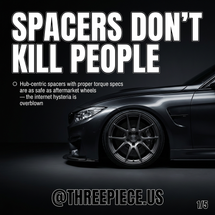
Hub-centric spacers with proper installation are as safe as aftermarket wheels. The internet hysteria stems from cheap parts and poor installation, not inherent design flaws. Professional racing series prove that quality spacers handle far more stress than street driving demands.
Focus on execution over paranoia. Buy quality parts like proper wheel accessories, follow torque specifications, and maintain your setup properly. The same principles that make quality wheels safe apply to spacers — material quality and manufacturing precision matter more than internet fear-mongering.