
Posted by THREEPIECE.US on Mar 8th 2026
Are Forged Pistons Worth It for K-Series Turbo Builds? Street Reality Check
Every K-series turbo build on Instagram gets the same advice: forged pistons are mandatory for reliability. But stock K20/K24 pistons handle 350-400hp daily on proper tunes — most street builds never reach the threshold where forged internals actually matter. You're probably throwing money at the wrong problem.
Quick links
- The Forged Piston Hype Machine
- Street Driving Reality Check
- Better Investment Alternatives
- When Forged Actually Makes Sense
- The Bottom Line
The Forged Piston Hype Machine
Walk into any tuner shop with a K24 turbo build plan, and forged pistons become the default answer. JE, CP, or Wiseco pistons get recommended for 250hp setups that barely stress the stock internals. Instagram build posts reinforce this mentality — every clean turbo Honda features a laundry list of forged components, creating the impression that cast pistons are fragile.
The truth is simpler: most tuners push forged internals because they're profitable and create a buffer against poor tuning. It's easier to sell $1200 forged pistons than explain why your tune needs to be conservative on stock parts. Check out our K-series swap donor guide to see which engines actually need internal work from the factory.
Street Driving Reality Check
Stock K-series pistons handle 8-12psi on good tunes — that translates to 350hp on a K24 turbo setup. The limitation isn't the piston crown cracking; it's ring seal and thermal expansion under sustained load. For street driving with occasional highway pulls, stock pistons survive just fine.
Forged pistons create new problems for street cars. They need longer warmup times because the tighter tolerances require thermal expansion to seal properly. Cold start knock becomes a real concern, and ring seal suffers until the engine reaches full operating temperature. Oil consumption goes up noticeably — something that matters when you're daily driving the car.
If you're building a street K-series, focus on the tuning quality before throwing parts at the problem. A conservative tune on stock internals beats an aggressive tune on forged parts every time.
Better Investment Alternatives
Want to strengthen your K-series bottom end? Start with the connecting rods. Stock K-series rods bend at 300hp — well before the pistons become the weak link. Eagle or Manley H-beam rods cost around $600 and provide a much better investment than $1200 forged pistons for most builds.
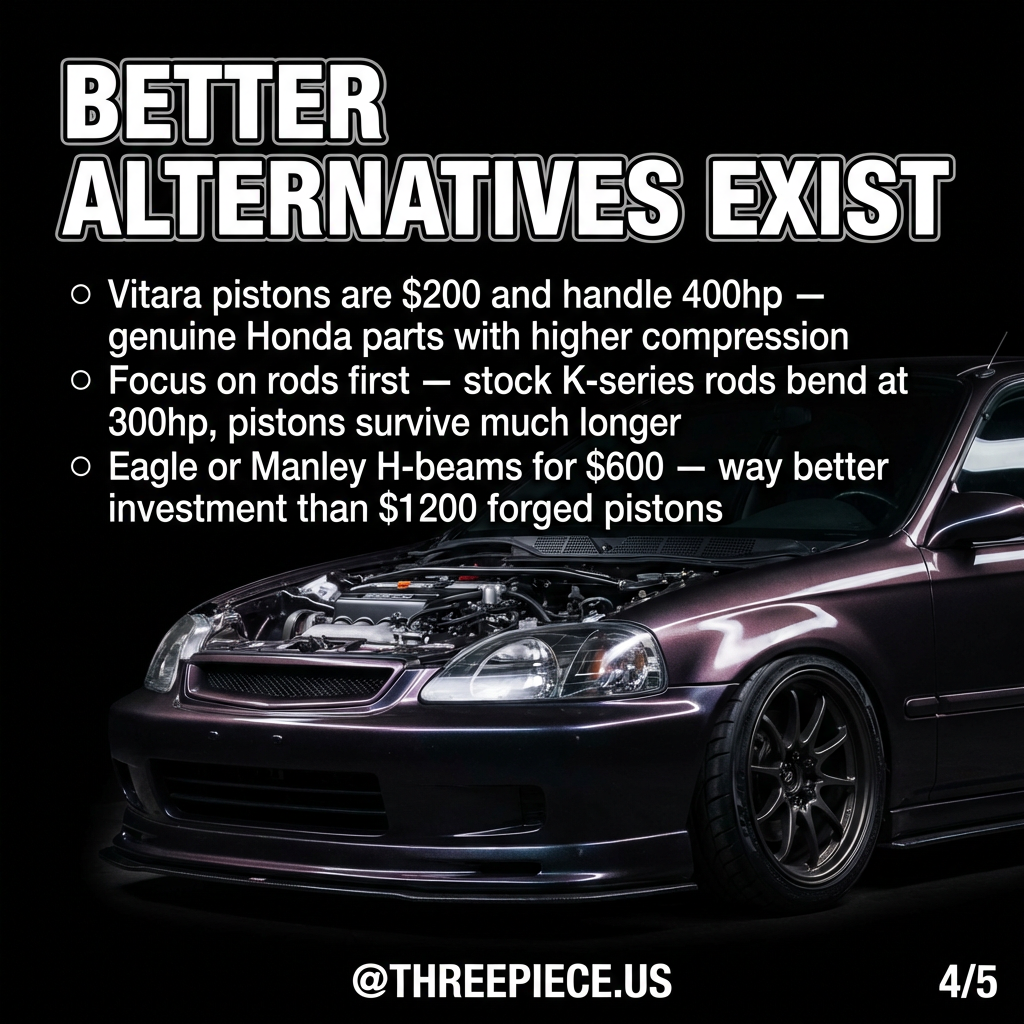
For budget builds, Vitara pistons are $200 and handle 400hp — genuine Honda parts with higher compression ratio than stock K24 pistons. They're cast, not forged, but they're designed for higher boost applications from the factory. Pair them with quality rods and you've got a 400hp-capable bottom end for $800 instead of $2000.
Your money goes further on supporting modifications: fuel system upgrades, intercooler sizing, and proper engine management. These modifications actually improve reliability and power delivery, unlike forged pistons that primarily serve as insurance against poor tuning. Consider reading our turbo K24 vs LS3 comparison to understand the total cost of K-series turbo builds.
When Forged Actually Makes Sense
Forged pistons aren't universally wrong — they're just wrong for most street applications. If you're building for 500+ horsepower, stock pistons become the weak link above 15psi. The thermal stress and combustion pressures exceed what cast aluminum can handle reliably.
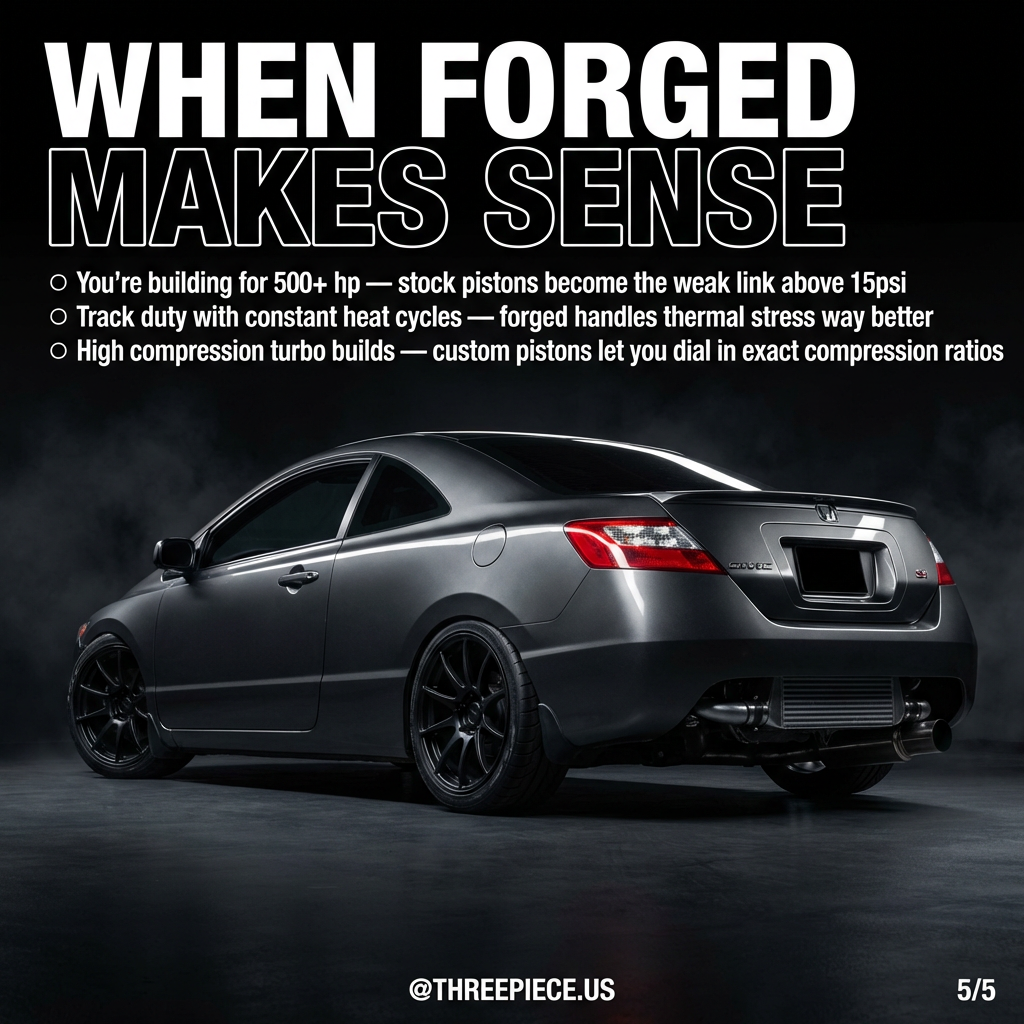
Track duty with constant heat cycles justifies forged internals. The repeated thermal expansion and contraction cycles stress cast pistons beyond their design limits. Forged pistons handle this abuse better, though they still require more frequent maintenance than street-driven engines.
High compression turbo builds need custom pistons regardless of material choice. If you're trying to run 10.5:1 compression with a turbo setup, you need pistons cut for that specific compression ratio. In this case, you're paying for the custom machining work, not just the forged material. Our FK8 vs FK7 build comparison shows how compression ratio affects turbo builds differently.
The Bottom Line
Save the forged piston money for modifications that actually improve your street experience. Better wheels and tires transform daily driving more than internal engine work. A set of Work Emotion wheels with proper fitment affects every mile you drive, while forged pistons sit inside the engine doing nothing until you exceed their necessity threshold.
Focus your K-series budget on proven upgrades: quality tune, fuel system, cooling, and suspension. When you're consistently making 400+ horsepower and hitting the track monthly, then consider forged internals. Until then, your stock pistons are waiting for you to actually stress them. Browse our vehicle gallery to see how successful K-series builds allocate their modification budgets across the entire car.