
Posted by THREEPIECE.US on Feb 28th 2026
315 vs 275 Mustang Tires: Why Wider Rear Rubber Wastes Money
The 315-wide rear tire trend on Mustangs is the automotive equivalent of buying a Rolex to tell time. Sure, they look impressive filling those rear wheel wells and give you bragging rights at car meets, but for 90% of drivers, they're actually hurting performance while emptying your wallet. The tire industry loves selling you the biggest rubber possible, but physics doesn't care about your ego — and your bank account will thank you for understanding the difference.

Quick links
- Why 315s Became the "Standard"
- The 275 Reality Check
- When 315s Actually Make Sense
- Run What Works for Your Build
- Save Money, Gain Performance
Why 315s Became the "Standard"
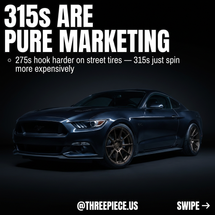
275s hook harder on street tires — 315s just spin more expensively. The push toward wider rear rubber started with drag racing, where contact patch matters for slicks and drag radials. But somewhere along the way, the street performance community got convinced that wider automatically equals better traction, regardless of compound or application.

Three factors drove the 315 obsession: Visual impact — wider rear stance fills the wells better and photographs well for social media. Drag credibility — Mickey Thompson ET Streets work best in 315 width for strip applications. Marketing pressure — tire manufacturers make higher margins on larger sizes, so they push "bigger is better" messaging.
The problem? Most Mustang owners never see a drag strip, and street tire compounds behave completely differently than drag radials. On pump gas with street tires, that extra contact patch often works against you. Check our guide on why proper alignment beats 275-wide tires on stock suspension for the suspension setup reality.
The 275 Reality Check
Here's what actually happens on the street: Nitto NT555 G2 in 275 hooks better than Michelin PS4S in 315 on pump gas builds under 500whp. The compound matters more than contact patch width, and the narrower tire puts more pressure per square inch on the pavement.

The math is brutal: 275s cost $200 less per tire — that's $800 savings every replacement cycle. For a street-driven car that sees 15,000+ miles per year, you're looking at tire replacement every 2-3 years. Over the ownership period, that's thousands saved that could go toward suspension upgrades that actually improve performance.
Street driving never uses the full 315 contact patch effectively. You're paying for unused rubber that adds rotational mass and hurts acceleration. The Michelin Pilot Sport A/S 4 245/40ZR18 at $244 proves this point — even narrower tires can deliver exceptional street performance when the compound is right.
When 315s Actually Make Sense
Don't misunderstand — there are legitimate applications for 315-wide rear tires. But they're more specific than most people realize.

600+ whp builds on slicks — you actually need the contact patch at the strip when you're making serious power. The Michelin Pilot Sport 4 S 295/30ZR19 at $448 shows how even slightly narrower high-performance tires cost significantly more than street alternatives.
Full drag setup with Mickey Thompson ET Street R — the compound matters more than width, but the 315 size is where these drag radials perform best. Track days on R-compounds — Hoosier A7s in 315 are worth the grip upgrade when you're running dedicated track wheels.
Notice the pattern? These are all specialized applications with dedicated tire compounds, not daily-driven street cars on all-season or summer tires. For more context on when wider makes sense, read our analysis of square vs staggered on RWD coupes.
Run What Works for Your Build
275 Nitto NT555 G2 for street — best bang for buck traction under 500whp. The compound hooks hard, the price is reasonable, and the width is appropriate for street driving dynamics.

Save the 315 budget for suspension upgrades that actually improve performance. Quality coilovers, proper springs, and alignment make a bigger difference than tire width. Our suspension category shows the components that transform handling.
Width doesn't equal grip — tire compound and suspension setup beat contact patch every time. The Michelin Pilot Sport 4 S 305/30ZR19 at $453 demonstrates how even premium 305-width tires cost significantly more than 275 alternatives while delivering questionable street performance gains.
For wheel sizing, focus on proper offset and diameter rather than accommodating the widest possible tire. Browse 19-inch wheels in 5x114.3 for S550 Mustang fitment, or check our S650 Mustang wheel & tire fitment guide for the latest generation.
Save Money, Gain Performance
The 315 tire trend proves that enthusiast culture often prioritizes appearance over function. For street-driven Mustangs under 500whp, 275-width rear tires deliver better traction, cost less to replace, and improve overall driving dynamics.
That $800 per replacement cycle savings adds up to serious money over ownership. Invest those savings in suspension components, brake upgrades, or engine modifications that actually transform performance. Check out our coilover vs springs comparison for smart suspension spending priorities.
Ready to build a Mustang that performs instead of just posing? Start with proper tire sizing, invest in quality Work Wheels that won't break the bank, and focus on the modifications that actually matter. Your wallet and your lap times will thank you.