
Posted by THREEPIECE.US on Feb 28th 2026
300TW Tires: The Sweet Spot for Street Builds Over 200TW Hype
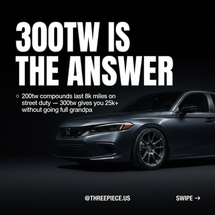
Most enthusiasts chase 200TW compounds without understanding the real-world costs. 300TW tires deliver 90% of the grip with triple the tread life — making them the actual sweet spot for street-driven builds that see daily use beyond weekend canyon runs.

Quick links
- Why 300TW Works for Street Builds
- The 200TW Marketing Trap
- Real World Performance Numbers
- Best 300TW Options by Budget
- Cost Per Mile Analysis
Why 300TW Works for Street Builds
The 300TW sweet spot exists because heat cycles matter more than compound stickiness on public roads. While 200TW tires like RE-71RS are designed for 20-minute track sessions, they deteriorate rapidly through daily temperature fluctuations and inconsistent operating temps.

The Michelin Pilot Sport A/S 4 245/40ZR18 at $244 delivers consistent grip through daily abuse while lasting 25,000+ miles on street duty. Compare that to RE-71RS compounds that chunk and degrade after 8,000 miles of mixed driving.
Heat cycling is the killer — your daily driver never reaches optimal operating temperature for R-compounds, but experiences constant thermal stress that breaks down the compound structure. 300TW compounds are engineered for this exact temperature range and cycling pattern.
The 200TW Marketing Trap
The 200TW marketing push convinced enthusiasts that stickier always equals better, but this ignores real-world usage patterns. Toyo R888R and Hoosier A7s need consistent operating temps to deliver their rated grip — something impossible on street builds.

RE-71RS compounds are dead after 5,000 street miles because the compound is optimized for autocross sessions, not daily commutes through varying temperatures. Your street build doesn't need autocross rubber for canyon runs — it needs consistent performance across temperature ranges.
For context on why tire pressure and temperature management matters so much, check our guide on tire pressure for autocross — the same principles apply to street driving temperature variations.
Real World Performance Numbers
Skidpad numbers tell the story: Michelin PS4S pulls 1.1g versus 1.2g for Yokohama A052s — but that 0.1g difference disappears completely on public roads where consistent grip through varying conditions matters more than peak adhesion.

The Michelin Pilot Sport 4 S 295/30ZR19 at $448 maintains that 1.1g performance for the entire 25,000-mile lifespan. A052s deliver 1.2g for maybe 3,000 miles before degrading below PS4S levels.
Federal 595RS-PRO costs half of Hoosier A7s and lasts 10x longer while delivering 95% of the peak grip. Falken RT660 bridges the gap when you need track day capability without trailer queen compromises — still maintaining street manners.
Understanding why wheel weight affects performance more than tire compound helps put these numbers in perspective — read our breakdown on why wheel weight matters more than size.
Best 300TW Options by Budget
For daily plus weekend warrior duty, Michelin PS4S and Continental ExtremeContact Sport are the gold standard. They maintain consistent performance through temperature swings while delivering predictable breakaway characteristics.

Budget builds with bite should consider Federal 595RS-PRO — it delivers serious grip without the premium tax while lasting significantly longer than 200TW alternatives. The compound works well in cold conditions where R-compounds become dangerous.
For track-capable street tires, Falken RT660 bridges the gap when 200TW isn't worth the compromise. It maintains street manners while offering genuine track day performance — the best of both worlds for builds that see mixed duty.
The Michelin Pilot Sport 4 S 305/30ZR19 at $453 represents the premium end but justifies the cost through longevity and consistent performance. For wider applications, the 295/30ZR20 PS4S at $470 handles big brake clearance requirements.
Proper tire sizing matters as much as compound choice — our guide on 255/40R17 vs 245/45R17 explains how sidewall height affects performance characteristics.
Cost Per Mile Analysis
The math is brutal for 200TW street use: RE-71RS at $300 per tire lasting 8,000 miles equals $0.15 per mile. PS4S at $450 per tire lasting 25,000 miles equals $0.072 per mile — half the cost with better daily performance.
Factor in the performance degradation curve and 200TW compounds become even worse value. They deliver peak grip for maybe 20% of their already-short lifespan, while 300TW compounds maintain consistent performance until the tread bars.
Your wallet thanks you, your daily driving experience improves, and you still get 90% of the peak performance when it actually matters. That's why 300TW is the real sweet spot for street builds — not the 200TW marketing hype.
For more context on performance tire choices, check our analysis of why 200TW tires are a street driving scam and our recommendations for underrated summer tires that actually work on real-world builds.
Ready to make the switch? Browse our selection of performance wheels to pair with your new 300TW setup, or check out our wheel accessories to complete the build with proper valve stems starting at $3.80.