
Posted by THREEPIECE.US on Feb 28th 2026
18x10.5 +15 Offset: Why Most Cars Need Fender Work (3 Exceptions)
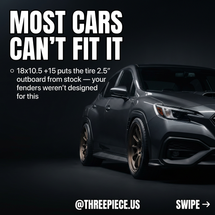
Running 18x10.5 +15 wheels is aggressive fitment that pushes the contact patch 2.5-3 inches outboard from stock positioning. The math is brutal: +15 offset moves the wheel face 25-35mm further out than most OEM setups, while the 10.5-inch width places the tire sidewall 1.3 inches beyond stock dimensions. This combination creates clearance nightmares on 90% of platforms.

Quick links
The Brutal Offset Math
Most enthusiasts underestimate how dramatically +15 offset changes wheel positioning. On a typical sport compact with +45 to +50 factory offset, switching to +15 pushes the wheel face 30-35mm outward. Combined with the extra width from 10.5-inch barrels, you're moving the entire contact patch 2.5-3 inches closer to your fender lips.

The 10.5-inch width compounds the problem. Where a stock 8.5-inch wheel places the tire sidewall roughly 4.25 inches from the centerline, a 10.5-inch wheel pushes it out to 5.25 inches. That extra inch of tire sidewall, combined with the aggressive offset, creates the clearance nightmare most people don't anticipate until after they've ordered wheels.
For suspension components, check out our selection of performance suspension to handle the geometry changes that come with aggressive wheel specs. The Eibach Pro-Spacer 15mm spacers at $182 can help fine-tune fitment on platforms that are close to clearing.
What You'll Hit First
The contact points aren't what most people expect. Front fender liner screws hit first under compression — those plastic fasteners that seem insignificant become wheel destroyers when your suspension cycles through its travel. On lowered cars, this happens within the first 2-3 inches of suspension compression.

Rear fender lips present the next challenge, especially on full lock. The combination of steering angle and lowered suspension geometry creates contact points that don't exist at static ride height. Inner barrel clearance becomes critical too — most strut housings weren't designed for the reduced backspace that comes with +15 offset.
Our guide on wheel spacer safety covers similar clearance issues when pushing wheels outward. The physics are identical whether you're using spacers or aggressive offset.
The Three Platform Exceptions
Only three platforms handle 18x10.5 +15 without extensive modification. The Nissan 350Z/370Z was designed with factory fender flares and a wide track that accommodates aggressive fitment. The wheel wells are massive, and the suspension geometry actually benefits from the wider track.

The BMW E9X M3 represents the second exception. Its wide-body design from the factory, combined with generous fender wells, handles 10.5-inch wheels without drama. The suspension pickup points were engineered for track use, making aggressive offsets less problematic than on narrower platforms.
Subaru WRX/STI from the blob-eye and hawk-eye generations (2004-2007) complete the trio. Their aggressive factory fender flares and rally-inspired wheel arch design accommodate wide wheels that would require extensive work on other platforms.
For 350Z owners looking to maximize this fitment advantage, the Air Lift Performance rear kit at $1,037 provides adjustability to dial in the perfect stance. The Mishimoto PCV catch can at $580 addresses the VQ35DE's oil consumption issues that become more apparent with aggressive driving.
BMW E9X owners can benefit from the Torque Solution billet jack pads at $261 for safe lifting with lowered suspension. Subaru WRX/STI platforms can handle the Air Lift Performance front kit at $1,115 for ultimate adjustability.
Making It Work Anyway
If you're committed to the 18x10.5 +15 setup on a non-compatible platform, fender rolling and pulling becomes mandatory. Professional work adds 15-20mm of clearance but permanently alters your body lines. The rolled edge creates a visible line that changes the car's aesthetic profile.

Raising the car 10-15mm from your ideal stance preserves the paint but kills the aggressive look most people want with wide wheels. Track-focused builds often accept the rub, touching up paint seasonally and treating wheel contact as consumable maintenance.
The 15mm spacer guide explains similar fitment challenges when pushing wheels outward. Our hub-centric ring article covers the bearing stress that comes with aggressive offsets and wider track widths.
Consider the Clutch Masters FX300 kit at $823 for WRX/STI builds that can handle the aggressive fitment. The Chase Bays clutch line at $95 improves pedal feel on modified Subarus.
Know Before You Order
The 18x10.5 +15 specification looks incredible but requires serious commitment on most platforms. Unless you're building a 350Z, E9X M3, or blob/hawk WRX/STI, budget for fender work or accept compromised ride height. The aggressive look comes with aggressive consequences.
Browse our wheel selection to find specifications that work with your platform's limitations. Check out the 18x8.5 +45 guide for more manageable daily driver specs, or explore our vehicle gallery for real-world fitment inspiration.