
Posted by THREEPIECE.US on Feb 28th 2026
17-Inch vs 18-Inch Wheels: Why Bigger Kills Street Performance
Most enthusiasts think bigger wheels equal better performance, but 17-inch wheels outperform 18-inch wheels in every metric that matters for street driving: acceleration, braking distance, ride comfort, and tire costs. The physics work against you when you prioritize Instagram likes over actual performance.

Quick links
Why 17s Accelerate Faster
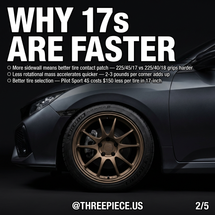
The biggest advantage of 17-inch wheels is reduced rotational mass. A typical 17x8 wheel weighs 2-3 pounds less per corner than its 18-inch equivalent. That's 8-12 pounds of unsprung weight reduction, which feels like removing 32-48 pounds from the car due to the rotational inertia effect.

More sidewall also means better tire contact patch geometry. A 225/45/17 tire has more sidewall flex than a 225/40/18, allowing the contact patch to stay flatter under cornering loads. This translates to better grip in real-world driving conditions where perfect smooth pavement doesn't exist.
Tire selection heavily favors 17-inch sizing. The Michelin Pilot Sport A/S 4 245/40ZR18 costs $244, while the same tire in 17-inch sizing typically runs $150-180. That's real money when you're replacing four tires. For more on wheel weight impact, check out our breakdown of why wheel weight matters more than size.
The 18-Inch Tax
Bigger wheels cost more in ways most people don't calculate. 18-inch wheels bend easier than 17s because there's less tire sidewall to absorb impact. Pothole damage that would leave a 17-inch setup unscathed can crack or bend an 18-inch wheel, especially on lower-profile setups.

Ride quality suffers dramatically with less sidewall. Every expansion joint, crack, and road imperfection transfers directly through the wheel to your spine. The difference between 45-series and 40-series sidewall height is more noticeable than most suspension modifications.
Tire wear accelerates on lower-profile rubber. Less sidewall means more stress concentration at the contact patch edges, leading to faster shoulder wear. Expect 20% shorter tire life on 18-inch setups compared to 17s with equivalent driving habits.
For daily drivers dealing with real-world road conditions, consider our guide on why sidewall height changes everything. The comfort difference is massive.
When 18s Make Sense
Bigger wheels aren't always wrong — they just need the right application. Big brake kits often require 18-inch minimum clearance. If you're running 6-piston Brembos or similar setups, you need the extra diameter. The EBC Racing BRZ/GT86 big brake kit at $1,979 requires 18-inch wheels minimum.

Track days with sticky rubber favor 18s. A 295/30/18 Hoosier A7 offers more contact patch area than any 17-inch equivalent. When you're chasing lap times on smooth pavement with tire warmers and perfect conditions, the extra contact patch wins.
Show points matter more than performance for some builds. Stance culture values the visual impact of larger wheels with stretched tires. If your car spends more time at shows than on backroads, aesthetics might outweigh performance considerations.
For big brake applications, check out options like the Kartboy Subaru big brake adapters at $272 that can help 17-inch wheels clear larger rotors.
Choosing the Right Size
Daily drivers should prioritize 17-inch wheels unless big brakes demand otherwise. The comfort, cost savings, and real-world performance advantages outweigh any aesthetic concerns. Your back and wallet will thank you after 50,000 miles.
Track-focused builds earn 18-inch wheels when you're running R-compounds and big brakes. The extra contact patch and brake clearance justify the compromises when lap times matter more than ride quality.
The ideal solution is two sets: 17s for street driving and 18s for track days. This gives you the best of both worlds without compromise. Mount your daily tires on lightweight 17s and save the 18s for sticky rubber and track abuse.
For wheel sizing guidance, browse our selection of 17-inch wheels or 18-inch options depending on your application. The Work Emotion series offers both sizes in proven designs.
Check out our perfect daily wheel spec guide for more sizing recommendations, or read about why most street cars don't need expensive forged wheels. For wheel accessories like 90-degree valve stems at $3.80 or center caps, we have everything you need to complete your build.