
Posted by THREEPIECE.US on Feb 28th 2026
15mm Wheel Spacers Fix More Problems Than They Cause - Here's Why
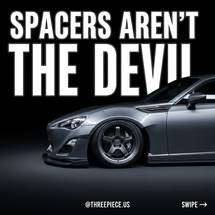
Most people treating 15mm spacers like they're going to kill you have never actually run them. The internet loves to hate spacers, but here's the reality: a quality 15mm spacer solves more fitment problems than it creates. Yes, there are risks — but they're not what most people think.

Quick links
- Why spacers actually work for most setups
- The real risks (not what forums tell you)
- What 90% of people completely miss
- How to do it without compromising safety
Why spacers actually work for most setups
The biggest advantage of 15mm spacers is brake caliper clearance. Instead of limiting your wheel choices to only designs with deep enough barrels, a thin spacer opens up the entire market. This matters more than most people realize — especially on cars with Brembo or other large brake packages.

Spacers also fix scrub radius when you size up from factory wheels. Going from 17-inch to 18-inch wheels changes the contact patch geometry, and a small spacer brings the steering feel back to factory specs. This is why our 17 vs 18-inch wheel comparison recommends spacers for certain size-up scenarios.
Hub-centric spacers distribute load properly through the hub bore, not the wheel studs. This is identical to how a wheel with a deeper barrel works — the hub carries the weight, studs provide clamping force. Check out our guide on hub-centric rings for the full explanation of why this matters.
The real risks (not what forums tell you)
The actual dangers aren't what keyboard warriors claim. Cheap slip-on spacers without hub rings will vibrate and loosen — but that's a quality issue, not a spacer issue. Universal spacers from eBay are garbage because they can't be hub-centric to your specific car.

Going beyond 25mm changes suspension geometry enough to affect handling. Your car's engineers designed the suspension pickup points around a specific scrub radius and track width. Thick spacers push you outside those parameters, which is why we stick to thin corrections for daily drivers.
Not using longer bolts or studs is the real killer. Thread engagement needs to be at least 1.5 times the bolt diameter — so M14x1.5 bolts need minimum 21mm of thread engagement. A 15mm spacer means you need bolts that are 15mm longer than stock. The M8x32 assembly bolts at $10 are perfect for 3-piece wheel builds requiring proper thread engagement.
What 90% of people completely miss
OEMs use spacers from the factory. BMW M cars run them on the rear axle to achieve proper track width without redesigning the entire suspension. If spacers were instant death, BMW wouldn't stake their reputation on them in $80,000 performance cars.

Proper hub-centric spacers are machined parts, not universal slip-ons. Companies like H&R and Eibach machine them to your car's exact hub bore and bolt pattern. The Eibach suspension components starting at $114 show the same precision engineering that goes into their spacers.
Most fitment "fixes" change offset anyway. Switching from a +45 offset wheel to a +30 offset wheel moves the contact patch outward by 15mm — exactly what a 15mm spacer does. The spacer just does it honestly instead of forcing you into a specific wheel design. Our offset guide explains why aggressive offsets cause more problems than spacers ever will.
How to do it without compromising safety
H&R or Eibach only. Get hub-centric spacers machined for your specific car's hub bore and bolt pattern. Generic spacers are trash because they can't be hub-centric to every car — they rely on the wheel studs to carry the load, which causes vibration and loosening.

15-20mm max for daily drivers. Any more and you're changing the car's character in ways the engineers never intended. This keeps you within the suspension's design parameters while solving clearance issues. For reference, the Daystar coil spacers at $135 show how even suspension spacers are engineered for specific applications.
Longer wheel bolts are mandatory. Calculate thread engagement before you drive. Stock bolts plus spacer thickness equals disaster — you need bolts that are at least as long as the spacer thickness plus original engagement depth. The M7x32 assembly bolts at $10 work for most metric applications requiring extended length.
If you're building a proper setup, browse our wheel accessories section for quality hardware. The 90-degree valve stems at $3.80 and M8 assembly nuts at $3.80 complete the proper installation with OEM-quality components.
Stop letting forum myths dictate your build decisions. Quality spacers solve real problems when installed correctly. Check out our vehicle gallery to see properly executed builds that use spacers as part of a complete fitment solution. The difference between a hack job and a professional setup isn't the spacers — it's the quality and installation method.