

Posted by THREEPIECE.US on May 4th 2026
ECU Tune Worth It? Real Dyno Numbers and Honest Verdict
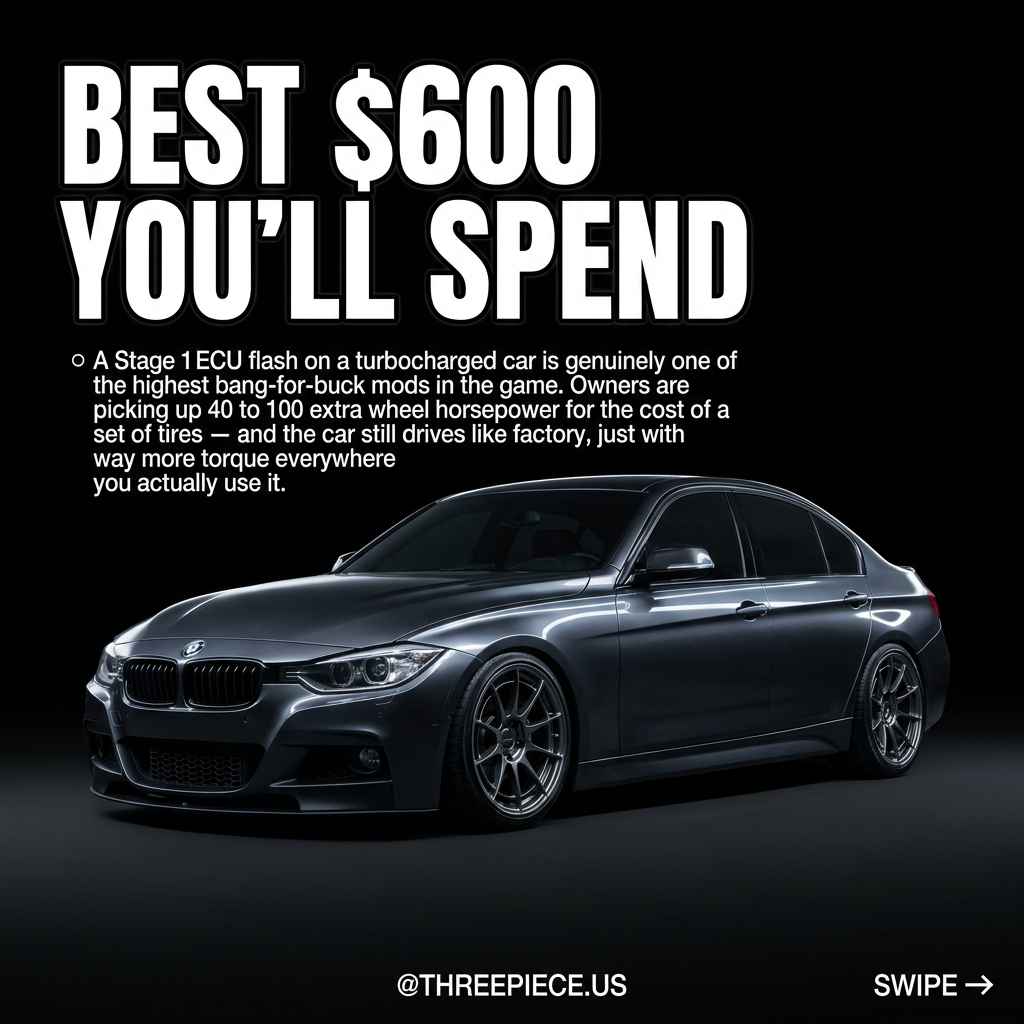
An ECU tune is the single highest horsepower-per-dollar modification you can make to a turbocharged car. That's not hype — it's backed by dyno sheets, forum data, and tens of thousands of miles of real-world ownership across platforms from the VW GLI to the Audi S6. But the conversation changes completely depending on whether your car is forced induction or naturally aspirated, and most content glosses over that distinction. Here's what actually happens when you flash your ECU, what it costs, what breaks, and whether it's worth it for your specific build.
Quick links
- Why the Gains Are Real on Turbo Cars
- NA Cars: A Completely Different Equation
- What an ECU Tune Actually Costs You
- Risks, Failures, and Warranty Tradeoffs
- The Verdict: Who Should Tune and Who Should Wait
Why the Gains Are Real on Turbo Cars
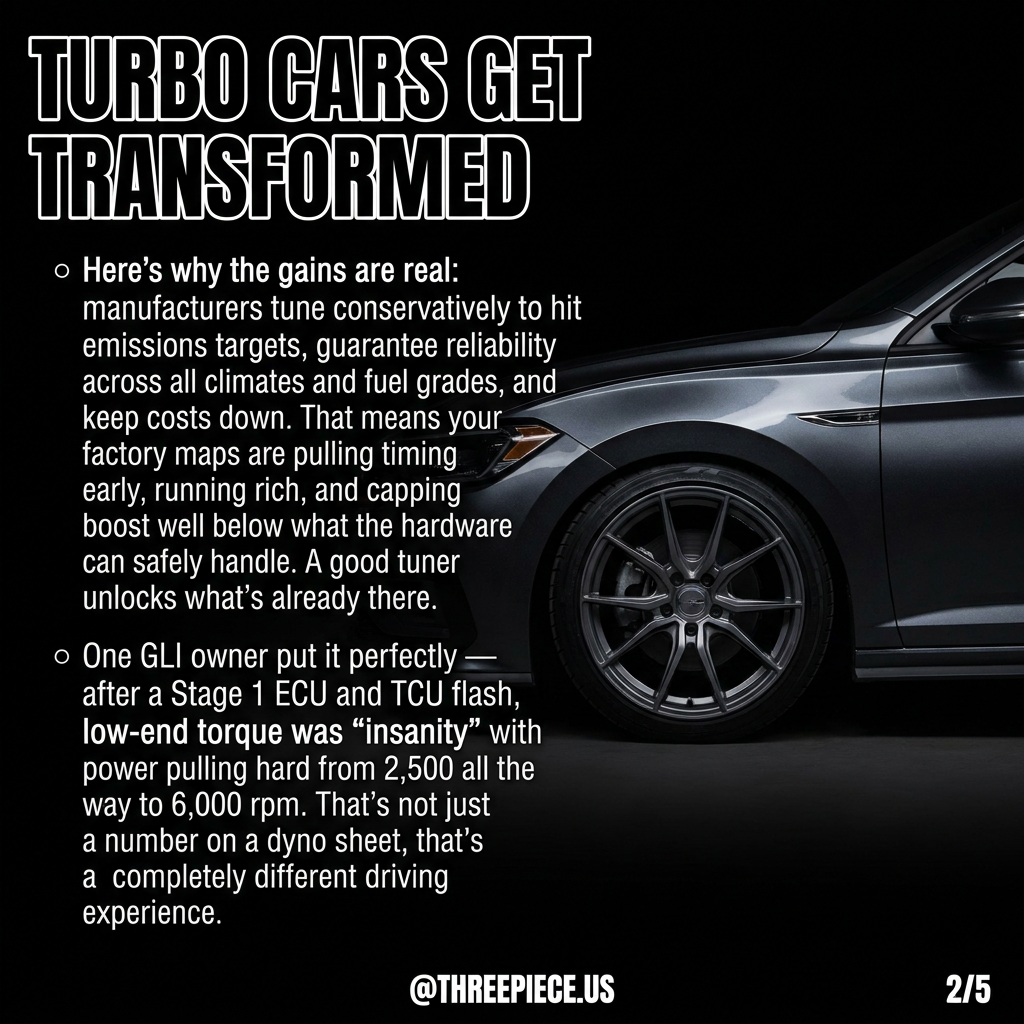
Manufacturers don't ship your car with the best possible tune. They ship it with the safest possible tune — one that has to work on 87 octane in Phoenix in August, pass emissions in California, and survive owners who never change their oil. That means your factory maps are pulling timing early, running overly rich fuel mixtures, and capping boost well below what the turbo, intercooler, and internals can safely handle. A good tuner doesn't add anything magical — they unlock what's already there.
The numbers back this up. A 2016 Audi S6 owner on Audizine ran a baseline dyno at ~414 whp / 436 wtq, then flashed an APR Stage 1 ECU and TCU tune on 93 octane. The result: 531 whp / 664 lb-ft — a gain of +117 whp and +228 wtq from software alone. On the more affordable end, real Stage 1 vs Stage 2 dyno data shows BMW B58 owners (M340i, A90 Supra) picking up +80 to 100 whp from a $600 software license. That works out to roughly $6–$8 per wheel-horsepower gained. Nothing else in the modification world touches that ratio.
One GLI owner described the transformation perfectly: after a Stage 1 ECU and TCU flash, low-end torque was "insanity" with power pulling hard from 2,500 all the way to 6,000 rpm. That's not just a number on a dyno sheet — that's a completely different car. If you're building a GTI or Golf R platform, a downpipe plus Stage 2 tune for around $1,800 combined puts you into the low 400s at the wheels. The Hyundai/Kia 2.0T crowd is seeing +30–50 whp and +50–70 wtq from a SeoulfulRacing reflash on stock hardware — platforms like the Elantra N and Veloster N respond incredibly well to software.
NA Cars: A Completely Different Equation
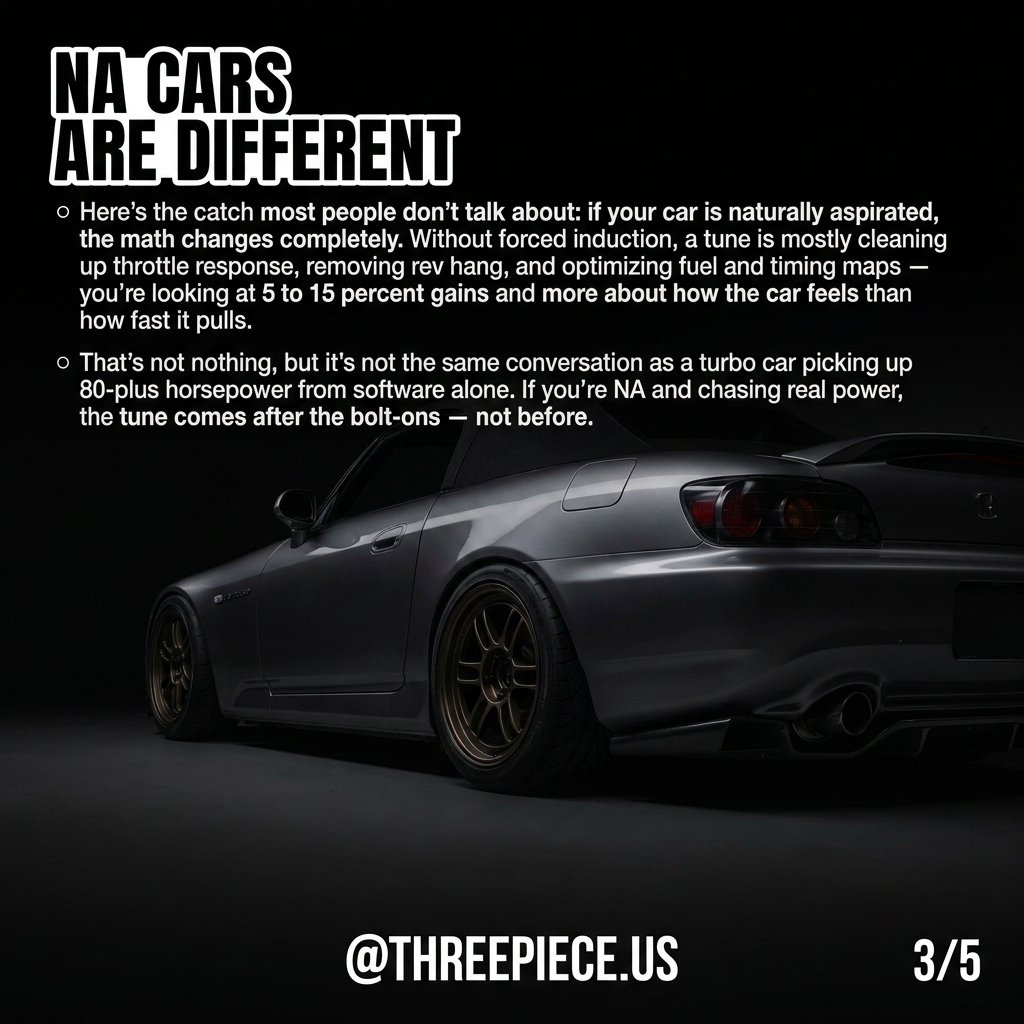
Here's the part most tuning companies won't tell you upfront: if your car is naturally aspirated, the math changes completely. Without forced induction to manipulate boost pressure, a tune is limited to optimizing ignition timing, cleaning up fuel maps, removing rev hang, and adjusting throttle response curves. You're looking at 5–15% gains and it's more about how the car feels than how fast it pulls.
An NC Miata owner on Miata.net ran a MotoEast tune on top of intake, exhaust, and header — the result was +10–24 hp and +10–16 lb-ft spread across the RPM band, plus removal of the annoying factory second-gear power cut. That's noticeable and worth doing if you already have bolt-ons, but it's not the same conversation as a turbo car picking up 80+ whp from software alone. An Infiniti G37 with an Osiris/UpRev tune showed +12 whp / +3 wtq — smoother power delivery and eliminated detonation under load, but not a transformation.
If you're on an NA platform — a VQ35DE 350Z, an S54 E46 M3, or an FA20 FR-S — the tune should come after the bolt-ons, not before. Header, intake, exhaust, and then a tune to tie it all together. On its own, the software just isn't going to deliver the same bang for the buck that a turbo car sees. Sometimes a set of lightweight wheels and quality tires will change how your car feels more than chasing 15 extra horsepower. Browse the Work Emotion lineup or check our vehicle gallery for real builds that prioritize the complete package.
What an ECU Tune Actually Costs You
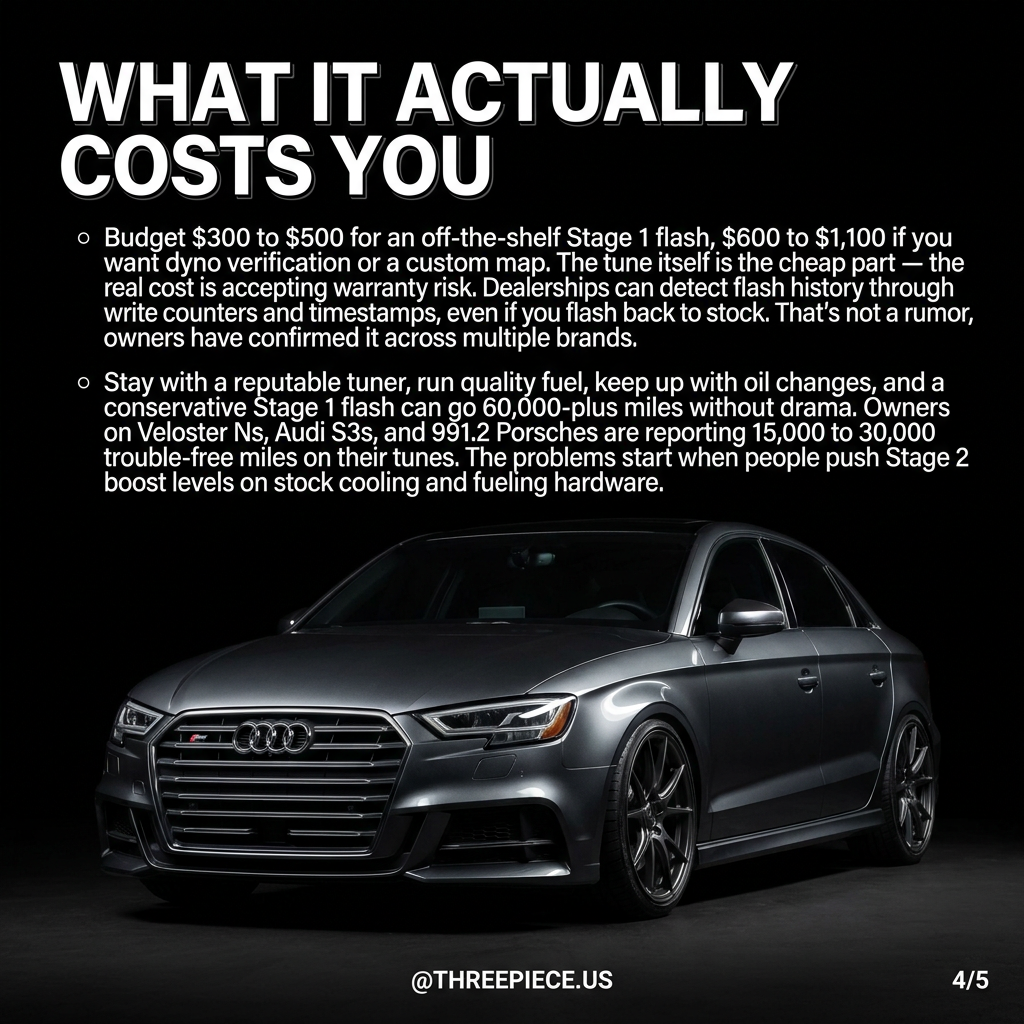
Budget $300–$500 for an off-the-shelf Stage 1 flash and $600–$1,100 if you want dyno verification or a custom map dialed in for your specific bolt-ons and fuel. The software itself is the cheap part. The real costs come in two forms: supporting modifications and warranty exposure.
For supporting mods, a Stage 1 flash on stock hardware is generally safe — most reputable tuners design their maps around the factory intercooler, fuel system, and cooling capacity. The problems start when people try to run Stage 2 boost levels on stock cooling and fueling. If you're pushing past Stage 1, you need to budget for a downpipe, upgraded intercooler, and potentially an intake upgrade — though read our breakdown on cold air intake problems before you throw money at a CAI that doesn't actually help. On EcoBoost platforms like the Focus ST or Focus RS, the mod order matters enormously — intercooler before tune, not after.
On the maintenance side, run 91–93 octane consistently, keep up with oil changes, and monitor your car's behavior. Owners on Veloster Ns, Audi S3s, and 991.2 Porsches are reporting 15,000–30,000 trouble-free miles on Stage 1 tunes, and conservative flashes on well-maintained cars regularly go 60,000+ miles without drama. The key word is conservative — a reputable tuner with a track record on your platform, not the cheapest flash you found on a forum.
Risks, Failures, and Warranty Tradeoffs
Let's talk about the part nobody wants to hear: dealerships can detect flash history. Flash write counters, checksums, bootloader flags — even if you flash back to stock before a service visit, the evidence is often still there. Multiple Kia Stinger owners have reported dealerships claiming any ECU flash "100% voids" the powertrain warranty. This isn't a rumor — it's confirmed across multiple brands and multiple forums.
On the failure side, the most common issue is LSPI (Low Speed Pre-Ignition) on small-displacement turbocharged direct-injection engines. The 1.5T and 2.0T platforms are particularly vulnerable — factory low-RPM boost combined with aggressive tuning makes LSPI much more likely, which can wreck pistons and head gaskets. Owners on DriveAccord and EcoBoost Mustang forums have documented these failures, and they're not always the tune's fault — some of these engines have weak points that a tune simply exposes faster. The N54 335i is a textbook example of a platform where tuning unlocks massive power but also accelerates known failure points like charge pipes and wastegate actuators.
There's also the install quality factor. A K20A2 owner on Hondata's forum loaded a "stock mods + calibration" tune with a cheap aftermarket TPS and ended up with erratic idle and destroyed low-end power. The tune was fine — the hardware and install were the problem. If you're building a K-series Honda, platforms like K-Pro give you incredible control, but you need every sensor and supporting part to be right. One K20A2 build with cold air intake, exhaust, header, RBC intake manifold, and K-Pro tuning hit ~225 whp / ~160 lb-ft — real numbers, but only because everything was done correctly.
The takeaway: a tune doesn't exist in isolation. It's the final piece that ties your modifications together. If the supporting hardware isn't there — or if it's installed poorly — the tune can't save you. Make sure your suspension, cooling, and fueling are sorted before you start chasing power numbers.
The Verdict: Who Should Tune and Who Should Wait
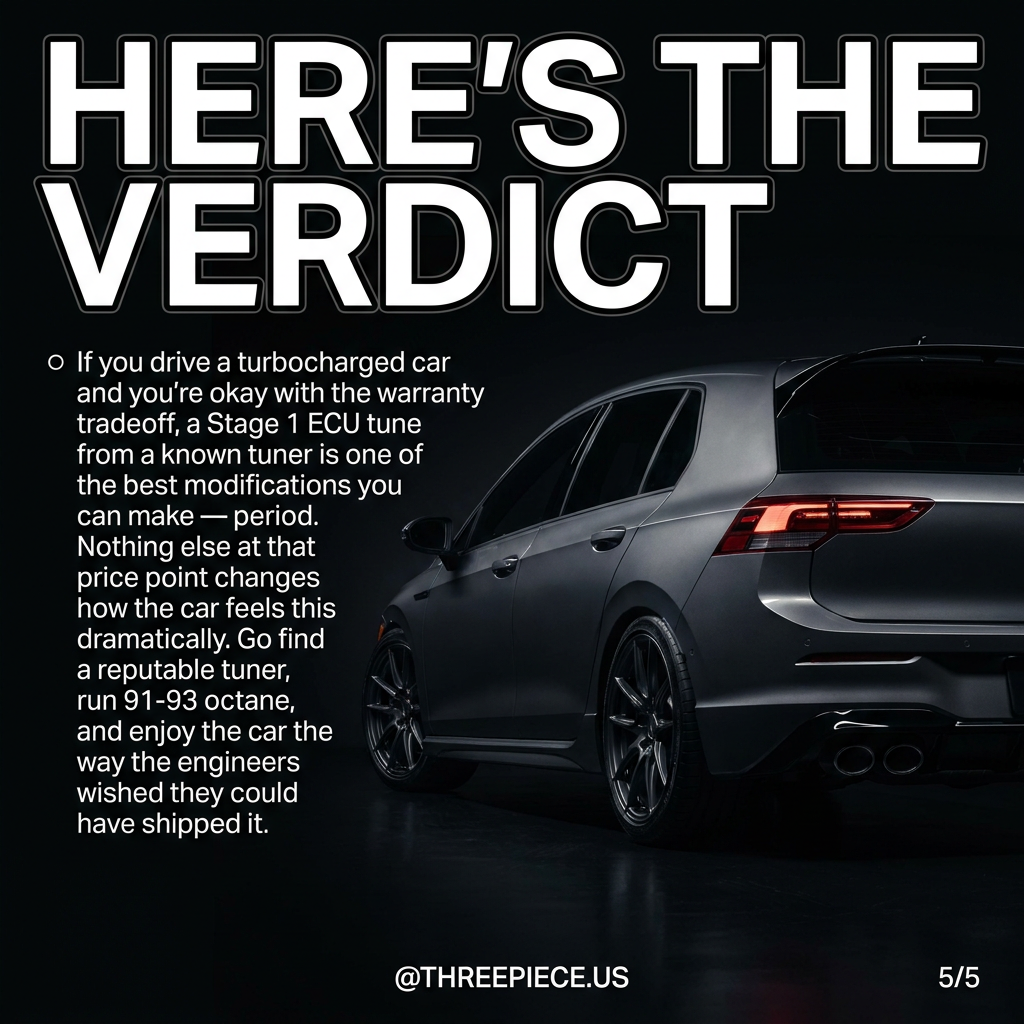
If you drive a turbocharged car and you're okay with the warranty tradeoff, a Stage 1 ECU tune from a reputable tuner is one of the best modifications you can make — period. Nothing else at that price point changes how the car drives this dramatically. Whether you're on a B8 S4 3.0T, an F30 335i N55, a Mazdaspeed 3, or an FK8 Civic Type R, the formula is the same: find a tuner with a proven track record on your platform, run 91–93 octane, stay on top of maintenance, and enjoy the car the way the engineers wished they could have shipped it.
If you're naturally aspirated, temper your expectations. A tune is still worthwhile — especially after bolt-ons — but the gains are modest and the money might be better spent elsewhere first. A lightweight flywheel will change how the car revs. Quality coilovers will change how it handles. And a set of properly fitted lightweight wheels will change how the entire car feels in ways that 15 extra horsepower simply can't match. If you're running a BRZ/GR86 or a 370Z, the tune comes after headers, exhaust, and intake — not before.
No matter which route you take, the wheels and tires are what actually put that power down. Browse our full wheel catalog to find the right setup for your build, and grab a set of 90-degree valve stems at $3.80 each while you're at it — because nothing ruins a clean wheel setup faster than a busted valve stem. Finish the look with a Work VS Reproduction Center Cap at $50 or a Work Rezax Reproduction Center Cap at $50 if you're running Work barrels. The tune makes the car faster — the right wheels and fitment make it complete.