

Cold Air Intake Problems: 3 Reasons to Skip the CAI
A cold air intake is the most popular first mod in the sport-compact world — and it's also the one most owners end up regretting. The marketing promises 10-15 horsepower, the reality delivers 1-5 hp at peak RPM, and the side effects range from annoying to engine-ending. We already covered the nuances in our deep dive on whether a cold air intake is worth it. This article is the blunt version: three documented reasons to keep your wallet closed and your stock airbox bolted in.

Quick links
- You're paying for noise, not power
- Your MAF sensor will hate you
- Water goes where air goes
- Where that $300 actually makes a difference
- Final verdict
You're Paying for Noise, Not Power
On a stock naturally aspirated engine, most aftermarket cold air intakes deliver somewhere around 1-5 horsepower at peak RPM. That's not a conservative estimate — that's what repeated dyno testing on platforms from WRXs to Maximas to Civic Sis consistently shows. Worse, owners across these platforms report actually losing mid-range torque in the RPM range where you spend most of your time driving. One Maxima owner summed it up perfectly: "it just gets you more noise, more dirt, and in most cases more heat into your engine."
Here's the part nobody wants to hear: your factory airbox is already engineered with tuned resonators, sealed ducting, and calibrated intake runners that keep intake air temperatures low and airflow smooth. OEM engineers spent millions optimizing that system. Ripping it out for an exposed cone filter sitting in the engine bay often means you're sucking hot air, not cold air. That's the cruel irony — the mod literally named "cold air intake" frequently raises your intake temps during city driving and idle. Heat soak from the engine bay wrecks whatever marginal gain the less-restrictive filter media provides.

If you're building a turbo car and thinking a CAI is the gateway to real power, understand the difference between Stage 1 and Stage 2 tune results. A CAI alone, without ECU calibration, often disrupts the OEM airflow profile enough to cause drivability issues while delivering nothing measurable on the dyno. The intake is a supporting mod — it belongs at the end of your mod order, not the beginning.
Your MAF Sensor Will Hate You
This is the problem that generates the most forum threads and the most regret. Oiled cotton filters — the kind that come in most popular CAI kits from brands like K&N and Injen — shed oil onto your Mass Air Flow (MAF) sensor over time. The MAF's exposed heating element or hot wire gets coated, and suddenly your ECU is getting inaccurate air mass readings. The result: lean or rich fuel trim codes, rough idle, hesitation, poor throttle response, surging, and Check Engine Lights (CELs).
This isn't theoretical. BMW owners frequently cite CELs within weeks of CAI installs — faulty sensor alignment, loose connections, or altered airflow profiles are the usual culprits. A Chevy Malibu 1.5 Ecotec owner posted classic symptoms: CAI install, lean air codes, MAF code, possible vacuum leak, engine feels off. The diagnostic tech confirmed the CAI was causing every issue. Swap back to stock, problems vanish.
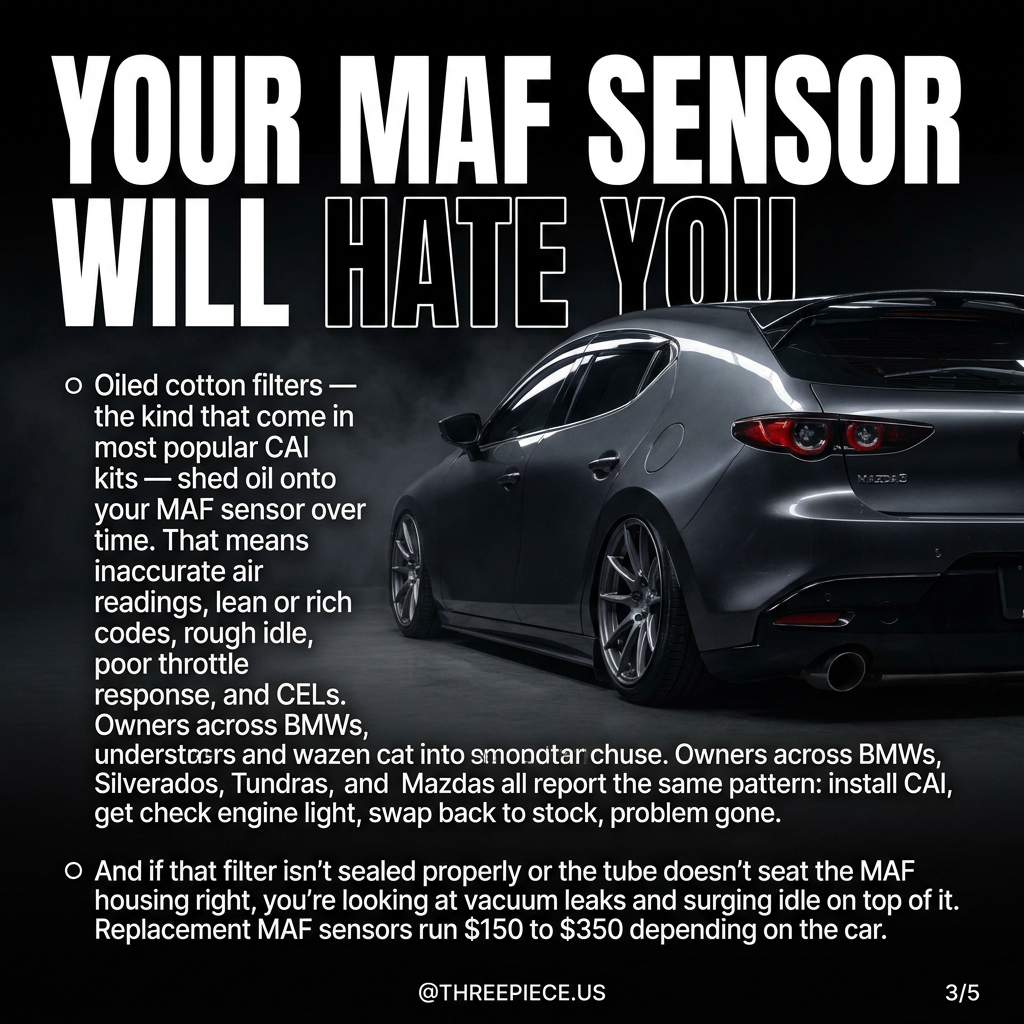
And it's not just the oil. If the intake tube doesn't seat the MAF housing perfectly — and many aftermarket kits don't — you're introducing vacuum leaks and turbulent airflow that the sensor wasn't calibrated for. Replacement MAF sensors run $150 to $350 depending on the platform. So that $300 intake you bought to gain 3 horsepower could easily cost you another $300 in sensor replacement, plus hours of diagnostic frustration. If you're running an N54-powered BMW, you already know the platform is sensitive enough — read our N54 problem breakdown to understand why adding intake variables to that engine is a bad idea. The same logic applies to the N55 in the F30 335i build guide — notice how intake isn't at the top of the mod order.
Water Goes Where Air Goes
Your stock airbox is sealed and mounted high in the engine bay for a reason. Low-mounted cone filters — the kind most CAI kits use to get the filter closer to "cold" air near the fender or bumper — are exposed to rain, puddles, and road splash in ways the factory never intended. Owners have reported stalls, misfires, and CELs from water saturating the filter element during heavy rain. In a worst case, enough water ingestion causes hydrolock — water enters the combustion chamber, the piston can't compress it, and connecting rods bend. That's not a sensor replacement. That's an engine rebuild.

An F-150 EcoBoost owner running an Injen CAI noted that while the risk is minimal under normal driving, it becomes very real in any standing water situation. A BMW 323i owner with an AEM intake had foam and water enter the cone in heavy rain, triggering stalls and CELs — returning to stock eliminated everything. Civic Si owners considering Skunk2 CAIs are routinely warned on 9th-gen forums to at least run a waterproof pre-filter or keep the filter mounted as high as possible.
The takeaway: if you live anywhere it rains regularly, or if you ever drive through standing water, a low-mounted CAI is a liability your stock airbox simply isn't. The risk-reward math doesn't work when the reward is 3 horsepower and the risk is bent connecting rods.
Where That $300 Actually Makes a Difference
This is the part that matters. If you've got $250-400 burning a hole in your pocket and you want to actually feel a difference every time you drive, here's where that money goes further than a cold air intake ever will.
Turbo cars: downpipe first. On any turbocharged platform, a catted downpipe paired with an ECU tune is the single biggest bang-for-buck power mod available. The factory downpipe is the primary exhaust restriction on most turbo setups, and replacing it unlocks measurable spool improvement and top-end power that a CAI alone can't touch. For the 10th-gen Civic Si and Sport Touring, the Invidia catted 70mm downpipe at $1,044 is a proven piece. If you're on the Civic platform with a tighter budget, the Skunk2 catted downpipe kit at $768 is the move. FK8 Type R owners should look at the Skunk2 Type R downpipe for $825. Our FK8 buying guide covers why this platform responds so well to exhaust-side mods.

Running a BMW G80 M3 or G82 M4? The Akrapovic catted downpipe at $4,348 is the gold standard — expensive, but it's a genuine performance piece, not a noise maker. For F-150 EcoBoost owners who were considering a CAI, the Stainless Works 3-inch downpipe with high-flow cats at $1,527 is where the real power lives on that 3.5L twin-turbo.
NA cars: exhaust and suspension. On a naturally aspirated platform, the intake side is rarely the bottleneck. Your money goes further on a quality cat-back exhaust system that actually improves flow — like the aFe Takeda cat-back for the 370Z at $1,890. If you're building a Z, check our 370Z VQ37VHR mod order guide — notice where intake falls in the priority list (hint: not first).
Or skip the engine entirely and put that money toward something you feel every single drive. Quality coilovers transform how a car handles, communicates, and looks. A proper set of aftermarket wheels drops unsprung weight and changes the entire character of the car. Browse our vehicle gallery to see what a wheel and suspension setup does for a build versus a cone filter zip-tied to a fender liner. If you're not sure where to start with wheel sizing, our GR86 fitment guide and G35 fitment guide show how much detail goes into getting it right.
For platform-specific mod orders that put every dollar in the right place, we've written guides for the Focus ST, WRX STI, FR-S/86, G37, and RX-8. Every single one of them puts intake modifications well behind exhaust, tuning, suspension, and wheels.
Keep the Stock Airbox. Spend Smarter.
A cold air intake on a stock or lightly modded car is a $300 noise generator with real downsides: MAF contamination, heat soak, hydrolock risk, and power gains so small they're within dyno margin of error. The factory airbox works. It was designed by engineers who spent millions on airflow simulation, sensor calibration, and filtration — and it does all of that better than a cone filter in your engine bay.
Save the intake upgrade for when the rest of your build actually demands the airflow. Until then, put that money toward wheels, suspension, exhaust, or tuning — the mods you actually feel every time you turn the key.