F30 335i N55 6MT Build Guide: Mod Order That Works
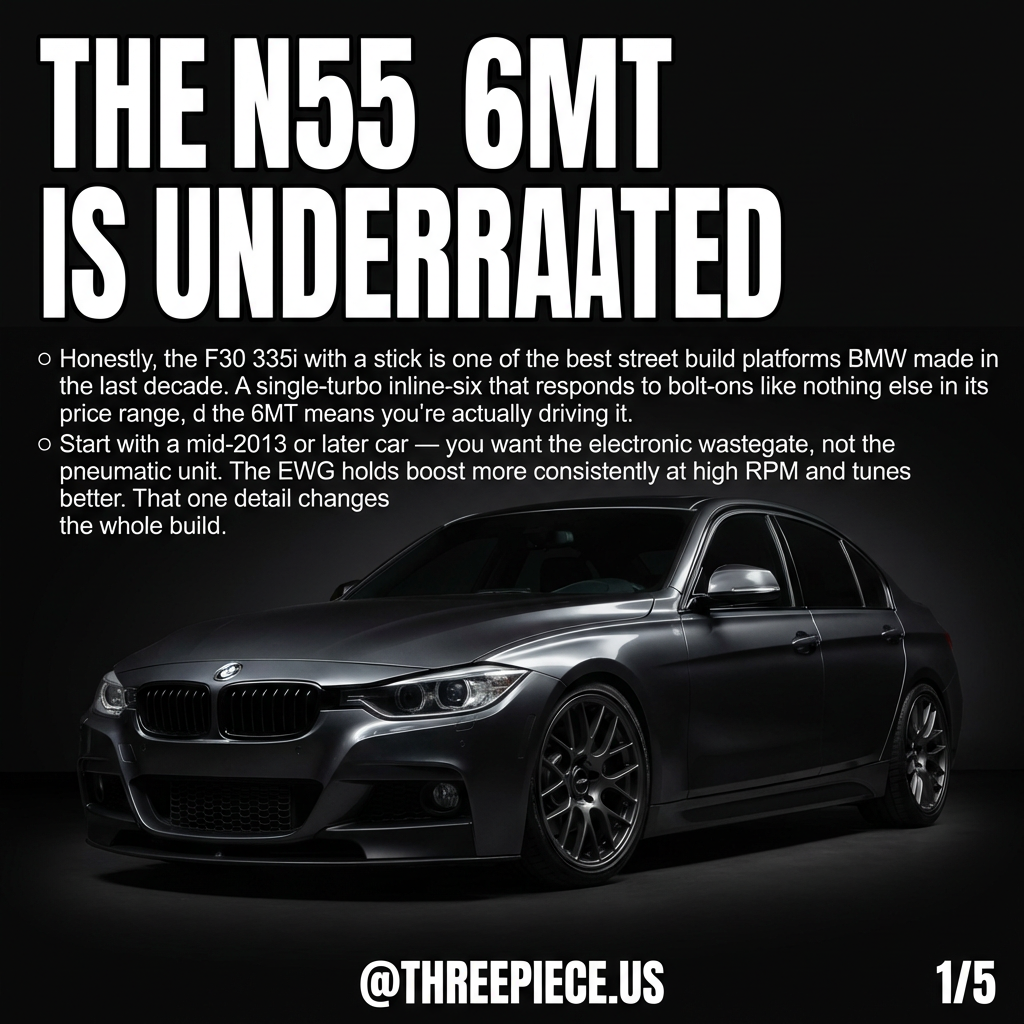
The BMW F30 335i N55 6MT is quietly one of the best build platforms BMW produced in the last fifteen years. A single-turbo inline-six that responds to bolt-ons like almost nothing else in its price range, paired with a six-speed manual that keeps you connected to every bit of power you add. While everyone was chasing F80 M3 markups, the N55 manual was sitting on lots making 300+ whp on a Stage 1 flash for the cost of a nice dinner. Here's how to build one properly — in the right order, with the right parts, so you don't waste money or wreck the car.
Quick links
- Why the EWG N55 Changes Everything
- Tune First, Bolt On Second
- Suspension Setup That Actually Works
- F30 Wheel Fitment Specs
- The Finished Build
Why the EWG N55 Changes Everything
Not all F30 335i models are created equal, and this is the detail most buyers miss. Early 2012 and early-2013 N55 engines came with a pneumatic wastegate (PWG) that struggles to hold consistent boost at high RPM. The result is sagging power up top and inconsistent tune behavior — not what you want on a car you're about to throw money at. Starting around mid-2013, BMW switched to an electronic wastegate (EWG), which holds boost more precisely under load and tunes significantly better. If you haven't bought the car yet, this is the single most important spec to check. The EWG variant is the one you want.
If you already own a PWG car, it's still buildable — but the ceiling is lower and the tuning is fussier. Swapping wastegate components is possible but expensive. For anyone still shopping, the E90 335i N54 build guide covers the predecessor platform if you want to compare. The F30 chassis is stiffer, lighter in feel, and the N55's single turbo is more reliable than the N54's twin-turbo setup — fewer headaches, more consistent power delivery.
Tune First, Bolt On Second
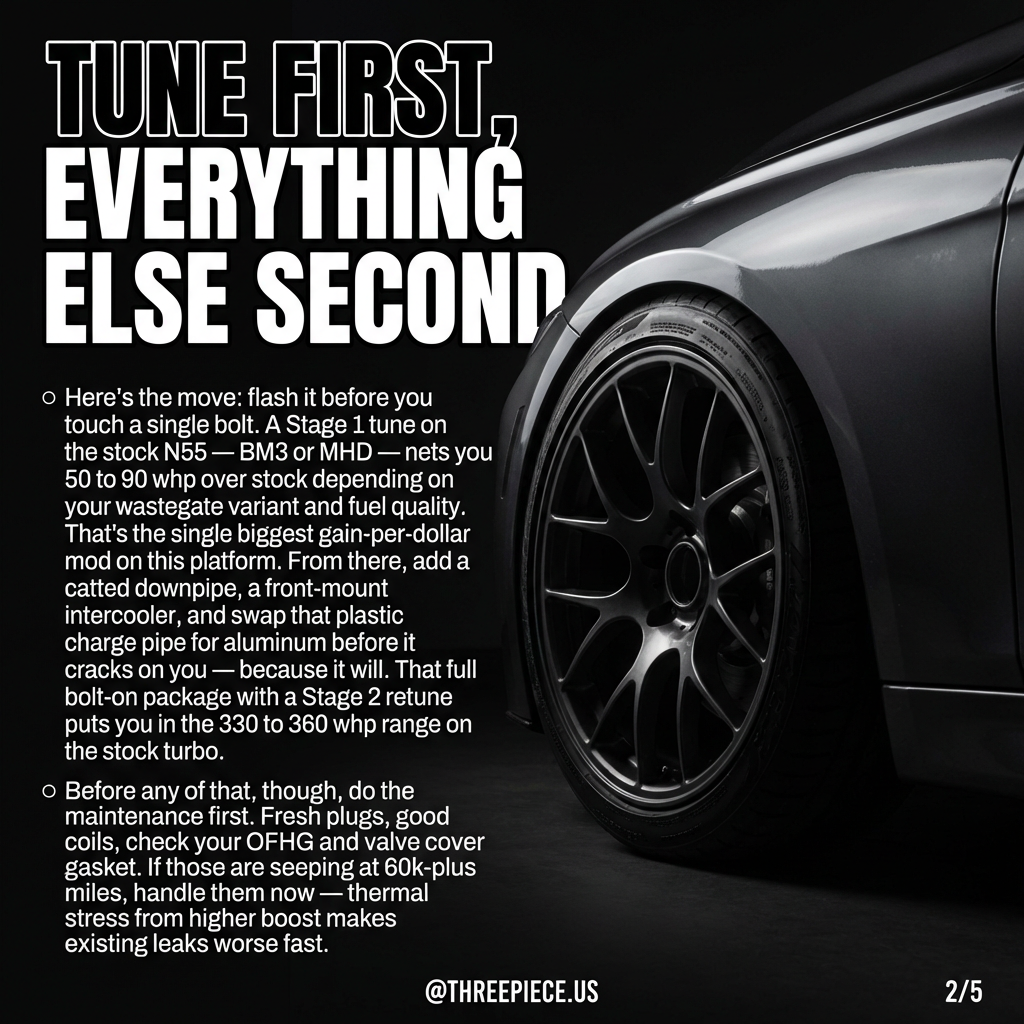
Here's where most people get the order backwards. Before you touch a single bolt, flash the ECU. A Stage 1 tune on the stock N55 — BootMod3 or MHD — nets you 50 to 90 whp over stock depending on your wastegate variant and fuel quality. That's the single biggest gain-per-dollar mod on this platform, and it costs a fraction of what most hardware does. Our Stage 1 vs Stage 2 tune comparison breaks down real dyno numbers if you want to see what these gains look like on paper.
But before even the tune, do the maintenance first. Fresh spark plugs (NGK 97506 laser iridium), good ignition coils (Eldor or Delphi upgrades over degraded OEM units), and check your oil filter housing gasket (OFHG) and valve cover gasket (VCG). Both commonly start seeping around 60,000–100,000 miles, and the thermal stress from higher boost makes existing leaks worse fast. Budget $800–$1,200 in shop labor if either needs replacement. Handle this now so you're not chasing oil leaks while tuned.
From there, the bolt-on path is straightforward:
- Aluminum charge pipe — the OEM plastic unit will crack under boost. Evolution Racewerks and BMS are the most common replacements. This is a reliability mod as much as a performance one.
- Catted downpipe — removes the most restrictive point in the exhaust. Owners report +50–70 whp combined with a Stage 2 retune versus stock. If you want to see how intake upgrades compare, that breakdown covers the gains-per-dollar math.
- Front-mount intercooler (FMIC) — the stock top-mount heat soaks quickly under sustained pulls. An Evolution Racewerks or similar FMIC keeps intake temps consistent.
- Cold air intake — MST and aFe are the popular choices. Modest gains on their own, but they complete the airflow path for the Stage 2 retune.
That full bolt-on package with a Stage 2 retune puts you in the 330–360 whp range on the stock turbo. That's the sweet spot for a street car — serious power without pushing the drivetrain past its comfort zone.
If you're going beyond Stage 2 into 400+ whp territory, you need upgraded fuel injectors (Nostrum Stage II DI), a high-pressure fuel pump, and a stronger clutch. The F80 M3 twin-plate clutch and flywheel transplant onto 6-bolt flywheel blocks and is the industry-standard solution for high-torque 6MT builds. Be aware that the GS6-45BZ manual gearbox has documented 2nd-gear failures between 40,000–70,000 miles under abuse or heavy torque — plan accordingly.
Suspension Setup That Actually Works
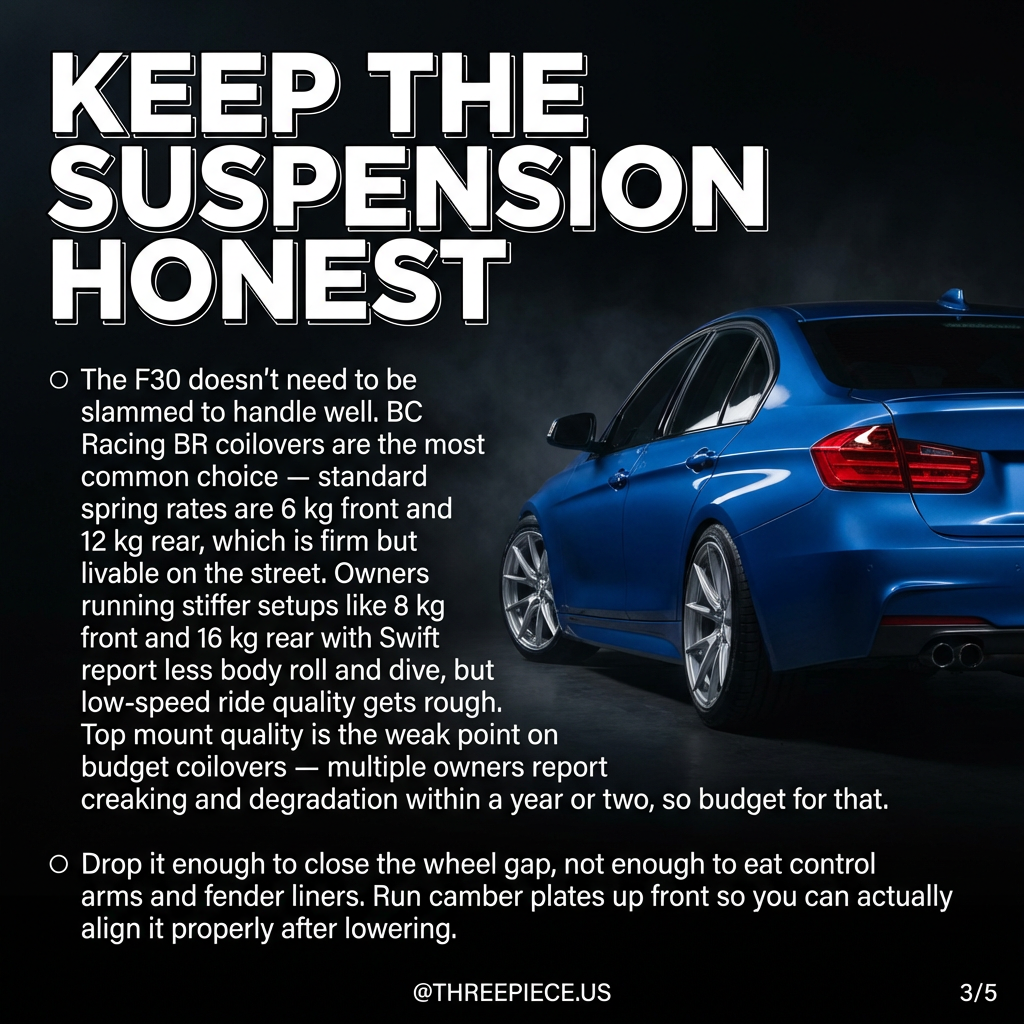
The F30 doesn't need to be slammed to handle well. The goal is closing the wheel gap and improving body control without destroying ride quality or eating through control arms. BC Racing BR coilovers are the most common choice on this platform — standard spring rates are 6 kg/mm front and 12 kg/mm rear, which is firm but livable on the street. Owners running stiffer setups like 8 kg/mm front and 16 kg/mm rear with Swift springs report less body roll and dive, but low-speed ride quality gets rough.
The weak point on budget coilovers is always top mount quality — multiple F30 owners report creaking and degradation within a year or two. Budget for replacement top mounts or factor that into your decision. If you're weighing whether coilovers are the right move at all, our breakdown of whether coilovers are worth it on daily drivers covers the tradeoffs. And if you're considering cheaper options, read why springs beat cheap coilovers before spending money on the wrong setup.
Run camber plates up front so you can actually align the car properly after lowering. Drop it enough to close the wheel gap — not enough to eat fender liners. For aggressive builds, SPL rear suspension arms for camber and toe control are what the high-power builds use to keep the rear planted.
F30 Wheel Fitment Specs
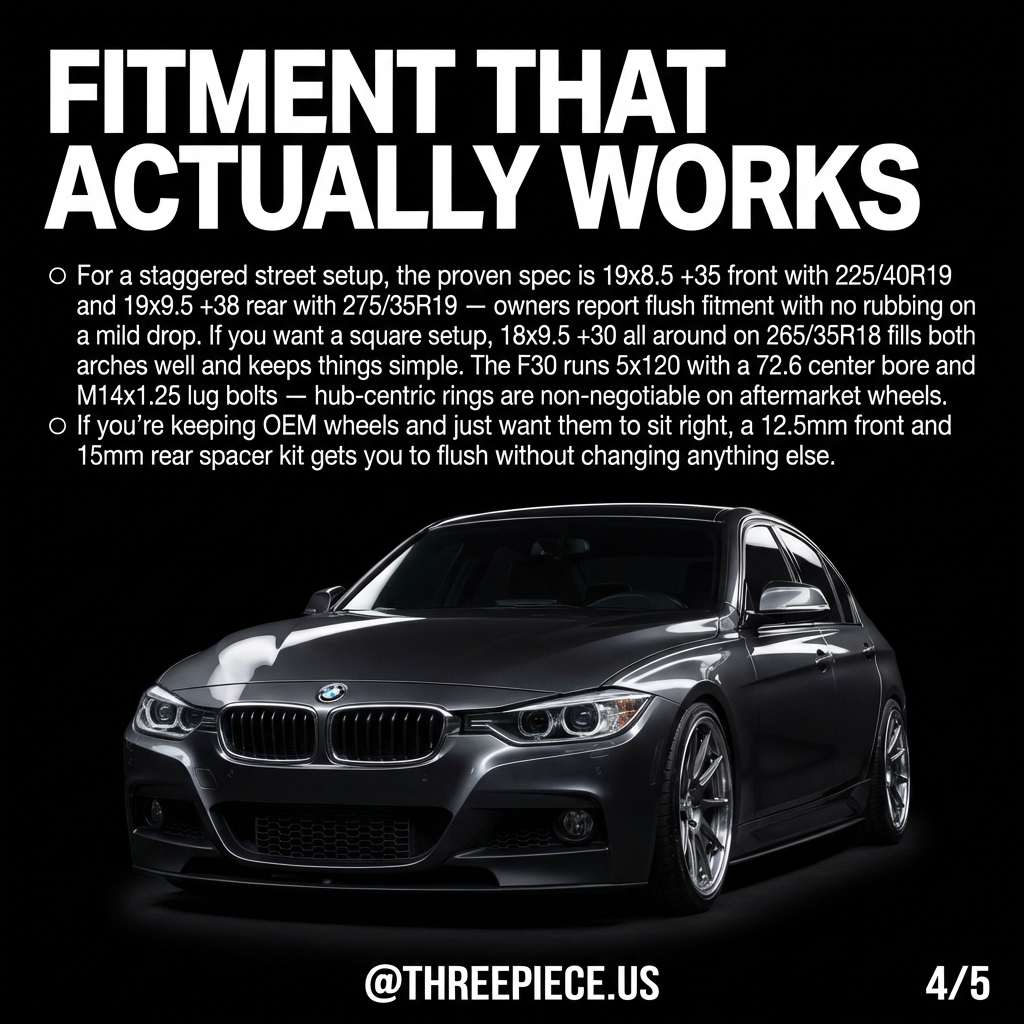
The F30 3 Series runs 5x120 bolt pattern with a 72.6mm center bore and M14x1.25 lug bolts. Hub-centric rings are non-negotiable on aftermarket wheels — skip them and you'll feel vibration at highway speed no matter how well the wheels are balanced. If you're new to fitment details, our wheel spacer safety guide covers the engineering behind proper hub-centric fitment.
For a staggered street setup, the proven spec is:
- Front: 19x8.5 +35 with 225/40R19
- Rear: 19x9.5 +38 with 275/35R19
Owners report flush fitment with no rubbing on a mild drop. For tires, the American Roadstar Sport AS 225/40R19 at $114 is a solid all-season front option, and the American Roadstar Sport AS 275/35R19 at $232 covers the rear. If you want a premium touring tire for the rear, the Continental ProContact TX 275/35R19 at $443 is a step up in wet grip and noise isolation. For winter capability, the Michelin Pilot Alpin 5 275/35R19 at $419 is purpose-built for cold-weather performance.
Browse 19-inch wheels in 5x120 to see what's available for the staggered setup.
If you want a square setup — simpler, better for rotation, and arguably better balanced for a 6MT car you're actually driving hard — the spec is:
- All four corners: 18x9.5 +30 with 265/35R18
This fills both arches well and keeps things simple. The American Roadstar Sport AS 265/35R18 at $108 per tire makes this an affordable square setup. Browse 18x9.5 wheels in 5x120 to find options.
If you're keeping OEM wheels and just want them to sit right, a 12.5mm front and 15mm rear spacer kit gets you to flush without changing anything else. And if you're considering forged wheels for this build, our cast vs forged wheels breakdown covers what actually matters for your setup. Check the vehicle gallery for build inspiration across platforms.
The Finished Build
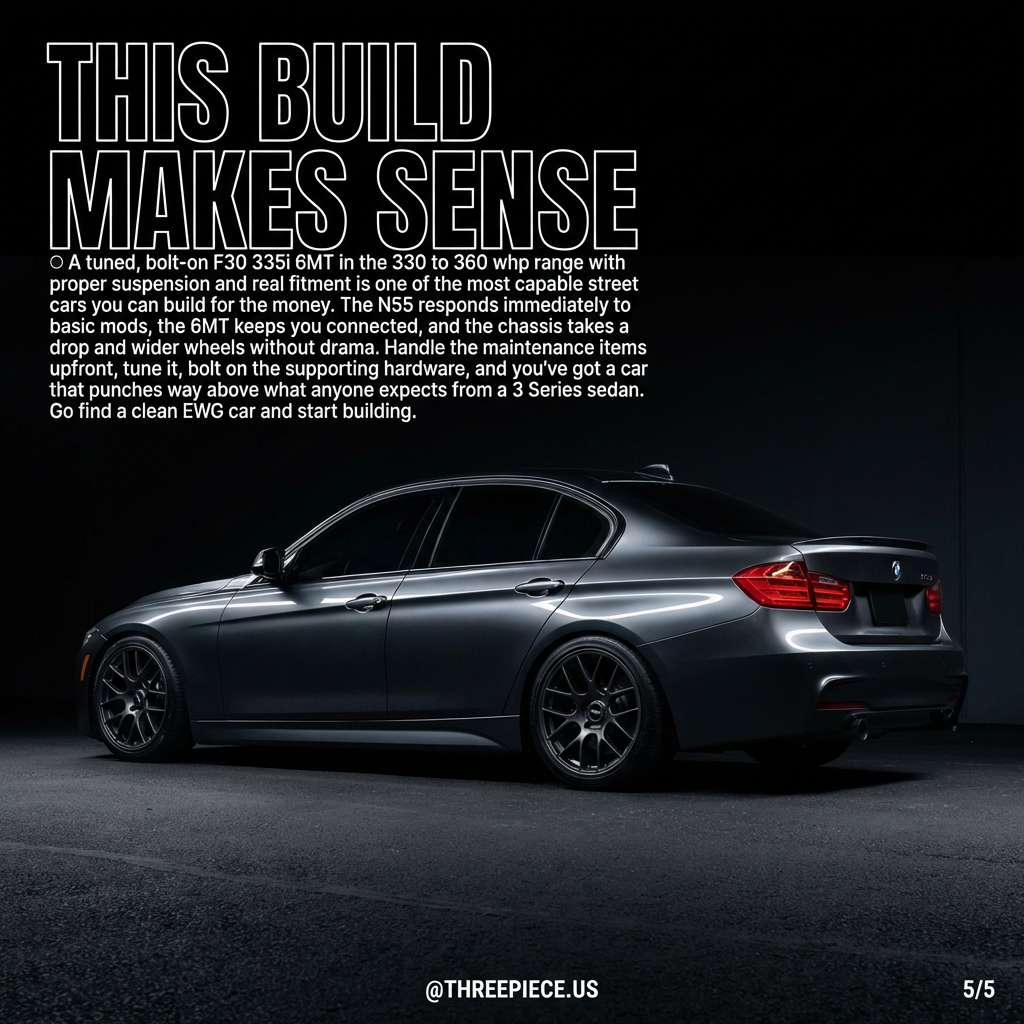
A tuned, bolt-on F30 335i 6MT in the 330–360 whp range with proper suspension and real fitment is one of the most capable street cars you can build for the money. The N55 responds immediately to basic mods, the 6MT keeps you connected, and the chassis takes a drop and wider wheels without drama. Handle the maintenance items upfront, tune it, bolt on the supporting hardware, and you've got a car that punches way above what anyone expects from a 3 Series sedan.
The build path is clear:
- Buy a mid-2013+ EWG car with documented maintenance
- Address gaskets, plugs, and coils before anything else
- Flash Stage 1, enjoy the free power
- Add charge pipe, downpipe, FMIC, intake — retune to Stage 2
- Drop it on quality coilovers with camber plates
- Fit proper wheels and tires in the specs above
If you've already built an E90 335i, the N54 build guide is worth comparing side by side — the F30 is the more refined platform, but the N54 has a higher power ceiling with its twin-turbo setup. For lighting upgrades to finish the look, the Spyder F30 LED DRL Projector Headlights in black at $567 are a clean OEM+ upgrade, and the black smoke variant at $582 gives a more aggressive look.
The F30 335i isn't flashy. It doesn't have an S-prefix engine or a carbon roof. But built with intention, it's one of the most satisfying daily-driven sport sedans you can own — and it still flies under the radar at every meet. Go find a clean EWG car and start building.