
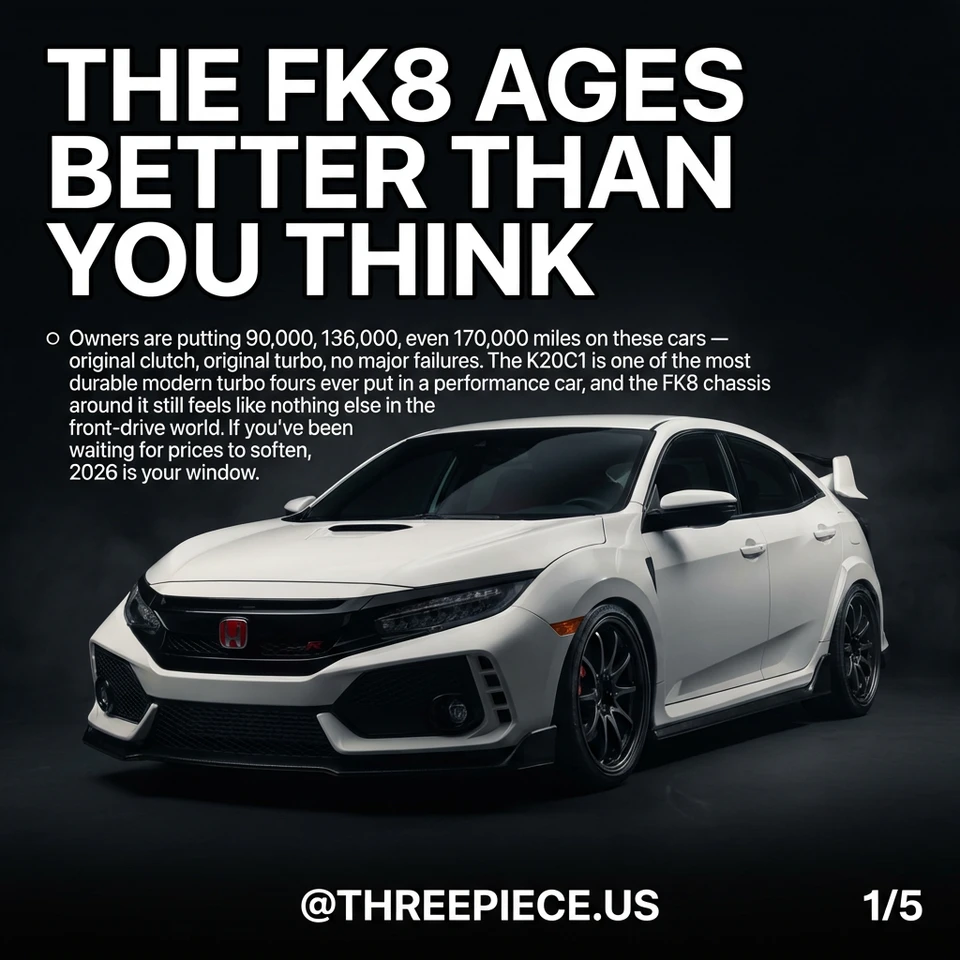
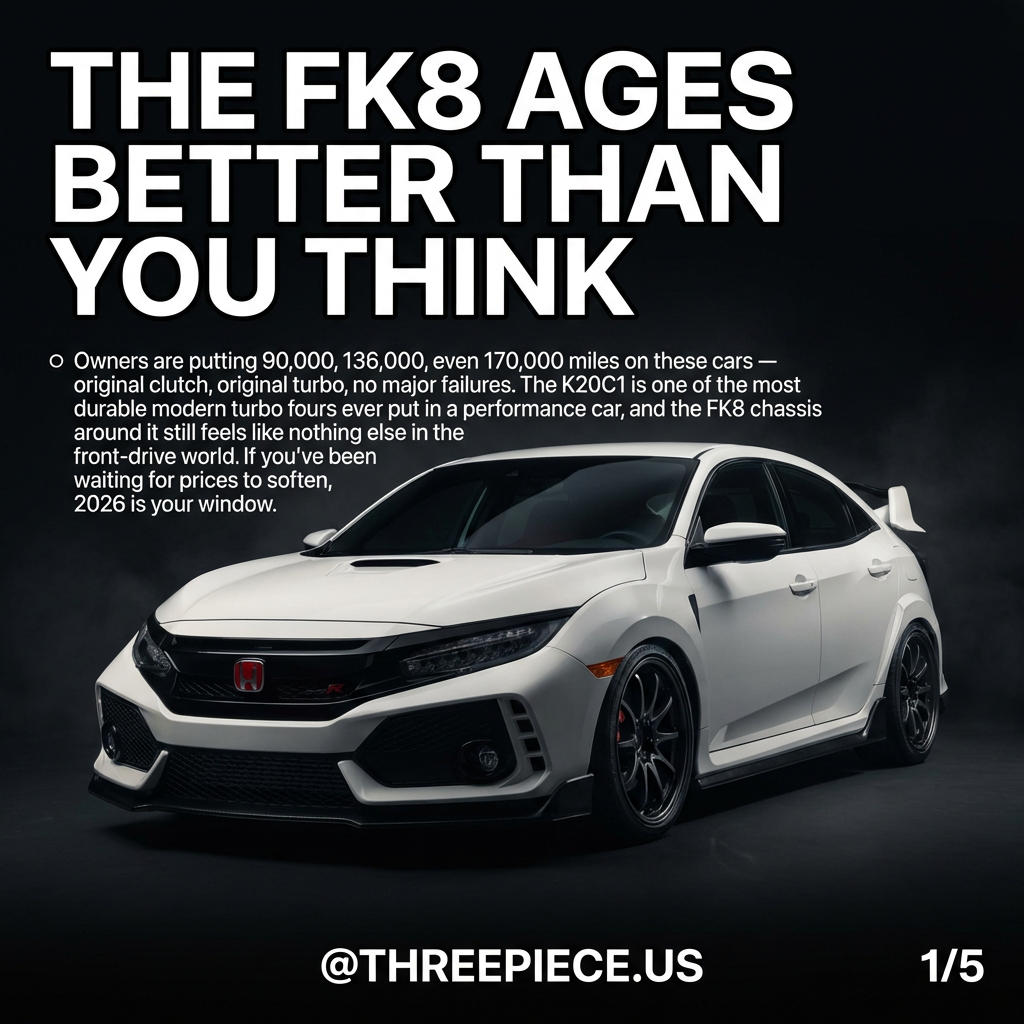
The FK8 Civic Type R was the loudest, most aggressive thing Honda had built in decades — and while the internet spent the last few years arguing about the styling, real owners were quietly stacking miles. We're talking 90,000, 136,000, even 170,000+ miles on original clutches and original turbos. The K20C1 doesn't just survive — it thrives. And now that FL5 markups have cooled and GR Corolla hype has normalized, the FK8 is sitting in a pricing window that won't last. If you've been circling listings for six months, this is the guide that tells you exactly what to look for, what breaks, and what to budget before you sign.
Quick links
- Why the FK8 Ages Better Than You Think
- Nothing Else Feels Like This
- The Tuning Ecosystem Is Fully Mature
- Known Failure Points: What Actually Breaks
- Pre-Purchase Checklist and Budget
- FK8 Wheel Fitment: Why Owners Downsize to 18s
- Stop Circling — Go Buy One
Why the FK8 Ages Better Than You Think
The narrative around the FK8 was always about the wing, the vents, the triple exhaust tips — surface-level stuff that distracted from the mechanical reality underneath. The K20C1 2.0L turbocharged four-cylinder makes 306 horsepower and 295 lb-ft of torque through a close-ratio six-speed manual, and it does this with a reliability record that embarrasses cars costing twice as much. Forum threads are full of owners past six figures on the odometer with nothing more than scheduled maintenance on the books.
The chassis is equally durable. The adaptive dampers hold up, the helical limited-slip differential doesn't grenade itself like clutch-type LSDs in competing platforms, and the dual-axis strut front suspension — Honda's answer to torque steer — still works as intended at high mileage. Compare that to the Mk7 Golf R, which shares a similar price bracket but brings Haldex coupling complexity and DSG mechatronic risk. The FK8 is mechanically simpler and ages better for it.
Clean examples with documented service history are already commanding premiums in Championship White and Phoenix Yellow. The ones with full records are disappearing from the market every month. This isn't a car that's going to get cheaper.
Nothing Else Feels Like This
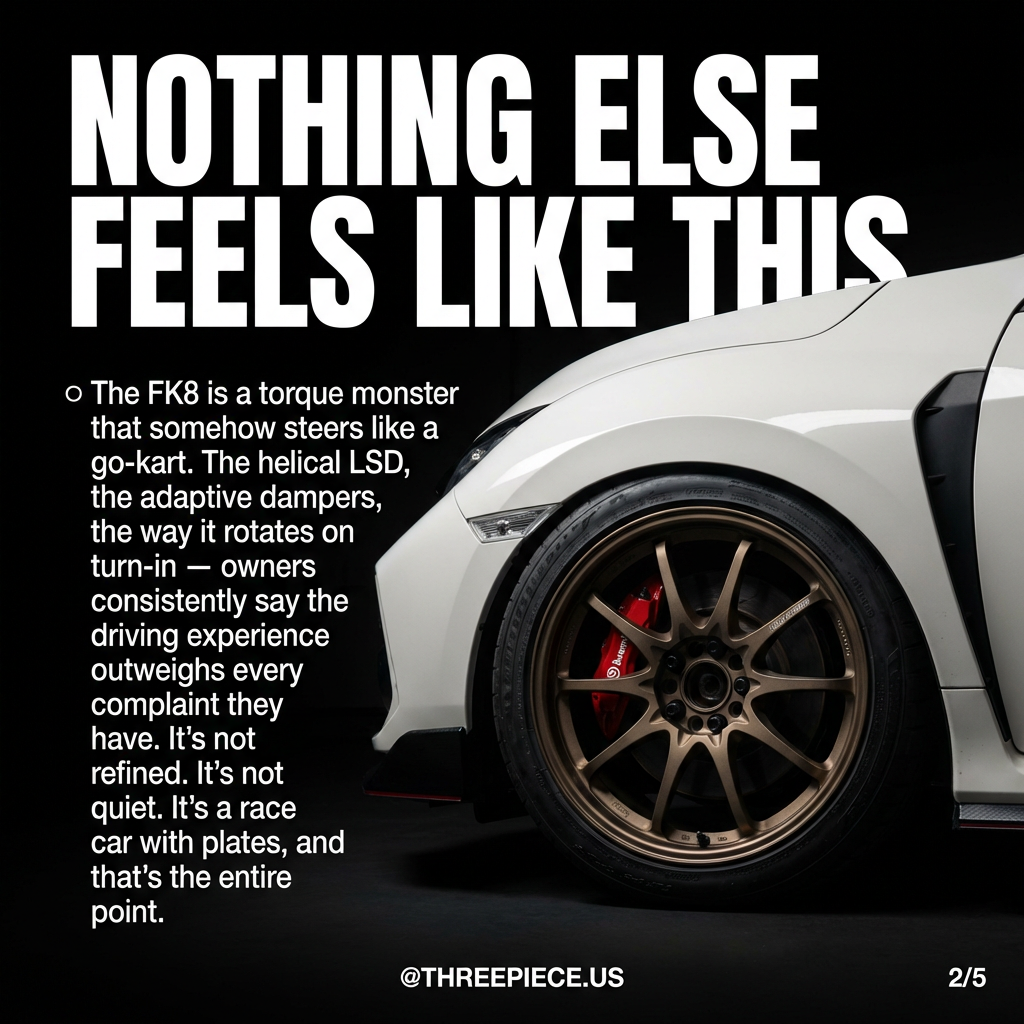
Front-wheel-drive performance cars have a ceiling in most people's minds, and the FK8 exists specifically to wreck that assumption. The combination of Honda's dual-axis strut suspension, the helical LSD, and adaptive dampers with three modes creates a car that rotates on turn-in like a mid-engine chassis. Owners consistently describe it as a go-kart with a turbo strapped to it — and that's not hyperbole. The steering is direct, the brake pedal has real feel, and the shift action through that short-throw six-speed is the kind of mechanical engagement that makes you take the long way home every time.
The K20C1 delivers 295 lb-ft from 2,500 to 4,500 RPM, which means you have a massive torque plateau for street driving, but it also revs cleanly to 7,000 RPM when you want it to. The turbo spools fast enough that there's no meaningful lag in daily driving. It's not refined. It's not quiet. The ride in +R mode is genuinely punishing. That's the entire point.
If you're cross-shopping the GTI Mk7 against the Civic Type R platform, understand that the FK8 isn't trying to be comfortable. It's trying to be fast, and it succeeds at that mission better than anything else in the front-drive world. Check our vehicle gallery for build inspiration from owners who've leaned into that identity.
The Tuning Ecosystem Is Fully Mature
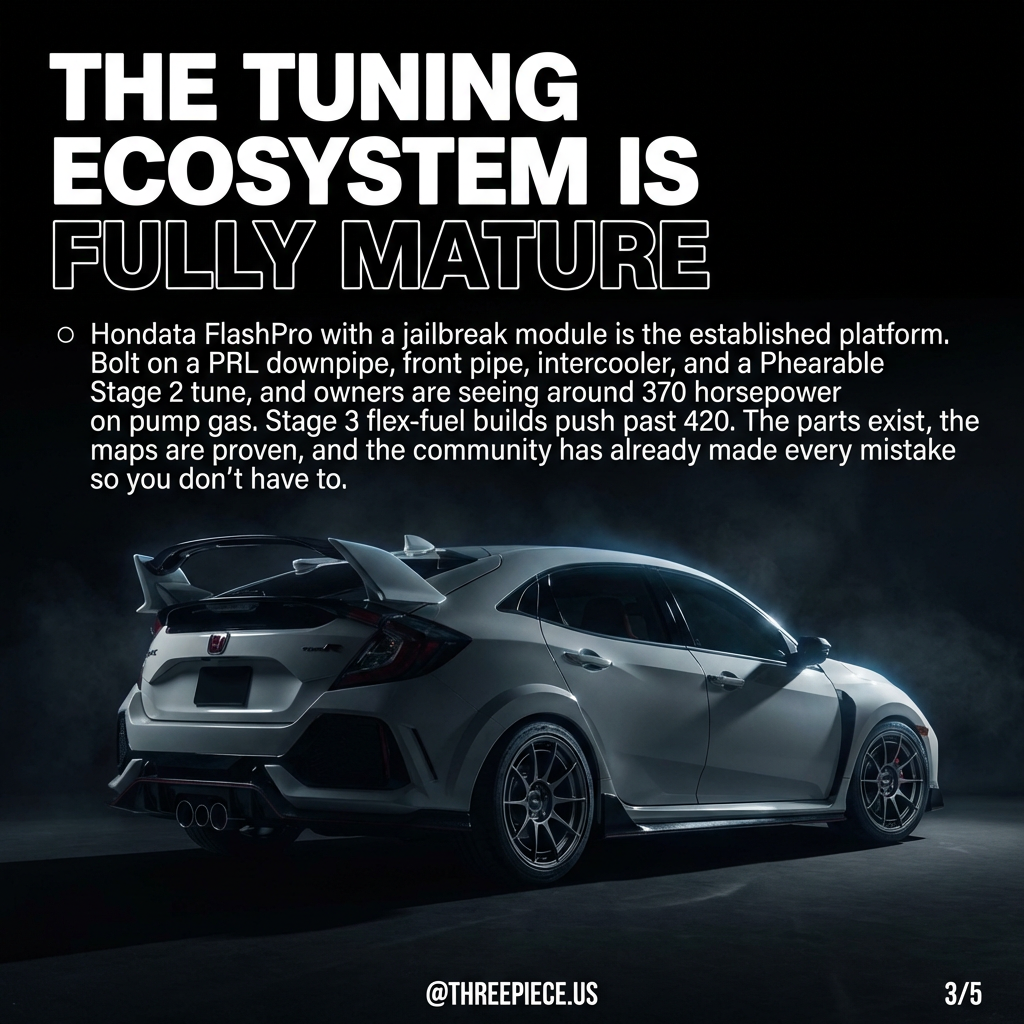
This is where the FK8 separates itself from almost every competitor in the segment. The tuning path is proven, documented, and affordable — the community has already made every mistake so you don't have to. Hondata FlashPro with a jailbreak module is the established ECU platform, and the bolt-on path is straightforward:
- Stage 1 (bolt-ons + tune): PRL downpipe, front pipe, intercooler, and a Phearable Stage 2 tune — owners are consistently seeing ~370 whp on 93 octane pump gas
- Stage 2 (flex fuel): Add E85 capability and a flex-fuel kit, and builds push past 420 whp on the stock turbo
- Stage 3+ (built motor): Pushing toward 500+ whp requires stronger rods, pistons, ARP head studs, and a bigger turbo — but the K20C1 bottom end handles ~350 whp reliably on stock internals
The downpipe is the single most impactful bolt-on for the FK8. The Skunk2 18-20 Honda Civic Type R Downpipe Kit w/ Cat at $825 is a direct-fit catted option that pairs perfectly with a Hondata tune. For the 1.5T Civic Si crowd feeding into the Type R world, the Skunk2 16-20 Honda Civic 1.5T Downpipe Kit at $768 and the Invidia 2016+ Honda Civic 1.5T Catted 70mm Downpipe at $1,044 are both proven pieces.
For context on what tuning actually delivers in real-world numbers, our Stage 1 vs Stage 2 dyno comparison breaks down the gains you can expect at each level. The FK8 responds to bolt-ons better than almost any turbo four on the market right now.
Known Failure Points: What Actually Breaks
The K20C1 is strong, but it's not invincible. Here's what real owners are reporting — not theoretical concerns, but documented recurring failures from forums, Reddit, and parts dealers.
1-2 Shift Grind (The Big One)
The FK8's six-speed gearbox carries over from the FK2, including its weak points. The 1-to-2 shift grind is the most commonly reported issue, typically appearing under 30,000-50,000 miles. It's worse when cold and worse with aggressive shifting. The root cause is synchro and dog-tooth design inherited from the previous generation. Owners address it by deleting the clutch delay valve (CDV), switching to ACDelco or Motul Multi ATF transmission fluid, adjusting the clutch master cylinder plunger, and upgrading engine mounts to reduce drivetrain movement. Shifting slower when cold also helps significantly.
4th Gear Lock-Out
Cars that see track duty or haven't had transmission fluid serviced by 25,000-30,000 miles can develop 4th gear refusal — the gear either grinds, won't engage, or slips. A full transmission rebuild with LSD runs $3,900-$4,500 in parts and labor. Flush your trans fluid early and use OEM or high-quality replacement fluid. This is not optional maintenance on a tracked FK8.
Water Intrusion on Cylinder 4
The FK8's hood scoop and valve cover design allows water into the spark plug wells, particularly on 2017-2019 models. Cylinder 4 is the most affected, producing misfires (P0304), corroded coil boots, and rusted plug wells. Updated valve covers with improved sealing exist, and owners seal the underhood area with silicone. Never pressure wash directly into the hood scoop.
Oil Dilution and Carbon Buildup
Direct injection means fuel dilution is a fact of life on the K20C1. You'll smell fuel on the dipstick, and carbon accumulates on intake valves over time. The fix is simple but non-negotiable: oil changes every 5,000 miles and periodic walnut blasting for carbon deposits. If you're coming from a Subaru platform, you already know this drill — our FA20DIT carbon buildup guide covers the same fundamental issue on a different engine. Skip your oil intervals on the K20C1 and you're creating problems that didn't need to exist.
Head Gasket Failures
Higher-mileage cars — especially those driven hard or running increased boost — can develop head gasket failures or cracked cylinders near the head seal. The K20C1 uses torque-to-yield head bolts that can stretch under sustained high load, losing clamping force. Symptoms include coolant loss, pressure in the overflow tank, overheating, and misfires on cylinders 3 and 4. A head gasket job with machining runs $4,000-$7,000+ depending on damage. Modded cars running higher boost should budget for ARP head studs as preventive insurance.
Thermal Management Under Track Use
The stock cooling system can struggle under sustained high-load driving — track days, canyon runs in hot weather, or extended highway pulls. Heat soak reduces power, and turbo housing bolts can fail from thermal cycling. An upgraded intercooler is the first line of defense, followed by radiator upgrades and improved front-end airflow. If you're reading our cold air intake deep dive, understand that intake temperature management is even more critical on the FK8 than on naturally aspirated platforms.
Pre-Purchase Checklist and Budget
Before you hand anyone money for an FK8, run through this list. These aren't suggestions — they're requirements.
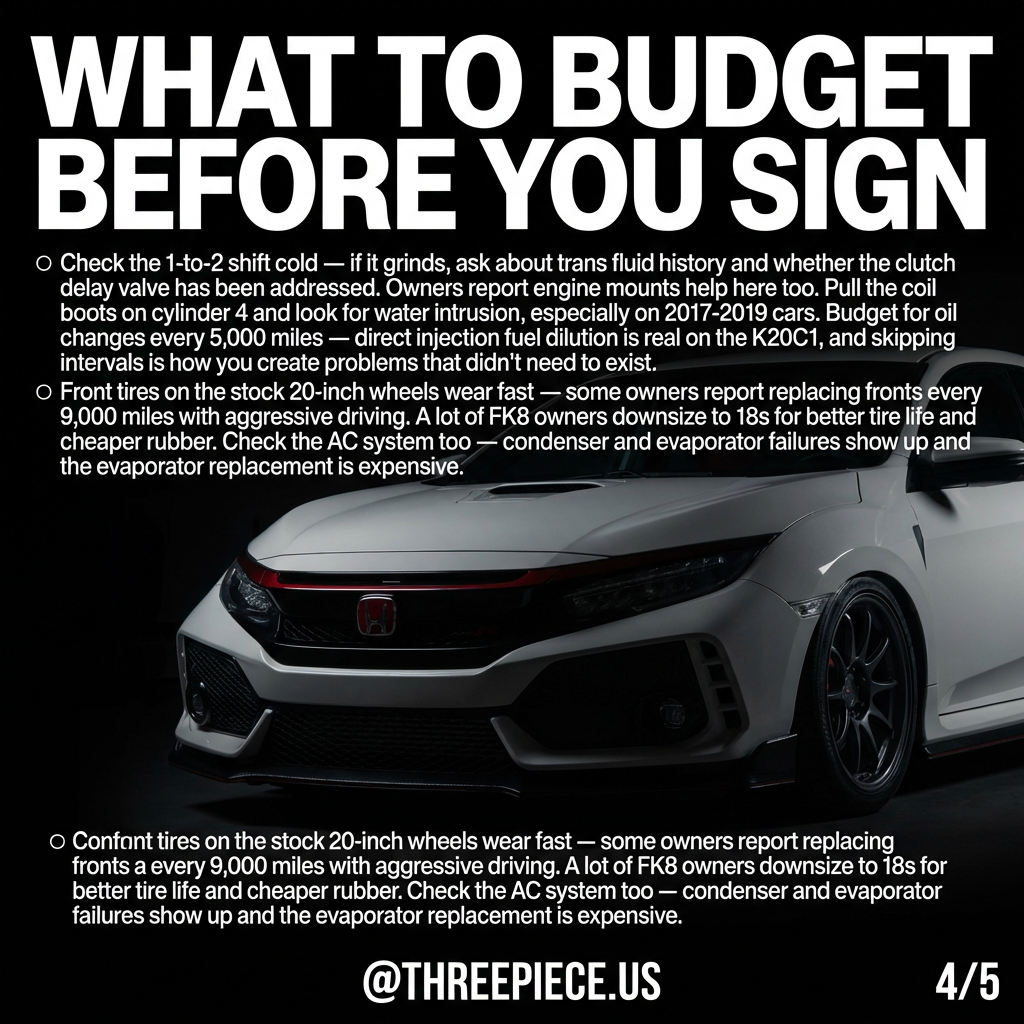
- Cold 1-to-2 shift test: Start the car cold and shift from first to second at moderate RPM. Any grinding, notchiness, or resistance means the transmission needs attention. Ask about trans fluid history and whether the CDV has been deleted.
- Pull coil boots on cylinder 4: Look for water intrusion, corrosion, or rust — especially on 2017-2019 cars. This is a 10-minute check that can save you hundreds.
- Smell the dipstick: Strong fuel odor means oil dilution is advanced. Ask when the last oil change was and whether they've been running 5,000-mile intervals.
- Check the AC system: Condenser and evaporator failures are documented on the FK8. The evaporator replacement is expensive because it requires dashboard removal. Run the AC on max cold for 10 minutes during your test drive.
- Fuel pump recall (2018-2019): Verify the recall has been completed. This is a free fix at any Honda dealer but will leave you stranded if it hasn't been addressed.
- Front tire wear: On the stock 20-inch wheels with 245/30R20 tires, front tires can wear out in as few as 9,000 miles with aggressive driving. Check tread depth and factor replacement cost into your budget.
Budget $1,500-$2,000 in the first year for deferred maintenance on any used FK8 — trans fluid flush, fresh spark plugs and coils, valve cover gasket inspection, and a walnut blast if the car is over 50,000 miles. That's not a repair budget; that's the cost of doing it right from day one.
FK8 Wheel Fitment: Why Owners Downsize to 18s
The stock FK8 rolls on 20x8.5 +60 wheels wrapped in 245/30R20 Continental SportContact 6 tires. They look aggressive, but the 30-series sidewall means you feel every expansion joint, and the front tires wear fast under spirited driving. A huge portion of the FK8 community downsizes to 18-inch wheels for better tire life, cheaper rubber, improved ride quality, and — honestly — better proportions once you drop the car.
The most popular aftermarket fitment is 18x9.5 +38 on the FK8's 5x120 bolt pattern with a 64.1mm center bore. This clears the Brembo front calipers comfortably and allows for a 265/35R18 tire — a massive improvement in sidewall height and contact patch over stock. Browse 18x9.5 wheels in 5x120 to see what's currently available. If you want something slightly more conservative, 18x8.5 +38 with 245/40R18 tires is a proven daily setup — search 18x8.5 wheels in 5x120 for options.
The Work Emotion series is one of the most popular choices on FK8 builds — the ZR10 and CR Kiwami in particular look right at home on the aggressive fender lines. For a more classic JDM look, the Work Meister line gives you a stepped-lip three-piece option that transforms the car's presence. If you're weighing whether to go forged on this platform, our cast vs forged wheel breakdown covers the real-world differences that matter.
Tire choice matters as much as the wheel. On 18s, you're looking at 265/35R18 tires for the aggressive setup or 245/40R18 tires for the daily-friendly option. Either way, you're getting more rubber between you and the road than the stock 20s ever offered. Make sure you're running hubcentric rings to adapt from the 64.1mm center bore if your aftermarket wheels have a larger bore — it eliminates vibration and centers the wheel properly on the hub.
Stop Circling — Go Buy One
The FK8 Civic Type R is the last truly unfiltered Honda. The FL5 is faster on paper, more refined, and better looking to most people — but it's also more expensive, less raw, and harder to find in the configuration you actually want. The FK8 gives you a 306-horsepower turbocharged four with a proven path to 420+ whp, one of the best front-drive chassis ever engineered, a six-speed manual with real mechanical engagement, and a community that has already mapped out every modification, every failure point, and every solution.
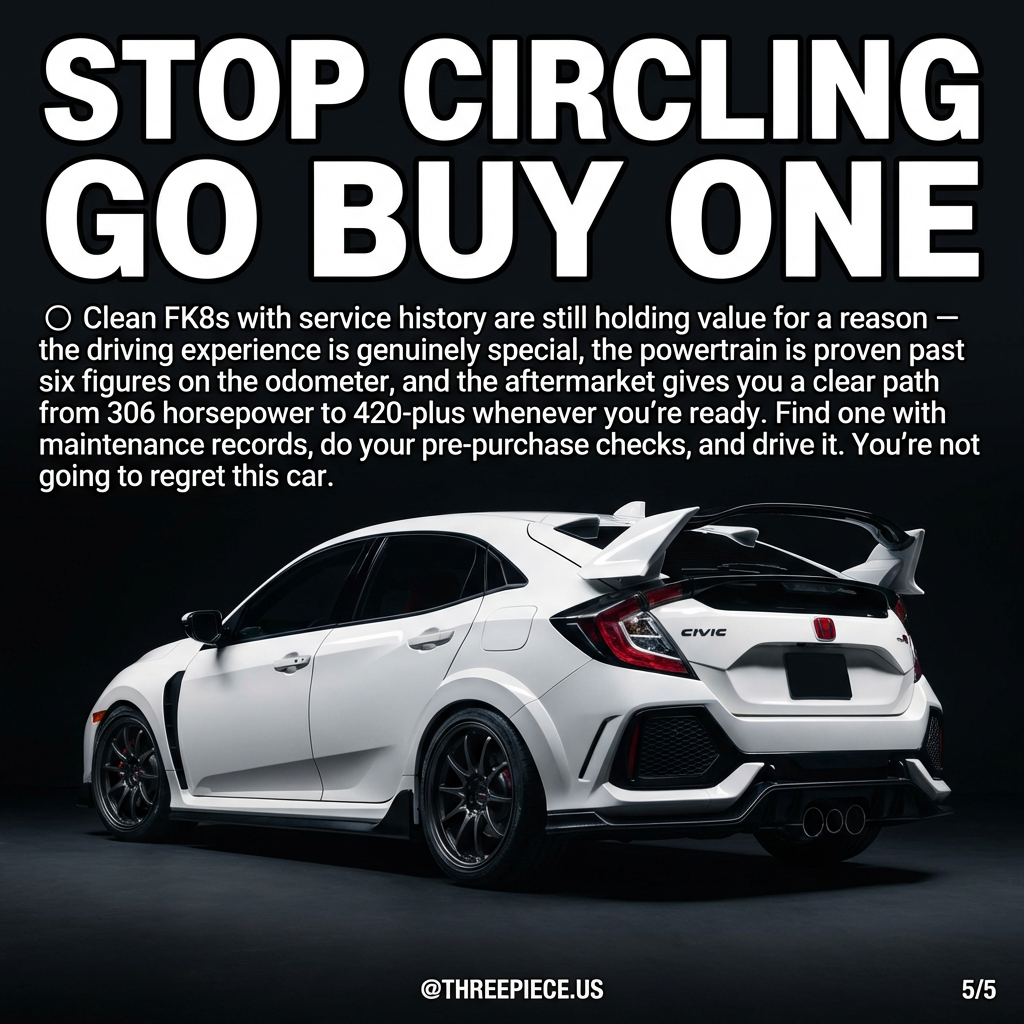
Clean FK8s with service history are holding value because the driving experience is genuinely special. The powertrain is proven past six figures on the odometer. The aftermarket is mature. The only thing left is for you to stop browsing and start buying.
If you're building your FK8 right, start with the wheels and tires — it's the single biggest visual and dynamic transformation you can make. Browse our full wheel catalog for 18-inch options that clear the Brembo brakes, grab a Skunk2 Type R downpipe to start the power path, and check the coilover guide for daily drivers when you're ready to dial in the ride height. The FK8 rewards owners who do the work — and punishes the ones who skip maintenance. Be the first type.