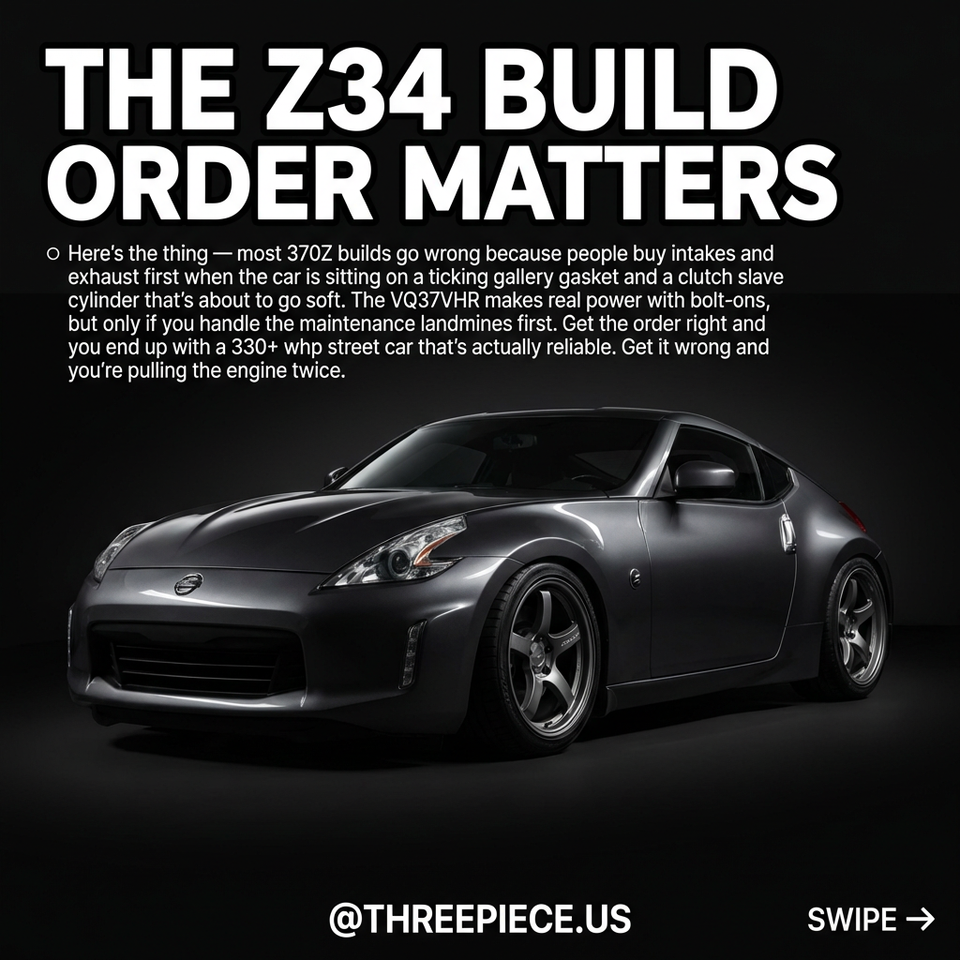
The Nissan 370Z Z34 is one of the best naturally aspirated sport-compact platforms you can still buy for under $25K — but most builds go sideways because people start with intakes and exhaust when the car is sitting on a ticking gallery gasket and a clutch slave cylinder that's about to go soft. The VQ37VHR makes 332 hp from the factory and responds genuinely well to bolt-ons, but only if you handle the known failure points first. Get the mod order right and you end up with a 330+ whp street car that's actually reliable. Get it wrong and you're pulling the engine twice. Here's the build sequence real owners follow — drawn from documented builds, dyno sheets, and long-term ownership threads.
Quick links
- Fix It Before You Build It
- Gallery Gaskets: The VQ37's Achilles Heel
- Clutch Slave Cylinder Elimination
- Bolt-Ons Plus Tune: The Proven 330 WHP Recipe
- Suspension Done Right
- Z34 Wheel Fitment That Actually Works
- The Finished Car Is Worth the Discipline
Fix It Before You Build It
Every experienced 370Z owner will tell you the same thing: the first "performance mods" on a Z34 aren't performance mods at all — they're preventative maintenance items that the factory should have gotten right. If you skip these and go straight to intakes and exhaust, you're building on a foundation that's going to crack. The VQ37VHR is a strong engine, but it has two well-documented weak points that need to be addressed before you add a single bolt-on. Our 370Z Sport 6MT buying guide covers what to look for when purchasing, but this guide picks up where that one leaves off — with the wrench in your hand.
Gallery Gaskets: The VQ37's Achilles Heel
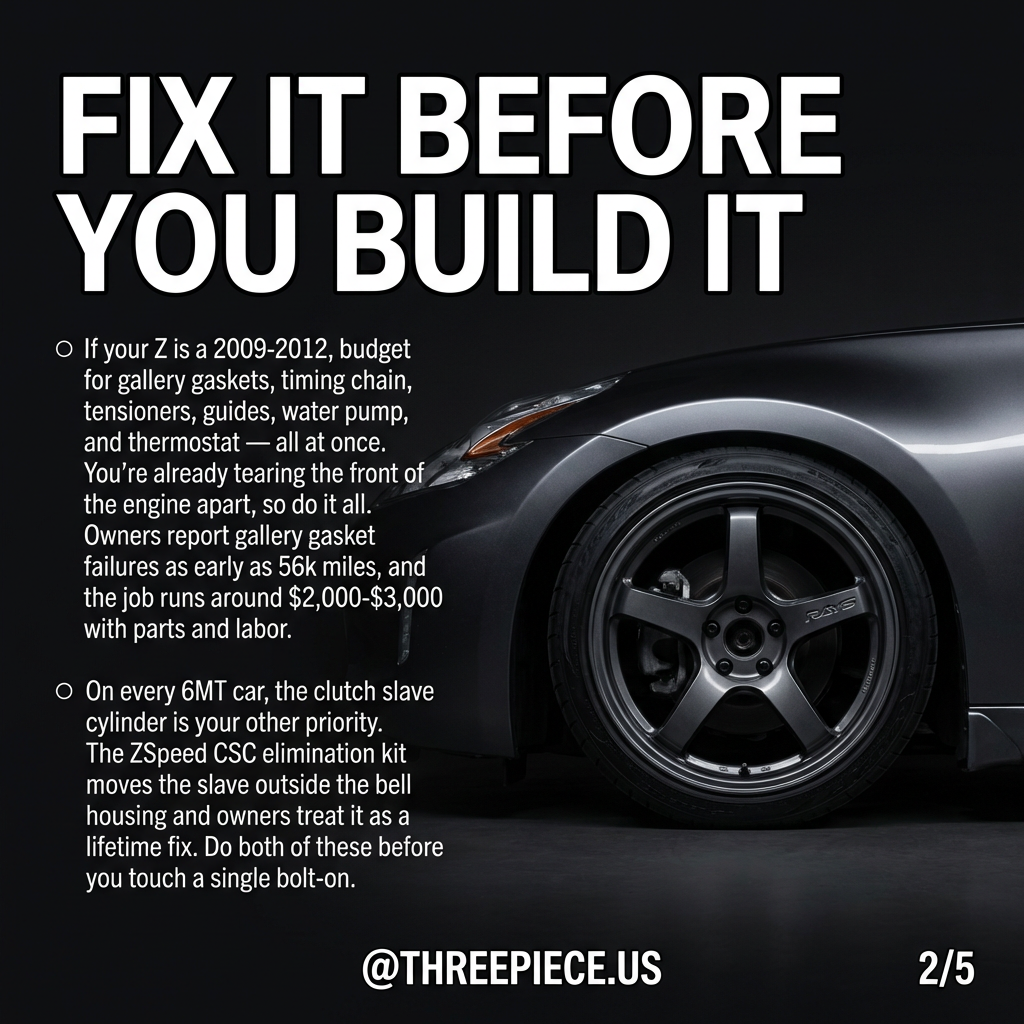
If your Z34 is a 2009–2012 model, budget for gallery gaskets before anything else. The factory paper gaskets tend to split around the bolts, causing oil seepage, low oil pressure, and eventually engine noise. Owners report failures as early as 56,000 miles, with the most common failure window landing between 85,000–100,000 miles. By the time you hear it, the damage is already underway.
The smart move is to replace the gallery gaskets with upgraded metal units and — since you're already tearing the front of the engine apart — do the timing chain, tensioners, guides, water pump, and thermostat all at once. Owners quote the full job at roughly $2,000–$3,000 with parts and labor. That sounds steep until you realize doing it in stages means pulling the front cover twice, which doubles the labor cost. If you're coming from the Z33 world, our VQ35DE engine breakdown covers why the earlier VQ was more forgiving in this area — the VQ37's VVEL system added complexity that the gasket design didn't keep up with.
While you're addressing engine reliability, consider upgrading your ignition system. The Mishimoto 2009-2020 Nissan 370Z Ignition Coil at $85.50 is a direct replacement that handles the increased heat and demand of a tuned VQ37 better than the aging OEM coils. Swap all six while the engine bay is apart.
Clutch Slave Cylinder Elimination
On every 6MT 370Z, the concentric clutch slave cylinder (CSC) is your other priority. It lives inside the bell housing, which means when it fails — and it will — you're pulling the transmission to replace a $50 part. Owners report CSC failures as early as 36,000 miles, with the bulk happening in the 50,000–60,000 mile range, especially under spirited driving.
The community-standard fix is the ZSpeed CSC Elimination Kit, which relocates the slave cylinder outside the bell housing where it's accessible and serviceable. Most owners treat this as a lifetime fix. If you're already pulling the trans for the CSC, that's also the time to evaluate your clutch. The stock clutch handles the factory 270 lb-ft fine, but once you start adding airflow mods and a tune, a Stage 1 setup with a lightweight flywheel becomes smart insurance. The ACT 2015 Nissan 370Z Performance Street Sprung Disc at $211.86 is purpose-built for this platform and handles the torque increase from a full bolt-on tune without the harshness of a puck-style disc. Owners commonly drop the stock flywheel from ~27–28 lbs down to a 19–22 lb lightweight unit for sharper throttle response.
Bolt-Ons Plus Tune: The Proven 330 WHP Recipe
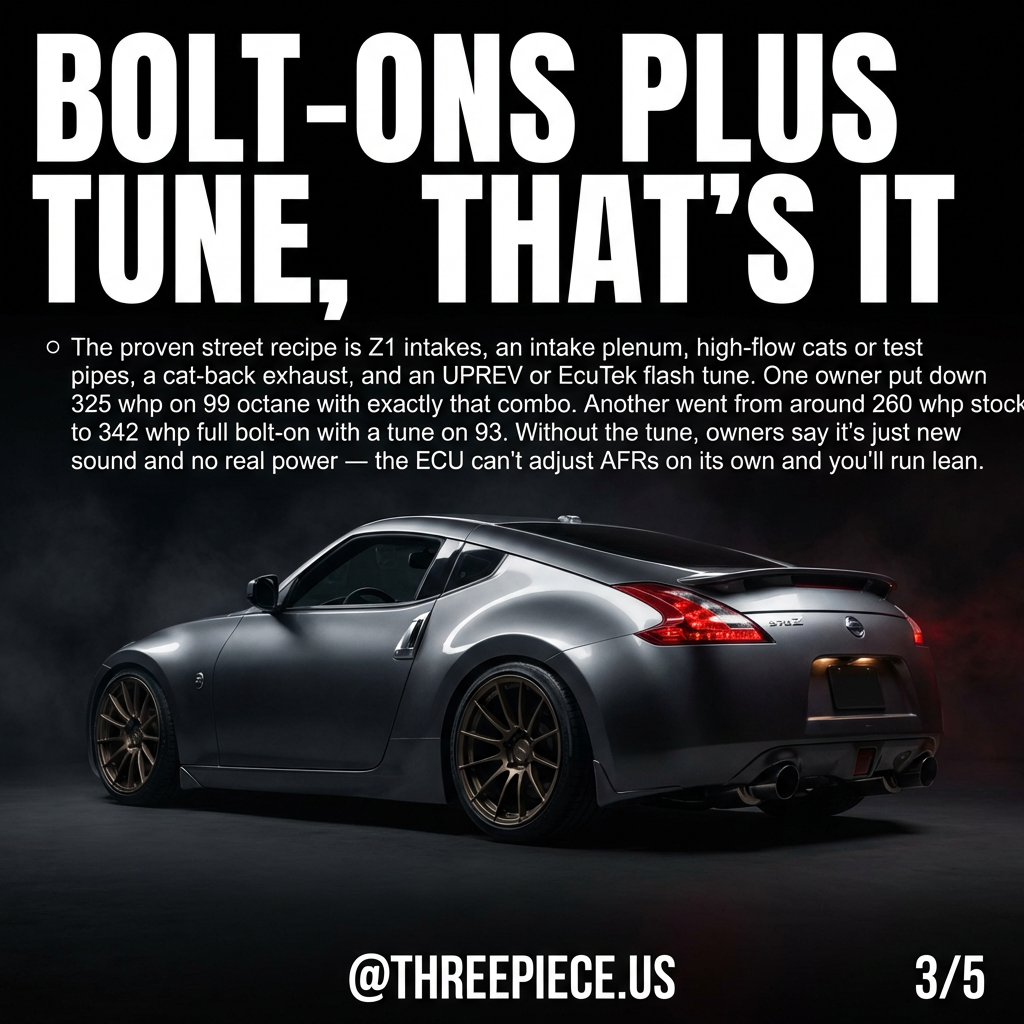
Once the reliability items are sorted, the VQ37VHR responds to airflow modifications in a way that's genuinely rewarding for a naturally aspirated engine. The proven street recipe, confirmed across multiple dyno-verified builds, looks like this:
- Z1 Motorsports dual intakes (cold air, routed into the bumper)
- Z1 intake plenum spacer
- High-flow cats (200-cell sport cats from Torqen or Berk test pipes)
- Cat-back exhaust — Tomei, Borla S-Type, or Torqen Zorst 3-inch with resonators
- ECU flash tune — UPREV or EcuTek with a custom map
One documented build with exactly this combination put down 325 whp on 99 octane. Another owner went from roughly 260 whp stock to 342 whp full bolt-on with a tune on 93 octane. The tune is non-negotiable — without it, owners consistently report that bolt-ons just add sound with no real power gain. The stock ECU can't adjust air-fuel ratios on its own, and you'll run lean without a proper remap. If you want to understand why the tune matters more than the parts, our Stage 1 vs Stage 2 tune results article breaks down real dyno numbers across platforms. And for a deeper look at whether cold air intakes actually do anything, our intake deep dive covers the data.
For the exhaust, the aFe Takeda 2.5" SS Cat-Back Exhaust for the 370Z at $1,890.10 is a stainless steel unit with polished tips that fits 2009–2013 models directly. It's a quality piece that complements the Z1 intake path without being obnoxiously loud — resonated cat-backs on the VQ37 sound incredible without droning on the highway.
Suspension Done Right
Suspension comes after the drivetrain is solid. That's not opinion — it's the order that prevents you from doing the same job twice. Once you're making 330+ whp and the clutch and CSC are sorted, it's time to put the chassis underneath it.
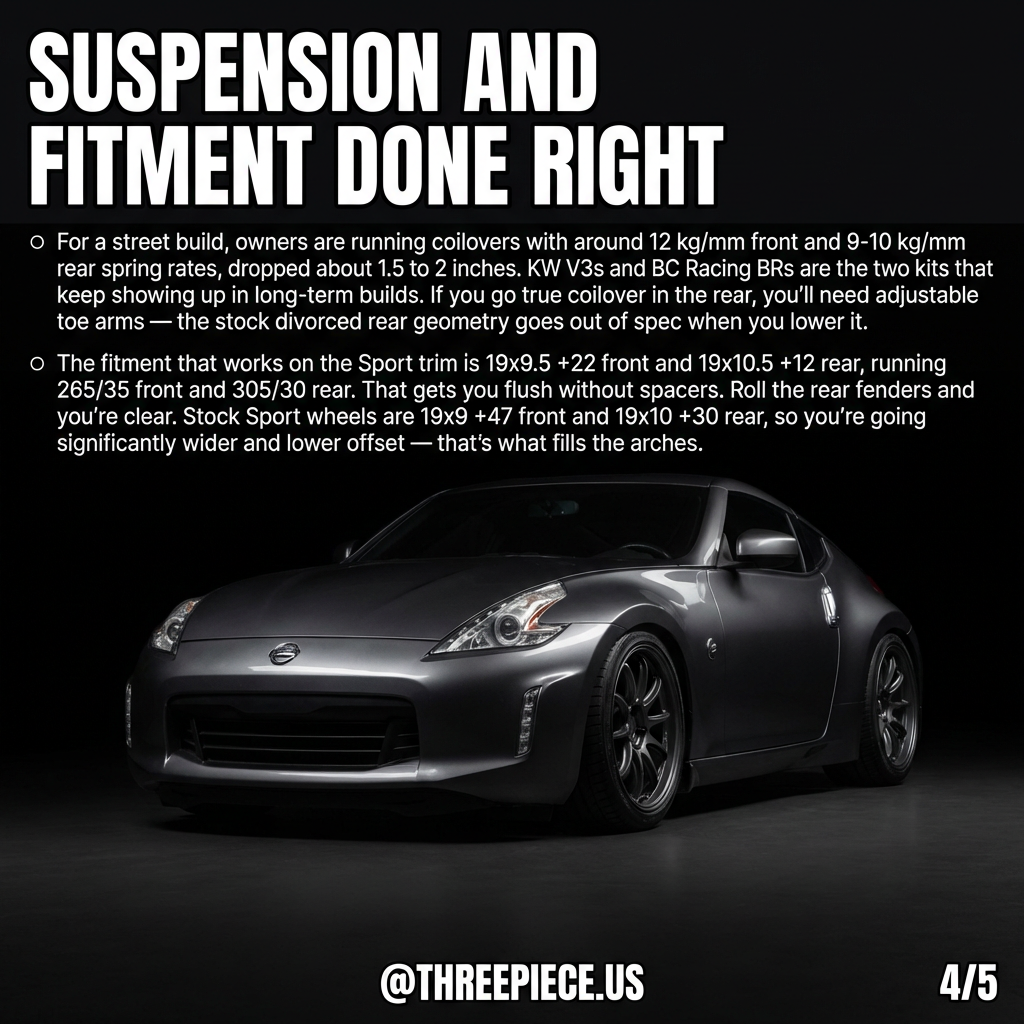
For a street build, owners are running coilovers with approximately 12 kg/mm front and 9–10 kg/mm rear spring rates, dropped about 1.5 to 2 inches. The two kits that keep appearing in long-term builds are KW V3s and BC Racing BRs. The Function and Form Type 3 Coilovers for the Nissan 370Z Z34 (09+) are another solid option — they're a true coilover design with 32-way damping adjustment, purpose-built for the Z34 platform.
Here's the critical detail most people miss: if you go true coilover in the rear, you need adjustable toe arms. The 370Z's divorced rear suspension geometry goes out of spec when you lower it, and the stock toe links can't compensate. Z1 Motorsports rear toe arms and camber arms are the go-to. While you're under there, Z1 subframe collars and a polyurethane transmission mount tighten up the chassis without adding NVH that makes the car unlivable as a daily. If you're debating whether coilovers are worth it on a car you drive every day, our coilover daily driver guide covers the tradeoffs. And if you're tempted by budget coilovers, read why 90% of coilover buyers make this expensive mistake before you order.
Z34 Wheel Fitment That Actually Works
The 370Z Sport comes from the factory with 19x9 +47 front and 19x10 +30 rear — Rays-forged wheels that are genuinely nice but have conservative offsets that tuck deep into the fenders. The fitment that fills the arches properly on a lowered Sport is 19x9.5 +22 front and 19x10.5 +12 rear, running 265/35R19 front and 305/30R19 rear. That gets you flush without spacers. Roll the rear fenders and you're clear.
The Z34 runs a 5x114.3 bolt pattern with a 66.1mm hub bore, so the aftermarket wheel selection is massive. Browse 19" wheels in 5x114.3 to see what's currently available. For tires, search 265/35R19 for the front and 305/30R19 for the rear. If you're considering 3-piece wheels for this platform, our guide on why 3-piece wheels cost $4K+ and whether they're worth it explains the construction differences. The Work Emotion series and Work Meister line both look exceptional on the Z34's aggressive fender lines.
If you're running 3-piece wheels on this car, make sure you're using proper hubcentric rings to match the 66.1mm hub bore — the Z34 is sensitive to wheel vibration at highway speeds. And for builds using deep-lip wheels, 90-degree valve stems at $3.80 each make tire pressure checks possible without removing the wheel. For context on how fitment choices affect handling on staggered-setup cars like the Z, the wheel spacer safety guide is worth reading if you're considering spacers instead of proper offsets.
The Finished Car Is Worth the Discipline
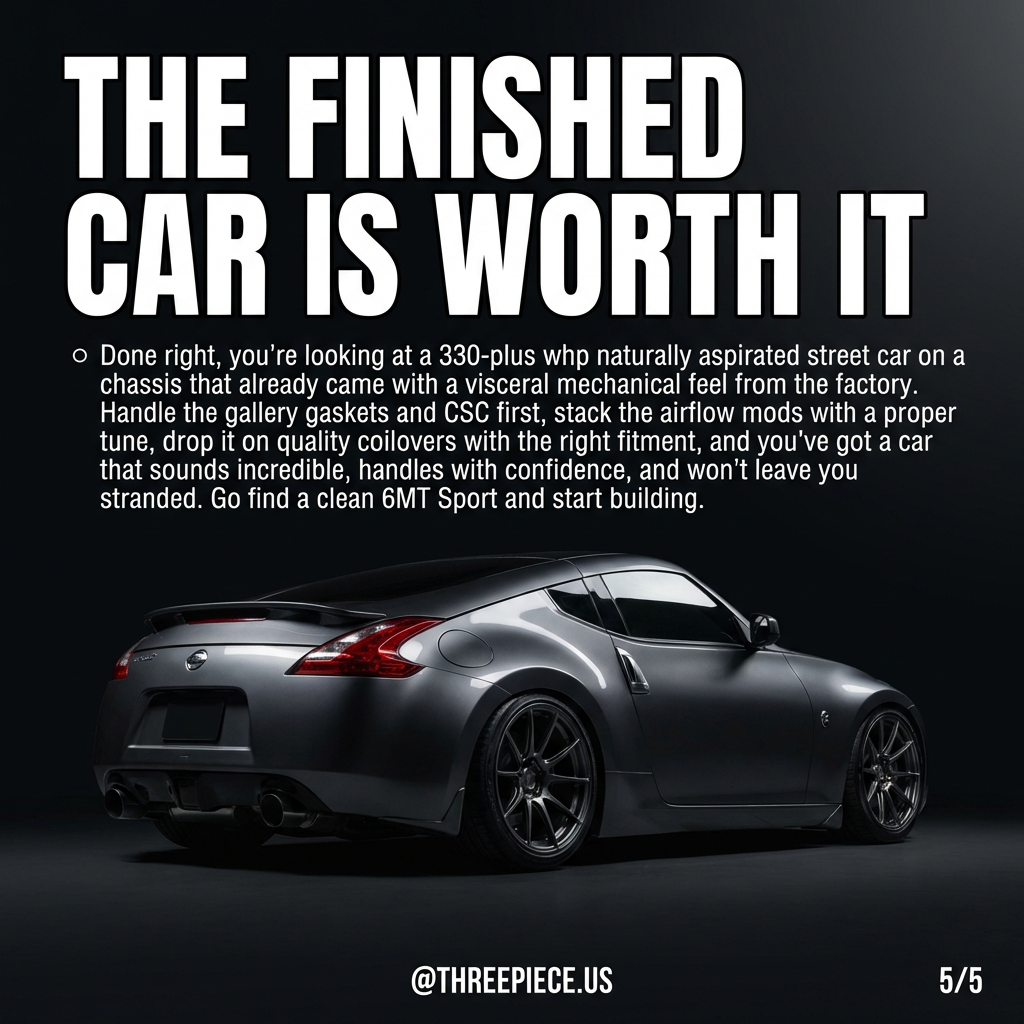
Done right, you're looking at a 330+ whp naturally aspirated street car on a chassis that already came with a visceral mechanical feel from the factory. The Z34 doesn't need 500 hp to be rewarding — it needs to be built with a plan. Handle the gallery gaskets and CSC first, stack the airflow mods with a proper ECU flash, drop it on quality coilovers with adjustable rear links, and finish it with wheels that actually fit the fenders.
The 370Z shares DNA with the Z33 — if you want to see how the older platform builds differently, our 350Z track build guide covers that mod order. And if you're cross-shopping the Z34 against other platforms in this price range, the G37 Sport 6MT buying guide covers the sedan alternative that shares the same VQ37 and rear-drive layout. For build inspiration across platforms, check the ThreePiece vehicle gallery — there are some properly sorted Z34s in there.
Go find a clean 6MT Sport, sort the known issues, and build it in the right order. The result is a car that sounds incredible, handles with confidence, and won't leave you stranded.