
Posted by THREEPIECE.US on Apr 13th 2026
2013-2014 Nissan 370Z Sport 6MT Buying Guide for 2026
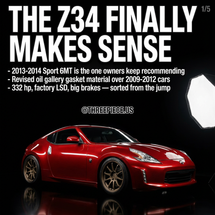
The 2013-2014 Nissan 370Z Sport 6MT is the Z34 that long-term owners keep telling people to buy — and in 2026, the market is finally separating these revised cars from the early-model reputation that haunted the platform for years. With 332 hp from a naturally aspirated 3.7L V6, a factory viscous LSD, upgraded brakes, and Rays forged wheels straight from the dealer, the Sport trim was always the one that made sense. Now that prices have softened while clean examples quietly disappear, this is the window to grab one before the Z34 follows every other analog Japanese coupe into collector territory.
Quick links
- Why 2013-2014 is the sweet spot
- What nothing else replicates
- Sport trim: factory LSD, big brakes, Rays wheels
- The bolt-on mod path that actually works
- Budget these weak points, then relax
- Z34 wheel fitment and tire sizing
- Pre-purchase inspection checklist
- Stop waiting — go buy one
Why 2013-2014 is the sweet spot
The 2009-2012 Z34 had a real problem: paper oil gallery gaskets that could fail and starve the engine of oil pressure. Nissan revised these to a more durable material starting with the 2013 model year, and forum data overwhelmingly confirms that post-2013 VQ37VHR engines have dramatically fewer oil-related failures. This single change is why experienced owners point people toward 2013+ cars specifically. The early-car anxiety that kept prices suppressed for years doesn't apply here.
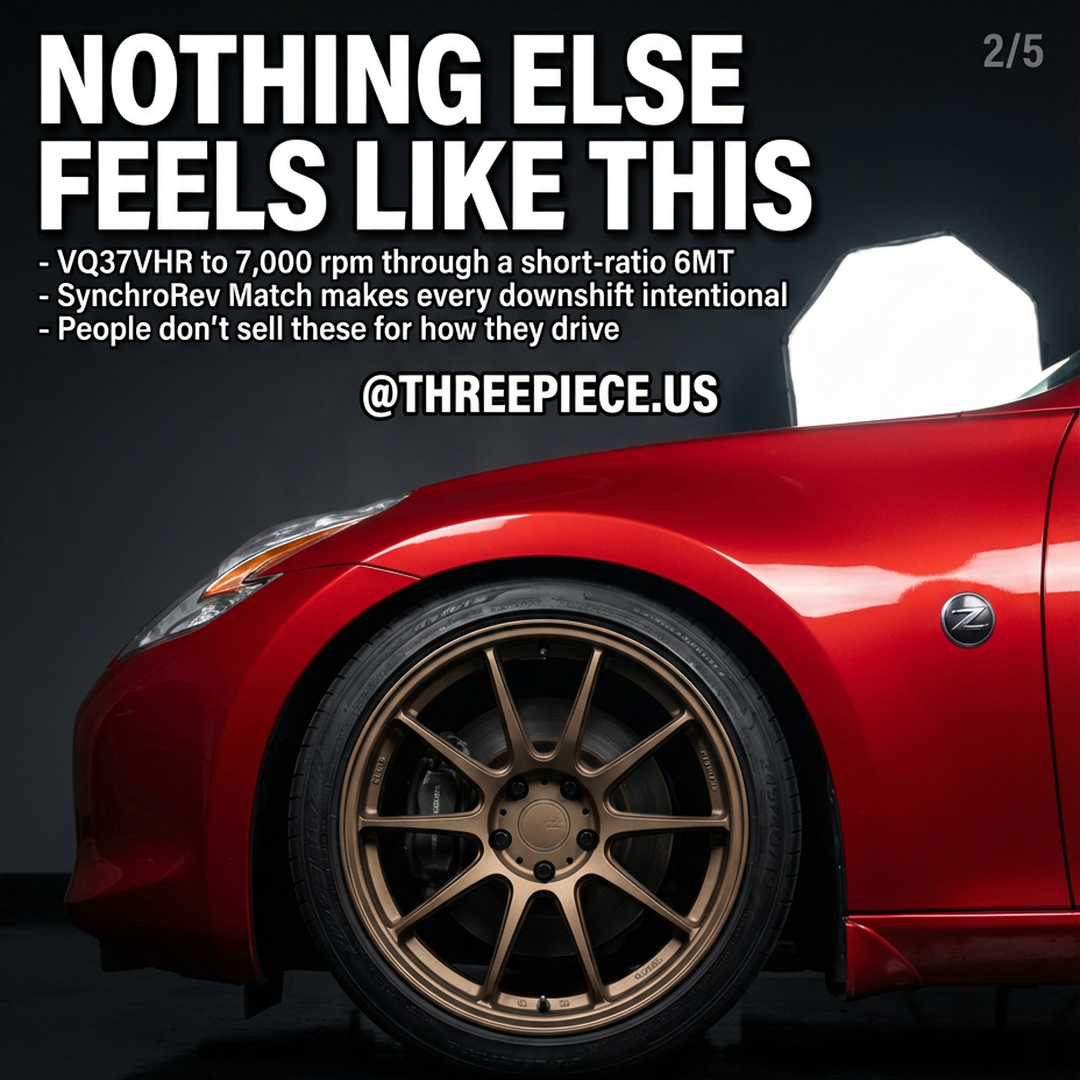
The VQ37VHR itself is a 3.7L DOHC 24-valve aluminum V6 making 332 hp at 7,000 rpm and 270 lb-ft at 5,200 rpm. It's naturally aspirated — no turbos to maintain, no intercooler plumbing to leak, no boost threshold to wait through. If you've been reading about the A90 Supra's complicated ownership reality, the Z34's simplicity is a feature, not a compromise. And if you're comparing it to the older Z platform, our 350Z engine problems and inspection guide shows exactly why the VQ37VHR is a generational improvement over the VQ35DE.
What nothing else replicates
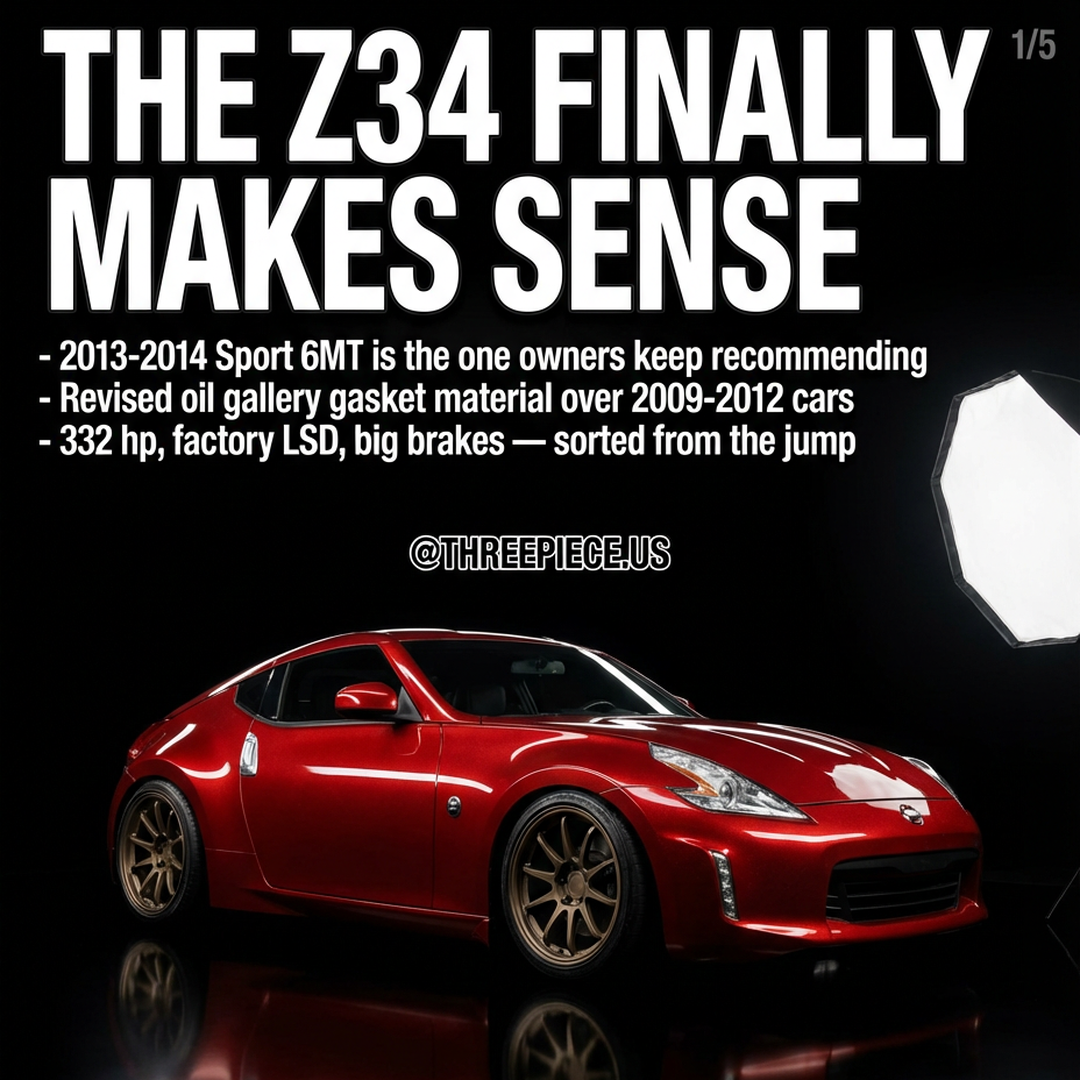
The 370Z Sport 6MT pairs the VQ37VHR with a short-ratio CD009 6-speed manual that pulls cleanly to the 7,000 rpm redline. The throws are direct, the ratios are tight, and the mechanical connection between your right hand and the rear wheels is the entire point. This is the kind of drivetrain that makes you take the long way home.
Then there's SynchroRev Match — Nissan's factory rev-matching system that blips the throttle on every downshift. Purists can turn it off, but most owners leave it on because it's genuinely good. It makes every heel-toe moment effortless without removing driver engagement. People don't sell these cars because of how they drive. They sell them because life changes. The driving experience is never the reason.
For context on why naturally aspirated power delivery matters more than peak numbers, read why 350WHP Civics feel slower than 260WHP Miatas. The Z34's 332 hp in a 3,300 lb chassis with rear-wheel drive and an LSD feels faster than the spec sheet suggests.
Sport trim: factory LSD, big brakes, Rays wheels
The Sport trim is the one you want. It's not a marketing exercise — it's a genuinely different car from the base model. Here's what you get:
- Viscous limited-slip differential — not an electronic nanny, a real mechanical LSD
- Larger front brakes with 14-inch rotors and 4-piston Akebono calipers
- Rays forged aluminum wheels from the factory — 19x9 +47 front, 19x10 +30 rear
- SynchroRev Match on the 6-speed manual
The factory Rays wheels alone are worth noting. Most cars in this price range ship with cast wheels that weigh 25+ lbs each. The Z34 Sport comes with forged units from one of the most respected wheel manufacturers in Japan. If you're curious about why that matters, our breakdown of cast vs forged wheels explains the weight and strength differences in detail. And if you want to understand the premium tier, our 3-piece wheel explainer covers why enthusiasts upgrade beyond even forged monoblock.
The bolt-on mod path that actually works
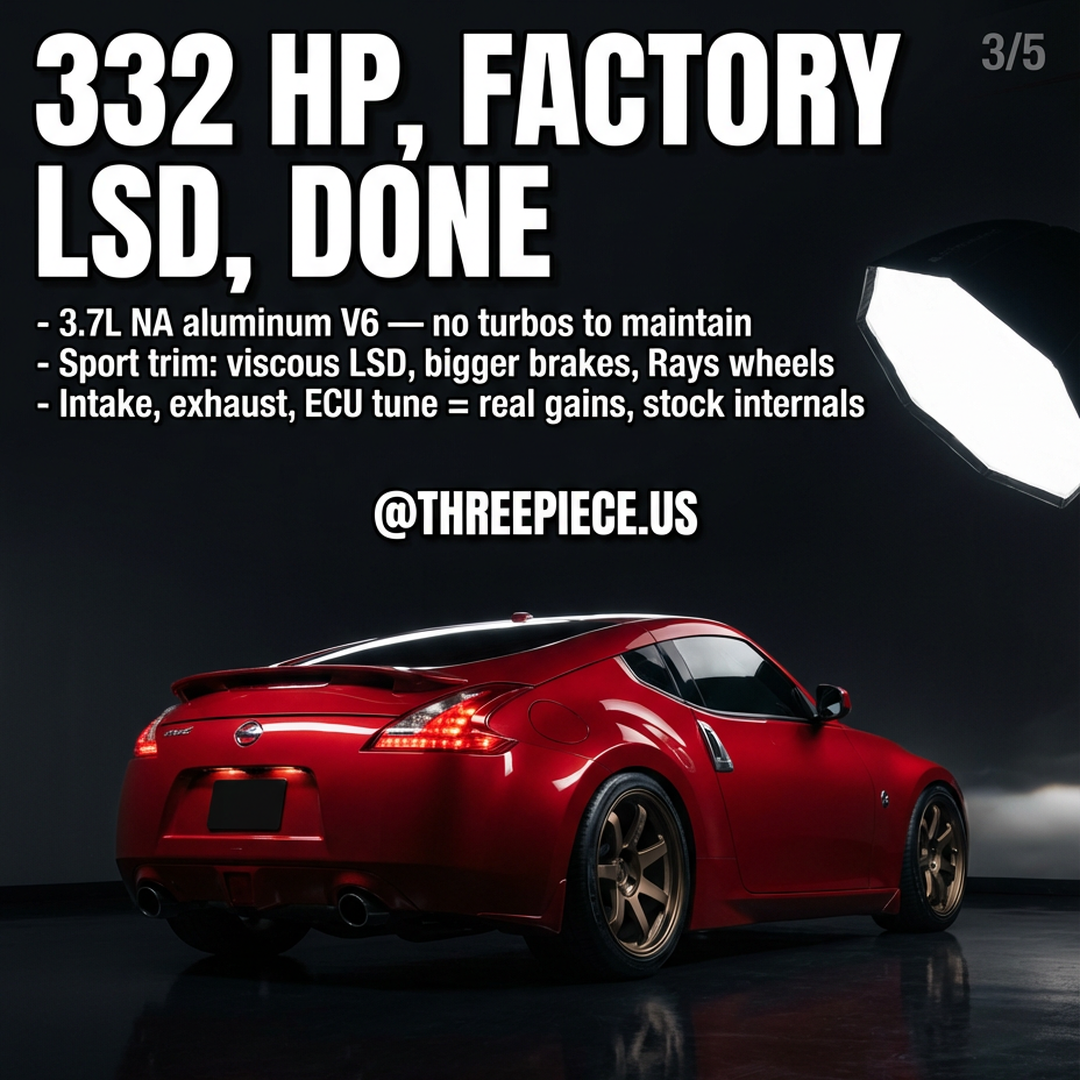
The VQ37VHR responds well to breathing mods without needing internal work. The established first-mod sequence looks like this:
- Cold air intake — opens up the top end, adds induction sound. Gains: 8-12 whp.
- Cat-back exhaust — the aFe Takeda 2.5" SS Cat-Back Exhaust for the 370Z at $1,890 is a full stainless system with polished tips that frees up flow across the entire exhaust path. Gains: 10-18 whp depending on the rest of the setup.
- ECU tune — EcuTek and UpRev are the two established platforms for the VQ37VHR. A proper tune on intake + exhaust gets you into the 310-320 whp range at the wheels, up from roughly 280-285 whp stock. That's 30-35 whp on stock internals with no reliability concerns.
- Test pipes or high-flow cats — the biggest single power adder, but legality varies by state. Check our state inspection rules on aftermarket downpipes before committing.
The FM chassis also takes suspension and wheel upgrades without fighting you. It's one of the best modern Japanese platforms for clean fitment, and the ThreePiece vehicle gallery has plenty of Z34 builds for inspiration. If you're considering going lower, read our take on whether coilovers are overrated before you spend money on the wrong kit.
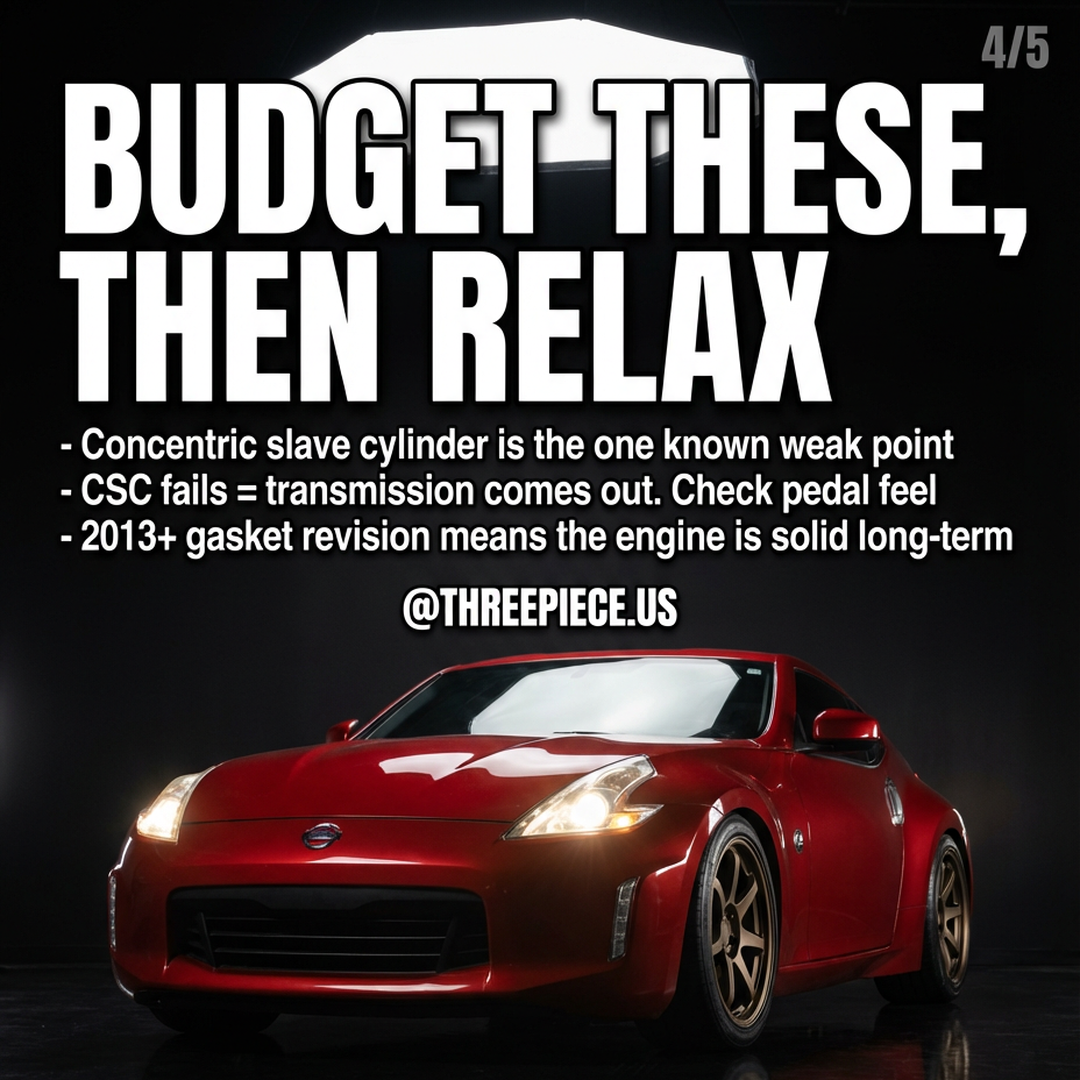
Budget these weak points, then relax
The Z34 is not a fragile car. But there is one well-documented failure point you need to understand before buying:
The concentric slave cylinder (CSC). This is the hydraulic actuator for the clutch, and on the 370Z it's integrated inside the bell housing. When it fails — and it does fail, typically between 60,000-100,000 miles — the transmission has to come out to replace it. The part itself is cheap. The labor is $1,200-$1,800 at an independent shop. Symptoms: soft or spongy clutch pedal, inconsistent engagement point, clutch fluid loss with no visible external leak.
The smart move: if you're buying a 2013-2014 with over 60K miles and the CSC has never been replaced, budget for it. If you're already pulling the transmission, upgrade the clutch at the same time. The ACT Performance Street Sprung Disc for the 370Z at $211.86 is a direct replacement that handles more torque than stock while maintaining street manners. Do both jobs at once and you won't touch the bell housing again for the life of the car.
Beyond the CSC, the 2013+ VQ37VHR is remarkably solid. Oil changes every 5,000 miles with quality synthetic, coolant flush every 60K, and spark plugs at 60-80K. Annual maintenance on a 370Z is cheaper than most German competitors in this performance bracket. For comparison, look at what RS3 ownership actually costs.
Z34 wheel fitment and tire sizing
The 370Z runs a 5x114.3 bolt pattern with a 66.1mm hub bore. The factory Sport wheels are 19x9 +47 front and 19x10 +30 rear, which gives you a baseline for what the fenders can handle. Most owners running aftermarket wheels go with a staggered setup:
- Front: 19x9.5 +15 to +22 with 245/40R19 or 255/35R19
- Rear: 19x10.5 +15 to +22 with 275/35R19 or 285/35R19
If you want to drop to 18s for better tire selection and lower unsprung weight — and you should consider it — 18x9.5 front / 18x10.5 rear is the proven combo. Browse 19" wheels in 5x114.3 or 18" wheels in 5x114.3 to see what's available. For tire sizing, check 275/35R19 tires for the rear.
The Z34 is one of the best platforms in the Japanese sport-compact world for clean wheel fitment. The fenders are generous, the geometry works with moderate offset changes, and the staggered stance looks correct. For a deeper dive into running different front and rear widths, our Volk TE37 vs Work Meister comparison covers how wheel construction affects fitment decisions. The Work Emotion series and Work Meister line are both popular choices on this platform. If you're building a set of 3-piece wheels, Work replacement halves let you dial in exact widths and offsets.
Pre-purchase inspection checklist
When you find a 2013-2014 Sport 6MT, here's what to check beyond the normal used-car inspection:
- Clutch pedal feel: Press it slowly. It should be firm and consistent through the entire stroke. Any softness, sponginess, or inconsistent engagement point means the CSC is going or gone. This is your strongest negotiation tool.
- Clutch fluid reservoir: Check the level. If it's low with no visible leak at the master cylinder, fluid is going into the bell housing through the CSC. Walk away or negotiate hard.
- Oil level and condition: Pull the dipstick. The VQ37VHR does consume some oil — 0.5-1 qt per 3,000 miles is considered normal by Nissan. But if it's low and the seller doesn't know when it was last topped off, that's a maintenance red flag.
- Timing chain noise: Cold start the car and listen for chain rattle in the first 10 seconds. The VQ37VHR uses timing chains, not belts, and they're generally reliable — but a noisy chain on a car with under 100K miles suggests oil starvation history.
- Differential whine: Drive at 30-50 mph in 3rd or 4th gear, then coast. Listen for whining from the rear. The viscous LSD in the Sport is durable, but abused examples can develop gear noise.
- Brake condition: The Sport's Akebono brakes are excellent but expensive to replace. Pads are $150-200 for quality replacements; rotors are $300-400 per axle.
- Rust: Check the rear quarter panels, rocker panels, and underneath. Z34s in northern climates can develop rust earlier than you'd expect for a 2013+ car.
If the CSC, clutch, and engine all check out, you're looking at one of the most mechanically straightforward sports cars you can buy in 2026. The new Z is already covered in our 2023+ Nissan Z buying guide, but the Z34 offers something the new car doesn't: a naturally aspirated character that Nissan chose not to carry forward.
Stop waiting — go buy one
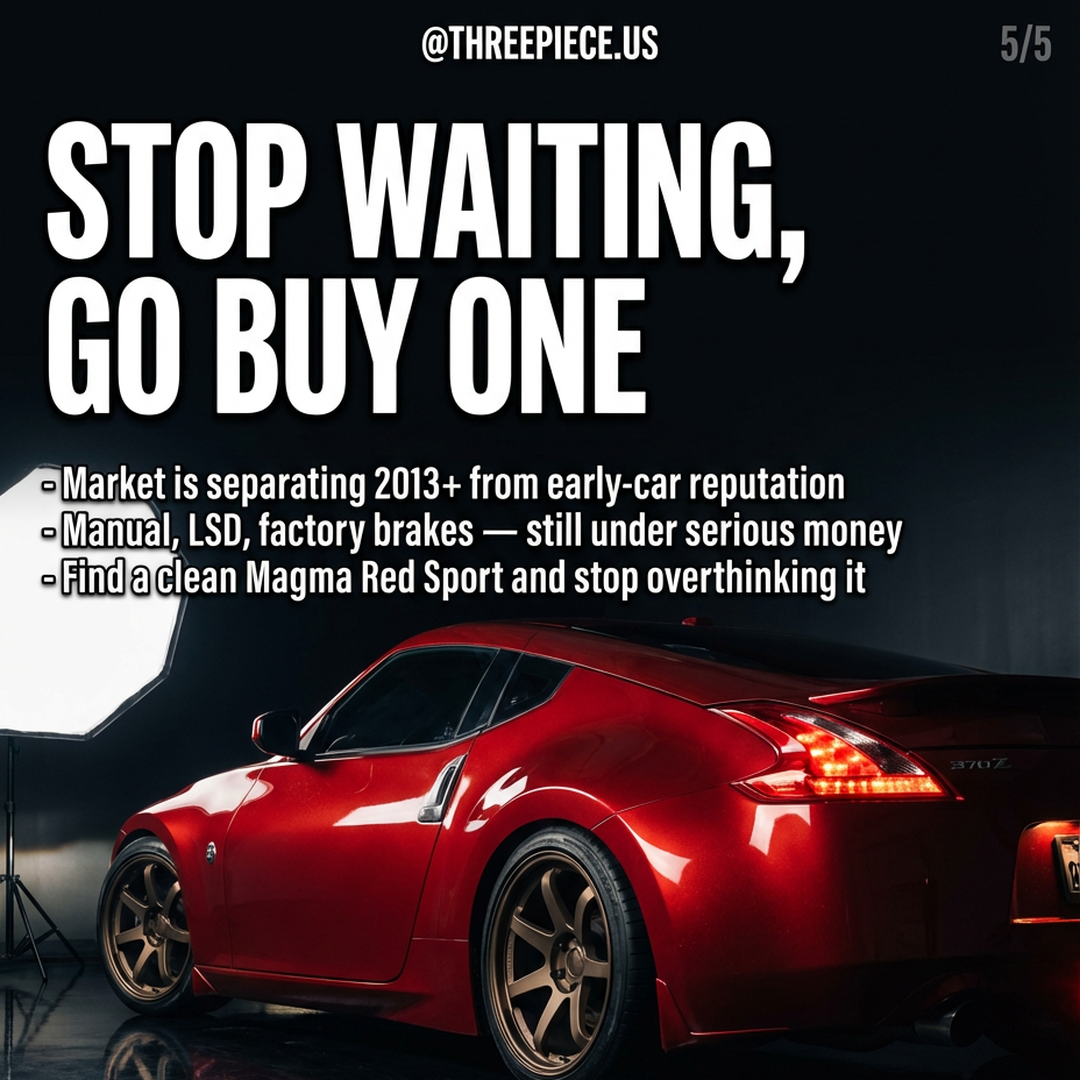
The market is actively separating 2013-2014 Z34s from the early-car reputation. Clean Sport 6MTs with documented maintenance are getting harder to find, and the ones that remain are being snapped up by owners who've done their homework. Manual transmission, factory LSD, naturally aspirated V6, big brakes, forged wheels from the factory — all still available for serious money under what a comparable new sports car costs.
If you're building one out, the Function and Form Type 3 Coilovers for the Z34 are a direct-fit suspension upgrade that transforms the chassis. Pair them with proper wheels from the ThreePiece wheel catalog, the right tires, and the aFe Takeda cat-back, and you've got a complete, sorted sports car that rewards you every time you turn the key. For more builds like this, check the underrated project cars under $20K and 3 underrated Japanese sports cars from the 2000s.
Find a clean Magma Red Sport and stop overthinking it.