
350Z Track Build Guide: Z33 Mod Order That Works
The Nissan 350Z track build is one of the most rewarding projects in the sport-compact world — if you do it in the right order. The Z33's FM platform gives you front-mid engine placement, near 50/50 weight distribution, and a chassis that responds to every suspension dollar better than almost anything else under $15K. But most builds get it backwards: exhaust and intake before the car can even rotate properly. Here's the mod order that actually produces fast lap times, pulled from documented build threads and real track results.
Quick links
- Why the Z33 Rewards Chassis Work First
- Bolt-On Power Roadmap: DE vs HR
- Suspension Setup That Transforms the Car
- Track Fitment That Actually Clears
- Drivetrain Weak Points and Fixes
- The Complete Build Order
Why the Z33 Rewards Chassis Work First
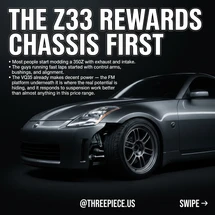
Most people start modding a 350Z with an exhaust and intake because that's what YouTube shows them. The guys actually running fast laps — the ones posting in-car data on my350z.com and 350z-uk.com — started with control arms, bushings, and alignment. The VQ35DE already makes decent power in stock form. The FM platform underneath it is where the real potential hides.
Nissan's FM (Front Midship) architecture positions the engine behind the front axle, which gives the Z33 rotational characteristics that most cars in this price range simply don't have. But the factory rubber bushings, soft sway bars, and conservative alignment geometry hold it back significantly. Address those first and you'll find a car that rotates on throttle, holds a line under braking, and communicates through the steering wheel in a way that bolt-on power never delivers on its own.
Bolt-On Power Roadmap: DE vs HR
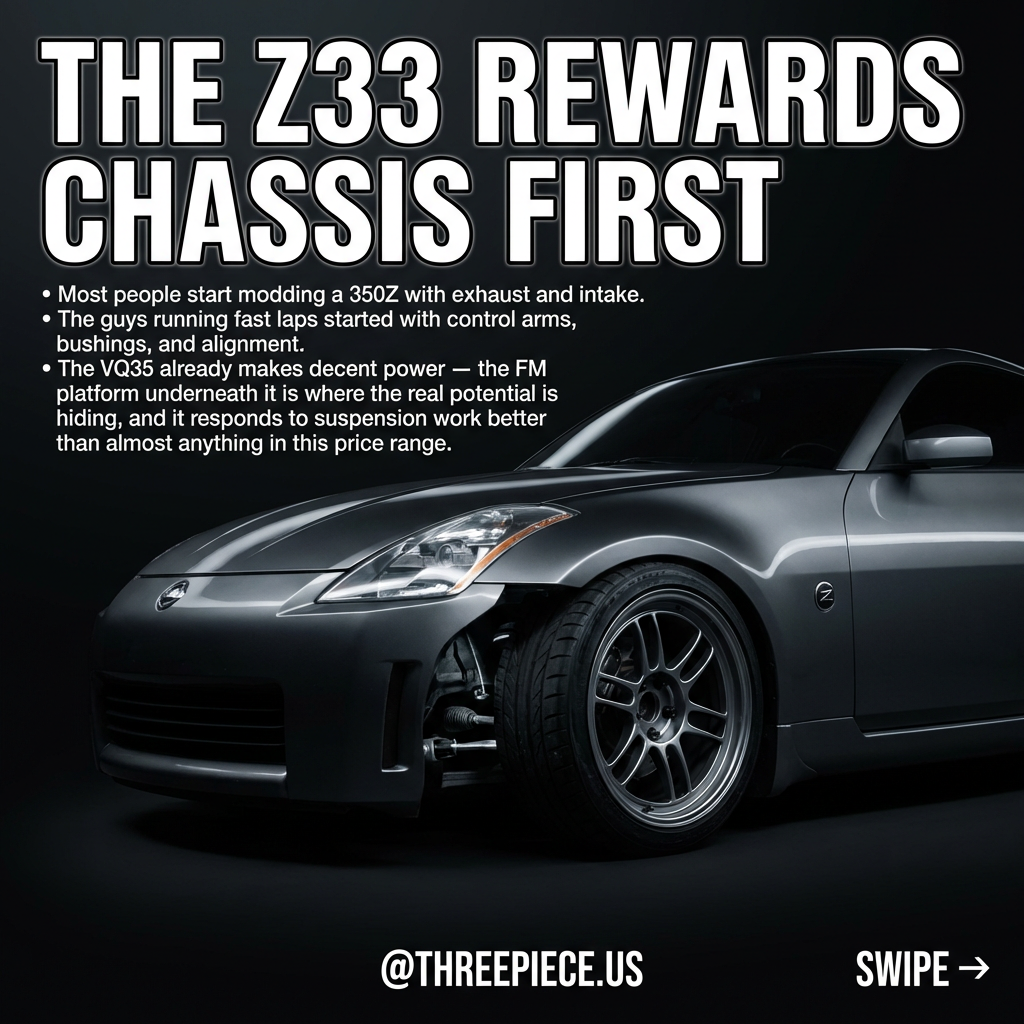
Here's the realistic power roadmap for naturally aspirated Z33 builds. Cold air intakes, a plenum spacer, test pipes, a full exhaust, and an UpRev or Admin Tuning flash gets a healthy DE to around 280–300 whp, and an HR into the 300–320 whp range. The order matters: intakes first, then exhaust opening, headers, and the tune comes last — after every airflow mod is installed. The tune corrects fuel and ignition maps for the new airflow characteristics. Without it, you're leaving 20–40 whp on the table and potentially running lean under load.
For the exhaust side, the Invidia High Flow Cat for 02-06 350Z at $1,087 is one of the better bolt-on exhaust upgrades — it replaces the restrictive factory catalytic converters while keeping things street-legal. Pair that with a quality Y-pipe (Motordyne or Tomei are the proven choices) and a cat-back, and you've opened the exhaust side properly. To understand whether a cold air intake is actually worth it, the answer on the VQ platform is yes — but only when paired with the tune.
If you're curious how tuning stages stack up across platforms, our Stage 1 vs Stage 2 dyno comparison breaks down what each level actually delivers. On the Z33 specifically, the HR motor responds better to bolt-ons than the DE due to its revised intake manifold and higher-flowing heads. The DE's ceiling without forced induction is real — accept it and focus on making the car faster through the corners instead.
For HR-equipped cars (2007–2008), the Mishimoto PCV-Side Catch Can Kit at $580 addresses oil vapor recirculation that can foul intake valves over time — especially relevant on track cars seeing sustained high RPM. The Mishimoto Black Silicone Hose Kit for 07-09 350Z at $154 replaces the aging factory rubber coolant hoses that become failure points under track heat cycling.
Suspension Setup That Transforms the Car
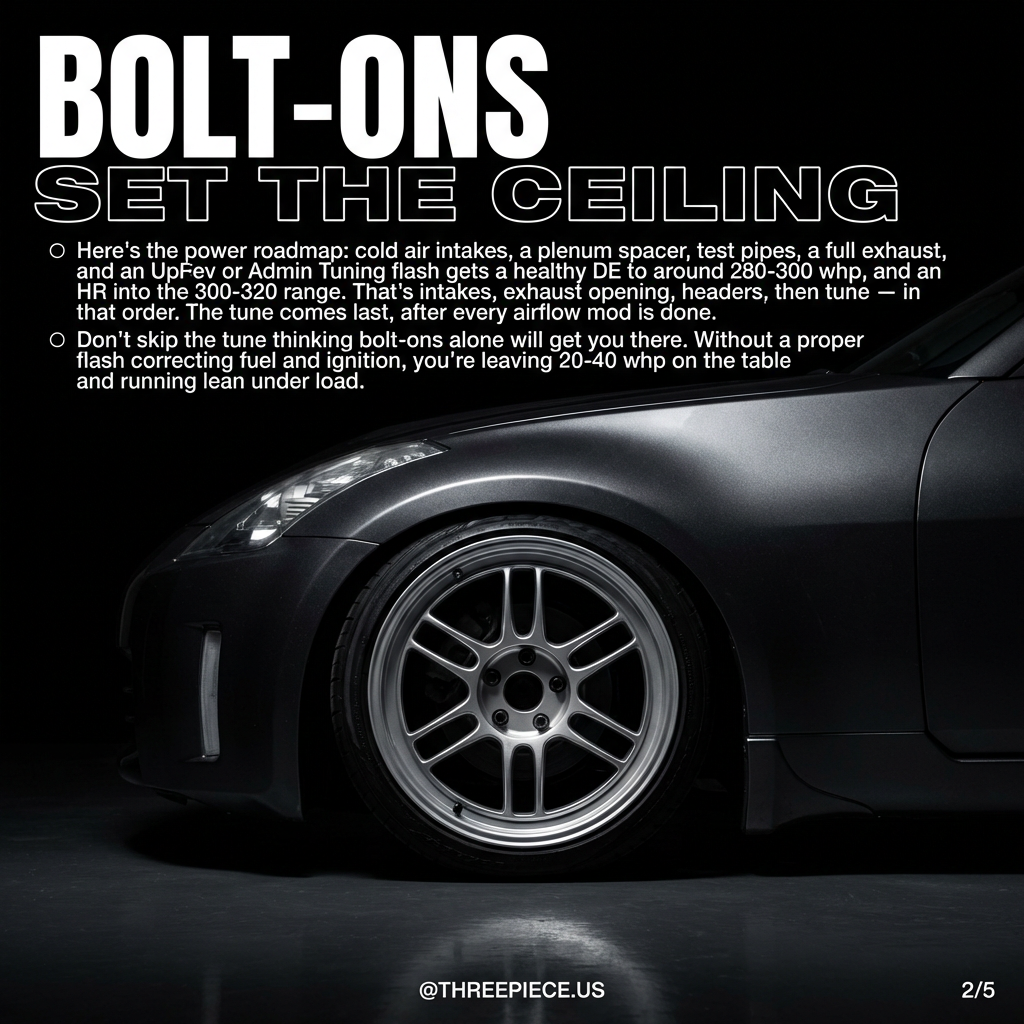
This is where the Z33 lives or gets wrecked. For a track-focused street car, the target is 10–12 kg/mm front and 8–10 kg/mm rear on monotube coilovers with independent rebound and compression adjustment. Drop 25–35mm from stock height — enough to tighten the geometry without destroying suspension travel. Go past that and you're fighting bumpsteer and excessive camber gain that no alignment can correct.
Documented builds from the UK track scene run MeisterR GT1 or MCS (Motion Control Suspension) coilovers with Eibach ERS springs. The key is valving that matches the spring rate — cheap coilovers with stiff springs create a car that skips and chatters over track surfaces instead of loading tires progressively. If you're weighing your options, read our breakdown of whether coilovers are worth it and the expensive mistake most coilover buyers make. Browse our full suspension catalog for options across platforms.
The real move is adjustable arms everywhere: front upper camber/caster arms, rear camber arms, rear traction arms, toe links, and solid subframe and differential bushings. SPL, SPC, and FDF all make proven components for this chassis. The NVH goes up noticeably, but the steering response and rear stability transform the car. One UK build thread documented replacing every rubber bushing with spherical bearings and described the difference as "a completely different car — like the chassis finally woke up."
For alignment targets on track, run approximately -3° front camber and -2° to -2.5° rear camber. You need adjustable arms to achieve these numbers without binding or running out of factory adjustment range. Our camber setup guide explains the geometry in detail. Hotchkis front and rear sway bars are the go-to upgrade — they sharpen turn-in and reduce body roll without making the ride punishing on the street.
Track Fitment That Actually Clears
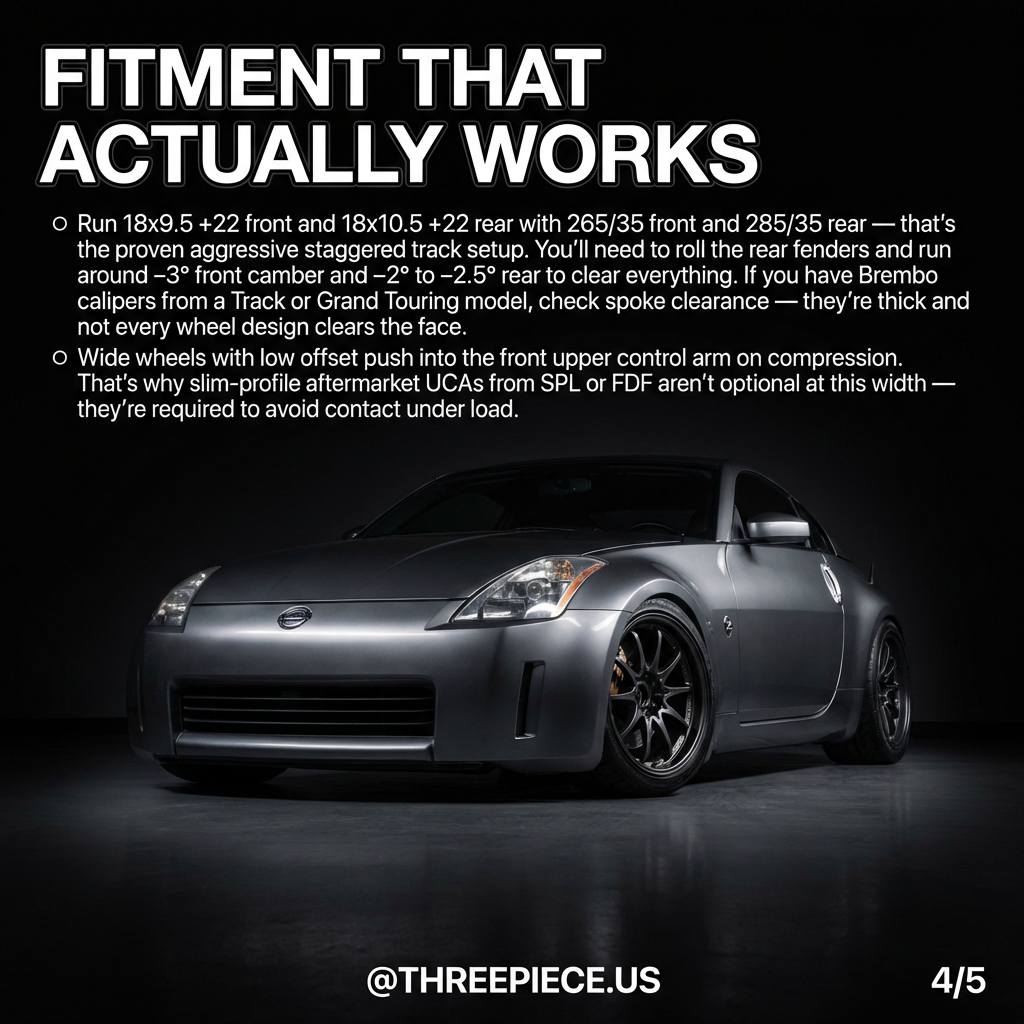
The proven aggressive staggered track setup for the Z33 is 18x9.5 +22 front and 18x10.5 +22 rear with 265/35R18 front and 285/35R18 rear tires. You'll need to roll the rear fenders and run the camber numbers mentioned above to clear everything. If your car has the Brembo calipers from a Track or Grand Touring model, check spoke clearance carefully — they're thick and not every wheel design clears the caliper face.
Browse 18x9.5 wheels in 5x114.3 and 18x10.5 wheels in 5x114.3 to see what's currently available. The Z33 runs a 5x114.3 bolt pattern with a 66.1mm hub bore, so grab a set of hubcentric rings to eliminate vibration if your wheels don't match the factory bore exactly.
Wide wheels with low offset push into the front upper control arm on compression. That's why slim-profile aftermarket UCAs from SPL or FDF aren't optional at this width — they're required to avoid contact under load. This is a detail most fitment galleries miss because they only show static photos. The contact happens at full compression during hard cornering, and it'll chew through your control arm in a single track day.
For tires, pair the front wheels with 265/35R18 tires and the rears with 285/35R18 tires. Yokohama AD08R and Hankook RS4 are the documented favorites in Z33 track threads for their progressive breakaway characteristics. If you want to understand whether wheel spacers are safe as an alternative to low-offset wheels, the short answer is yes — with quality hub-centric spacers like the Eibach Pro-Spacer 15mm for 350Z/370Z at $182, which is specifically designed for the 5x114.3 / 66.1mm hub.
The Z33 shares its platform with the Infiniti G35, so fitment data crosses over almost 1:1. If you're considering cast vs forged wheels for track use, forged is the clear winner — the weight savings at 18" is significant and directly translates to faster transient response. Check out the Work Emotion series for lightweight options, or explore why 3-piece wheels command premium pricing and whether they make sense for your build.
Drivetrain Weak Points and Fixes
The Z33 has one well-documented drivetrain failure point that you need to address before tracking the car hard: the internal concentric slave cylinder (CSC). The factory clutch slave sits inside the bellhousing, and under repeated hard use it fails — leaving you stranded with no clutch actuation. JWT makes a heavy-duty internal replacement, and ZSpeed offers their CSMAK external conversion kit that relocates the slave cylinder outside the bellhousing entirely. Budget for one of these early. Multiple build threads cite CSC failure as the single most common mechanical issue on tracked Z33s.
For serious track use, the OS Giken TR Series Dampened Twin Plate Clutch for 350Z/370Z VQ35HR at $1,739 is the gold standard. OS Giken's STR2C clutch appears in multiple documented Nismo and track builds for good reason — it holds serious power while remaining streetable thanks to the dampened design. One MotorTrend-featured Nismo build paired the OS Giken clutch with the ZSpeed CSC delete and a Nismo GT Pro LSD, along with 370Z hubs and axles for the 3.9 final drive swap.
The factory differential bushings are the other weak link. Under hard cornering, the diff moves in its mounts, creating inconsistent power delivery and a vague feeling at the rear. SPL solid differential bushings eliminate the slop completely. Whiteline also makes a solid subframe bushing kit that tightens up the entire rear end. These are inexpensive upgrades with outsized impact on how the car puts power down.
The Complete Build Order
A 300 whp Z33 on proper coilovers, adjustable arms, solid bushings, and real fitment is faster and more rewarding than a 350 whp Z33 on stock suspension and whatever wheels happened to clear the calipers. Here's the order that documented fast Z33 builds follow:
- Solid subframe and differential bushings — tighten the chassis foundation
- Coilovers with proper spring rates — 10-12 kg/mm front, 8-10 kg/mm rear
- Adjustable arms everywhere — SPL, SPC, or FDF camber/caster/traction/toe
- Sway bars — Hotchkis front and rear
- Brake pads and fluid — Hawk HP+ or Carbotech XP12 front, proper fluid
- Wheels and tires — 18x9.5/18x10.5, 265/285 staggered
- CSC upgrade — JWT internal or ZSpeed external conversion
- Exhaust, intake, and tune — all airflow mods first, tune last
- Oil cooler — Mishimoto thermostatic or Z1/Setrab setup
- Clutch and LSD — OS Giken clutch, Nismo GT Pro or OS Giken Superlock
The Z33 platform is still undervalued relative to what it delivers on track. Clean examples with the HR motor (2007–2008) are climbing in price but remain under $20K for solid cars. The G37 Sport shares much of the same DNA if you want a newer starting point, and the 370Z Sport buying guide covers the next-generation platform. But dollar for dollar, a properly built Z33 is hard to beat.
Ready to start your Z33 build? Browse wheels, Nissan-specific parts, and check the vehicle gallery for build inspiration.
