
Mazda RX-8 R3 Build Guide: Renesis Mod Order That Works
The Mazda RX-8 R3 is one of the most misunderstood platforms in the Japanese sport-compact world. A 50/50 weight distribution, a 9,000 rpm Renesis 13B rotary, a factory 6-speed, Bilstein dampers, and a limited-slip diff — Mazda handed you a chassis that most companies would charge twice the price for. But the RX-8 gets ignored because people either blow the engine chasing power the wrong way or write the whole platform off as unreliable. The Renesis isn't unreliable — it's unforgiving. Get the order of operations right and you'll have one of the best-handling cars under $15,000. Here's exactly how to build one.

Quick links
- Ignition First, Power Second
- Intake, Exhaust, and the Tune That Ties It Together
- Suspension Setup That Unlocks the Chassis
- 18x9.5 +35: The RX-8 Fitment Sweet Spot
- Cooling and Longevity: Budget for These Upfront
- Build It Before Clean R3s Disappear
Ignition First, Power Second
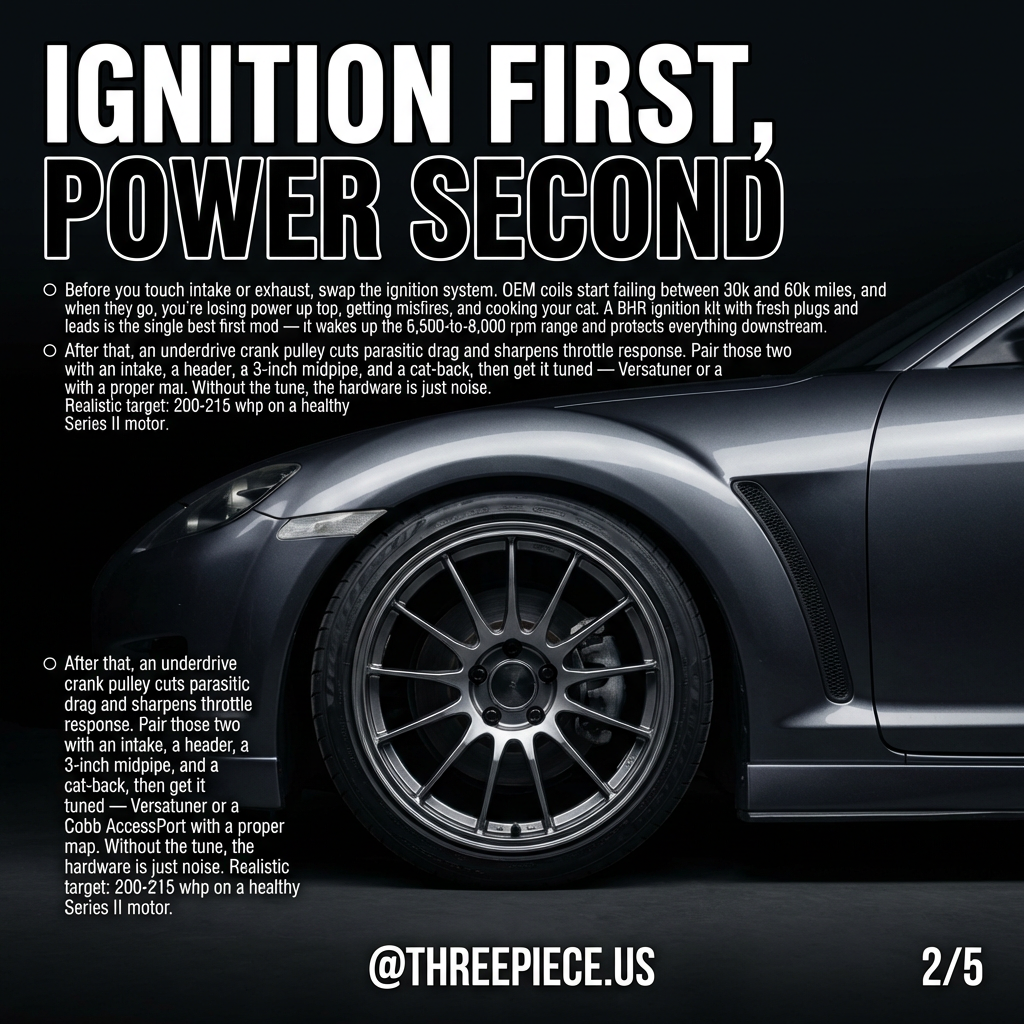
This is the single most important section in this entire guide. Before you touch the intake, before you think about exhaust, before you even look at wheels — swap the ignition system. OEM coils on the Renesis start failing between 30,000 and 60,000 miles. When they go, you're losing power above 6,500 rpm, getting misfires that you might not even feel at first, and cooking your catalytic converter from unburnt fuel. A BHR ignition kit with fresh plugs and new leads is the single best first modification you can make to any RX-8. It wakes up the entire 6,500-to-8,000 rpm powerband and protects everything downstream from cascading failures.
After the ignition kit, an underdrive crank pulley — like the Agency Power unit documented in multiple RX8Club build threads — cuts parasitic drag on the accessories and sharpens throttle response. These two mods together cost under $500 and make the car feel like a different machine. If you're wondering whether cold air intakes are actually worth the money, on a rotary the answer is a definitive yes — but only after the ignition system is sorted. Doing it in the wrong order is how people end up with lean conditions and warped side housings.
Intake, Exhaust, and the Tune That Ties It Together
Once the ignition is handled, the breathing mods come next. The proven combination from owner build threads on RX8Club is straightforward: a cold air intake, a header (Racing Beat is the go-to), a 3-inch midpipe, and a quality cat-back exhaust. The AEM Cold Air Intake for the 04-06 RX-8 at $387 is the most commonly installed intake on this platform — it appears in nearly every serious Renesis build thread. If you prefer the polished look, the AEM 04-06 Mazda RX-8 Blue Cold Air Intake - 21-485B runs $516, and the AEM 04-06 Mazda RX-8 Blue Cold Air Intake - 21-485B sits at $466.
For the exhaust, the Borla Cat-Back Exhaust for the 03-09 RX-8 at $1,394 is a serious piece — stainless construction, proper flow, and a sound that actually suits a 9,000 rpm rotary. Pair that with a Racing Beat header and a quality midpipe, and you've opened up the entire exhaust tract.
But here's the part everyone skips: without a tune, the hardware is just noise. Versatuner or a Cobb AccessPort with a proper map are the two platforms RX-8 owners consistently use. A BHR throttle body spacer combined with a cold air intake will create lean conditions on the stock map — multiple RX8Club threads document this exact failure mode. Get it tuned by someone who understands the Renesis fuel delivery requirements. Realistic target on a healthy Series II motor with this full bolt-on setup: 200-215 whp. That doesn't sound like a lot on paper, but in a 2,900 lb car that revs to 9,000 rpm, it's more than enough. Read our Stage 1 vs Stage 2 tune breakdown for context on what calibration actually does for naturally aspirated platforms.
Suspension Setup That Unlocks the Chassis
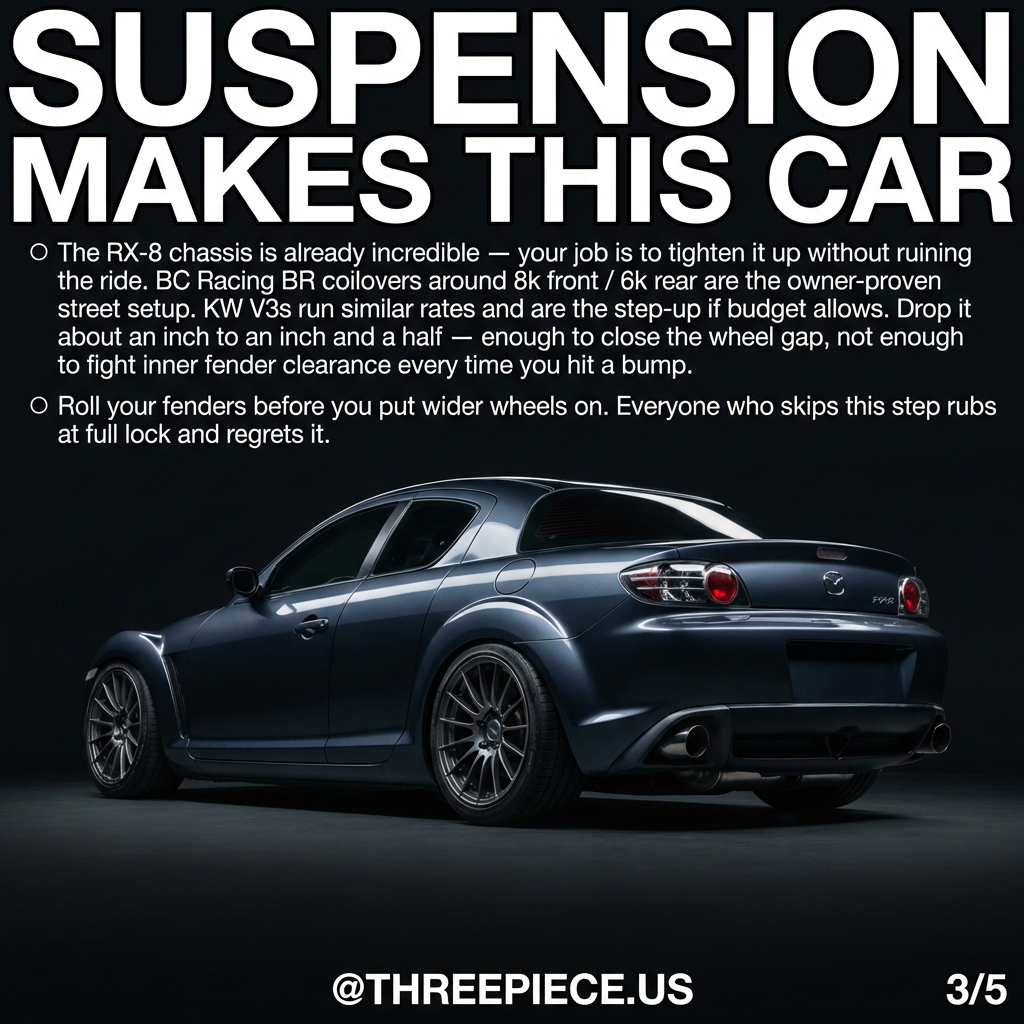
The RX-8 chassis is already incredible from the factory. The R3 variant came with Bilstein shocks, revised intake porting, and a factory LSD — Mazda basically handed you a 70% finished build. Your job with suspension is to tighten it up without ruining what's already there.
BC Racing BR coilovers at approximately 8k front / 6k rear spring rates are the owner-proven street setup. KW V3s run similar rates and are the step-up if budget allows. Drop it about one inch to one and a half inches — enough to close the wheel gap, not enough to fight inner fender clearance every time you hit an expansion joint. If you're debating whether coilovers make sense on a car you also daily drive, our guide on whether coilovers are worth it on daily drivers covers the real tradeoffs. And if you want to avoid the most common pitfalls, read why 90% of coilover buyers make this expensive mistake before you order anything.
One non-negotiable step: roll your fenders before you put wider wheels on. Every RX-8 owner who skips this rubs at full lock and regrets it. The rear arches on this car are tight, and the front isn't much more forgiving with the steering geometry at full travel. Do it properly with a heat gun and a roller — it takes an afternoon and saves you months of frustration. Browse our suspension catalog for options across multiple platforms.
18x9.5 +35: The RX-8 Fitment Sweet Spot
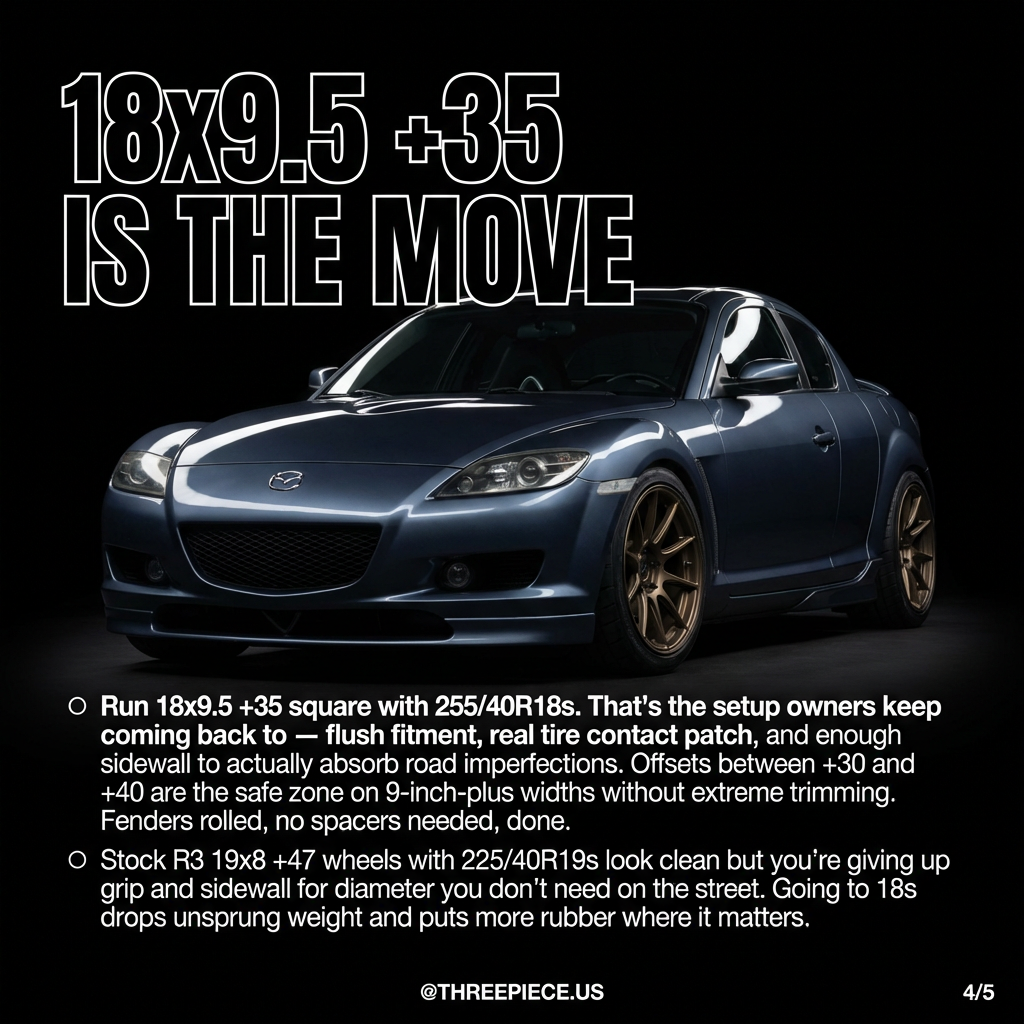
Run 18x9.5 +35 square with 255/40R18 tires. That's the setup RX-8 owners keep coming back to after trying everything else — flush fitment, a real tire contact patch, and enough sidewall to actually absorb road imperfections without destroying your spine or your wheel lips. Offsets between +30 and +40 are the safe zone on 9-inch-plus widths without extreme trimming. Fenders rolled, no spacers needed, done.
The stock R3 runs 19x8 +47 wheels with 225/40R19 tires. They look clean, but you're giving up grip and sidewall for diameter you don't need on the street. Going to 18s drops unsprung weight and puts more rubber where it matters. The RX-8 runs 5x114.3, which is one of the most common bolt patterns in the JDM world — the aftermarket options are enormous. Browse BBS CC-R 5x114.3 19x8.5+30 Satin Platinum to see what's currently available, or look at BBS CC-R 5x114.3 19x8.5+30 Satin Platinum specifically for the ideal RX-8 spec.
For tire sizing, search 255/40R18 tires to find rubber that matches this setup. If you're considering a set of 3-piece wheels for this build — and on a car this clean, you should — the Work Emotion series and Work Meister line both offer 18-inch options that suit the RX-8's aggressive but refined stance. Check out our vehicle gallery for build inspiration across similar platforms. If you want to understand how staggered vs. square setups affect handling on a 50/50 chassis like this, our GR86 fitment mistakes guide covers the same principles — square is almost always the right call on a balanced, lightweight platform.
Cooling and Longevity: Budget for These Upfront
If you're buying a high-mileage RX-8 — and most of them are high-mileage at this point — budget for a compression test before you hand over any money. Healthy Renesis compression should be above 100 PSI across all faces. Anything below 80 PSI means you're looking at an apex seal refresh, and that's a $2,000-3,000 job depending on who does it.
Even on a car with good compression, a Mazmart high-flow water pump and thermostat is cheap insurance. The Renesis runs hot — the side housings tend to warp around the exhaust ports if cooling isn't addressed, especially once you start adding intake and exhaust modifications that change airflow and heat distribution. A cooling refresh upfront — water pump, thermostat, fresh coolant, and inspecting all the hoses — costs a few hundred dollars and can save you from a five-figure engine replacement down the road.
The other longevity item nobody talks about: premix. Running 2-stroke oil premixed in your fuel at a ratio of about 1 oz per gallon keeps the apex seals lubricated in a way the OEM oil injection system doesn't fully handle at high RPM. This is standard practice among long-term rotary owners and it's the difference between a Renesis that lasts 80,000 miles and one that lasts 150,000+. If you're coming from a piston engine platform, this concept might seem foreign — but it's the rotary equivalent of running quality oil at proper intervals. The car rewards attention to detail.
For the exterior, the Xtune LED Tail Lights for the 04-08 RX-8 at $294 are a clean, modern upgrade that freshens up the rear end without going overboard. Small details like these separate a built car from a modified one.
Build It Before Clean R3s Disappear
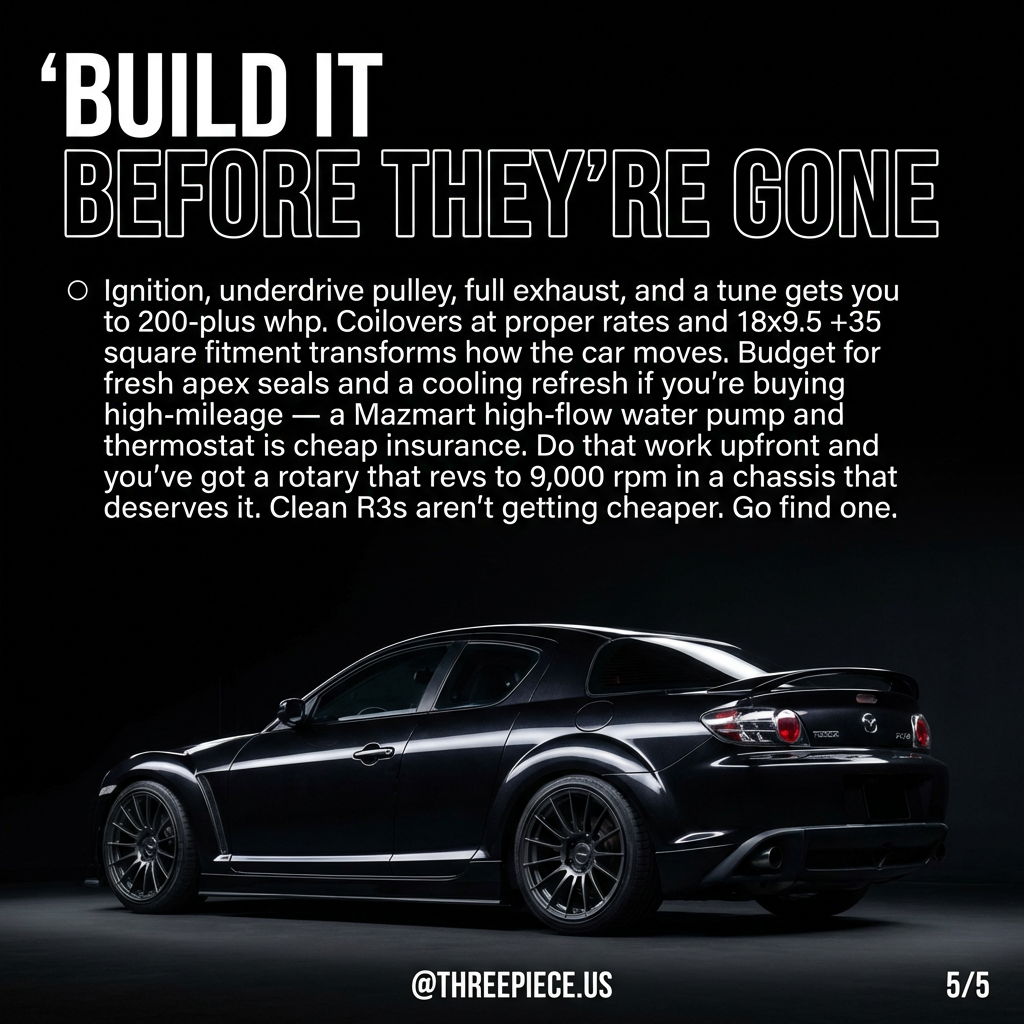
Here's the full build path in order: BHR ignition kit → underdrive crank pulley → cold air intake → header → 3-inch midpipe → cat-back exhaust → tune. That gets you to 200+ whp on a healthy Series II Renesis. Add coilovers at proper rates and 18x9.5 +35 square fitment with 255/40R18 tires, and you've transformed how the car moves in every direction. Budget for fresh apex seals and a cooling refresh if you're buying high-mileage, and premix your fuel from day one.
The RX-8 R3 came from the factory with Bilstein shocks, a limited-slip differential, and revised intake porting. Most people ignore all of that and slap a turbo kit on a motor with 80 PSI compression. Don't be that person. Do the work in the right order and you've got a rotary that revs to 9,000 rpm in a chassis that genuinely deserves it.
Clean R3 examples aren't getting cheaper. The ones with good compression and documented maintenance are disappearing from the market. Compare the RX-8's approach to other lightweight platforms in our FR-S build guide or our FR-S buying guide — the philosophy is the same: chassis first, power second, and never skip the fundamentals. Browse our full wheel catalog to find the right set for your build, and finish them off with proper valve stems and center caps to complete the look.