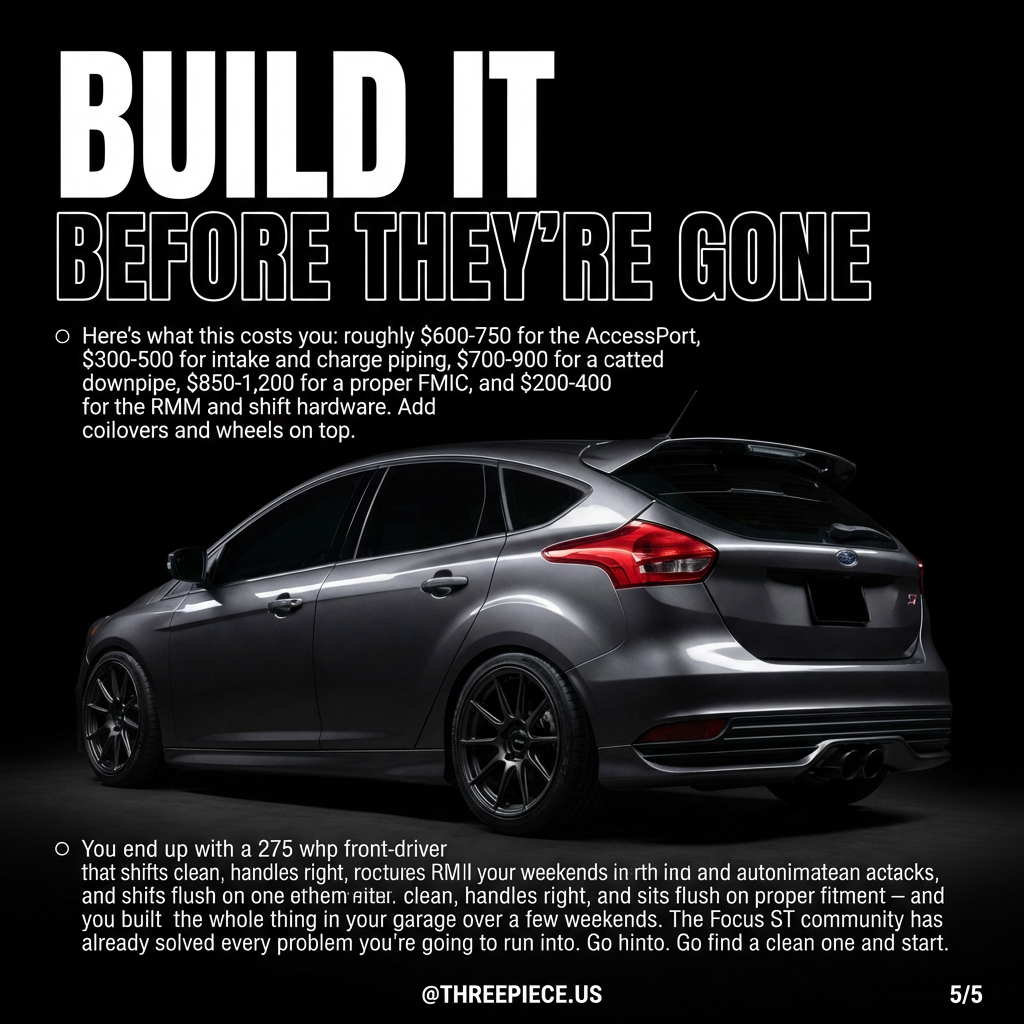
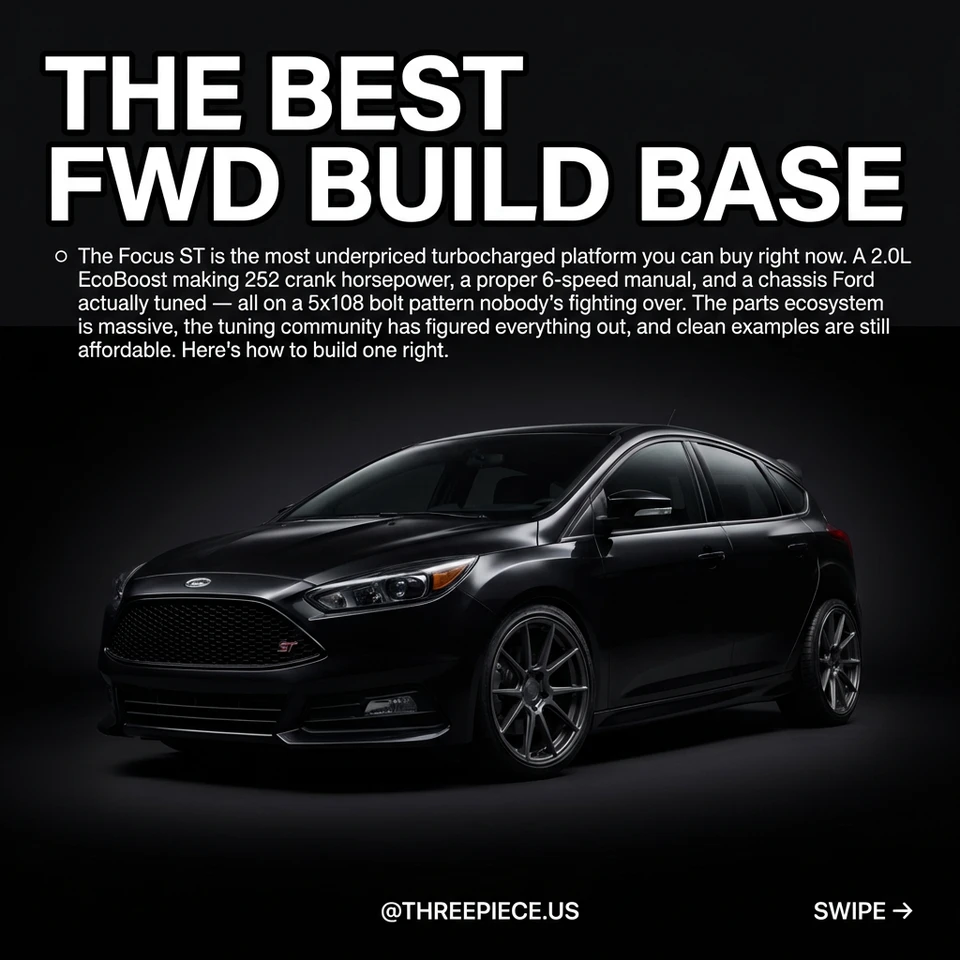
The Ford Focus ST Mk3 is quietly becoming the best-value turbocharged FWD platform you can build right now. A 2.0L EcoBoost making 252 crank horsepower, a proper 6-speed manual, Ford's genuinely well-tuned chassis, and a 5x10⁸ bolt pattern that nobody's bidding up — all for well under $15K. The parts ecosystem is enormous, the tuning community has solved every problem you'll encounter, and clean examples are still out there if you move quickly. Here's the correct mod order to build one, based on real owner builds and long-term forum data.
Quick links
- Cobb AccessPort First, Everything Else Second
- Fix the Chassis Feel Before Adding Power
- Full Bolt-On Power: Downpipe, FMIC, and Exhaust
- Focus ST Wheel Fitment: 18x9.5 +40 Is the Move
- Known Failure Points and Maintenance
- What the Full Build Costs
Cobb AccessPort First, Everything Else Second
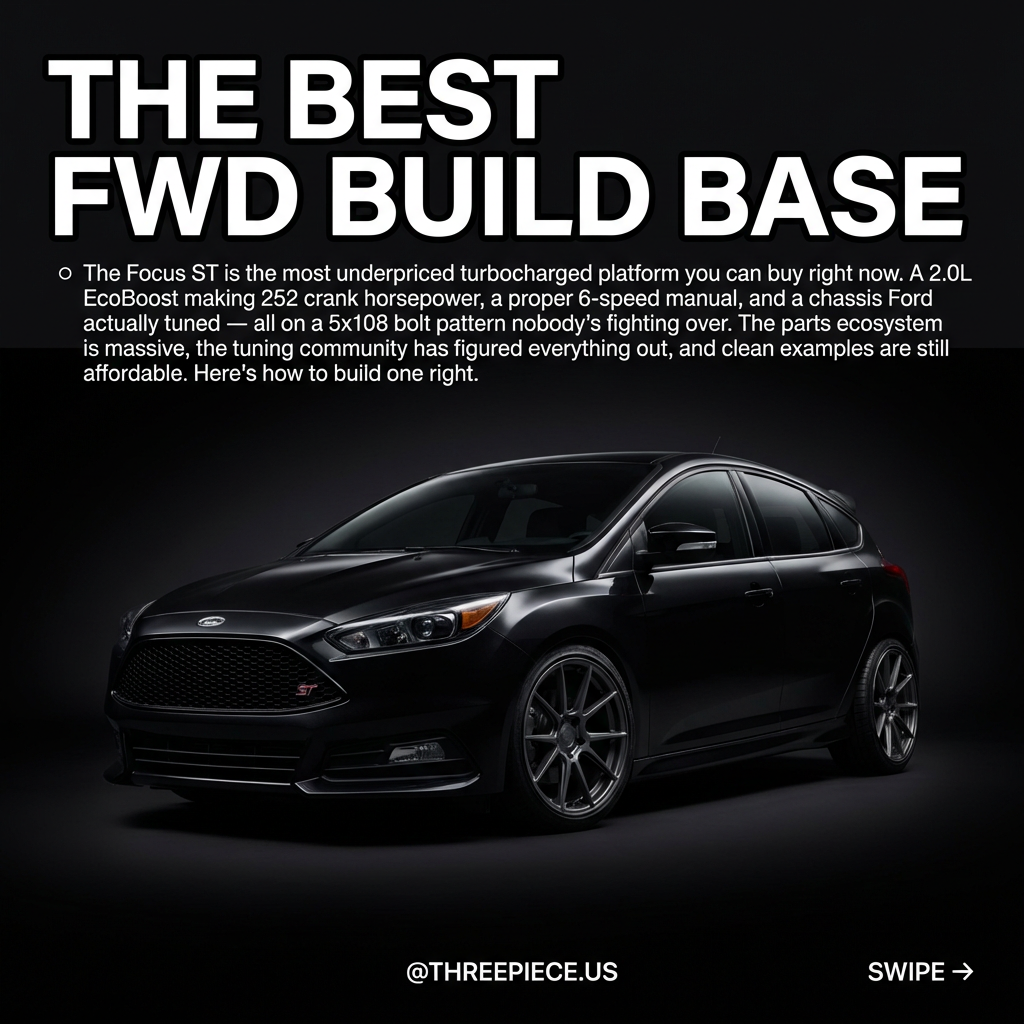
Every reputable Focus ST tuner in this ecosystem builds on the Cobb AccessPort V3. It's the foundation — not optional, not interchangeable. Start with a Stage 1 map on 93 octane and you're already making noticeably more boost with zero hardware changes. The stock turbo responds immediately to the revised boost targets and timing, and the difference in midrange pull is obvious from the first drive. If you're new to the tune-first philosophy, our breakdown of real Stage 1 vs Stage 2 dyno results explains why software always comes before hardware.
One thing the community universally agrees on: skip the off-the-shelf maps long-term. Once you have your bolt-ons sorted, get a custom e-tune from someone like Stratified or EMS. The drivability difference is real — smoother boost transitions, tighter knock margins, and better fuel economy under cruise. Owners running custom tunes on full bolt-on setups are putting down around 275 whp and 350 lb-ft at the wheels on the stock turbo. The stock bottom end is generally safe up to about 300 crank horsepower on quality fuel and a good tune — past that, piston ring lands start giving up.
Fix the Chassis Feel Before Adding Power
Before you even think about wheels or exhaust, do the rear motor mount. The stock mount lets the engine flop around under boost, wrecking your shift feel and amplifying torque steer — the two things that make FWD cars feel cheap. A COBB or Mountune RMM tightens everything up immediately. It's the single best mod for how the car drives, and it costs under $200. Pair it with shift bushings and a COBB short shift plate and the 6MT goes from adequate to genuinely satisfying. If you've been on the fence about whether chassis mods matter on a daily driver, our guide on whether coilovers are worth it for daily driving covers the philosophy in detail.
For coilovers, the community runs 7-8 kg/mm front and 5-6 kg/mm rear as the sweet spot for street and occasional track. BC Racing BR series at 7k/5k or KW V1s are the most common setups — both are proven over hundreds of builds on FocusST.org. Drop 25-35mm and you're flush without needing fender work. Go past 40mm of drop and you're into camber arms and fender rolling territory. If you're shopping coilovers and don't want to overspend, read why 90% of coilover buyers make this expensive mistake before you click buy. Browse the full suspension catalog for options across price points.
Full Bolt-On Power: Downpipe, FMIC, and Exhaust
Once the tune and chassis are sorted, it's time to open up the exhaust side. A 3-inch catted downpipe is the single biggest power adder on this platform after the tune. Whoosh, CP-E, and MBRP all make proven pieces. Pair it with a proper cat-back and you'll feel the turbo spool noticeably faster. The AWE Tuning Focus ST Touring Edition Cat-back Exhaust at $1,168 is one of the cleanest-sounding non-resonated options available — deep tone without the drone that cheaper systems produce.
The intercooler upgrade is non-negotiable for sustained driving. The stock intercooler heat-soaks aggressively — owners report intake air temps climbing 30-40°F above ambient after just a few pulls. A front-mount intercooler (FMIC) from CP-E, Depo Racing, or even the OEM Focus RS unit solves this completely. To connect it properly, the aFe BladeRunner 2.5" Intercooler Tubes for the 2012-2016 Focus ST at $518 give you the mandrel-bent aluminum piping that won't collapse under boost. On the intake side, the RS airbox with a K&N drop-in filter is the community's preferred solution — read our deep dive on whether a cold air intake is actually worth it for the full reasoning.
One critical note for tuned builds pushing past 275 whp: the stock clutch starts slipping. Forum data shows consistent clutch replacement around 130K-150K miles on stock tunes, but Stage 2+ builds can cook a clutch much sooner. The ACT XT/Race Sprung 6-Pad Clutch Kit for the Focus RS/ST at $1,689 is built for this exact scenario — rated for significantly more torque than stock and designed for the 2.0/2.3L EcoBoost platform. If you're chasing the 370-400 whp range that some owners target with bigger turbo setups, a clutch upgrade isn't optional — it's step one of the supporting mod list. Pair it with the ACT XACT Streetlite Flywheel at $713 for faster revs and cleaner shifts.
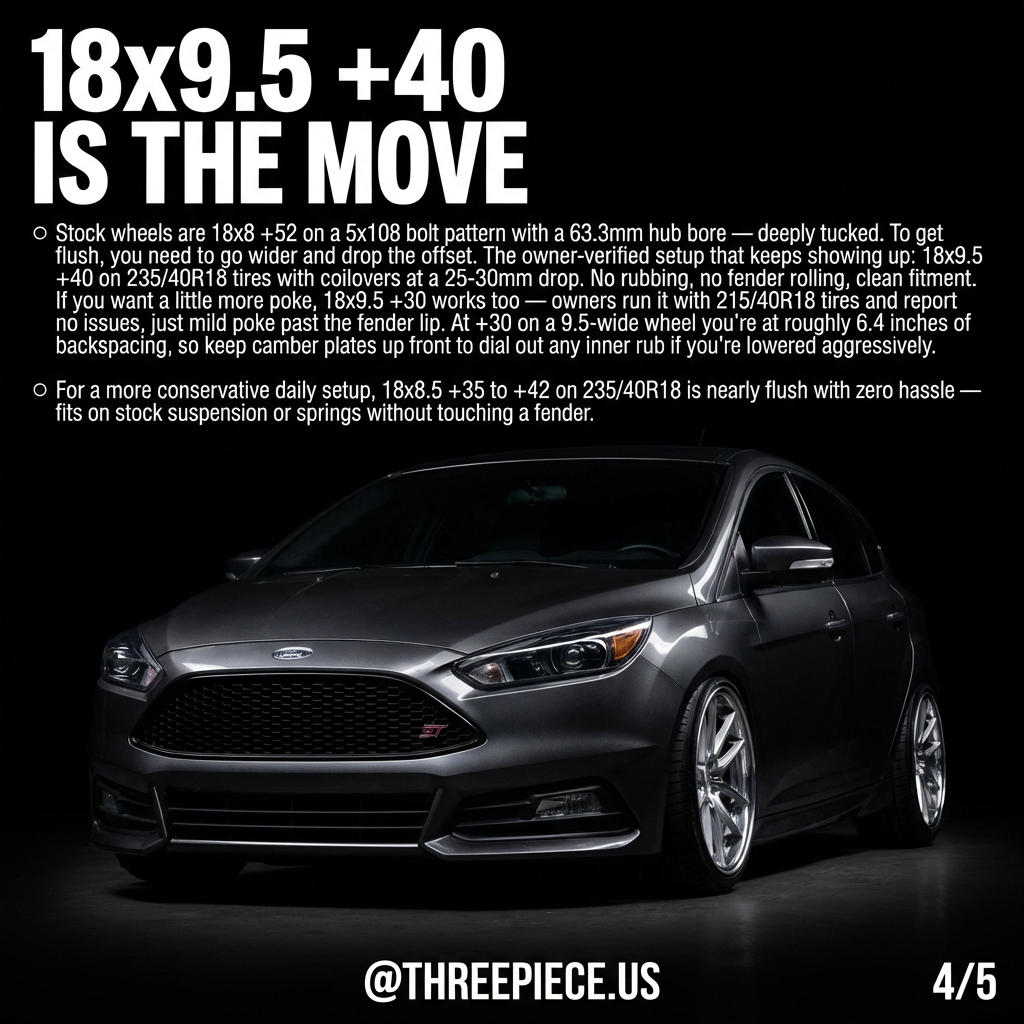
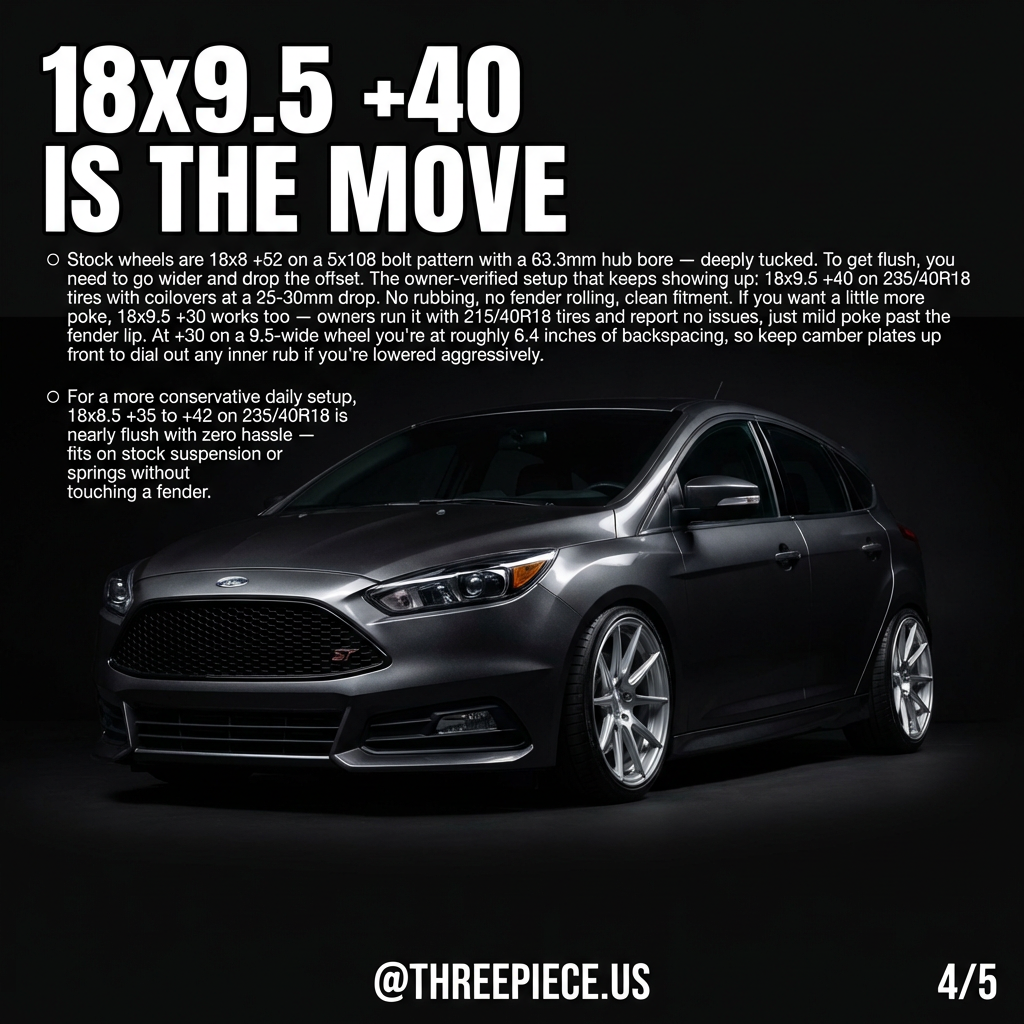
Focus ST Wheel Fitment: 18x9.5 +40 Is the Move
Stock wheels are 18x8 +52 on a 5x10⁸ bolt pattern with a 63.3mm hub bore — deeply tucked and visually underwhelming. To get flush, you need to go wider and drop the offset. The owner-verified setup that keeps showing up across FocusST.org and Reddit: 18x9.5 +40 on 235/40R18 tires with coilovers at a 25-30mm drop. No rubbing, no fender rolling, clean fitment. Browse Enkei NT03+M 5x10⁸ 18x9.5+40 Gunmetal to see what's currently available for this bolt pattern.
If you want a little more poke, 18x9.5 +30 works too — owners run it with 215/40R18 tires and report no issues, just mild poke past the fender lip. At +30 on a 9.5-wide wheel you're at roughly 6.4 inches of backspacing, so keep camber plates up front to dial out any inner rub if you're lowered aggressively. For a more conservative daily setup, 18x8.5 +35 to +42 on 235/40R18 is nearly flush with zero hassle — fits on stock suspension or springs without touching a fender.
For tires, the American Roadstar Sport AS 235/40R18 at $319 per set is a strong all-season option for daily-driven STs that still see spirited weekend driving. If you're running a more aggressive track-oriented setup, search 245/40R18 tires for wider rubber options. The Work Emotion series offers lightweight 2-piece options that look right on this platform — the concave spoke designs complement the ST's aggressive fender lines without looking overdone. Check our vehicle gallery for build inspiration across platforms.
Known Failure Points and Maintenance
The 2.0L EcoBoost is a strong engine, but it has documented weak points that long-term owners have mapped out in detail. Knowing these upfront saves you from surprises — and from blaming mods for problems that were coming regardless.
Cylinder head cracking is the big one. Reports surface between 100K-150K miles, with symptoms including white smoke, coolant in the exhaust, and misfires. This isn't a tuning-caused issue — stock cars see it too. It's a known casting weakness between cylinders. If you're buying used, a compression test and coolant system pressure test are mandatory. Our Focus ST Mk3 buying guide covers what to look for during a pre-purchase inspection in detail.
Valve cover gasket, purge valve, accessory belts, tensioner, and water pump all tend to need replacement around 60K-70K miles. Proactive replacement is cheaper than reactive — budget for these if you're buying a higher-mileage example. Coolant hoses and heater core O-rings leak between 100K-150K miles, and the coolant reservoir itself is known to crack. The fan control module (FCM) fails past 100K, causing the cooling fan to stop working — it's a two-plug replacement but easy to miss until you're overheating in traffic.
For tuned cars, spark plugs gapped to 0.024" (down from the stock 0.026-0.028") are standard practice under higher boost. Replace them frequently — every 15K-20K miles on a Stage 2 tune is not excessive. An oil catch can (Damond Motorsports Stage 1 is the go-to) helps control the GDI carbon buildup that plagues direct-injection engines under boost. The Focus RS platform shares many of these concerns — our Focus RS Mk3 build guide covers the 2.3L variant's maintenance overlap if you're cross-shopping.
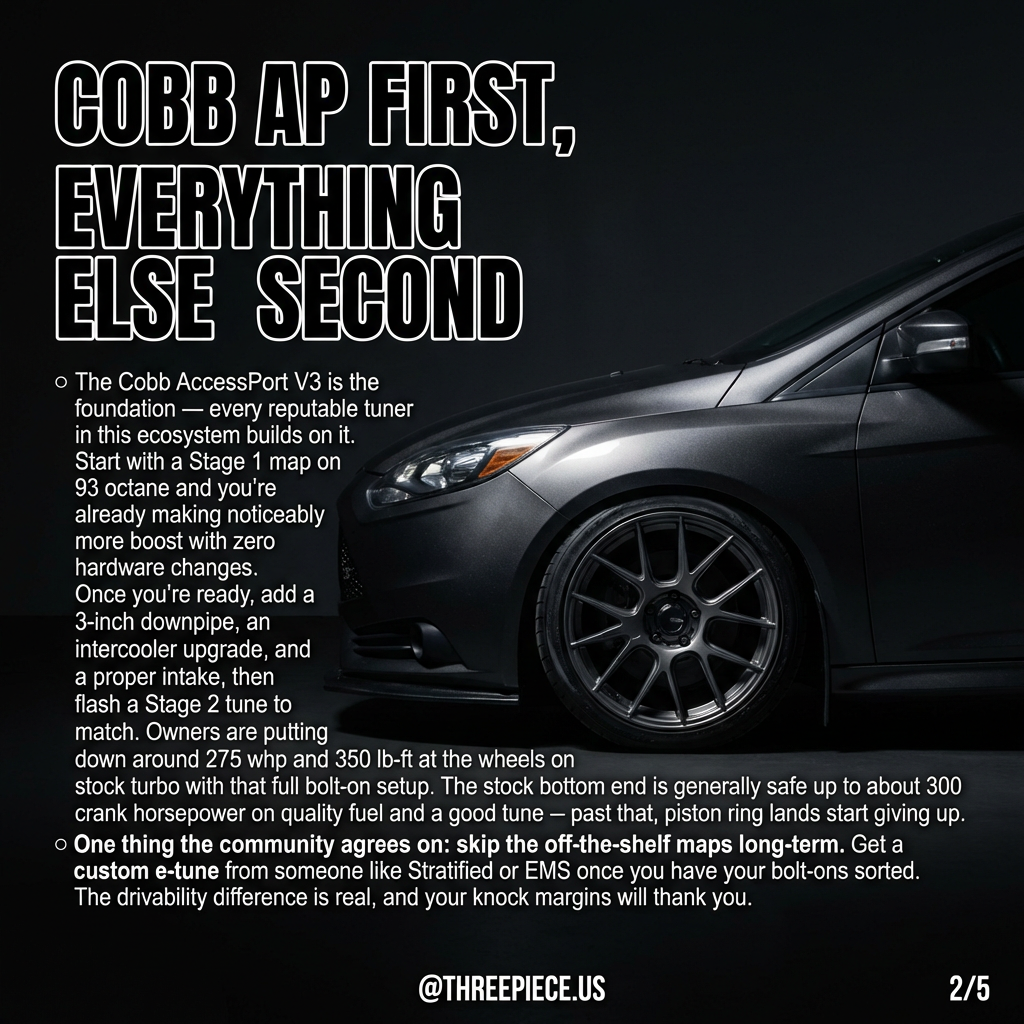
What the Full Build Costs
Here's the realistic budget for a complete, well-sorted Focus ST build:
- Cobb AccessPort V3 + custom e-tune: $600-750
- Intake and charge piping: $300-518 (the aFe BladeRunner 2.5in Red Intercooler Tubes Hot and Cold Side 12-16 Ford Focus ST 2.0L (t) - 46-20184-R at $518 are the premium option)
- Catted downpipe: $700-900
- Front-mount intercooler: $850-1,200
- Cat-back exhaust: $800-1,168 (the AWE Tuning Ford Focus ST Touring Edition Cat-back Exhaust - Non-Resonated - Chrome Silver Tips - 3015-32092 sits at the top of that range)
- RMM + shift hardware: $200-400
- Coilovers: $800-1,400
- Wheels + tires: $1,200-3,000+ depending on brand
- Clutch upgrade (if needed): $1,689 for the ACT 6-pad kit
All in, you're looking at $5,500-$10,000 to go from stock to a fully sorted 275 whp front-driver that shifts clean, handles right, and sits flush on proper fitment. You can build the whole thing in your garage over a few weekends. The Focus ST community has already solved every problem you're going to run into — the forums are a decade deep with verified data. Compare that to the Mazdaspeed 3 or the Mk7 Golf R and the ST's cost-to-performance ratio is hard to argue with.
Go find a clean one and start. Finish the look with proper valve stems and wheels from our catalog — because a 275 whp hot hatch on stock wheels is a build that's only half finished.