
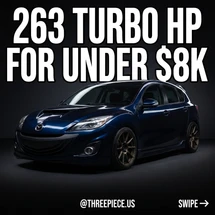
Mazdaspeed 3 BL Buying Guide: Best Turbo Hatch Under $8K
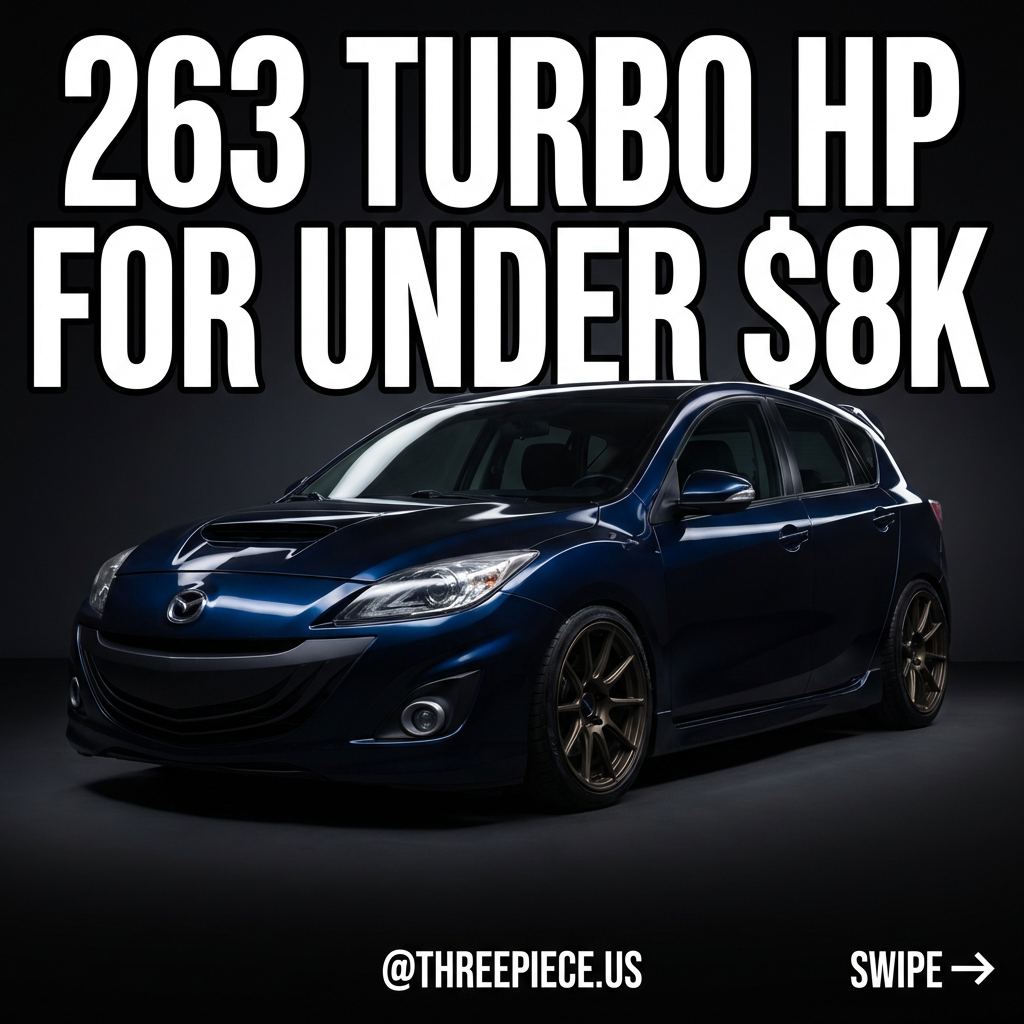
The 2010-2013 Mazdaspeed 3 (BL) is the most underpriced turbo platform you can buy in 2026. A 263 hp turbocharged hatch with a 6-speed manual, proven to 300,000 miles on stock internals, still sitting under $8,000 for clean examples — that's not a deal, that's a market failure. The BL chassis fixed the first-gen's interior cheapness and structural flex while keeping the same riotous 2.3L MZR-DISI turbo four that made the platform legendary. If you've been watching prices on the FK8 Type R or even the Golf R Mk7 climb past $30K, this is where your money actually goes further.
Quick links
- The DISI 2.3L Turbo: Why It Still Matters
- The Mod Path Is Solved — Every Power Level Mapped
- Known Failure Points: What Breaks and When
- Pre-Purchase Checklist for 2026
- Wheel Fitment for the BL Mazdaspeed 3
- Final Verdict: Go Find a Clean One
The DISI 2.3L Turbo: Why It Still Matters
Forget the spec sheet number for a second. The real story is 280 lb-ft at 3,000 rpm through a 6-speed manual in a hatchback that weighs under 3,300 lbs. That's mid-range torque that pins you to the seat on every on-ramp, and it's available from idle in a way that naturally aspirated competitors from the same era simply can't match. The DISI direct-injection turbo four shares its architecture with the first-gen Mazdaspeed 3 and the CX-7, which means parts availability is deep and the tuning community has had over 15 years to figure out every quirk.
On the dyno, stock BL Mazdaspeed 3s put down 220-240 whp and 240-260 wtq on a Dynojet — numbers that embarrass the naturally aspirated competition from 2010. Owners on r/mazdaspeed3 have documented cars cresting 200,000 and even 300,000 miles on original engine, transmission, clutch, and turbo. That kind of longevity from a turbocharged direct-injection motor is genuinely rare. The EJ257 in the GD STI can't say the same, and the FA20DIT in the VA WRX has its own well-documented carbon buildup headaches. The MZR-DISI isn't bulletproof — we'll get to that — but its bones are solid if you maintain it.
The Mod Path Is Solved — Every Power Level Mapped
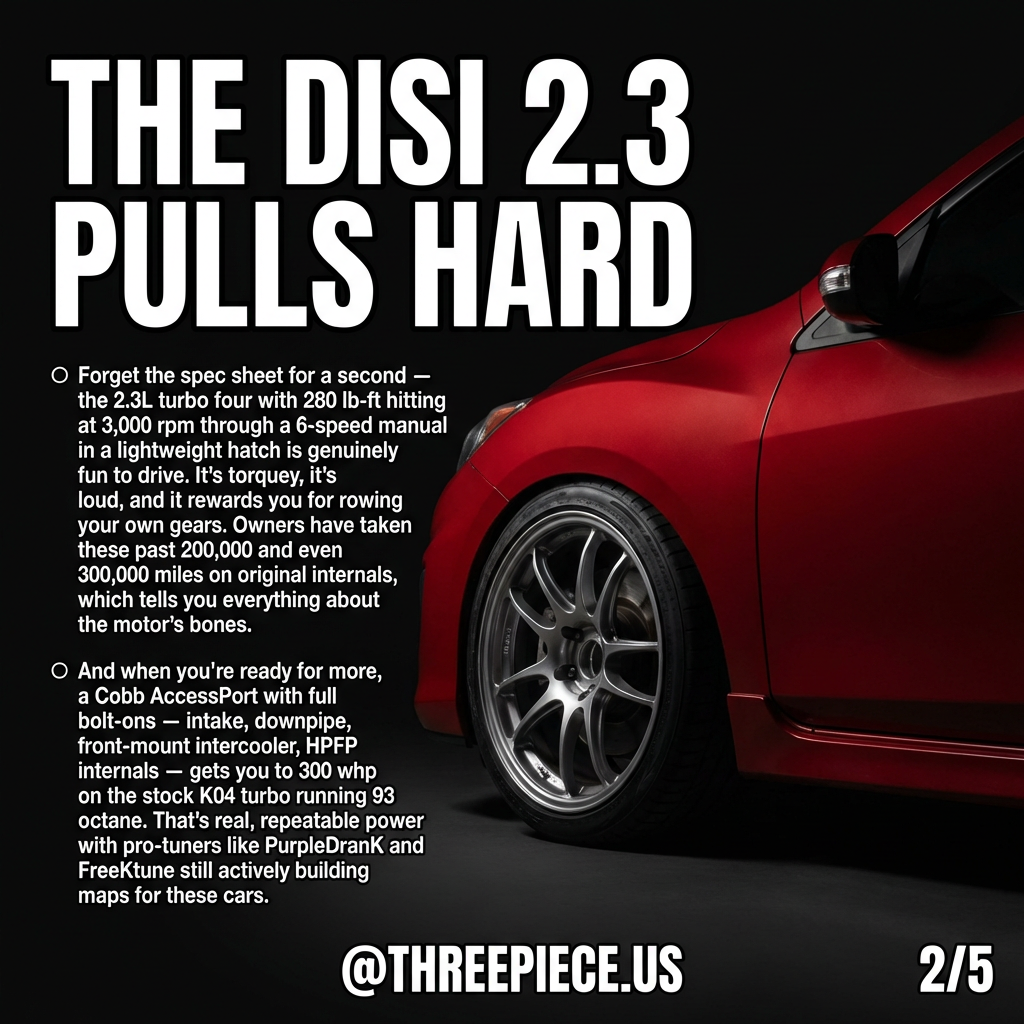
This is a platform where you're not guessing. The community has already mapped every single power level, and pro-tuners like PurpleDranK and FreeKtune are still actively building maps for these cars in 2026. Here's how the power curve stacks up:
- Stock K04 with full bolt-ons (intake, downpipe, FMIC, HPFP internals) + tune on 93 octane: ~300 whp
- Stock K04 pushed with aggressive tune on 93: 330-350 whp
- Stock K04 on E30 blend with supporting fuel work: 350-380 whp
- CST4 turbo upgrade on ethanol: 370-400 whp, still on the stock bottom end if you stay under ~400 whp
The Cobb AccessPort and Versatuner are the two primary ECU tuning platforms, and both have deep map libraries. CorkSport's intake manifold swap specifically addresses the cylinder 3 lean-out issue that the factory manifold causes under high boost — that's the kind of platform-specific institutional knowledge that only exists on mature platforms. You're not pioneering anything here; you're following a recipe that hundreds of builds have already validated. For a deeper dive on the exact mod order, read our Mazdaspeed 3 Gen 2 build guide — it covers the DISI mod sequence in detail.
If you're coming from the Subaru world and wondering how stage 1 vs stage 2 tuning translates to the Mazda platform, the short answer is that the Mazdaspeed 3 responds to bolt-ons more predictably than the EJ or FA motors, and the tuning ceiling on the stock turbo is higher relative to cost. A proper intake system paired with HPFP internals is non-negotiable before you touch boost — the stock high-pressure fuel pump can't keep up once you start adding airflow.
Known Failure Points: What Breaks and When
The Mazdaspeed 3 has earned its reputation, but it demands respect. Here's what actually fails, at what mileage, and what it costs to fix — all sourced from long-term owner reports:
Transmission Synchros (2nd and 3rd gear) — This is the platform's most common weak point. Grinding into 2nd or 3rd under load, especially during fast shifts, starts showing around 70,000-100,000 miles under hard driving. Synchro ring replacements and full rebuilds run $1,000-$2,500+ depending on the shop. Regular fluid changes with quality MTF help, but aggressive driving accelerates wear significantly.
K04 Turbo (BorgWarner K04-881/882) — Shaft play, oil leaks, and reduced boost response are the telltale signs. Primary failures tend to appear around 90,000-130,000 miles, earlier if the car has been tuned and pushed past 21 psi. Rebuilds cost $900-$1,500; replacement units cost more. Keep the banjo bolt screen clean and use proper oil feed lines. The stock K04 is reliable at stock boost levels — it's when owners push past 18-21 psi without supporting mods that things go sideways.
VVT Actuator and Timing Chain — Cold-start rattle is the warning sign. The VVT actuator can fail as early as 60,000-90,000 miles, and timing chain stretch shows up at 90,000-120,000+ miles. If the cam gear fractures, fragments can enter the oil system and cause catastrophic engine damage. Costs range from $1,500-$3,500 depending on extent. The 2011-2013 models received updated VVT components from the factory — if you're looking at a 2010, verify whether the updated parts have been installed.
Motor Mounts — The passenger-side mount fails hydraulically around 80,000-100,000 miles, causing engine rocking, vibration at idle, and misalignment issues. Aftermarket performance mounts from JBR or Damond run $150-$400 for parts. The tradeoff is more NVH in exchange for dramatically better shift feel — most tuned cars go solid and never look back. If you're weighing whether suspension upgrades are worth it on a daily, motor mounts are actually the first place to spend money on the Speed3.
Pivot Shaft Seal — A persistent oil leak on the transmission case above the pivot shaft, generally noticeable around 80,000-100,000 miles. The seal itself (part A601-17-131) costs about $8 from Mazda; labor to access it runs a few hundred. Cheap insurance on any pre-purchase.
Clutch — The factory clutch is surprisingly durable. Many owners report the original lasting to 200,000-230,000 miles on stock power. Modded or aggressively driven cars will see earlier failure. A clutch and flywheel job runs $1,000-$1,500 for parts and labor, depending on whether you stay with a dual-mass flywheel.
Pre-Purchase Checklist for 2026
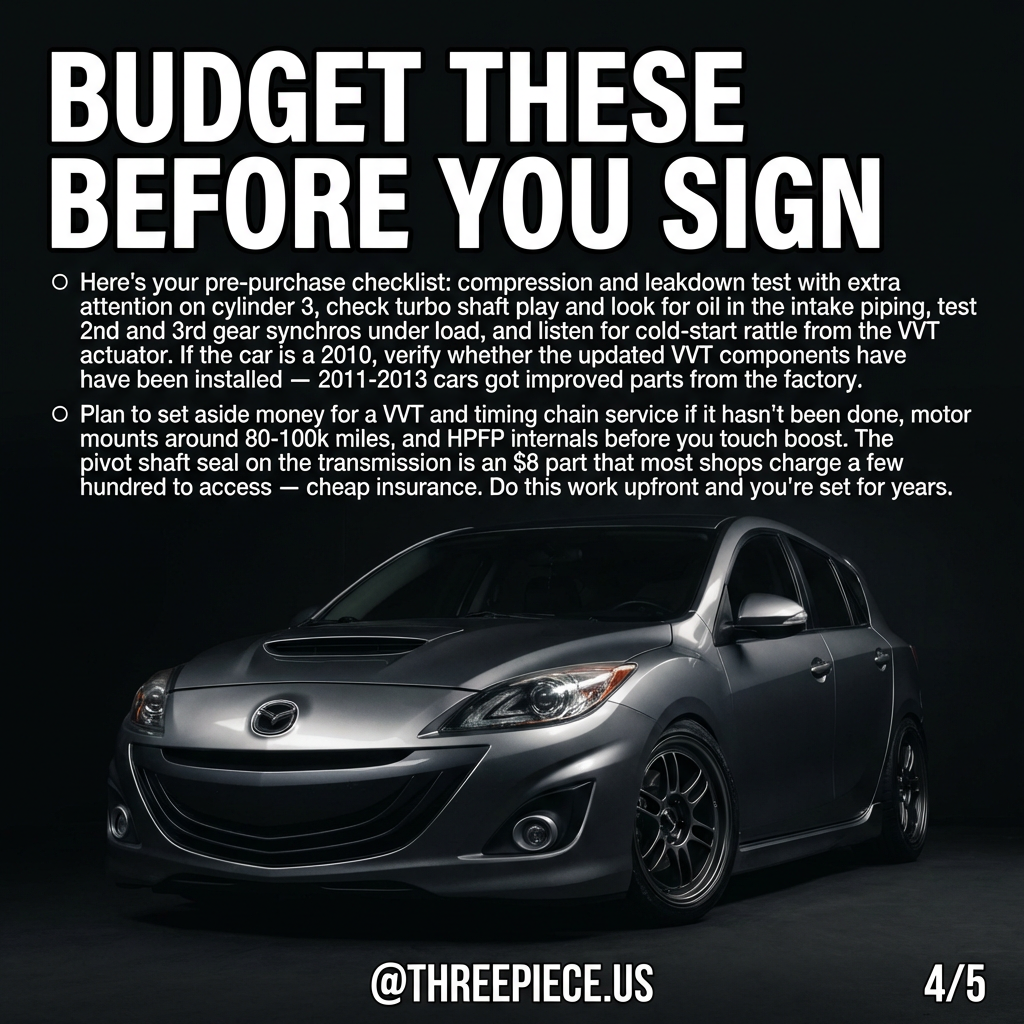
Most BL Mazdaspeed 3s on the market in 2026 are sitting at 120,000-200,000 miles. That means many of the failure items above are either already addressed or about to become your problem. Here's exactly what to check before you hand over cash:
- Compression and leakdown test — Look for even compression across all four cylinders. Pay extra attention to cylinder 3, which runs lean on the factory intake manifold under high boost. Direct injection carbon buildup can lower compression after 150K miles.
- Turbo shaft play — Check both axial and radial play. Inspect the compressor housing for oil. Any oil in the intake piping downstream of the turbo is a red flag.
- Transmission synchros — Test 2nd and 3rd gear shifts under load. Try a fast 1-2-3 pull and feel for grinding or binding. Also test 1st gear engagement from a stop.
- VVT actuator — Cold-start the car and listen for rattle or ticking in the first 10-15 seconds. If the car is a 2010, ask specifically about updated VVT components.
- Motor mounts — Look for hydraulic fluid leaks on the passenger-side mount. Have someone blip the throttle while you watch for excessive engine movement.
- Pivot shaft seal — Visual inspection of the transmission case for oil residue.
- Mod history — A stock or lightly modded car with service records is worth significantly more than a car that's been tuned to 350 whp and then "returned to stock" for sale. Ask about tune history, fuel pump work, and whether the turbo has been rebuilt.
This checklist mirrors what you'd do on any turbocharged platform — the same diligence applies if you're shopping a Mk7 Golf R or an N55 335i. The difference is the Mazdaspeed 3 costs a third of the price.
Wheel Fitment for the BL Mazdaspeed 3
The BL Mazdaspeed 3 runs a 5x114.3 bolt pattern with a 67.1mm hub bore — the most common JDM bolt pattern, which means the aftermarket wheel selection is enormous. Factory wheels are 18x7.5 +50, which is conservative. Most owners running aftermarket wheels land on 18x8.5 +35 to +45 as the sweet spot for a flush, aggressive look without pulling fenders or running excessive camber.
If you're going wider, 18x9.5 +35 is achievable with rolled fenders and proper coilover setup. Tire sizing for the 18x8.5 setup is typically 245/40R18, which gives you a good balance of sidewall protection and grip. For 18x9.5, step up to 265/35R18. Browse BBS LM 5x114.3 18x9.5+38 Diamond Silver or BBS LM 5x114.3 18x9.5+38 Diamond Silver to see what's currently available. For tires, check 245/40R18 options — the right rubber makes more difference than an extra 20 whp on the street.
The Work Emotion series is a natural fit for the Mazdaspeed 3's aggressive hatch proportions — the CR and ZR10 in particular look right at home on this platform. If you're building something more VIP or show-oriented, the Work Meister line in 18" gives you a stepped lip that transforms the car's stance. Pair any 3-piece setup with proper hubcentric rings — the 67.1mm hub bore means you'll need rings for most aftermarket wheels. Finish the build with 90-degree valve stems at $3.80 each if you're running deep-dish barrels where straight stems won't clear.
For build inspiration and to see how other owners are fitting wheels on similar platforms, check out the ThreePiece vehicle gallery.
Final Verdict: Go Find a Clean One
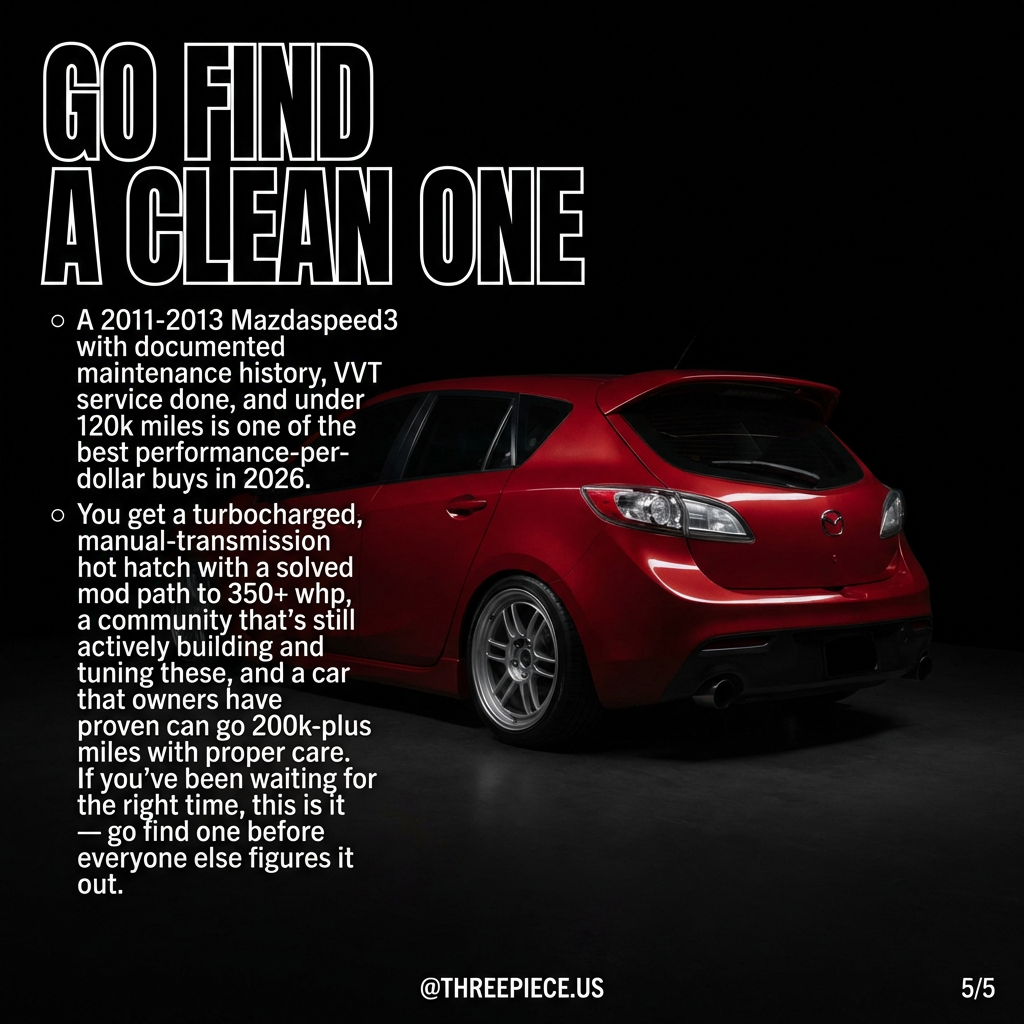
A 2011-2013 Mazdaspeed 3 with documented maintenance history, VVT service completed, and under 120,000 miles is one of the best performance-per-dollar buys available in 2026. You get a turbocharged, manual-transmission hot hatch with a solved mod path to 350+ whp, a community that's still actively building and tuning these cars, and a platform that owners have proven can go 200,000+ miles with proper care.
The window is closing. These cars got thrashed by a lot of first owners, which means clean, low-mile examples are getting harder to find every month. The FK8 Type R costs three times as much. The GD STI has already been priced into the stratosphere. The Mazdaspeed 3 is sitting right where the STI was five years ago — undervalued, under-appreciated, and about to get discovered by the broader market.
If you've been waiting for the right time, this is it. Go find one before everyone else figures it out — then come back and let us help you put the right wheels under it. Browse our full wheel catalog or start with BBS LM 5x114.3 18x9.5+38 Diamond Silver to see what fits your build.