
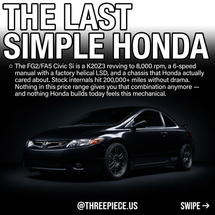
Honda Civic Si FG2/FA5 Buying Guide: K20Z3 Under $15K
The 2006–2011 Honda Civic Si (FG2/FA5) is one of the last naturally aspirated, manual-only sport compacts Honda built without electronic compromise. A K20Z3 revving to 8,000 RPM, a factory helical LSD, a 6-speed manual that actually rewards precision — nothing in this price range delivers that combination in 2026. Clean examples are thinning out fast, and the ones that remain are climbing. Here's everything you need to know before you buy one.

Quick links
- Why the FG2/FA5 still matters in 2026
- The driving experience nobody replicates
- Tuning ecosystem: bolt-ons, FlashPro, and all-motor builds
- Known failure points: what breaks and what it costs
- 2006–2008 vs. 2009–2011: which years to target
- Pre-purchase inspection checklist
- Wheel fitment for the 8th gen Civic Si
- Final verdict: buy now or regret it later
Why the FG2/FA5 Still Matters in 2026
The 8th gen Civic Si was the last time Honda paired a high-revving K-series four-cylinder with a chassis that actually communicated through the steering wheel. The K20Z3 produces 197 hp and 139 lb-ft of torque from the factory — modest numbers on paper, but the real-world character is what makes this car special. Stock examples dyno around 165–175 whp, and the engine is documented hitting 200,000+ miles on stock internals with proper maintenance. That kind of longevity from a performance motor that revs to 8K is essentially unmatched in this segment.
Compare it to anything Honda builds today: the 11th gen Si uses a 1.5L turbo with drive modes, rev-hang calibration, and electronic assists that filter out the mechanical connection. The FG2/FA5 has none of that. No turbo lag, no drive-by-wire vagueness, no nannies. It's a car that trusts you — and that's increasingly rare. If you've been looking at the FK8 Civic Type R but can't stomach the price premium, the 8th gen Si delivers a purer version of the same Honda philosophy for a fraction of the cost.
The Driving Experience Nobody Replicates
The K20Z3 doesn't make power like a turbo four — it makes you earn it. Below 5,800 RPM, the engine is pleasant but unremarkable. Then VTEC engages, the intake note changes, and the motor pulls hard all the way to the 8,000 RPM redline. That top-end rush is the entire personality of this car, and it's something no modern turbocharged Honda replicates.

The 6-speed manual (PNM3 designation) slots with short, precise throws. The factory helical LSD puts power down cleanly out of corners. And the chassis actually rotates on turn-in — the double-wishbone front suspension geometry gives this car a level of feedback that later Civics abandoned for cost reasons. Owners who've had these for 200K+ miles aren't selling because the car still feels alive every time they start it. That's the kind of ownership experience you read about in S2000 buying guides — except the Si costs a third of the price.
Tuning Ecosystem: Bolt-Ons, FlashPro, and All-Motor Builds
Fifteen years of aftermarket development means the FG2/FA5 tuning ecosystem is as mature as it gets. Hondata FlashPro remains the go-to ECU management solution, and the tuning knowledge base is enormous — forums like 8thcivic.com and K20A.org have thousands of documented builds with dyno sheets.
A clean bolt-on setup — intake, header, exhaust, and a proper FlashPro tune — realistically puts you around 200–220 whp on a stock block. Owners pushing further with aftermarket cams, ported heads, and RBC/RRC intake manifold swaps are seeing 230–250 whp all-motor. The parts ecosystem includes Skunk2, Hybrid Racing, PLM, and dozens of others. If you want to understand how cold air intakes actually affect performance, the K20Z3 is one of the best platforms to see real gains from intake work because the stock airbox is genuinely restrictive.
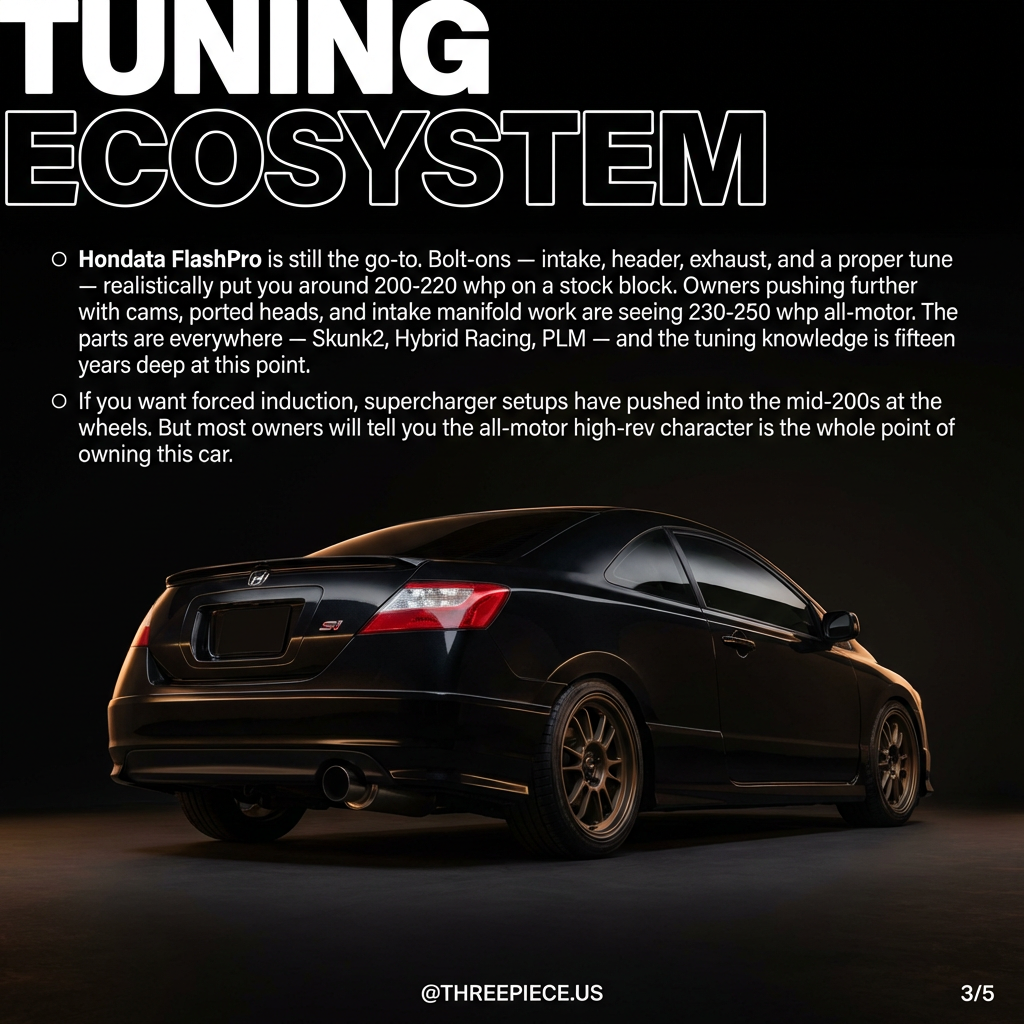
For forced induction, supercharger setups have pushed into the mid-200s at the wheels on stock internals. But most long-term owners will tell you the all-motor high-rev character is the entire point of owning this car. If you want a turbo four, there are better platforms — the Mazdaspeed 3 or Focus ST exist for that. The Si is about mechanical purity, and the tuning results reflect that philosophy.
One note on mods that stress things: hard launches wreck drivetrain components — dogbone mounts, motor mounts, and dampers take a beating. Aggressive cam profiles paired with neglected tensioner/VTC actuation cause timing chain failures. And pushing over 10 psi boost on stock internals introduces serious knock risk and rod damage. Build smart.
Known Failure Points: What Breaks and What It Costs
The FG2/FA5 is reliable by sport-compact standards, but it's not bulletproof — especially at the mileage most examples have accumulated by 2026. Here's what actually fails, sourced from real owner threads and TSBs.
2nd/3rd Gear Synchros and Shift Forks: This is the big one. 2006–2008 models are notorious for grinding or pop-out during 2→3 shifts, especially when cold. Honda issued TSB 08-020 (April 2008) mandating replacement of the 3rd gear set including synchros, springs, and related components. Repair cost: $1,500–$3,000 depending on shop rates and whether you source OEM or SynchroTech synchro kits. If you're buying a pre-2009 car, this is the first thing you check.
Timing Chain / VTC Actuator / Chain Tensioner: K20Z3 variants — especially early 2006–2008 production — develop cold-start rattle from chain slack. Chain guides crack, tensioner ratchet teeth wear, and the VTC actuator solenoid degrades. Low oil pressure or extended oil change intervals accelerate all of it. Owners upgrade to Hybrid Racing or Skunk2 tensioners and replace the VTC actuator with the updated "R5A" spec unit. Budget $800–$1,500 for tensioner, guides, and actuation components.
VTEC Solenoid Gasket and Valve Cover Gasket: Around 100,000+ miles, rubber seals age out from heat cycling. Leaks from the VTEC solenoid gasket, valve cover, oil pressure sensor, and timing cover perimeter seals are all documented. Parts are cheap — $15–$60 for quality gaskets from Fel-Pro or OEM — but labor is a few hours depending on access.
Clutch and Hydraulics: Clutches typically wear between 70,000–150,000 miles depending on driving style. Symptoms include low pedal, poor disengagement, and hard shifting — which owners sometimes misdiagnose as synchro issues. An OEM clutch set replacement runs $800–$1,200 at an independent shop. Upgrading to stainless steel clutch lines and replacing the master/slave cylinders transforms shift feel. If you're planning a clutch job on any Honda, the ACT XT/Perf Street Sprung Clutch Kit at $560 is worth considering — ACT's Honda-specific kits use the same K-series clutch architecture, and the HA3 series is compatible with several K-series applications. For heavier-duty needs, the ACT MaXX/Race Sprung 6-Pad Kit at $708 handles significantly more torque.
Clearcoat and Cosmetic Degradation: 2006–2008 cars, especially in dark colors, suffer from premature clearcoat failure. Windshield trim peels, steering wheels wear, and interior plastics degrade. These are cosmetic, but they signal owner care level — and they affect resale.
Annual maintenance at an independent shop runs roughly $350–$500, which is nothing for what this car gives back. Use 5W-30 synthetic and keep intervals tight — the K20Z3 punishes delayed oil changes harder than most engines.
2006–2008 vs. 2009–2011: Which Years to Target
If you can, buy a 2009–2011. The later cars came with revised synchro sets from the factory, addressing the 2→3 grinding issue that plagued early production. The timing chain tensioner design saw minor improvements, cooling and emissions hardware were tweaked, and clearcoat durability improved. Owners on 8thcivic.com consistently cite the 2009–2011 transmissions as the best Honda shipped from the factory in this generation.
That said, 2006–2008 cars aren't automatically bad. If a pre-2009 example has documentation showing the TSB 08-020 synchro repair was completed, it's essentially on the same footing as a later car. The K20Z3 engine spec, transmission architecture, and parts availability are identical across all years. A well-maintained 2007 with the synchro fix done is a better buy than a neglected 2010 with 180K miles and no service records.
The price gap between early and late cars is typically $2,000–$4,000 depending on condition and mileage. That premium for a 2009+ is almost always worth it for the reduced risk alone.
Pre-Purchase Inspection Checklist
Before you hand over cash for any FG2 or FA5, run through this list. These are the items that separate a solid buy from a money pit.
- Cold-start creep: Start the car stone cold and listen for rattle from the timing chain area. A brief rattle that fades in 2–3 seconds is common; sustained rattle or metallic ticking means the tensioner and possibly guides need replacement.
- 2→3 shift under load, cold and warm: Drive the car before it's fully warmed up. Shift firmly from 2nd to 3rd under moderate throttle. Grinding, notchiness, or pop-out is a red flag — especially on 2006–2008 cars without TSB documentation.
- Oil history: Ask for receipts showing regular oil changes with 5W-30 synthetic. Long intervals or conventional oil on a K20Z3 accelerate chain wear and VTC issues.
- Clutch feel: Does the pedal engage fully? Is there slippage at high RPM in 3rd gear? A spongy or low pedal often means the master/slave cylinders need attention — which many owners confuse with transmission problems.
- Leak inspection: Check around the VTEC solenoid gasket, valve cover, timing cover perimeter, and oil pressure switch. Minor seepage at 150K miles is expected; active dripping means budget for gaskets immediately.
- Clearcoat and cosmetics: Peeling clear, deteriorated trim, and worn interior plastics signal deferred maintenance across the board.
A clean example that passes all of these is increasingly rare. If you find one, don't hesitate — these cars aren't getting cheaper or cleaner. For more context on what to expect from maintenance costs on affordable performance cars, our Scion FR-S buying guide covers a similar price bracket with comparable ownership realities.
Wheel Fitment for the 8th Gen Civic Si
The FG2 and FA5 both run a 5x114.3 bolt pattern with a 64.1mm hub bore. Factory wheel size is 17x7 +55, which is conservative. Most owners stepping up to aftermarket wheels target 17x8 or 17x9 with offsets in the +35 to +45 range, or move to 18x8 or 18x8.5 for a more aggressive look without sacrificing ride quality.
For 17" setups, browse 17" wheels in 5x114.3 — the sweet spot is 17x9 +35 with a 245/40R17 tire for track-oriented builds. For 18" street setups, 18" wheels in 5x114.3 at 18x8.5 +38 with 225/40R18 tires give you a flush, clean look without rubbing on stock suspension.
The Work Emotion series is one of the most popular choices on 8th gen Si builds — lightweight, available in the right offsets, and they look correct on the FG2 coupe's body lines. The Emotion CR 2P in particular has become a staple on clean Si builds. If you're running 3-piece wheels and need to ensure proper hub fitment, grab a set of hubcentric rings — the 64.1mm bore is smaller than many aftermarket wheel center bores, so rings are essential for vibration-free driving.
For tire sizing, pair 18x8.5 wheels with 225/40R18 tires for a street setup, or step up to 245/40R18 if you're running wider wheels and want maximum grip. Check out our vehicle gallery for real-world fitment examples on Honda platforms.
Final Verdict: Buy Now or Regret It Later
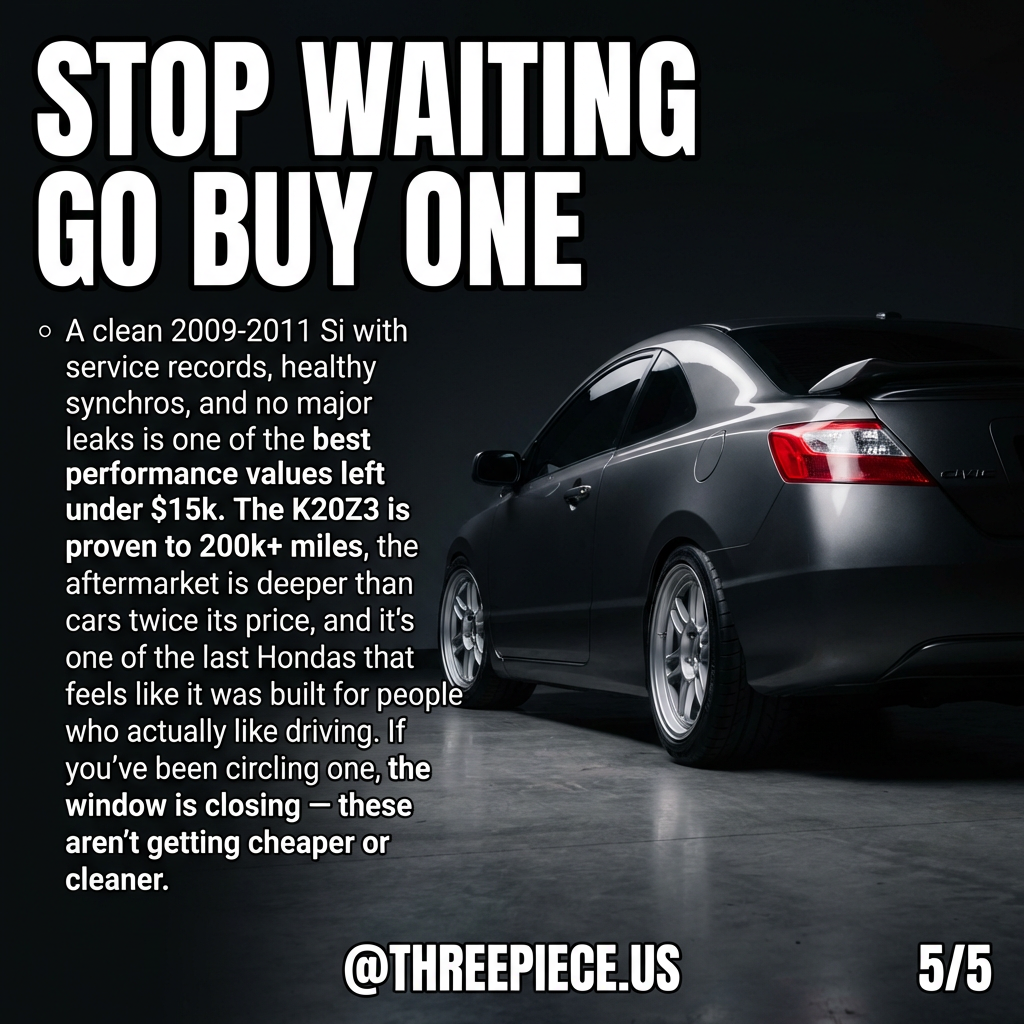
A clean 2009–2011 Honda Civic Si with service records, healthy synchros, and no major leaks is one of the best performance values left under $15,000. The K20Z3 is proven to 200K+ miles, the aftermarket is deeper than cars at twice the price, and it's one of the last Hondas that feels like it was built for people who actually like driving.
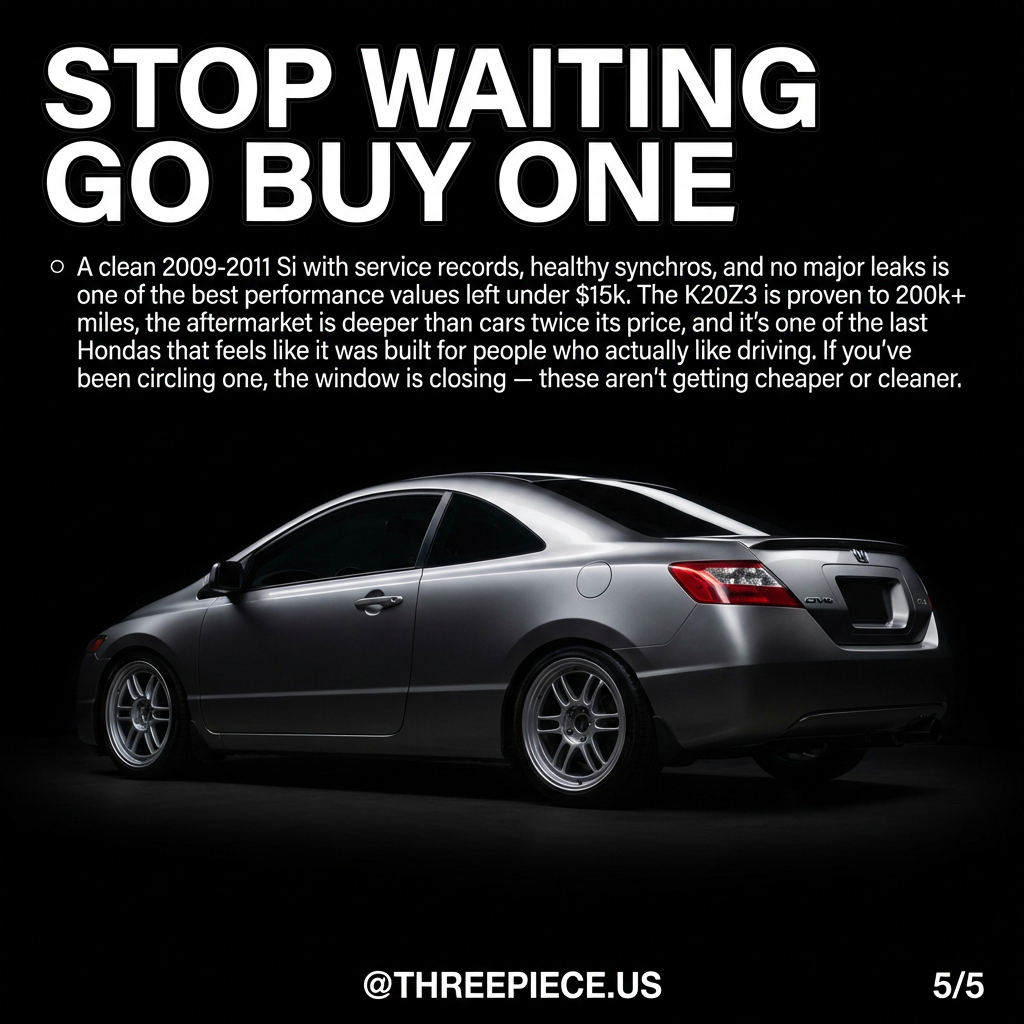
The window is closing. Every month, clean examples get harder to find — they're being modified beyond return, accumulating miles, or getting snapped up by owners who know exactly what they have. Find the right one, inspect it properly, and drive it like Honda intended.
Once you've secured the car, set it up right. Browse wheels, suspension, and wheel accessories at ThreePiece.us to finish the build the way it deserves.