

Honda S2000 CR AP2 Buying Guide: Why 2026 Is the Year
Honda built roughly 699 S2000 CRs for the US market across 2008 and 2009. No A/C, no stereo, stiffer springs, bigger rear tires, a quicker steering rack — this was Honda's factory track car wearing a license plate. Clean examples are trading between $45,000 and $65,000 right now, and pristine cars are pushing well past that. If you've been circling an AP2 CR on Bring a Trailer or S2Ki classifieds for the last two years, here's why 2026 is the year to stop thinking about it and start driving one — and exactly what to budget before you sign.

Quick links
- Nothing Else Feels Like This
- The F22C1: What Honda Fixed and What Still Breaks
- Transmission, Clutch & Diff: Known Weak Points
- Aftermarket & Power Potential
- Pre-Purchase Checklist: What to Test Before You Buy
- Budget These Costs in Year One
- Wheel & Tire Fitment for the AP2 CR
- Stop Waiting — Go Buy One
Nothing Else Feels Like This
The CR's steering ratio is 13.8:1 versus 14.9:1 on the base AP2. The front springs are roughly 50% stiffer. The F22C1 pulls to 8,000 rpm with a mechanical urgency that modern turbocharged cars simply don't replicate. It's not comfortable. It's not trying to be. Every input you give it comes back immediate and honest, and that's the entire point. In a world of drive-by-wire numbness and turbo lag masked by electronic torque vectoring, the CR is a time capsule of analog driving that isn't coming back. If you want to understand why lower-power cars can feel faster than big-number builds, drive an S2000 CR on a canyon road once.

The F22C1: What Honda Fixed and What Still Breaks
The late AP2 CRs use the F22C1 — Honda's 2.2L long-stroke revision of the original F20C. It redlines at 8,000 rpm instead of 9,000, trades a sliver of top-end scream for significantly more usable midrange torque, and comes with updated valve retainers that addressed the cracking issues that plagued early AP1 engines. Owners broadly consider it more reliable than the F20C — but it's not bulletproof.
Timing chain tensioner: Between 60,000 and 120,000 miles, the hydraulic timing chain tensioner degrades. Symptoms include rattle on cold start or chain slap at high revs. Replacement with guides runs $400–$800 depending on shop rates. If you hear it, it's not optional — address it immediately. The Gates DriveAlign Idler Pulley for 00-09 S2000 at $38.62 is worth replacing while you're in there.
VTEC solenoid failures: Gasket leaks at the VTEC solenoid trigger CEL codes, rough idle, and reduced performance above the VTEC engagement point. Fix cost is modest — $150–$350 for solenoid and gasket replacement. Oil weeping from valve cover gaskets and spark plug tube seals is common on higher-mileage AP2s and can foul ignition coils if left unchecked.
Cylinder wall scoring: Rare but documented. One 2008 CR owner at ~120k miles had a coil plug threading failure that dropped the coil into the cylinder, scoring the wall beyond repair. The fix was a replacement F22C longblock. Always get a compression and leak-down test before purchase — this is non-negotiable. For deeper context on how Honda's high-revving engines compare to other forced-induction platforms, our SR20DET vs K24 vs 2JZ breakdown covers the broader landscape.
Transmission, Clutch & Diff: Known Weak Points
The CR came standard with a 6-speed manual and a Torsen limited-slip differential. Both are strong — but both have well-documented failure modes that you need to check before buying.
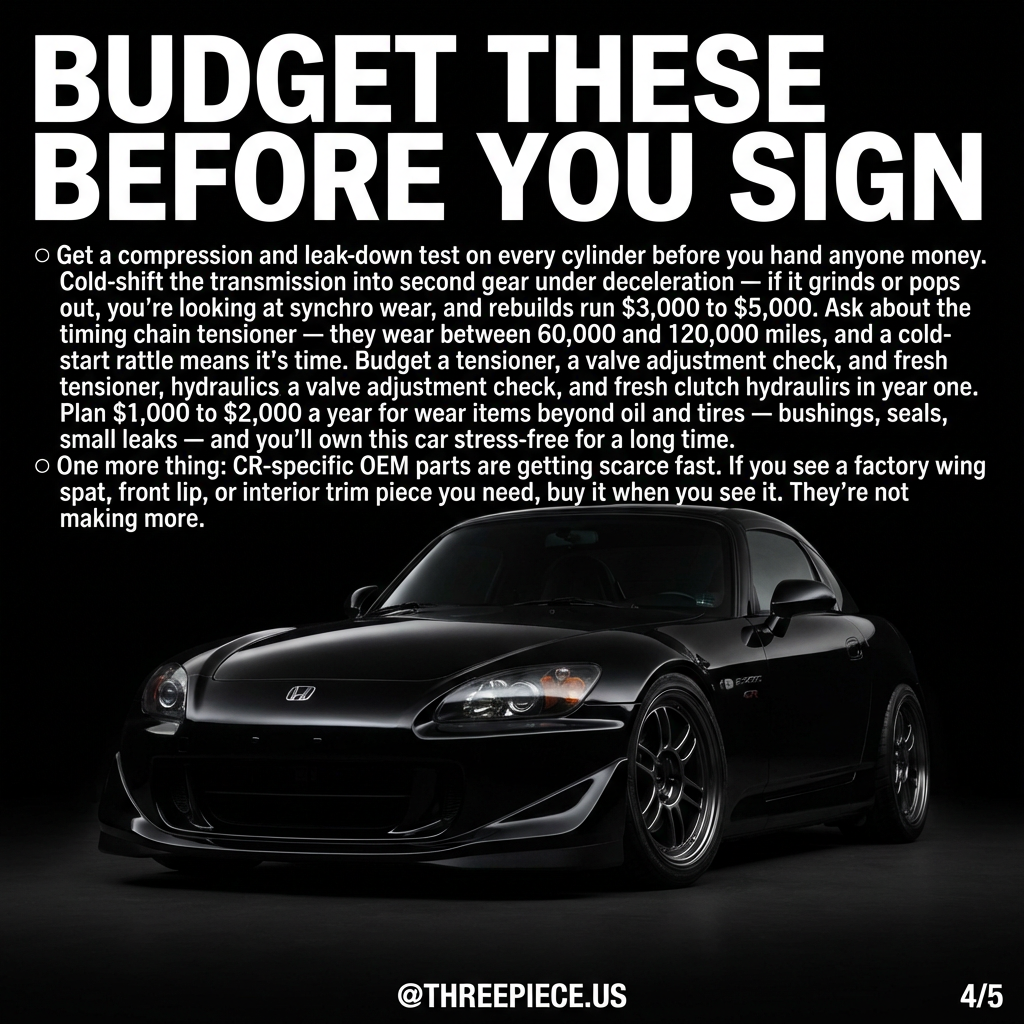
Second gear synchro wear is the most common transmission issue across all S2000s. Symptoms: grinding when shifting into 2nd when cold, or the gear popping out under engine braking. Heating up usually alleviates the grind, but if it persists when warm, you're looking at synchro wear. A full gearbox rebuild with aftermarket synchros runs $3,000–$5,000. During your test drive, deliberately cold-shift into second under deceleration — this is the single most revealing test you can do on an S2000.
Clutch master and slave cylinder leaks are common as mileage climbs past 60k. Soft pedal feel or slipping engagement are the telltale signs. The Rywire Honda S2000 Clutch Master Cylinder Kit at $241.28 is a direct replacement that addresses the OEM failure point — budget this as a year-one item on any higher-mileage CR.
Torsen LSD: Ages poorly under hard use. Owners report whining or pinion gear failures, especially after repeated track days or aggressive launches. One owner documented a cracked pinion gear at 88,000 miles — repair cost was roughly $1,000. Listen for whining under load during your test drive.
Aftermarket & Power Potential
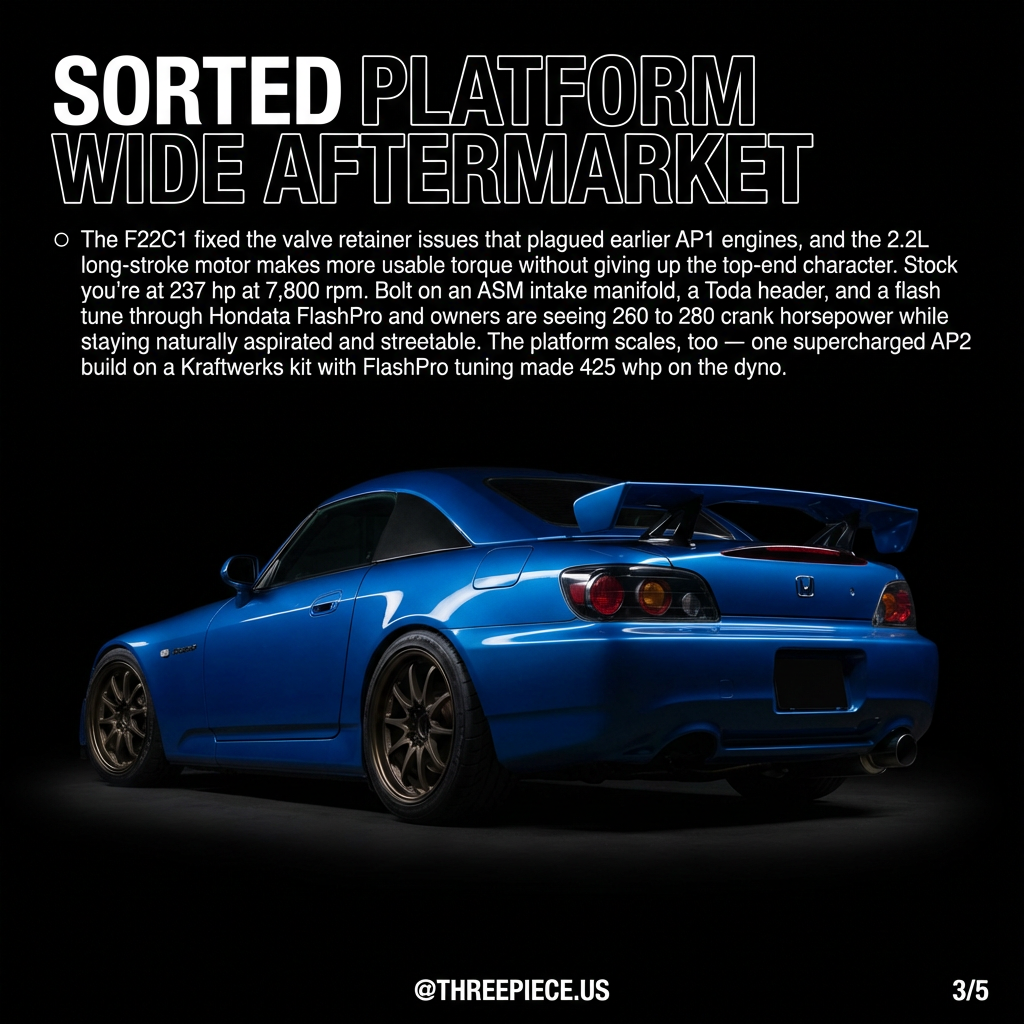
Stock, the 2007–2009 CR makes 237 hp at 7,800 rpm and 162 lb-ft at 6,800 rpm. That's enough to be engaging on the street, but the F22C1 scales well with bolt-ons. An ASM intake manifold, a Toda header, and a flash tune through Hondata FlashPro gets owners into the 260–280 crank horsepower range while staying naturally aspirated and streetable. The Remark 2000-2009 Honda S2000 Single Exit Cat-Back System at $1,331.08 is a popular exhaust choice for the platform — stainless steel construction with a single-exit design that clears the CR's rear diffuser cleanly.
The platform scales beyond bolt-ons, too. One well-documented supercharged AP2 build running a Kraftwerks kit with FlashPro tuning made 425 whp on the dyno. But pushing power magnifies every weak point — synchros, tensioner, oil control — so build the reliability foundation first. If you're planning a full build, our S2000 CR AP2 Build Guide covers the exact mod order and priority list.
Cooling matters on a car this light with this little airflow margin. The Mishimoto S2000 Black Silicone Hose Kit at $200.40 replaces the aging OEM rubber lines — a smart preventive move on any AP2 with 15+ years of heat cycles behind it. Note: this kit fits AP1 models (00-05), so confirm compatibility with your specific year or check Mishimoto's catalog for the AP2-specific application.
Pre-Purchase Checklist: What to Test Before You Buy
Real S2Ki and Reddit owners have distilled years of buying experience into a short list of non-negotiable checks. Do all of these before you hand anyone money:
- Compression and leak-down test on all four cylinders. You want consistent readings across all cylinders — any significant variance is a red flag for wall scoring or valve seat issues.
- Cold-shift into 2nd gear under deceleration. Grinding or popping out means synchro wear. This is the most expensive transmission fix on the platform.
- Inspect spark plug threads and coils. Verify threading is intact. A dropped coil has ruined blocks — this is a documented failure mode, not theoretical.
- Check oil pressure under hard driving if a gauge is installed. Oil starvation at high G-loads or sustained high revs is a real concern on track-driven examples.
- Look for leaks at the valve cover gasket, plug tube seals, oil pan, and cam cover. Goo buildup on intake boots or under the valve cover indicates long-term neglect.
- Demand service history. Has MTF been changed? Rear diff fluid? Coolant? Has the timing chain tensioner ever been replaced? No records on a $50K+ car is a walk-away.
For a broader framework on what separates good buys from money pits in the sport-compact space, our underrated project cars guide covers the mindset, even if the CR is well above that price bracket.
Budget These Costs in Year One
Assume the previous owner deferred maintenance. On a car this old and this rare, that's the safest approach. Here's what real owners recommend budgeting in your first year of CR ownership beyond oil and tires:
- Timing chain tensioner + guides: $400–$800
- Valve adjustment check: $200–$400
- Clutch hydraulics (master + slave): $200–$400 (or grab the Rywire Clutch Master Cylinder Kit for $241.28)
- VTEC solenoid gasket: $150–$350
- Bushings, seals, small leaks: $500–$1,000
- Sway bar bushings: The Energy Suspension 00-09 S2000 Rear Sway Bar Bushing Set at $40.35 replaces worn OEM rubber that's almost certainly deteriorated after 15+ years
Plan $1,000–$2,000 per year for wear items beyond consumables, and you'll own this car stress-free for a long time. That's cheap for what you're getting — a factory-lightweight, naturally aspirated, manual-transmission Honda with real collector trajectory. CR-specific OEM parts are getting scarce fast. If you see a factory wing spat, front lip, or interior trim piece you need, buy it when you see it. They're not making more.
Wheel & Tire Fitment for the AP2 CR
The CR came from the factory with a staggered setup: 17x7 front and 17x8.5 rear on a 5x114.3 bolt pattern with a 64.1mm hub bore. The rear tires were 245/40R17 versus the base AP2's 225/45R17 — Honda wanted more rear grip from the factory, and the wider rear rubber is a big part of the CR's balanced handling character.
For aftermarket wheels, the sweet spot most owners land on is 17x9 +45 to +63 all around, or staying staggered with 17x8 front / 17x9 rear. Some builds push to 18s, but the CR's lightweight ethos and sharp turn-in argue for keeping unsprung mass low. Browse 17-inch wheels in 5x114.3 to see what fits, or step up to 18-inch options in the same bolt pattern if you're running wider rubber for track days.
If you're considering forged wheels for a car at this price point — and you should be — read our breakdown of why 3-piece wheels cost $4K+ and whether they're worth it. On a 699-unit car trading at $50K+, the answer is obvious. The Work Emotion series and Work Meister line are both popular choices on S2000 builds — check our Volk TE37 vs Work Meister comparison for a deep dive on which direction suits your build. For tire sizing, pair 17x9 wheels with 255/40R17 tires for a square setup, or run 245/40R17 rear to match the factory stagger philosophy.
Check out our vehicle gallery for S2000 builds running aftermarket wheel setups — it's the fastest way to visualize what different sizes and styles look like on the AP2 chassis.

Stop Waiting — Go Buy One
Clean, low-mile CRs are trading between $45,000 and $65,000 right now, and pristine examples are pushing well past that. Prices aren't softening on a car this rare with this much mechanical credibility. Only 699 were made. The F22C1 is a sorted, proven engine. The chassis is one of the best Honda ever built. The aftermarket is deep and mature. And the driving experience — that raw, unfiltered, 8,000-rpm analog feedback loop — is something no new car on sale today can replicate.
If you want a lightweight, naturally aspirated, manual-transmission Honda that was built for the track from the factory, the window to buy one you can actually afford to drive is right now. Find one with records, run the pre-purchase checklist above, budget your year-one maintenance, and don't look back. For the full mod priority list once you've got the keys, our S2000 CR AP2 Build Guide picks up exactly where this article leaves off. And when you're ready to finish the look with wheels that match the car's pedigree, browse our full wheel catalog or explore wheel parts and accessories to complete the build.