
Honda S2000 CR AP2 Build Guide: Finishing What Honda Started
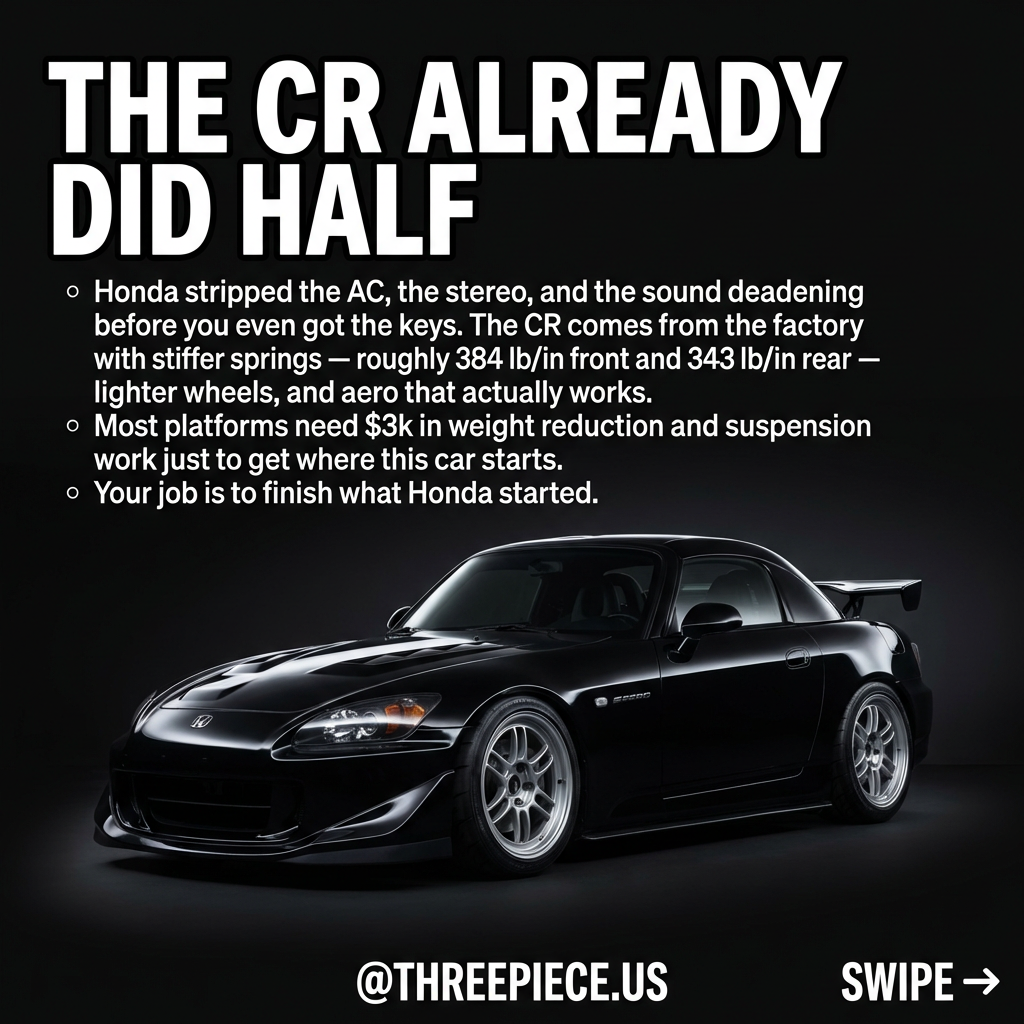
The Honda S2000 CR is one of the few cars where the factory already made the hard decisions for you. Honda stripped the A/C, the stereo, and the sound deadening before you got the keys. They installed stiffer springs — roughly 384 lb/in front and 343 lb/in rear — lighter wheels, and functional aero. Most platforms need $3,000+ in weight reduction and suspension work just to get where this car starts. Your job is to finish what Honda started, and this AP2 CR build guide covers exactly how to do that without ruining what makes the car special.
Quick links
- Why the CR changes your entire build strategy
- F22C power mods: intake, tune, exhaust — in that order
- Suspension: respect the CR's factory rates
- Wheel fitment without destroying fenders
- Maintenance items that will wreck your build
- The complete CR build list
Why the CR Changes Your Entire Build Strategy
The S2000 CR wasn't a trim level — it was Honda's factory track prep. The deletion of A/C and stereo shaved meaningful weight, and the spring rates Honda chose (384 lb/in front, 343 lb/in rear) are stiffer than most aftermarket lowering springs designed for the standard AP2. The CR also came with a factory front lip, rear diffuser, and a hardtop option that actually improves rigidity. If you've read our piece on OEM performance option markups, the CR is one of the rare cases where Honda's factory upgrades were genuinely worth the premium — because they made decisions most owners wouldn't make themselves, like deleting comfort features entirely.
This matters for your build plan because the CR's starting point eliminates entire categories of mods. You don't need lowering springs. You don't need to gut the interior. You don't need aftermarket aero to get downforce. The CR already has it. The mistake most owners make is treating it like a blank canvas when it's really a half-finished masterpiece. The moves you don't make matter just as much as the ones you do.
F22C Power Mods: Intake, Tune, Exhaust — In That Order
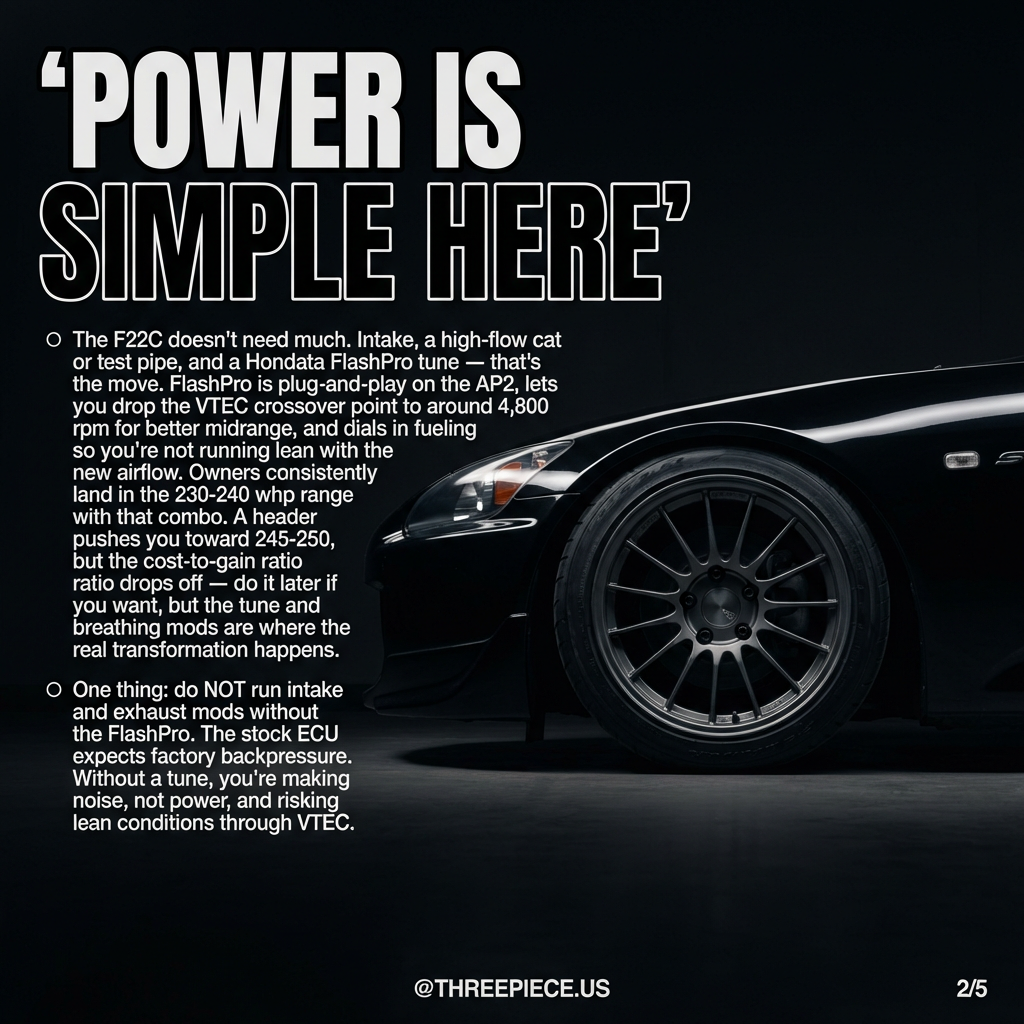
The F22C doesn't need much. The proven bolt-on recipe for the AP2 CR is an intake, a high-flow cat or test pipe, and a Hondata FlashPro tune. FlashPro is plug-and-play on the AP2, lets you drop the VTEC crossover point to around 4,800 RPM for better midrange response, and dials in fueling so you're not running lean with the new airflow. Owners consistently land in the 230–240 whp range with that combo on a stock long block. A header pushes you toward 245–250 whp, but the cost-to-gain ratio drops off sharply — do it later if you want, but the tune and breathing mods are where the real transformation happens.
One critical rule: do NOT run intake and exhaust mods without the FlashPro. The stock ECU expects factory backpressure. Without a tune, you're making noise, not power, and risking lean conditions through VTEC. This is the same principle we covered in our guide on aftermarket downpipe considerations — changing exhaust flow without recalibrating fueling is a recipe for problems.
For exhaust, the Remark 2000-2009 Honda S2000 Single Exit Cat-Back System at $1,331 is a direct-fit stainless option that pairs well with a high-flow cat and FlashPro map. It's a clean single-exit design that doesn't scream aftermarket but opens up the exhaust note in the upper rev range where the F22C lives.
If you're pushing cams, valve springs, and full engine management, builders report jumping into the 260–300 whp range — but that's a different build entirely. For a CR that you want to drive hard on canyon roads and occasional track days, the intake/cat/tune combo is the sweet spot. Anything beyond that and you're chasing diminishing returns on a naturally aspirated 2.2L.
Suspension: Respect the CR's Factory Rates
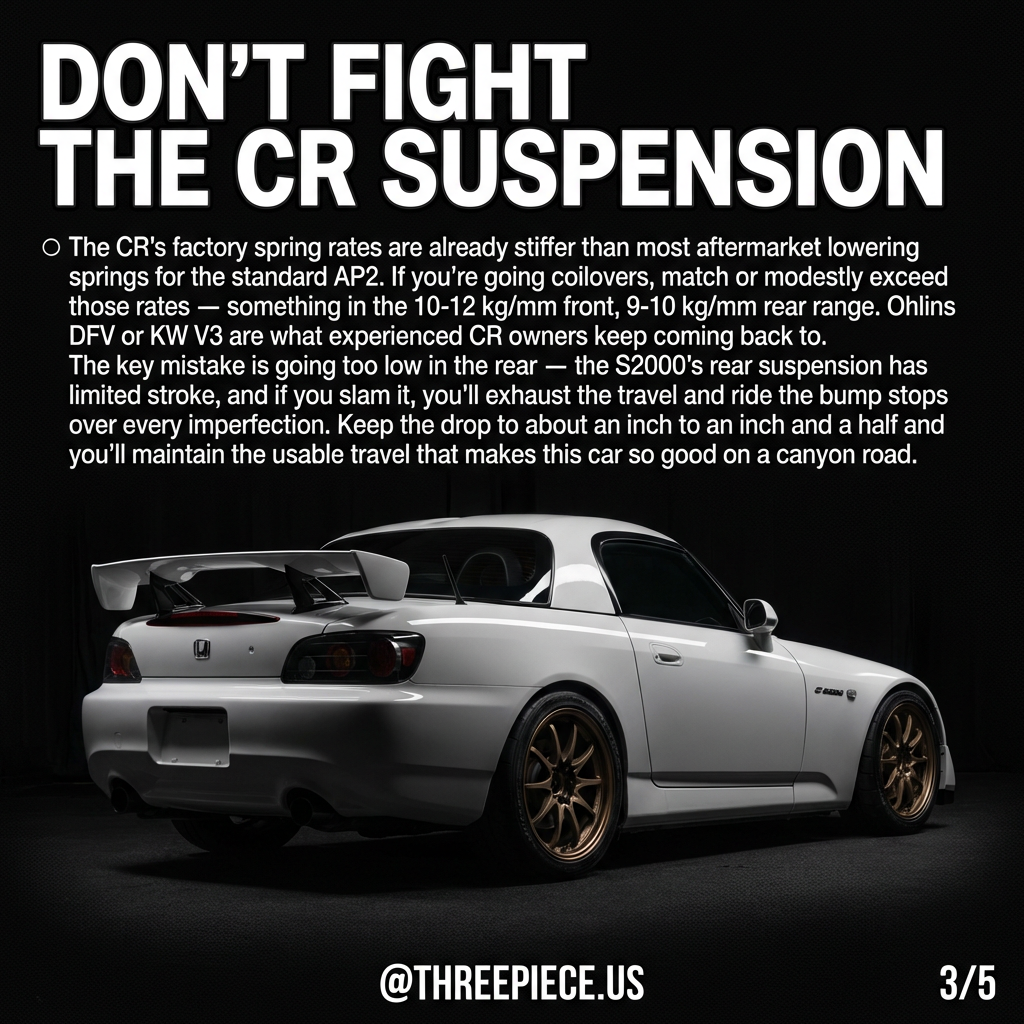
The CR's factory spring rates are already stiffer than most aftermarket lowering springs for the standard AP2. If you're going coilovers, match or modestly exceed those rates — something in the 10–12 kg/mm front and 9–10 kg/mm rear range. Ohlins DFV and KW V3 are what experienced CR owners keep coming back to on S2KI build threads. Both offer adjustable rebound damping, which is critical for controlling the S2000's tendency toward snap oversteer under trail braking.
The key mistake is going too low in the rear. The S2000's rear suspension has limited stroke, and if you slam it, you'll exhaust the travel and ride the bump stops over every imperfection. Keep the drop to about an inch to an inch and a half and you'll maintain the usable travel that makes this car so good on a canyon road. If you want to understand why matching spring rates to damper quality matters more than ride height, our breakdown of why springs beat cheap coilovers covers the physics in detail.
Beyond coilovers, the rear geometry deserves attention. Thicker rear lower control arms from Hardrace or similar help fix the CR's rear geometry that can hang during aggressive cornering. Alignment cams and shims are also common — running negative 1.5 to 2 degrees of camber in the rear helps tire wear and grip balance. Check our camber setup guide for the full breakdown on how camber actually affects tire contact patch and wear patterns.
For the rear sway bar, the Energy Suspension 00-09 Honda S2000 25.4mm Rear Sway Bar Bushing Set at $40.35 is one of those cheap-but-meaningful upgrades. The stock rubber bushings deflect under load, and polyurethane replacements sharpen turn-in response immediately. It's the kind of mod that costs almost nothing but changes how the car communicates through the steering wheel.
Wheel Fitment Without Destroying Fenders
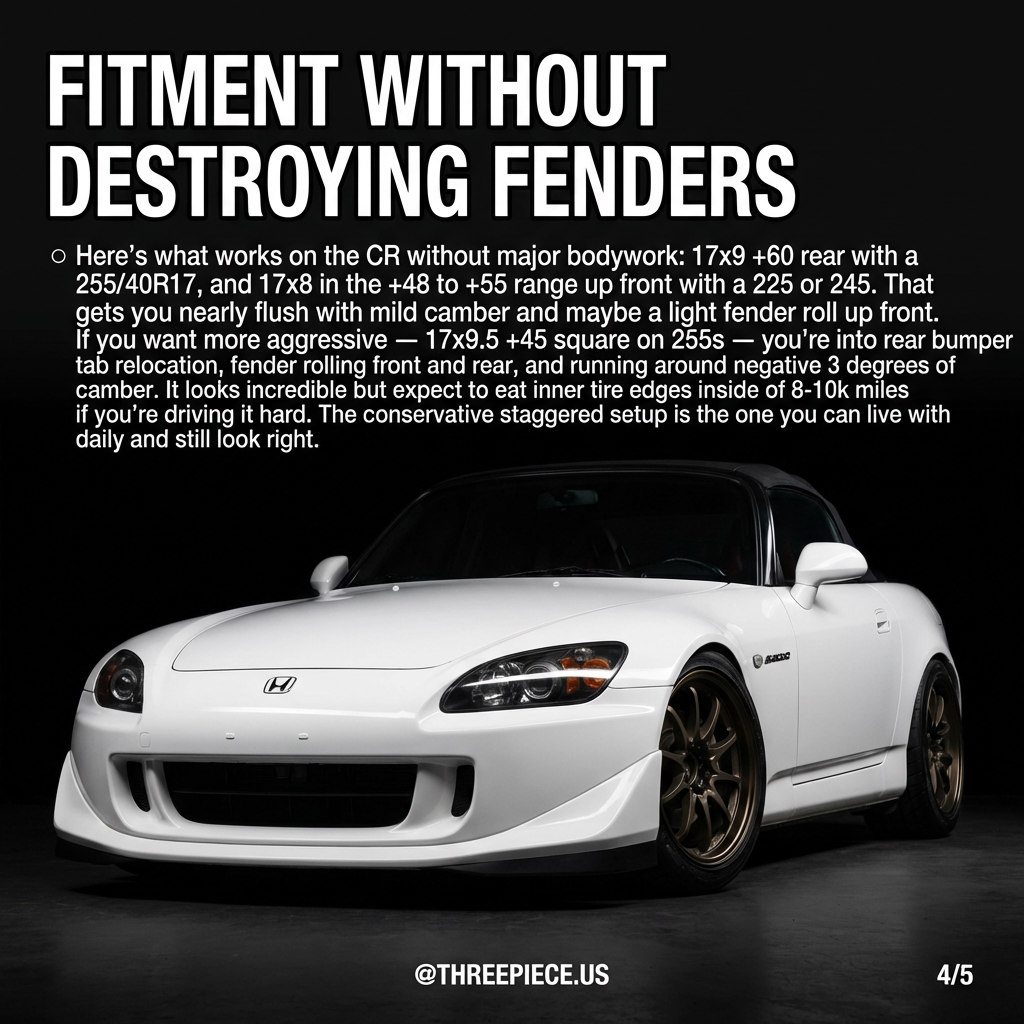
Here's what works on the CR without major bodywork: 17x9 +60 rear with a 255/40R17, and 17x8 in the +48 to +55 range up front with a 225/45R17 or 245/40R17. That gets you nearly flush with mild camber and maybe a light fender roll up front. This is the staggered setup you can live with daily and still look right.
If you want more aggressive — 17x9.5 +45 square on 255s — you're into rear bumper tab relocation, fender rolling front and rear, and running around negative 3 degrees of camber. It looks incredible but expect to eat inner tire edges inside of 8,000–10,000 miles if you're driving it hard. That's the tradeoff, and it's well-documented across S2KI build threads.
The S2000 runs a 5x114.3 bolt pattern with a 64.1mm hub bore. For 17-inch options, browse 17-inch wheels in 5x114.3 to see what's currently available. The Work Emotion series is a natural fit for the CR's lightweight ethos — the CR 2P and ZR10 2P in particular complement the car's aggressive-but-functional look. If you're considering whether forged wheels make sense on a car this light, our comparison of cast vs forged wheels breaks down where the weight savings actually matter.
For tires, the conservative staggered setup calls for 245/40R17 tires up front and 255/40R17 tires out back. Bridgestone RE71R and Yokohama AD09 are the go-to choices in the S2000 community for a reason — they're the stickiest 200-treadwear tires you can buy in these sizes. If you want to understand how tire choice interacts with wheel width and camber, the Volk TE37 and Advan Neova track combo breakdown covers the same principles that apply here.
If you're running 3-piece wheels, proper hardware matters. Grab 90-degree valve stems at $3.80 each for tight-clearance barrel setups, and make sure your assembly hardware is fresh — M7x32 chrome assembly bolts at $10 each are cheap insurance on a car that sees track duty.
Maintenance Items That Will Wreck Your Build
Before you spend a dollar on performance parts, address the maintenance items that will undermine everything else. The F22C has documented weaknesses that show up at higher mileage, and ignoring them will wreck your build faster than any bad mod choice.
Valve lash adjustment is the big one. The F22C uses mechanical lifters that require periodic adjustment — experienced owners check and adjust every 30,000–40,000 miles. Loose lash causes loss of mid and high-rev performance, and if you've been chasing a power loss that bolt-ons can't fix, this is probably why.
Transmission needle bearings are another known issue. While more common in early AP1 cars, high-RPM abuse on the AP2 also risks bearing failure. One S2KI owner documented replacing transmission internals after grinding 3rd gear at 148,000 miles, spending over $1,000 in parts alone. If you're buying a used CR, get the transmission inspected.
The clutch master cylinder is a wear item that gets overlooked until it fails at the worst possible time. The Rywire Honda S2000 Clutch Master Cylinder Kit at $241.28 is a proper replacement that addresses the factory unit's tendency to develop a soft pedal feel over time. Replace it proactively if your car has over 80,000 miles.
The idler pulley is another item that wears silently until it doesn't. The Gates DriveAlign Idler Pulley at $38.62 fits the 00-09 S2000 and is the kind of preventive replacement that costs almost nothing compared to a roadside failure. Do it during your next belt service and forget about it.
These aren't glamorous mods. They don't show up on Instagram. But if you're spending $50,000+ on a clean CR — which is where the market sits for low-mileage examples — skipping a $40 bushing set or a $240 clutch cylinder replacement is penny-wise and pound-foolish. Our guide on underrated suspension upgrades covers the same philosophy: the unsexy parts often make the biggest difference.
The Complete CR Build List
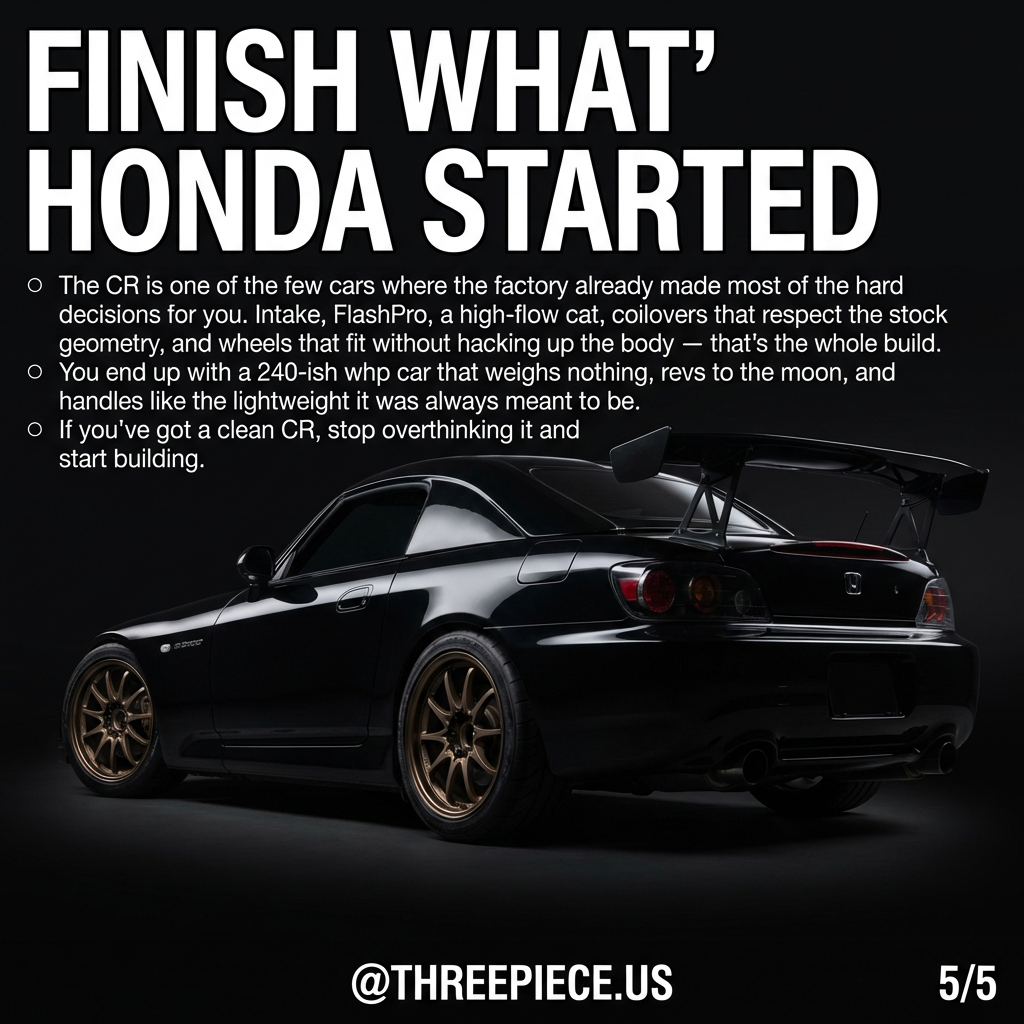
The S2000 CR is one of the few cars where the factory already made most of the hard decisions for you. Here's the full build order that finishes what Honda started:
- Intake + high-flow cat + Hondata FlashPro — 230–240 whp, better midrange, proper fueling
- Cat-back exhaust — the Remark S2000 cat-back opens up the top end without drone
- Ohlins DFV or KW V3 coilovers — 10–12 kg/mm front, 9–10 kg/mm rear, drop no more than 1.5 inches
- Rear sway bar bushings — Energy Suspension polyurethane set for sharper response
- Wheels — 17x9 +60 rear / 17x8 +48-55 front in 5x114.3, light fender roll at most
- Tires — 255/40R17 rear, 225-245/40R17 front, 200-treadwear compound
- Maintenance — valve lash check, clutch master cylinder, idler pulley, transmission inspection
You end up with a ~240 whp car that weighs nothing, revs to the moon, and handles like the lightweight it was always meant to be. If you've got a clean CR, stop overthinking it and start building. Browse the vehicle gallery for S2000 build inspiration, and check the full wheel catalog to find the right set for your CR.