
2022-2026 Subaru BRZ ZD8 Build Guide: FA24 Mod Order
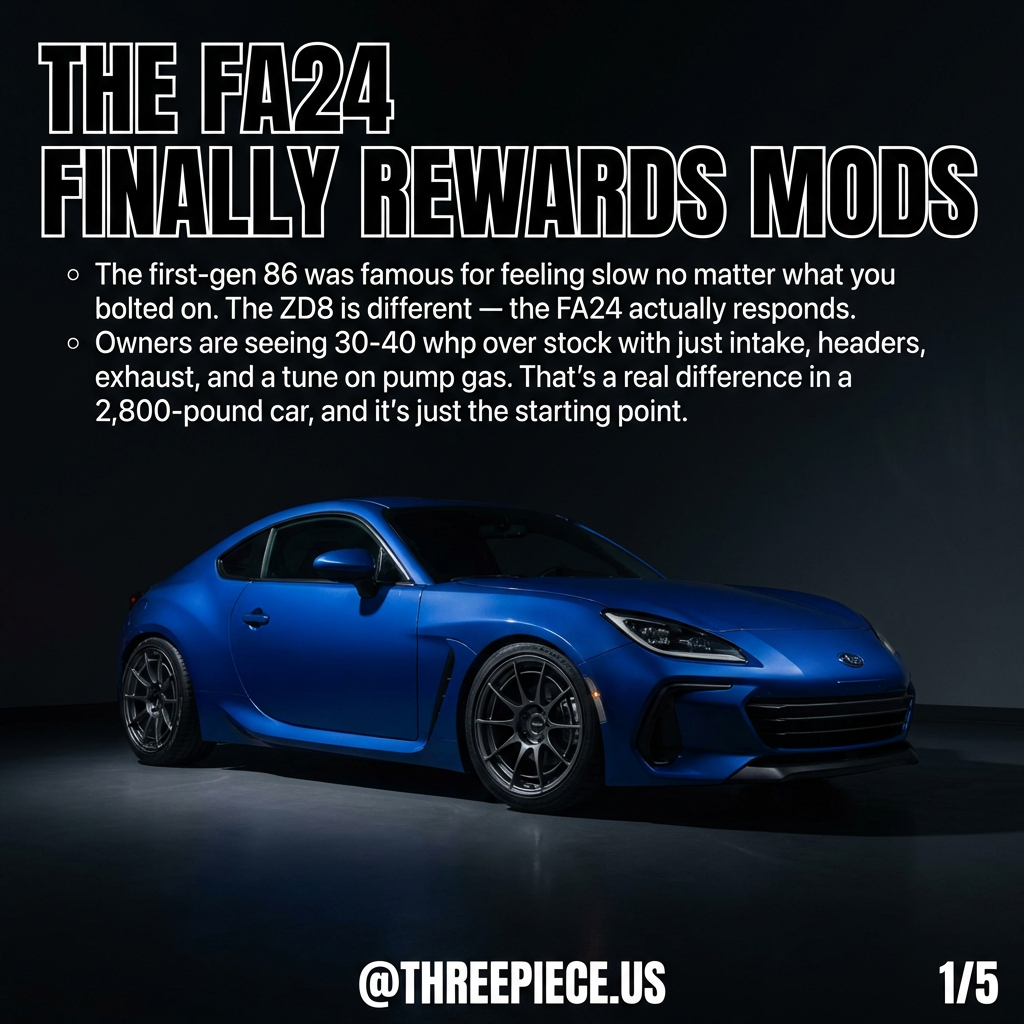
The 2022-2026 Subaru BRZ ZD8 is the first 86-platform car that actually rewards bolt-on modifications. Where the first-gen FA20 hit a frustrating wall around 200 whp no matter what you threw at it, the FA24 responds immediately — owners are documenting 30-40 whp gains with basic breathing mods and a tune on pump gas. In a car that weighs 2,800 pounds, that's the difference between "fun" and "genuinely fast." Here's the exact mod order that ZD8 owners are running, what it costs, and the fitment specs the community has already dialed in.
Quick links
- Why the FA24 actually responds to mods
- Headers and a tune first — the correct mod order
- Suspension setup that makes the ZD8
- 18x9.5 +38 is the spec — ZD8 wheel fitment
- Forced induction: turbo kits and what they demand
- Build it for under $5K
Why the FA24 Actually Responds to Mods
The first-gen 86 was famous for disappointing anyone who bolted parts onto it. The FA20's torque dip was structural — a byproduct of the intake manifold design and port injection limitations that no header or exhaust could fully solve. If you lived through that era, our FR-S ZN6 build guide covers exactly why the first gen needed such a specific approach.
The ZD8's FA24 2.4L boxer four fixes the fundamental issue: more displacement, direct injection, and a revised intake manifold that doesn't choke the midrange. Stock, the car puts down roughly 207-210 whp at the wheels. That's a real baseline — not inflated crank numbers. With a full bolt-on setup (intake, headers, exhaust, tune), owners are consistently dynoing 240+ whp with a flat torque curve and a noticeably sharper top end above 5,500 RPM. The gains are concentrated where you actually use them on a canyon road or track day.
Headers and a Tune First — The Correct Mod Order
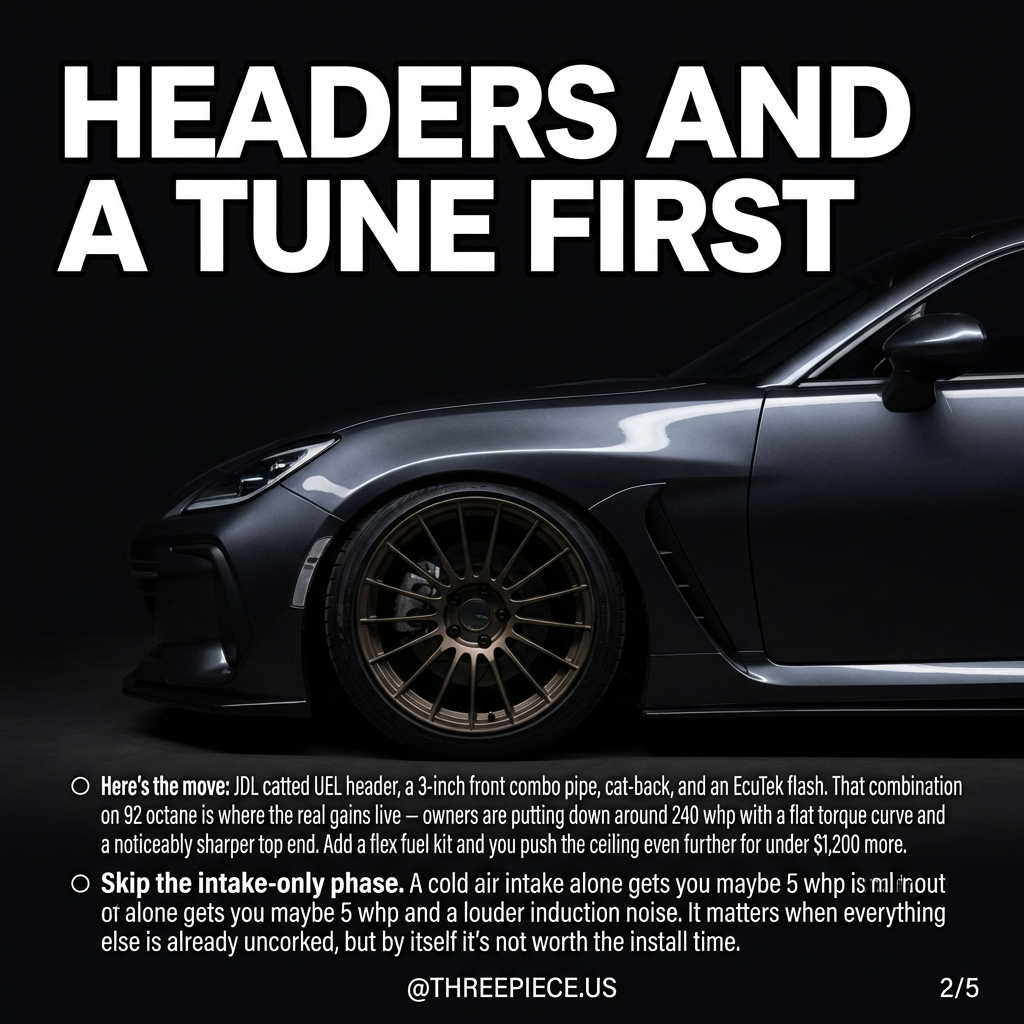
Here's where most ZD8 owners waste money: they start with a cold air intake. A CAI alone gets you maybe 3-7 whp and a louder induction noise. It matters once everything else is uncorked, but by itself it's not worth the install time or the potential AFR issues without a tune. Skip that phase.
The correct first move is a JDL catted UEL header, a 3-inch front combo pipe, a cat-back exhaust, and an EcuTek flash tune. That combination on 92 octane is where the real gains live. Headers alone with a tune net +15-25 whp. Add the full exhaust and you're looking at +30-40 whp over stock with a transformed powerband. The unequal-length header also gives you that classic boxer rumble the first gen lost when Subaru went equal-length.
One critical note from build threads: headers demand a tune or you risk lean conditions and persistent O2 sensor CELs. EcuTek via PhoneFlash is the go-to solution — it cracks the stock ECU so you can flash custom maps without a standalone. It also unlocks flat-foot shift, auto-blip, and launch control. If you're curious how modern ECU locks work across manufacturers, the BRZ is one of the few 2022+ cars where aftermarket tuning is still fully accessible.
Add a flex fuel kit and you push the ceiling further for under $1,200 more. E85 blends let the tuner pull more timing and lean on the higher octane rating for additional safe power. Owners running E60-E85 blends report another 10-20 whp on top of the pump gas numbers. Fuel delivery stays fine at this level on the stock pump — it's only when you push past 350 whp with forced induction that you need a DeatschWerks DW300C or similar high-flow unit.
Keep in mind that state inspection rules on aftermarket downpipes are tightening. Running catted headers and a catted front pipe keeps you on the right side of emissions in most states while still capturing the majority of the gains.
Suspension Setup That Makes the ZD8
The ZD8 chassis is already one of the best-handling cars under $35K. But stock ride height leaves too much body roll and not enough visual presence. For street and spirited driving, the community has converged on 6-7 kg/mm front and 7-8 kg/mm rear spring rates — stiff enough to transform turn-in and body control, soft enough to actually live with daily. Drop it 20-25mm and you're flush without destroying suspension travel.
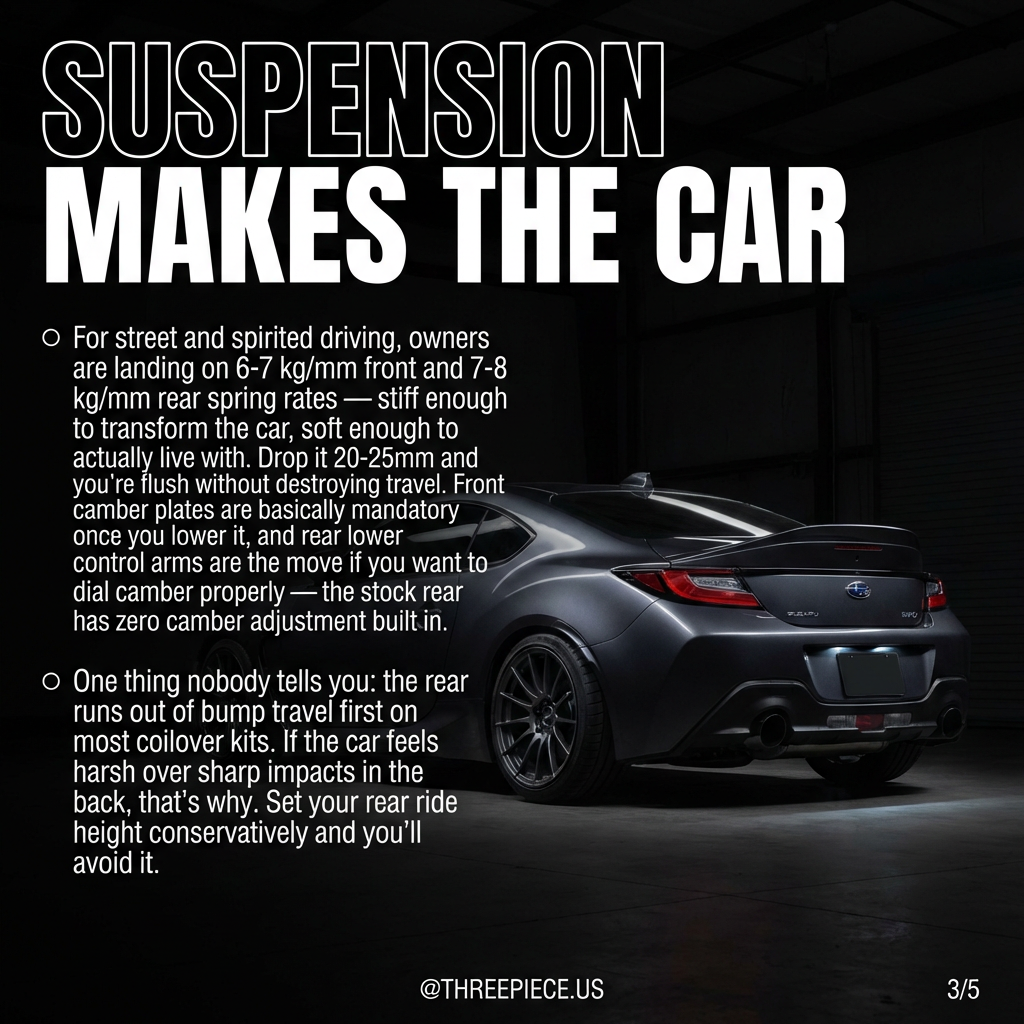
Here's what nobody tells you: the rear runs out of bump travel first on most coilover kits. If the car feels harsh over sharp impacts in the back, that's why. Set your rear ride height conservatively and you'll avoid it. If you're deciding between budget coilovers and a proper set, read our breakdown of why springs beat cheap coilovers — on the ZD8, a quality set in the $1,200-$1,500 range is the minimum for a setup that actually performs. Check our suspension category for current options.
Front camber plates are basically mandatory once you lower the car. The MacPherson strut front end has limited adjustment from the factory. The Cusco Auto Levelizer Adjustment Rod for Subaru BRZ / Toyota 86 at $70.86 is a must-have once you drop the car — it corrects the headlight auto-leveling system that goes haywire with any ride height change. For a deeper understanding of how negative camber works and why it matters for a lowered car, our camber setup guide covers the geometry.
Rear lower control arms are the move if you want to dial camber properly — the stock rear has zero camber adjustment built in. Without adjustable arms, lowering the car pushes the rear into excessive negative camber that eats inner tire edges. This is a platform-specific issue that catches a lot of first-time BRZ builders off guard.
18x9.5 +38 Is the Spec — ZD8 Wheel Fitment
The ZD8 runs 5x100 with a 56.1mm center bore. For a flush street setup, 18x9.5 +38 on 255/35R18 tires is the aggressive-but-achievable fitment owners are running on coilovers. You'll need enough negative camber up front to clear the MacPherson strut spring perch — that's the constraint on this platform, not the fender. The OEM perch sits close to the wheel's inner barrel, so linear spring coilovers with a narrower perch diameter solve what stock struts can't.
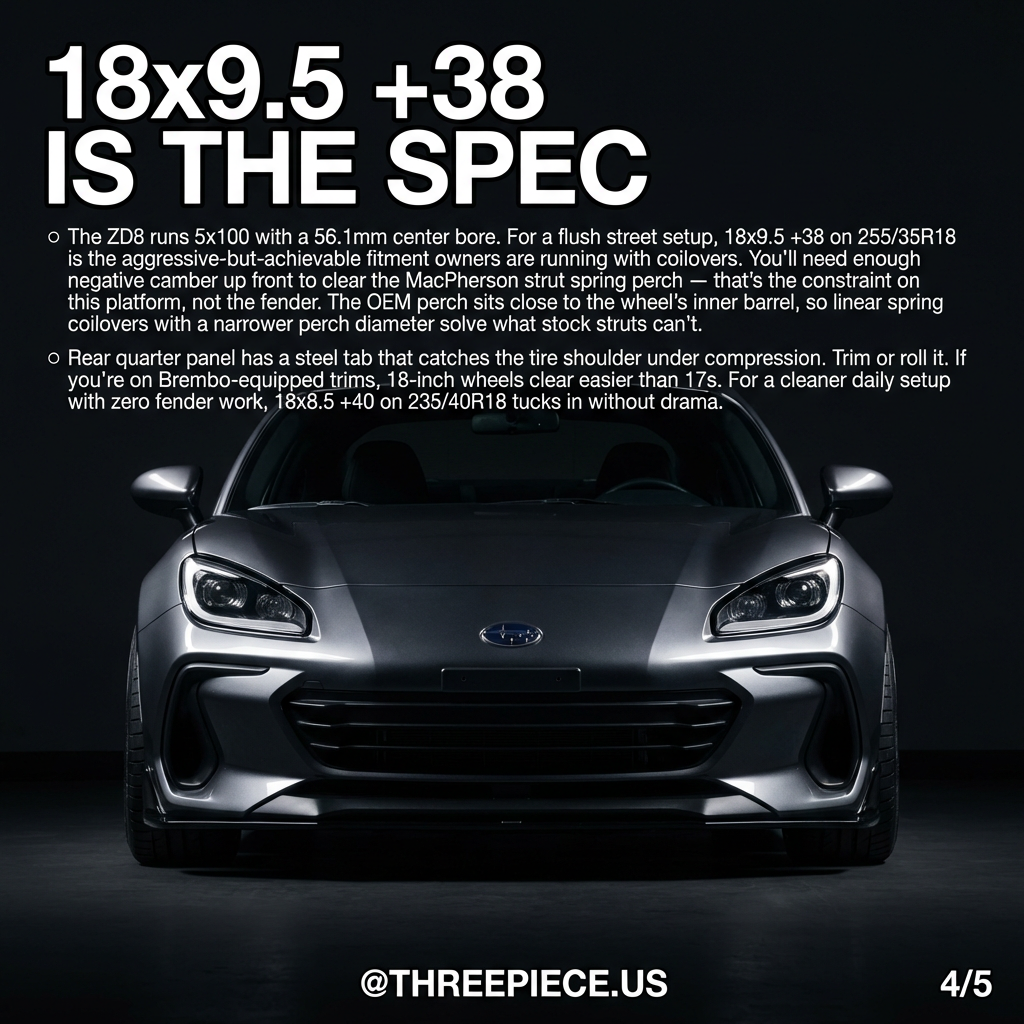
The rear quarter panel has a steel tab that catches the tire shoulder under compression. Trim or roll it. If you're on Brembo-equipped trims (Limited or tS), 18-inch wheels clear easier than 17s — the larger Brembo caliper sits tight inside a 17-inch barrel.
For tires on the aggressive setup, the American Roadstar Sport AS 255/35R18 at $96.03 is a strong budget option that fits the spec perfectly. For a cleaner daily setup with zero fender work, 18x8.5 +40 on 235/40R18 tucks in without drama — the American Roadstar Sport AS 235/40R18 at $319.96 (set of four) covers that fitment. Browse 18x9.5 wheels in 5x100 to see what's currently available for the aggressive spec.
If you're considering 3-piece forged wheels for the ZD8, the platform deserves them — at 2,800 pounds, every pound of unsprung weight you save is immediately felt. Our breakdown of why 3-piece wheels cost $4K+ and whether they're worth it explains the engineering. The Work Emotion series is a natural fit for this platform — lightweight, aggressive designs that complement the ZD8's lines without looking overdone. For builds using multi-piece wheels, make sure your spacer setup is safe if you're bridging offset gaps, and always run hubcentric rings to eliminate vibration on the 56.1mm center bore.
Check the ThreePiece vehicle gallery for real-world examples of wheel fitment on similar platforms.
Forced Induction: Turbo Kits and What They Demand
Once you've maxed out naturally aspirated gains — roughly 240-250 whp on the FA24 with full bolt-ons and flex fuel — the next step is forced induction. The two main turbo kit options the community gravitates toward are the HKS GTIII-RS and JDL turbo kits running offset Garrett turbos.
Mid-300 whp is the common target, and it's achievable with proper supporting mods. Some owners push toward 400 whp, but that's where the stock fuel delivery system starts failing. The stock fuel pump struggles past 350-400 whp — a DeatschWerks DW300C high-flow in-tank pump (around $180) is the standard upgrade. The Grams Performance 550cc Fuel Injectors for Subaru BRZ / Scion FR-S (Set of 4) at $385.54 handle the increased fuel demand on boosted applications where the stock injectors run out of headroom.
Oil management becomes critical under boost. Rapid oil starvation and windage under high RPM and high-G loads are documented failure points on the FA24. A baffled oil pan and dedicated oil cooler kit are mandatory for any turbo ZD8. Multiple build threads also stress heat shielding and heat wrap around the intake and oil pan area — the turbo manifold sits close to everything, and heat soak will wreck nearby components without proper insulation. For context on oil control in boosted boxer and turbo applications, our SR20DET oil control guide covers the same principles that apply here.
One thing to watch: HKS headers are heavily criticized by some owners for poor flow and materials. If you're going turbo, the turbo kit's manifold replaces the header anyway, but make sure you're not buying an HKS header as a "stepping stone" — it's wasted money if forced induction is the plan.
Build It for Under $5K
Here's the realistic budget breakdown for a complete ZD8 build that transforms the car:

- Headers + front pipe + cat-back exhaust: $1,500-$2,500
- EcuTek tune + flex fuel kit: $800-$1,200
- Coilovers: $1,200-$1,500
- Alignment hardware (camber plates, rear LCAs): $300-$500
That puts you at roughly $3,800-$5,700 for a car that's 40+ whp stronger, sits right, and still drives to work every morning. Wheels and tires are on top of that, but the spec is dialed — the community has already figured out what fits.
For the brake booster delete crowd running track days, the Chase Bays Dual Piston Brake Booster Delete for Toyota 86/FR-S / Subaru BRZ at $765.20 eliminates the bulky vacuum booster for a cleaner engine bay and more linear pedal feel. And the Chase Bays Clutch Line for BRZ/FR-S/86 at $95.20 is a worthwhile upgrade once you're pushing power — the stock rubber line flexes under hard use.
The AlphaRex NOVA-Series Prismatic LED Fourth Brake Light for GR86/BRZ at $301.68 is one of the cleanest visual upgrades you can do — the smoked lens with prismatic LEDs transforms the rear end without looking aftermarket.
The ZD8 is the best platform Subaru has given enthusiasts in years. The FA24 responds where the FA20 frustrated, the chassis was already sorted from the factory, and the aftermarket has matured enough that you're not guessing at fitment or tuning solutions anymore. Unlike the EJ257 STI where you're constantly managing a fragile engine, the FA24 is proving durable under bolt-on power levels. Build one right the first time and you'll have one of the most complete driver's cars on the road for the price of someone else's down payment on a Supra.