E46 M3 Build Guide: S54 Mod Order That Actually Works
The BMW E46 M3 is the last M car you can wrench on in a home garage and end up with something that embarrasses modern sports cars on a canyon road. The S54 inline-six makes 333 horsepower from the factory, revs to 8,000 rpm on individual throttle bodies, and rewards bolt-on modifications like almost nothing else in the naturally aspirated world. But the E46 M3 build order matters more than the parts list — get it wrong and you're throwing money at a chassis that's actively trying to tear itself apart. Here's the build path that real long-term owners have validated across thousands of forum pages, track days, and street miles.
Quick links
- Fix It Before You Build It
- S54 Bolt-Ons: Headers, Exhaust, and Tune
- Suspension That Works on the Street
- E46 M3 Wheel and Tire Fitment Specs
- Clutch and Drivetrain Upgrades
- Total Build Cost and Final Takeaway
Fix It Before You Build It
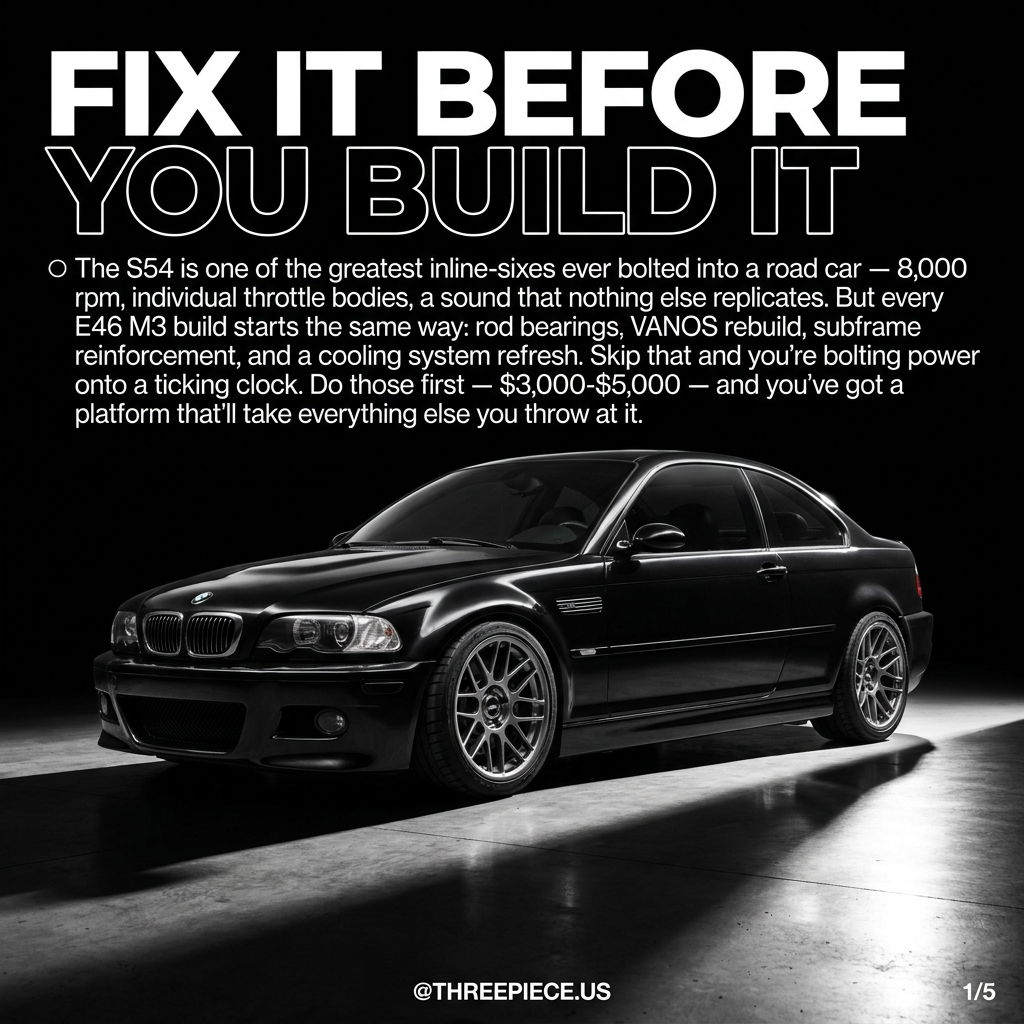
Every E46 M3 build thread on E46Fanatics and Bimmerpost starts the same way, and it's not with headers or coilovers. It's with the maintenance items that BMW should have recalled but never did. The S54 has a well-documented rod bearing issue — the factory bearings wear prematurely, and by 80,000-100,000 miles, you're rolling the dice every time you hit VTEC-like territory at 7,500 rpm. A rod bearing replacement runs $1,500-$2,500 at an independent shop, and it's non-negotiable.
Next is the VANOS rebuild. The variable valve timing system on the S54 uses seals and bearings that degrade over time, causing rough idle, power loss in the midrange, and CEL codes like P0012 (cam timing) and P0340 (cam position sensor). A full VANOS rebuild with upgraded seals costs around $500-$800 in parts if you do it yourself. Budget builders on E46Fanatics have documented this as the single biggest improvement to driveability before any performance mods go on.
Then there's the infamous rear subframe. US-spec E46 M3s have a documented weakness where the rear subframe mounting points crack through the sheet metal floor pan. Welded subframe reinforcement plates are the permanent fix — $800-$1,200 installed. Skip it and your chassis is structurally compromised, which makes every suspension and wheel upgrade pointless. If you're comparing the E46 to its successor, our E46 M3 vs E92 M3 comparison covers why the older car still wins on feel despite these maintenance demands.
Finally, refresh the entire cooling system. The E46's plastic expansion tank, thermostat housing, and water pump are all ticking time bombs past 80K miles. The Mishimoto 99-06 BMW E46 Silicone Hose Kit at $139 replaces every rubber coolant line with silicone that won't crack or swell. Pair it with a new water pump, thermostat, and expansion tank and you've eliminated the most common roadside failure mode on this platform. Total preventive maintenance budget: $3,000-$5,000. That's the price of admission before anything fun happens.
S54 Bolt-Ons: Headers, Exhaust, and Tune
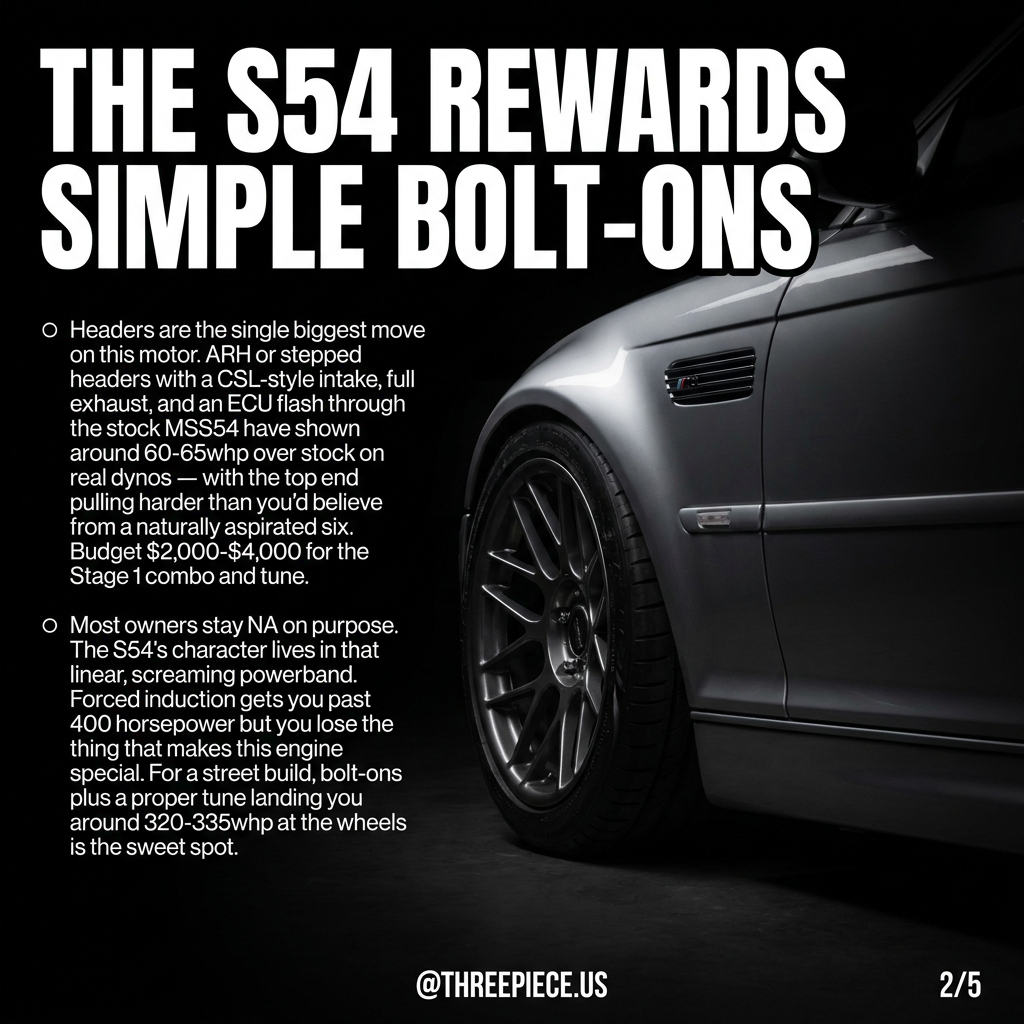
The S54 is one of those rare engines where the factory left real power on the table with the exhaust manifold design. Headers are the single biggest modification you can make on this motor. Stepped headers — whether ARH long tubes or CSL/Euro-spec units — paired with a full exhaust and ECU flash through the stock MSS54 ECU have shown 60-65 whp gains over stock on real dynos. That's not marketing; that's repeated across dozens of documented pulls on Bimmerpost.
The full Stage 1 combo looks like this: stepped headers, a CSL-style carbon airbox or high-flow intake, a full cat-back exhaust, and a proper ECU tune. Budget $2,000-$4,000 depending on whether you go new or used on the headers. The result is roughly 320-335 whp at the wheels — a naturally aspirated inline-six making that kind of power while pulling cleanly to 8,000 rpm is something modern turbocharged cars simply cannot replicate. For context on what tuning actually delivers across platforms, our Stage 1 vs Stage 2 dyno results breakdown shows how the S54 stacks up.
One thing worth noting: the intake side of this engine is less responsive to modification than the exhaust side. A CSL airbox or carbon intake helps with throttle response and sound, but the big numbers come from unshackling the exhaust. If you're curious about whether a cold air intake alone is worth the money, our deep dive on cold air intakes explains why the exhaust side should always come first on naturally aspirated engines.
Most experienced E46 M3 owners stay naturally aspirated on purpose. Forced induction kits like the Active Autowerke GTS8550 supercharger can push the S54 past 400 horsepower, but you lose the linear, screaming powerband that makes this engine special. The character of the S54 lives in that top-end pull from 5,500 to 8,000 rpm. For a street build, the bolt-on NA setup is the sweet spot — and it doesn't require upgraded internals, a clutch swap, or reinforced engine mounts.
Suspension That Works on the Street
This is where most E46 M3 builds go wrong. Cheap coilovers with aggressive spring rates turn the car into a pogo stick on anything that isn't glass-smooth tarmac. The builders who've been through two or three sets of suspension always land in the same place: KW V2/V3, Bilstein PSS10, or Öhlins Road & Track. These are the kits that long-term owners keep after burning through budget options. If you're still debating whether coilovers make sense on a daily-driven car, our coilover guide for daily drivers covers exactly why quality matters more than price on this platform.
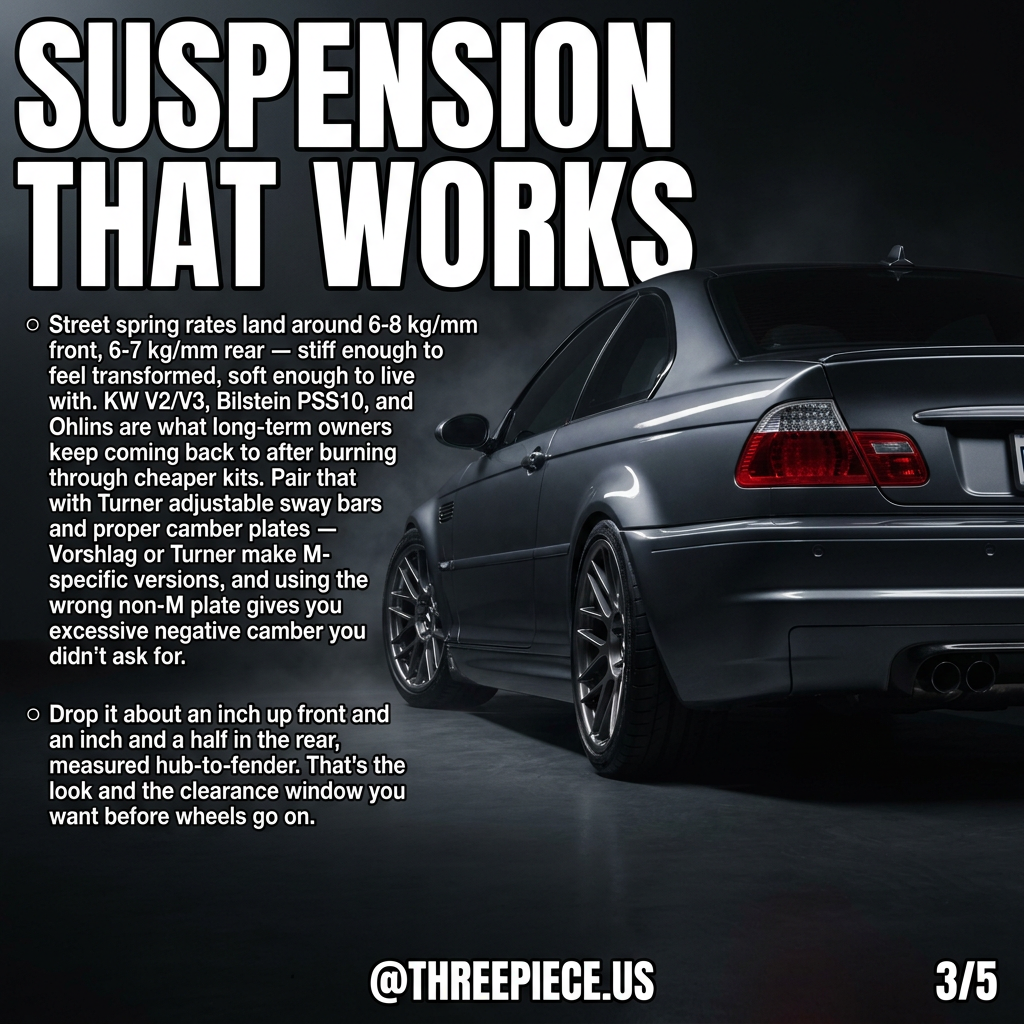
Street spring rates for the E46 M3 land around 6-8 kg/mm front and 6-7 kg/mm rear. That's stiff enough to feel completely transformed from stock but soft enough to live with five days a week. Pair the dampers with Turner adjustable sway bars and proper camber plates — Vorshlag or Turner make M3-specific versions. Using non-M camber plates is a common mistake that gives you excessive negative camber you didn't dial in. Read our breakdown of the most expensive coilover mistake to understand why matching components to the specific chassis matters.
For rear alignment correction, the Eibach Pro-Alignment Rear Camber Arm Kit for BMW E46 at $435 gives you adjustable rear camber arms that let you dial in exactly the geometry you need after lowering. Without adjustable arms, you're stuck with whatever camber the drop gives you — and on the E46, that's usually too much negative camber in the rear.
Target ride height is about one inch of drop up front and an inch and a half in the rear, measured hub-to-fender. That's the clearance window you need before wheels go on, and it's the stance that actually looks right on this chassis without destroying functionality.
E46 M3 Wheel and Tire Fitment Specs
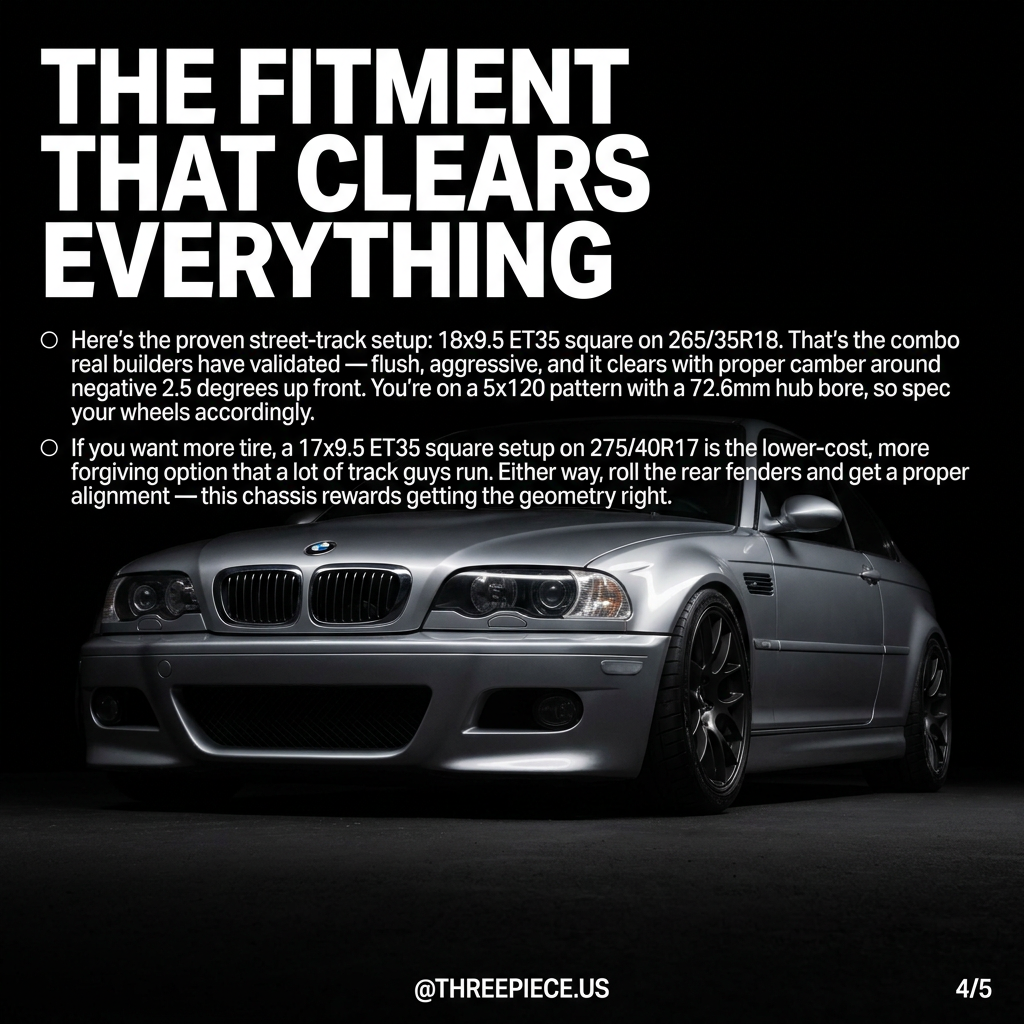
The E46 M3 runs a 5x120 bolt pattern with a 72.6mm hub bore. The proven street-and-track setup that real builders have validated over and over is 18x9.5 ET35 square on 265/35R18 tires. That combination sits flush, looks aggressive, and clears StopTech big brake kits with proper camber around negative 2.5 degrees up front. If you're running aftermarket wheels, spec them to those numbers and you won't have clearance issues.
For tires in that size, the American Roadstar Sport AS 265/35R18 at $108 per tire is a budget-friendly option that gets you on the road while you sort the rest of the build. For dedicated grip, search 265/35R18 tires to see the full range of options available. Browse 18x9.5 wheels in 5x120 to find wheels that match this exact fitment.
If you want more tire contact patch and don't care about aesthetics as much, the 17x9.5 ET35 square setup on 275/40R17 is the lower-cost, more forgiving option that a lot of dedicated track guys run. The smaller diameter clears everything easily and gives you a taller sidewall for better bump absorption. Check 17x9.5 wheels in 5x120 for that setup. Either way, roll the rear fenders and get a proper alignment — this chassis rewards getting the geometry right more than almost any other platform. For inspiration on how other builds handle fitment, browse the ThreePiece vehicle gallery.
If you're running 3-piece wheels on this build, make sure your assembly hardware is fresh. Corroded or stripped assembly bolts are a safety issue, not a cosmetic one. The valve stems should be replaced any time a wheel is disassembled — a 90 Degree Valve Stem at $3.80 makes air pressure checks far easier on deep-lip setups.
Clutch and Drivetrain Upgrades
Once you're making 320+ whp through the S54's bolt-on combo, the stock clutch becomes the weak link — especially if you're launching the car or tracking it hard. The factory clutch and dual-mass flywheel were designed for 333 crank horsepower, and they start slipping once you exceed that with headers and a tune. The DKM Clutch BMW E46 M3 Sprung Organic MB Kit with Steel Flywheel at $1,017 is rated for 440 ft/lbs of torque and includes a single-mass steel flywheel. That's enough headroom for a supercharged S54, let alone a bolt-on NA setup.
The single-mass flywheel conversion is worth discussing. The stock dual-mass unit smooths out NVH but adds rotational mass and is an expensive wear item to replace. A single-mass conversion gives you faster revs, a more connected throttle feel, and a flywheel that doesn't need replacing every 80K miles. The trade-off is more gear chatter at idle and a slightly harsher engagement. For a build car, most owners consider that an upgrade, not a compromise. Our dual-mass vs single-mass flywheel breakdown covers exactly when the swap makes sense.
Serious track builds also swap to a 4.10 limited-slip differential from the stock 3.62 ratio. That shortens every gear, making the car feel significantly faster in acceleration without adding a single horsepower. It's a common mod on documented Nürburgring-spec E46 M3 builds, and it transforms how the car pulls out of corners.
Total Build Cost and Final Takeaway
Here's what the full E46 M3 build looks like in real dollars, assuming you're starting with a clean 6-speed manual example:
- Preventive maintenance (rod bearings, VANOS, subframe, cooling): $3,000-$5,000
- Stage 1 bolt-ons and tune (headers, exhaust, airbox, ECU flash): $2,000-$4,000
- Suspension (quality coilovers, sway bars, camber plates, alignment arms): $2,500-$4,000
- Wheels and tires (18x9.5 square, 265/35R18): $1,500-$3,000
- Clutch upgrade (if needed): $1,000-$1,500
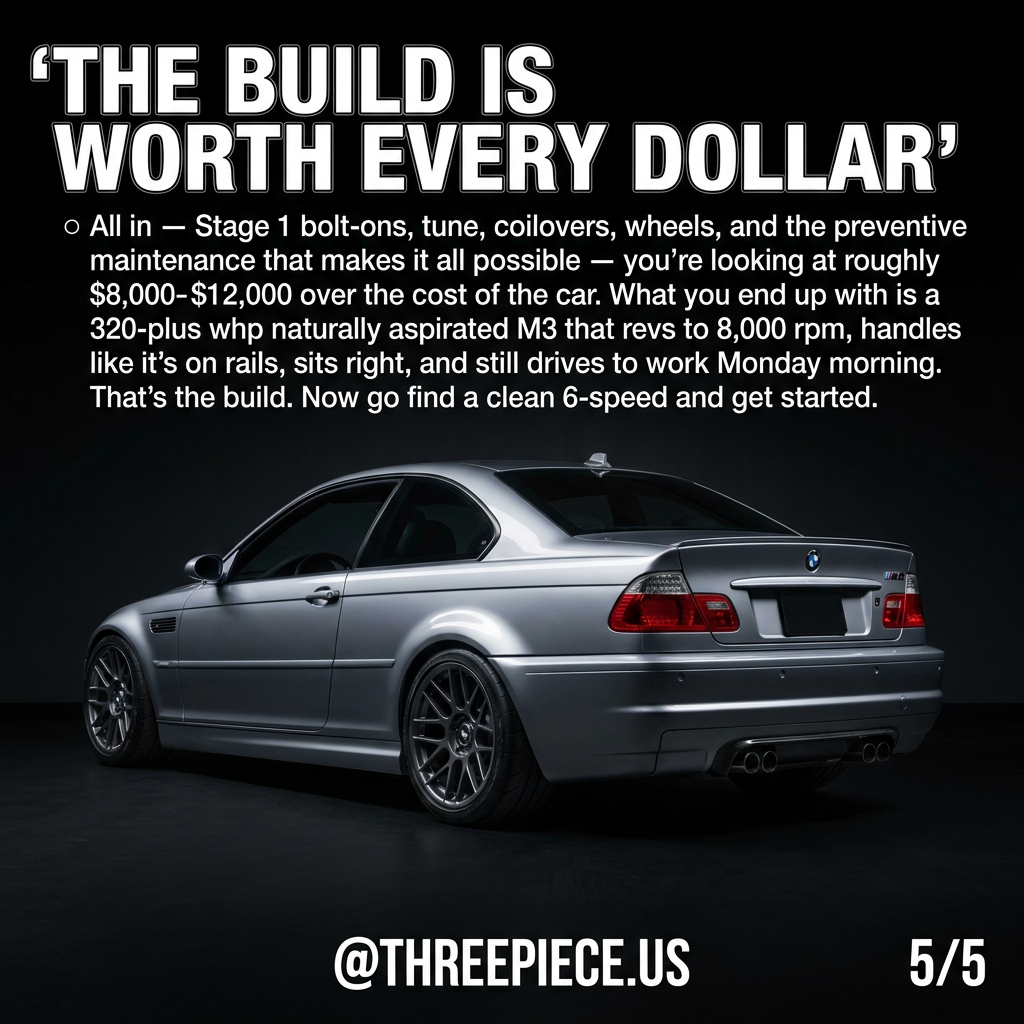
All in, you're looking at roughly $8,000-$12,000 over the cost of the car. What you end up with is a 320+ whp naturally aspirated M3 that revs to 8,000 rpm, handles like it's on rails, sits right, and still drives to work Monday morning. The S54 in this configuration is one of the most rewarding engines in the enthusiast world — nothing turbocharged replicates that linear, screaming pull through the top third of the tachometer.
These cars are appreciating. Clean 6-speed examples that were $20,000-$25,000 three years ago are now $30,000-$40,000 for low-mileage examples. Building one correctly now — with the right maintenance foundation and a thoughtful mod order — means you're investing in a car that will only become more valuable and more enjoyable over time. If you're cross-shopping with the N54-powered 335i as a cheaper entry point, read our N54 335i problems guide to understand why the S54's simplicity is worth the premium.
Find a clean 6-speed, do the maintenance first, and build it right. Browse wheels, suspension, and wheel accessories at ThreePiece.us to start putting your E46 M3 build together.