
Lexus IS 350 XE20 Build Guide: 2GR-FSE Mod Order That Works
The 2006–2013 Lexus IS 350 XE20 is one of the most overlooked sport-sedan platforms in the enthusiast world. A 306-horsepower direct-injected V6, rear-wheel drive, double-wishbone front suspension, and Lexus build quality — all sitting at half the price of an IS-F. While everyone was chasing the F or ignoring the IS line entirely, the 350 quietly became one of the best foundations for a street build under $15K all-in. The 2GR-FSE is rev-happy, genuinely reliable when maintained, and the aftermarket is finally deep enough to build one properly. Here's the blueprint.
Quick links
- Why the 2GR-FSE Deserves More Respect
- Stage 1 Tune First — Not Headers
- Exhaust and Intake: Where Bolt-Ons Actually Matter
- Suspension Setup That Transforms the Chassis
- Fix It Before You Mod It: Maintenance Priorities
- IS 350 XE20 Wheel Fitment: 18x9 ET+30 Is the Answer
- Full Build Order and Budget Breakdown
Why the 2GR-FSE Deserves More Respect
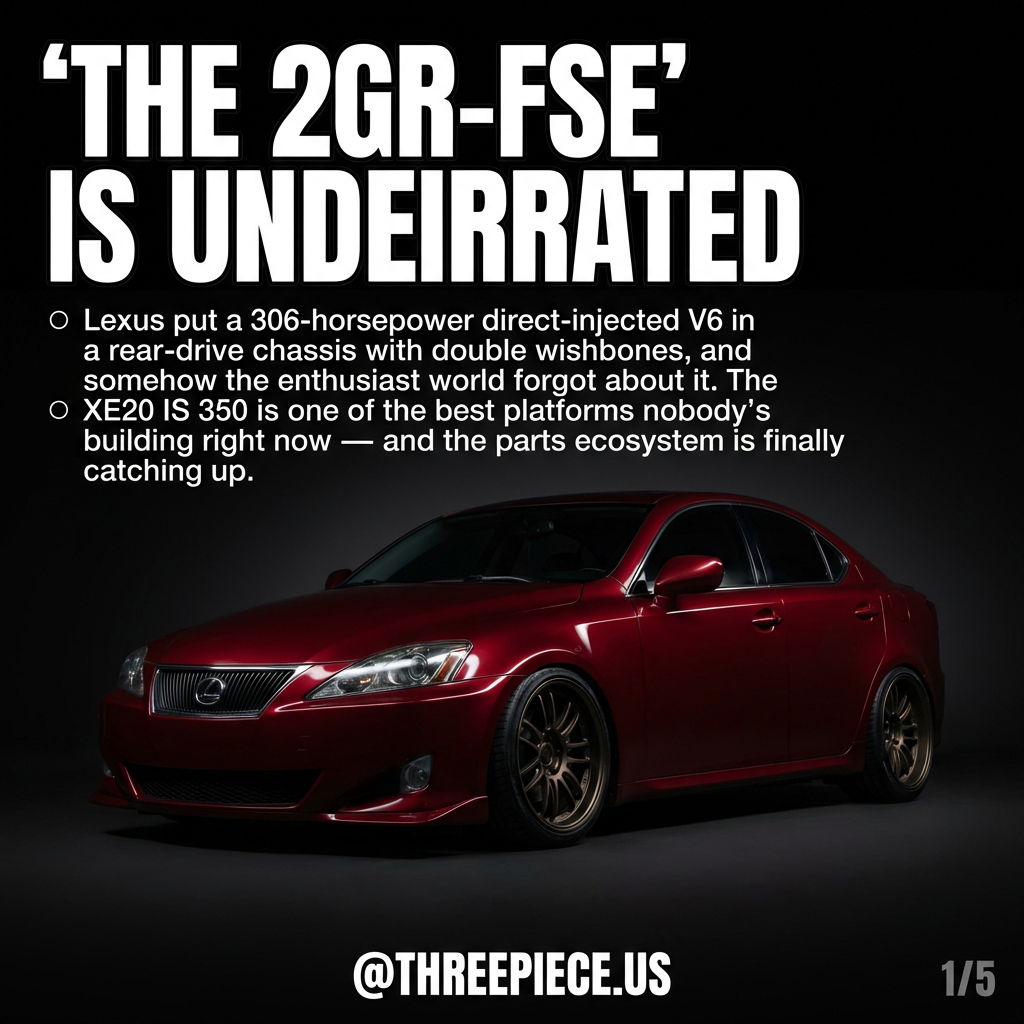
Toyota's 2GR family is one of the most proven V6 architectures ever built. The FSE variant in the XE20 IS 350 uses D-4S dual injection (port and direct) on most model years, VVT-i on both cams, and revs to 6,400 RPM with a broad, flat torque curve. Stock output is 306 hp / 277 lb-ft at the flywheel. That's competitive with the VQ37VHR in the G37 and the N52 in the E90 — except the 2GR doesn't eat timing chain guides or burn oil.
The chassis is equally underrated. Double wishbones up front with a multi-link rear is a geometry package most sedans in this price range can't touch. The XE20 shares its platform bones with the GS and the IS-F, so the suspension pickup points and subframes are overbuilt for what the car weighs. Pair that with a 3,400 lb curb weight and you have a platform that responds dramatically to basic suspension work. If you're shopping in the same price range as a VQ35DE 350Z or a high-mileage E92, the IS 350 is the one nobody's bidding up yet.
Stage 1 Tune First — Not Headers
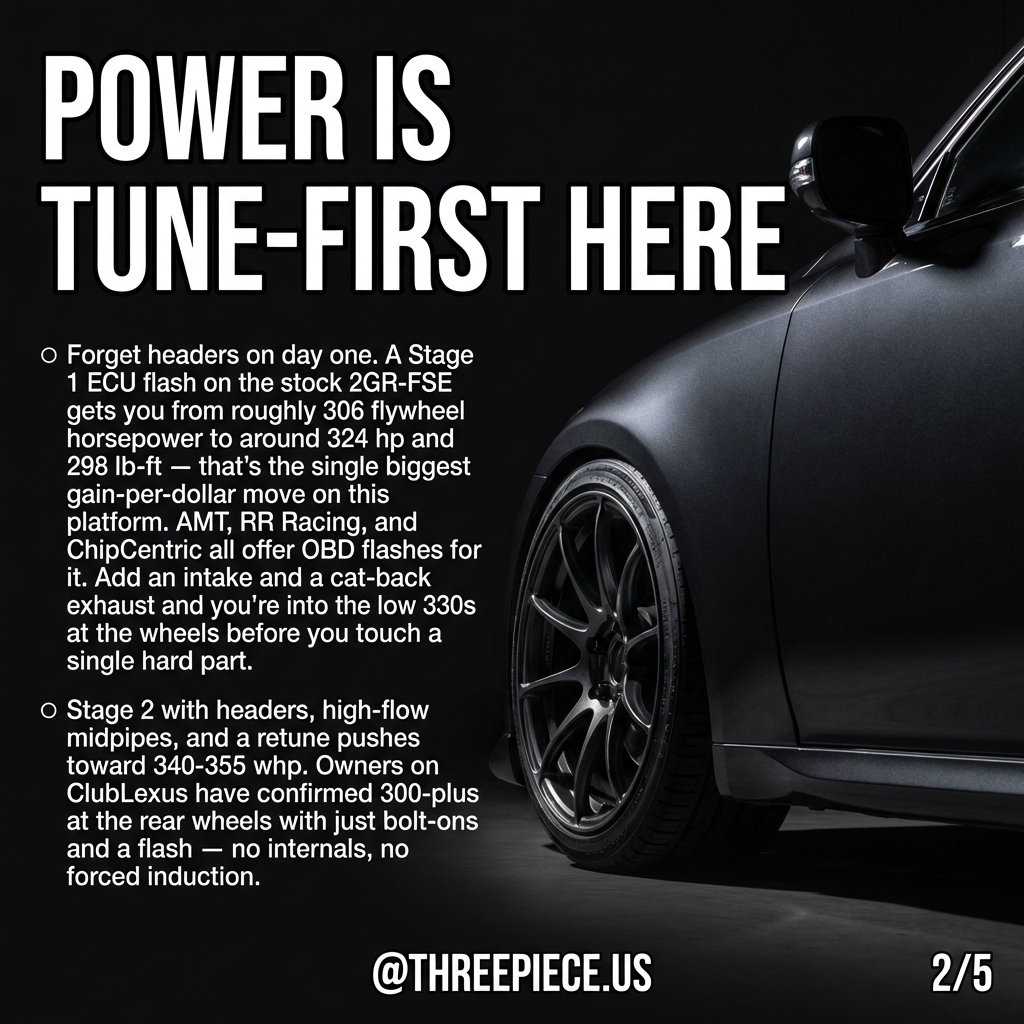
This is where most IS 350 builds go wrong. Owners bolt on headers and an exhaust before touching the ECU, and then wonder why they only picked up 7 whp. On the 2GR-FSE, the single biggest gain-per-dollar move is a Stage 1 ECU flash. The Denso 76F-series ECM in these cars is flashable via OBD2, and tuning houses like AMT Tuning, RR Racing, and ChipCentric all offer calibrations for it.
The numbers are documented: a Stage 1 flash on the stock 2GR-FSE moves output from roughly 306 hp / 277 lb-ft to approximately 324 hp / 298 lb-ft at the flywheel — on 93 octane, no supporting mods required. That's an 18 hp / 21 lb-ft gain from a flash alone. For context, that's a better return than most cold air intakes and cat-back exhausts combined. If you want to understand why a tune should always come before bolt-ons, our breakdown of Stage 1 vs Stage 2 real dyno numbers covers the logic in detail.
Budget $800–$1,200 for a quality tune on this platform. RR Racing is the go-to for owners running high-octane fuel; AMT Tuning offers both Stage 1 and Stage 2 packages with OBD cables included. Either way, this is step one.
Exhaust and Intake: Where Bolt-Ons Actually Matter
Once the tune is in, the exhaust and intake are where you unlock Stage 2 territory. The proven bolt-on path on ClubLexus and the IS forums looks like this:
- Cold air intake (aFe Pro 5R or equivalent) — modest gains alone, but essential for the tune to pull more air. Read our deep dive on whether a cold air intake is actually worth it for the full picture.
- Megan Racing 2.5" stainless midpipes — direct bolt-on, catless or high-flow cat options. Paired with an Invidia axle-back, owners have dynoed approximately 281 rwhp on the stock tune, confirming real gains from exhaust flow alone.
- Cat-back exhaust — MagnaFlow and Invidia are the two most common choices. MagnaFlow's stainless systems are well-documented on this platform.
- PPE headers — these are the Stage 2 unlock. High-flow or catless headers paired with midpipes and a retune push the 2GR-FSE toward 340–355 whp. Owners on ClubLexus have confirmed 300+ at the rear wheels with just bolt-ons and a flash — no internals, no forced induction.
The total for intake, midpipes, and a cat-back runs $1,000–$2,000 depending on brand choices. Headers add another $800–$1,500 but are where the serious power lives.
Suspension Setup That Transforms the Chassis
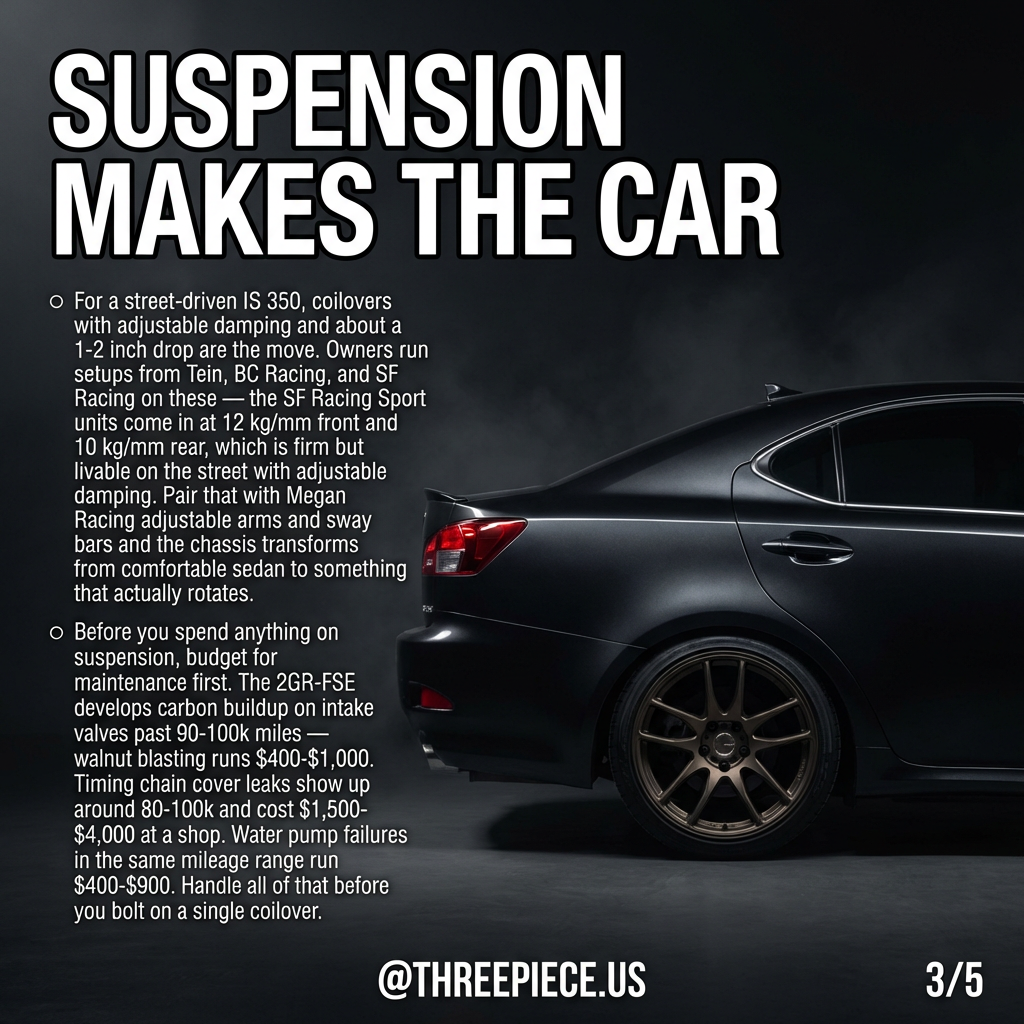
The XE20's double-wishbone front and multi-link rear geometry is genuinely good from the factory — but the stock dampers and springs are tuned for Lexus comfort, not engagement. Coilovers with adjustable damping and a 1–2 inch drop completely change how this car rotates and responds to inputs.
Owners run setups from Tein, BC Racing, and SF Racing on these. The SF Racing Sport units are popular at the budget end, specced at 12 kg/mm front / 10 kg/mm rear — firm but livable on the street with 32-click damping adjustment. BC Racing BR series is the mid-tier standard. If you want to understand the real differences between budget and quality coilovers, read why 90% of coilover buyers make this expensive mistake before you spend a dollar.
Beyond coilovers, the chassis responds well to Megan Racing adjustable rear control arms, traction arms, and sway bars — front and rear. The stock rear sway bar is soft, and upgrading it is one of the cheapest ways to add rotation. Budget $1,500–$2,500 for coilovers and arms combined. If you're debating whether coilovers are even the right move for a street car, our verdict on coilovers on daily drivers covers that question directly. Browse our full suspension category for options across platforms.
Fix It Before You Mod It: Maintenance Priorities
Before you bolt on a single coilover or flash a tune, the 2GR-FSE has three known weak points that need to be addressed on any car past 80,000 miles:
- Carbon buildup on intake valves — the direct-injection side of the D-4S system deposits carbon on intake ports past 90,000–100,000 miles. This chokes lower-RPM drivability and costs $400–$1,000 for walnut blasting. Non-negotiable on a high-mileage car. If you've dealt with this on a Subaru, the FA20DIT carbon buildup breakdown explains the same fundamental problem.
- Timing chain cover leaks — shows up around 80,000–100,000 miles as an oil weep from the front of the engine. Shop cost is $1,500–$4,000 depending on labor rates. This is a gasket/reseal job, not a chain replacement in most cases.
- Water pump failure — the OEM water pump is good for roughly 100K miles before it starts weeping. Replacement runs $400–$900 at a shop. Replace the thermostat at the same time.
Total maintenance budget on a 100K-mile car: $1,000–$2,000 to sort all three. Do this first. A tuned engine with a leaking timing cover and carboned-up valves is just a fast car with a ticking clock.
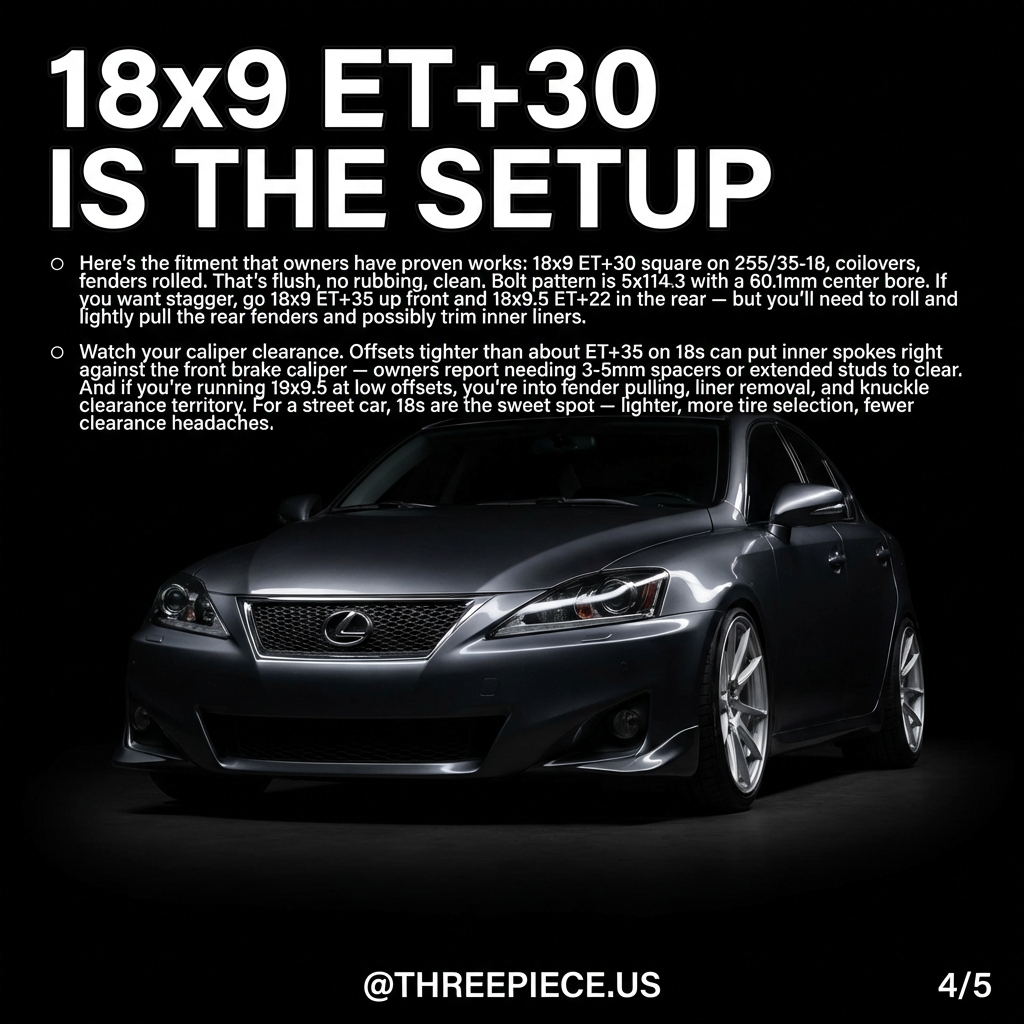
IS 350 XE20 Wheel Fitment: 18x9 ET+30 Is the Answer
The XE20 IS 350 runs a 5x114.3 bolt pattern with a 60.1mm center bore. Here's the fitment that owners have proven works without drama:
- Square setup: 18x9 ET+30 all around on 255/35R18 tires, coilovers, fenders rolled. That's flush, no rubbing, clean.
- Staggered setup: 18x9 ET+35 front / 18x9.5 ET+22 rear — requires rolling and lightly pulling the rear fenders and possibly trimming inner liners.
Watch your caliper clearance. Offsets tighter than about ET+35 on 18s can put inner spokes right against the front brake caliper. Owners report needing 3–5mm spacers or extended studs to clear. If you're running 19x9.5 at low offsets, you're into fender pulling, liner removal, and knuckle clearance territory. For a street car, 18s are the sweet spot — lighter, more tire selection, fewer clearance headaches. Our newer Lexus IS 350 fitment guide covers the latest generation if you want to compare platform differences. For staggered fitment theory, read cast vs forged wheels to understand which construction makes sense at these widths and offsets.
Browse 18x9 wheels in 5x114.3 to see what fits the square setup, or 18x9.5 in 5x114.3 for the rear stagger option. For tires, the 255/35R18 size has strong availability across performance compounds. The Work Emotion series is a natural fit for this platform — lightweight, aggressive spoke designs, and available in 18x9 and 18x9.5 specs. If you go 3-piece, finish the look with proper valve stems — a 90 Degree Valve Stem at $3.80 keeps things clean behind deep-dish lips.
Running Work Wheels? Grab a set of Work VS Reproduction Center Caps at $50 each, or browse Work center caps for the correct cap for your specific model. If you need replacement barrel halves or lips down the road, the Work wheel halves section has what you need. Check the ThreePiece vehicle gallery for real-world examples of these fitments on similar platforms.
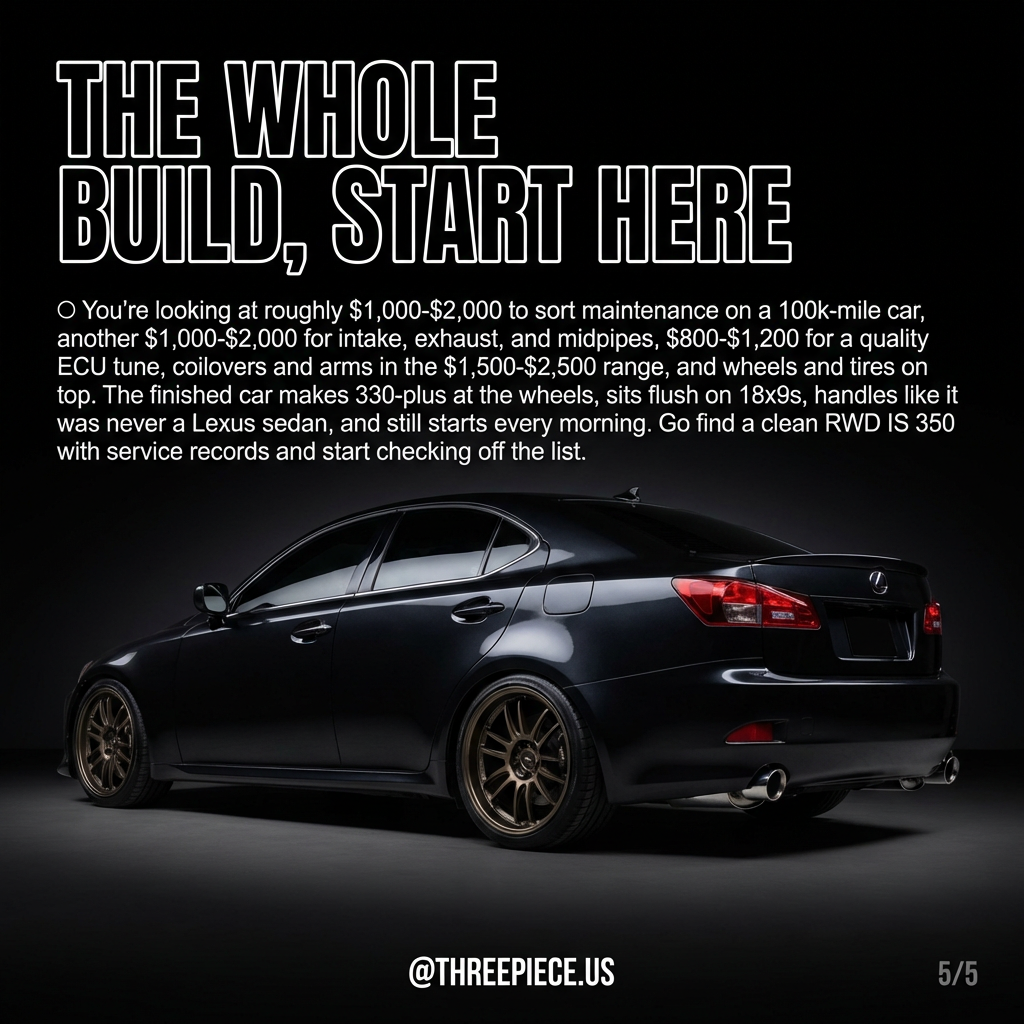
Full Build Order and Budget Breakdown
Here's the correct sequence for building an XE20 IS 350. This isn't a "top 5 mods" list — it's the order that maximizes every dollar and avoids wasted work.
- Maintenance first ($1,000–$2,000): Walnut blast the intake valves, reseal the timing cover if it's weeping, replace the water pump and thermostat. This is non-negotiable on any car past 80K.
- Stage 1 ECU tune ($800–$1,200): Flash the stock engine and pick up ~18 hp / 21 lb-ft with zero supporting mods. Biggest single gain on the platform.
- Intake + exhaust + midpipes ($1,000–$2,000): Cold air intake, Megan Racing midpipes, and a cat-back (MagnaFlow or Invidia). This unlocks the tune's full potential and gets you into the low 330s at the flywheel.
- Coilovers + arms ($1,500–$2,500): BC Racing BR, Tein, or SF Racing Sport coilovers. Add Megan Racing adjustable arms and sway bars. The chassis transforms.
- Wheels + tires ($2,000–$4,000+): 18x9 ET+30 square on 255/35R18. Roll the fenders. Done.
- Optional Stage 2 ($1,500–$3,000): PPE headers, retune, upgraded spark plugs (ruthenium), and possibly an oil cooler. This pushes toward 340–355 whp.
Total for a complete street build: $6,300–$12,700 on top of the car itself. The finished product makes 330+ at the wheels, sits flush on 18x9s, handles like it was never a Lexus sedan, and still starts every morning. Clean RWD IS 350s with service records are still out there under $15K — go find one before the market catches on. If you're cross-shopping similar platforms, compare the build path to our 370Z build guide or the F30 335i build guide — the IS 350 undercuts both on entry price and maintenance costs. Start your wheel search with our full wheel catalog and build from there.