

Corvette LT1 Evolution: C4 vs C7 Known Problems & Buyer Guide
The C4 LT1 and the C7 LT1 share a name, share a displacement, and share absolutely nothing else. Thirty years of GM small-block evolution separate a 300 hp reverse-flow-cooled pushrod V8 from a 455 hp direct-injected, variable-valve-timed marvel — and the ownership experience is just as different as the power figures. If you're shopping one of these right now, the question isn't which is "better." It's which set of problems you'd rather manage, which repair bills you can stomach, and which driving experience actually matches your life. Here's the honest breakdown from forum threads, documented build teardowns, and real owner data.

Quick links
- The C4 LT1: What It Actually Is
- C4 LT1 Known Failure Points
- The C7 LT1: 30 Years of Engineering Later
- C7 LT1 Known Failure Points
- Ownership Cost Reality Check
- Wheel Fitment for C4 and C7 Corvettes
- Which One Do You Actually Buy
The C4 LT1: What It Actually Is
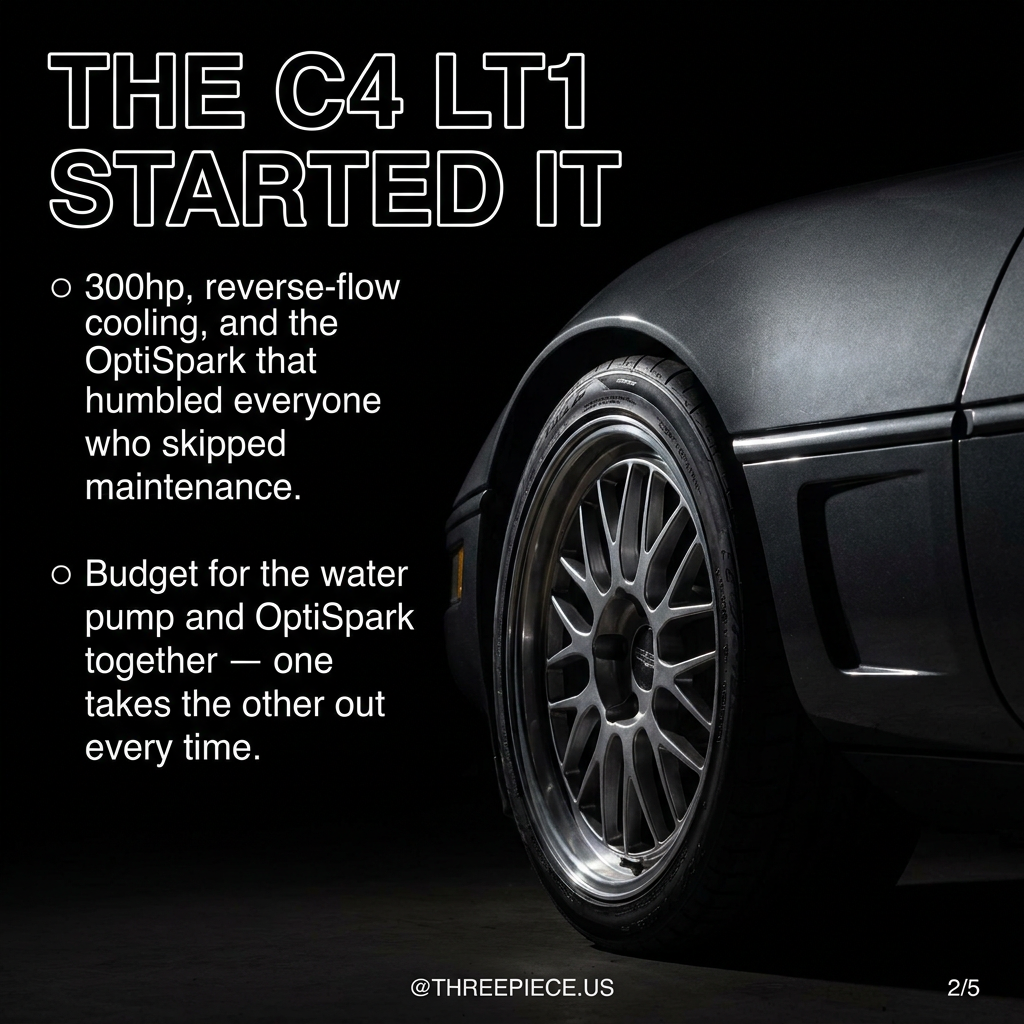
The 1992–1996 C4 LT1 was GM's first serious attempt at modernizing the small-block Chevy after decades of carbureted inertia. It made 300 hp (later 330 hp in LT4 trim) from a 5.7L pushrod V8 with reverse-flow cooling — a system that sent coolant to the cylinder heads first, then down to the block. The idea was better combustion chamber temperature control and higher compression without detonation. It worked. It also created a unique maintenance chain reaction that defines C4 ownership to this day.
Many C4 LT1s have been documented at 150,000–200,000+ miles on original bottom ends, which is remarkable for a '90s American sports car. The engine itself is stout. The accessories bolted to it are where the story gets interesting. If you're comparing this era to other American V8 sports cars, the LT1 was genuinely ahead of its time — it just came with a few design choices that aged poorly.
C4 LT1 Known Failure Points
The OptiSpark distributor is the single most discussed component in C4 ownership. It sits at the front of the engine, directly below the water pump — which means any water pump leak drips straight onto your ignition system. Moisture intrusion causes misfires, rough idle, and eventual complete failure. Replacement parts run $300–$600 for a quality AC Delco unit, but the labor is several hours because you're pulling the front cover and accessory drive. The real move: budget for the water pump and OptiSpark together. One takes the other out every time, and forum veterans will tell you that doing one without the other is just scheduling your next breakdown.
Head gasket failure is the second big-ticket item. The composite gasket between the aluminum heads and cast-iron block deteriorates over time, especially in hot climates or with any track use. Cylinder #8 is the usual suspect. Once it goes, you're looking at $2,500–$4,000 for a proper job with both heads machined, MLS gaskets installed (not the original composite), and fresh head bolts — reusing stock bolts is a common shortcut that leads to repeat failure. If you're buying a high-mileage C4 that hasn't had this done, budget for it immediately.
Cooling system cascade failures tie it all together. Radiator end-tank leaks show up around 85,000 miles, water pump failures between 65,000–100,000 miles, and each one can trigger the next problem in the chain. Proactive hose, radiator, and water pump replacement is the single best investment you can make on a C4 LT1. The parts are cheap. The consequences of ignoring them are not.
On the transmission side, the C4 is relatively drama-free. The 6-speed manual (ZF S6-40) has syncro wear over time but is generally durable. The 4L60E automatic benefits from an auxiliary transmission cooler if you're driving hard, but full rebuilds run only $1,500–$3,000 — modest by modern standards. If you're weighing drag radials vs street tires for your C4, the drivetrain can handle more than most people think.
The C7 LT1: 30 Years of Engineering Later
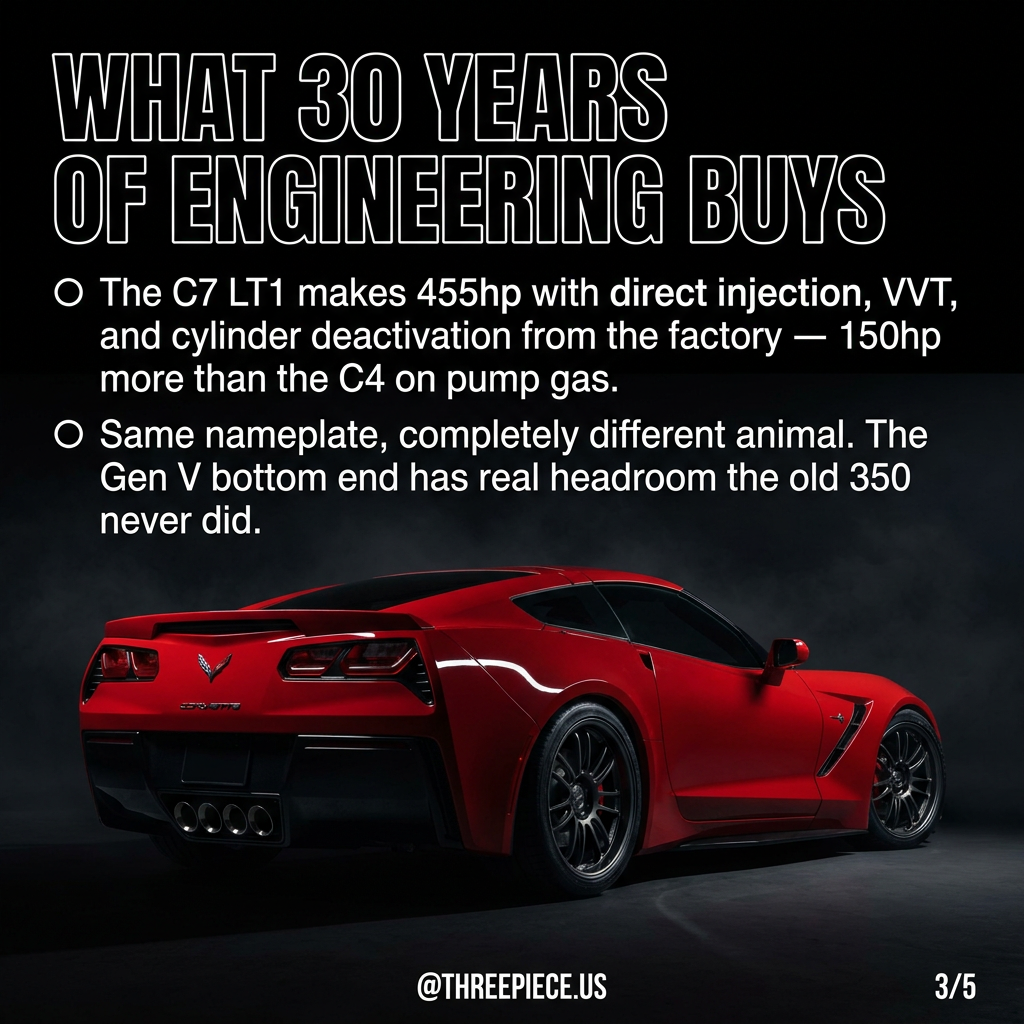
The 2014–2019 C7 Stingray's Gen V LT1 is a completely different animal wearing the same badge. 455 hp and 460 lb-ft from a 6.2L V8 with direct injection, variable valve timing, and Active Fuel Management cylinder deactivation — all on pump gas. That's 150+ hp more than the C4 LT1 from roughly the same displacement philosophy. The bottom end has real headroom; bolt-on builds regularly hit 500 hp without touching internals.
The chassis is equally transformed. The C7's aluminum frame, Magnetic Ride Control (on Z51 and above), and electronic limited-slip differential create a car that embarrasses vehicles at twice its price point on a road course. This is a modern supercar experience at used-Corvette money — but the maintenance and repair bills reflect that sophistication. Every sensor, every solenoid, every electronically controlled system is another potential failure point that didn't exist in 1992.
C7 LT1 Known Failure Points
The 8L90 automatic transmission is the C7's version of the OptiSpark — the component that defines the ownership conversation. The "shudder" between 30–65 mph is well-documented on 2015–2017 models especially. It feels like driving over rumble strips: the torque converter clutch slips erratically, creating a vibration that ranges from annoying to genuinely alarming. GM issued TSB 18-NA-355 covering fluid flushes, but many owners ended up replacing the torque converter entirely. A fluid flush runs $500–$1,200. Torque converter replacement is $2,500–$4,000 in parts and labor. A full transmission replacement at a dealer can exceed $7,000. If you're shopping C7 automatics, target 2016+ build dates or any year with the 7-speed manual and sidestep this entirely.
Active Fuel Management lifter failure is the second major concern. The AFM system deactivates cylinders for fuel economy, and the specialized lifters it uses can fail between 60,000–100,000 miles. Symptoms include persistent ticking on cold start, misfire codes, and rough idle. The fix is pulling the lifters and replacing them — either with updated GM parts or non-AFM solid lifters combined with a tune to disable the system entirely. Budget $1,500–$3,000 for the job. Many owners disable AFM preventatively via tune, which is arguably the smartest money you can spend on a C7.
Oil pump case leaks and timing chain tensioner guide wear round out the trifecta. Low oil pressure at high RPM, DTC P06DD codes, and potential bearing damage from debris are all documented, particularly on pre-mid-2015 builds. GM issued a TSB covering the full 2014–2019 range. Guide replacement and resealing runs around $1,000, but if the pump face is damaged or debris has circulated through the bearings, you're looking at $3,000–$5,000 for a full cleanup. Early 2014–2015 cars also showed isolated valve guide wear — not widespread, but worth a compression test on any early-production car.
If you're comparing these failure modes to other performance platforms, the pattern is similar to what we've documented with the N54-powered E90 335i or the W212 E63 AMG — more technology means more potential failure points, but the driving experience justifies the complexity if you budget for it.
Ownership Cost Reality Check
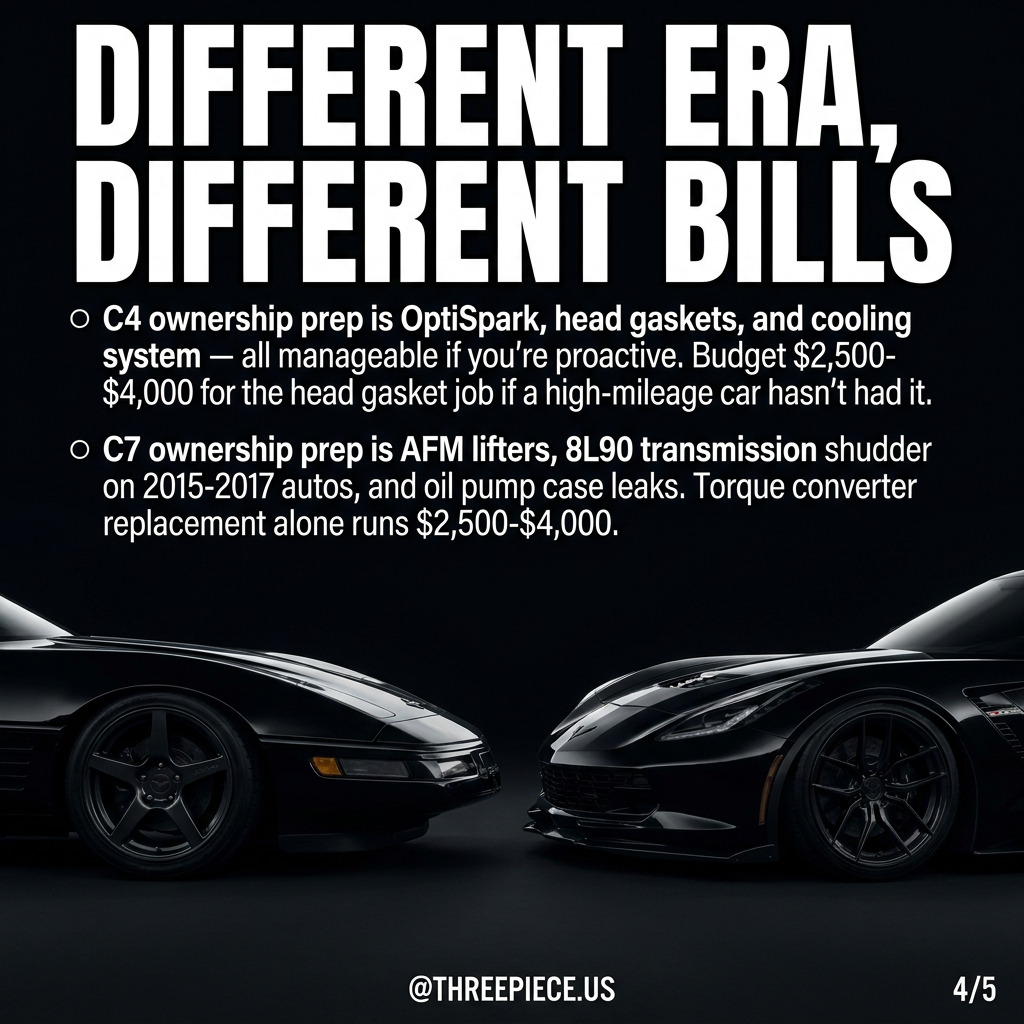
Here's the part nobody wants to hear: both cars have a $2,500–$4,000 repair bill waiting for you. On the C4, it's the head gasket job. On the C7, it's the torque converter or lifter replacement. The difference is context.
A clean C4 LT1 can be had for $8,000–$15,000. That head gasket bill represents 25–50% of the car's value, which sounds brutal — but the parts are cheap, the systems are simple enough for a competent home mechanic, and the engine is one of the most documented small-blocks ever produced. You can wrench on this car in your garage with hand tools and a Corvette Forum tab open. The C4 is the weekend car you build a relationship with.
A clean C7 Stingray sits at $30,000–$45,000 depending on trim, transmission, and miles. That same dollar amount in repairs represents a smaller percentage of value, but the repairs themselves require more specialized knowledge and tooling. You're not doing an 8L90 torque converter swap in your driveway. The C7 is the car you drive hard out of the box and maintain through a good independent shop.
For suspension upgrades on either platform, proper coilovers transform the experience. The Fortune Auto 500 Series Coilovers for C5 Corvette at $1,950 give you a reference point for Corvette-platform suspension pricing, and the Fortune Auto 500 Series for C6 at the same price covers the next generation. If you want track-focused valving with external reservoirs, the Fortune Auto 510 Series for C5 at $2,499 and 510 Series for C6 at the same price are the move. For budget-conscious builds, the Function and Form Type 3 Coilovers for C5/C6 at $1,590 deliver solid street performance without the track-day price tag.
Wheel Fitment for C4 and C7 Corvettes
This is where both cars reward you for doing the homework. The C4 runs a 5x120.65mm (5x4.75") bolt pattern — classic GM fitment shared with Camaros, Firebirds, and a massive aftermarket catalog. Common fitments are 17x9.5 front / 17x11 rear on the later C4s, with room for 18s if you're willing to roll fenders. The staggered setup is part of the car's identity. If you're unfamiliar with how staggered fitments affect handling and tire wear, our E46 M3 square vs staggered guide breaks down the tradeoffs — the principles apply directly.
The C7 uses the same 5x120.65mm pattern but steps up to 18x8.5 front / 19x10 rear on the base Stingray and 19x10 front / 20x12 rear on the Z51 and Grand Sport. Those rear widths are serious — a 12"-wide rear wheel with a 335/25R20 tire is supercar territory. Browse 19x10 wheels for the front and 20x12 options for the rear to see what's available in that fitment range.
For either generation, the right wheel set transforms the car's presence. A C4 on period-correct mesh wheels or deep-dish 3-piece designs looks like it belongs in a '90s poster. A C7 on forged multi-spoke wheels with proper concavity looks like it costs twice what you paid. Check the vehicle gallery for build inspiration across both platforms. The Work Wheels catalog has options that suit both eras — from the Work Emotion CR Kiwami starting at $270 for a clean lightweight look, to the Work Emotion CR 3P at $895 if you want the full forged 3-piece experience with custom offsets and finishes. Finish the build with a ThreePiece.us license plate frame at $9.99 and proper 90-degree valve stems at $3.80 each — deep-dish lips and standard valve stems don't mix.
Which One Do You Actually Buy
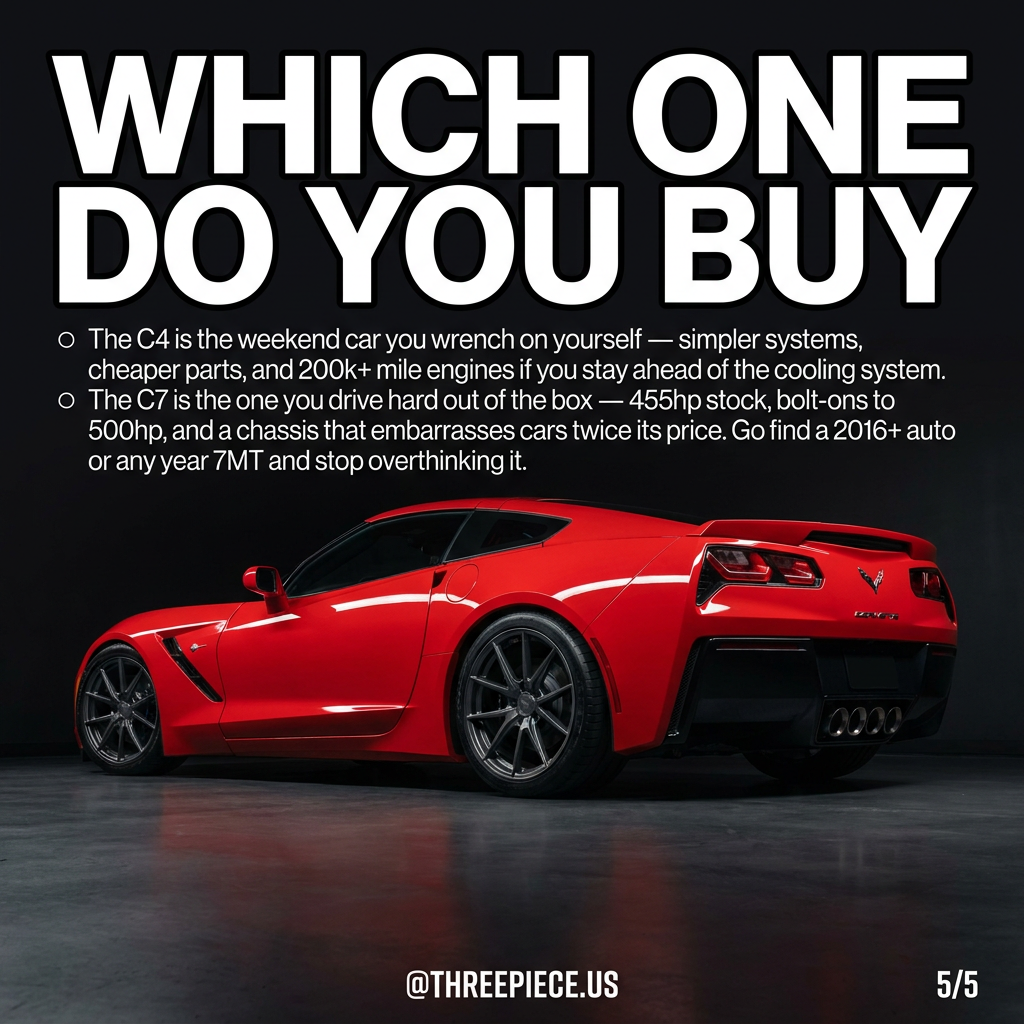
If you want the car you wrench on, learn on, and build into something personal — the C4 LT1 is one of the best values in the American sports car market right now. Sub-$15K entry, a massive parts ecosystem, and an engine that rewards proactive maintenance with genuine longevity. Stay ahead of the cooling system, budget for the head gasket job on any car over 100,000 miles, and you have a 300 hp rear-drive V8 that costs less per year than most people's car payments.
If you want to drive hard immediately with modern safety, modern grip, and modern power — the C7 is the answer. 455 hp stock, bolt-ons to 500 hp, and a chassis that embarrasses cars twice its price. Target a 2016+ automatic to avoid the worst of the 8L90 shudder issues, or buy any year with the 7-speed manual and stop overthinking it. Budget for an AFM delete tune early and you'll sidestep the lifter issue entirely.
Both cars share one truth: the Corvette small-block, in any generation, rewards owners who understand what breaks and fix it before it does. That's the real evolution — not just the horsepower number on the window sticker, but the relationship between you and the machine.
So which side are you on — buy the C4 and build the legend yourself, or let GM's 30 years of engineering do the heavy lifting on the C7?