
The E46 M3 is one of those platforms where the factory wheel fitment was deliberately conservative — BMW left serious room inside those fenders, and two decades of forum builds have mapped exactly how far you can push it. The question isn't whether you can go wider than the stock 18×8 ET47 front / 18×9 ET22 rear. You can. The real question is whether you want identical grip at all four corners for tire rotation and balanced handling, or you want that rear-biased, planted stance that lets the S54 claw its way out of corners. This guide covers both paths — with the exact offsets, tire sizes, camber specs, and mod requirements that separate a clean setup from an expensive lesson in fender-liner clearance.
Quick links
- OEM Baseline: What BMW Gave You (and Why It's Not Enough)
- Square Setups That Actually Clear
- Staggered Done Right
- Camber & Alignment: The Numbers That Save Your Tires
- What Goes Wrong: Real Fitment Failures
- Wheel Picks for the E46 M3
- Pick Your Lane
OEM Baseline: What BMW Gave You (and Why It's Not Enough)
Every E46 M3 fitment decision starts from the same factory numbers:
- Bolt pattern: 5×120
- Hub bore: 72.6 mm
- Lug bolts: M12×1.5, 60° conical seat, torqued to ~88 ft-lb (120 Nm)
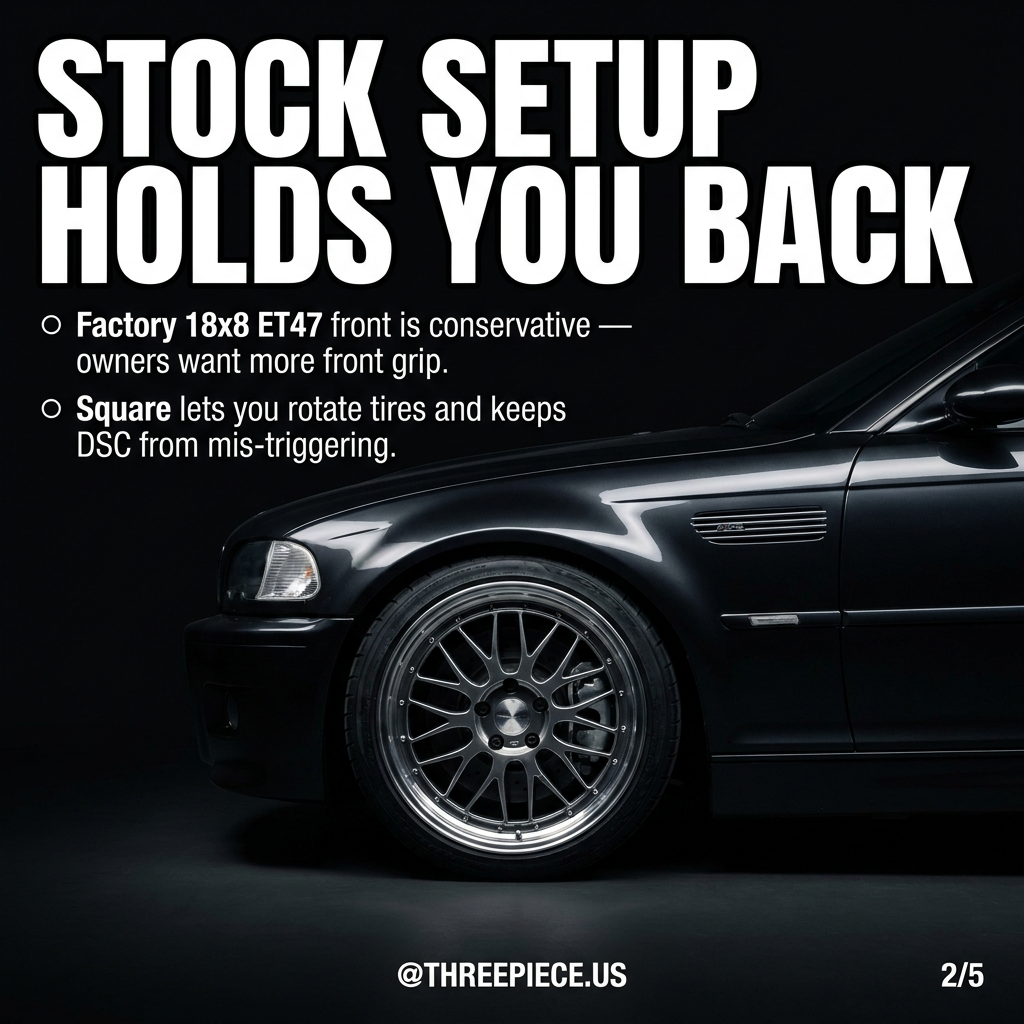
- Stock wheels (Style 67): 18×8 ET47 front with 225/45-18, 18×9 ET22 rear with 255/40-18
That front wheel is the problem. An 8-inch-wide wheel at ET47 is tucked so far inboard that the front end is visually starved and mechanically undergripped compared to the rear. The S54 makes 333 hp and sends it exclusively to the rear — which is why BMW biased grip rearward from the factory. But on track, at autocross, or even on a spirited canyon run, the front end washes out before the rear is anywhere near its limit. If you've ever felt the E46 M3 understeer into a corner entry and thought this car deserves better, you're right. It does. Understanding how different wheel constructions affect weight and fitment is worth reading before you commit to a setup.
Square Setups That Actually Clear
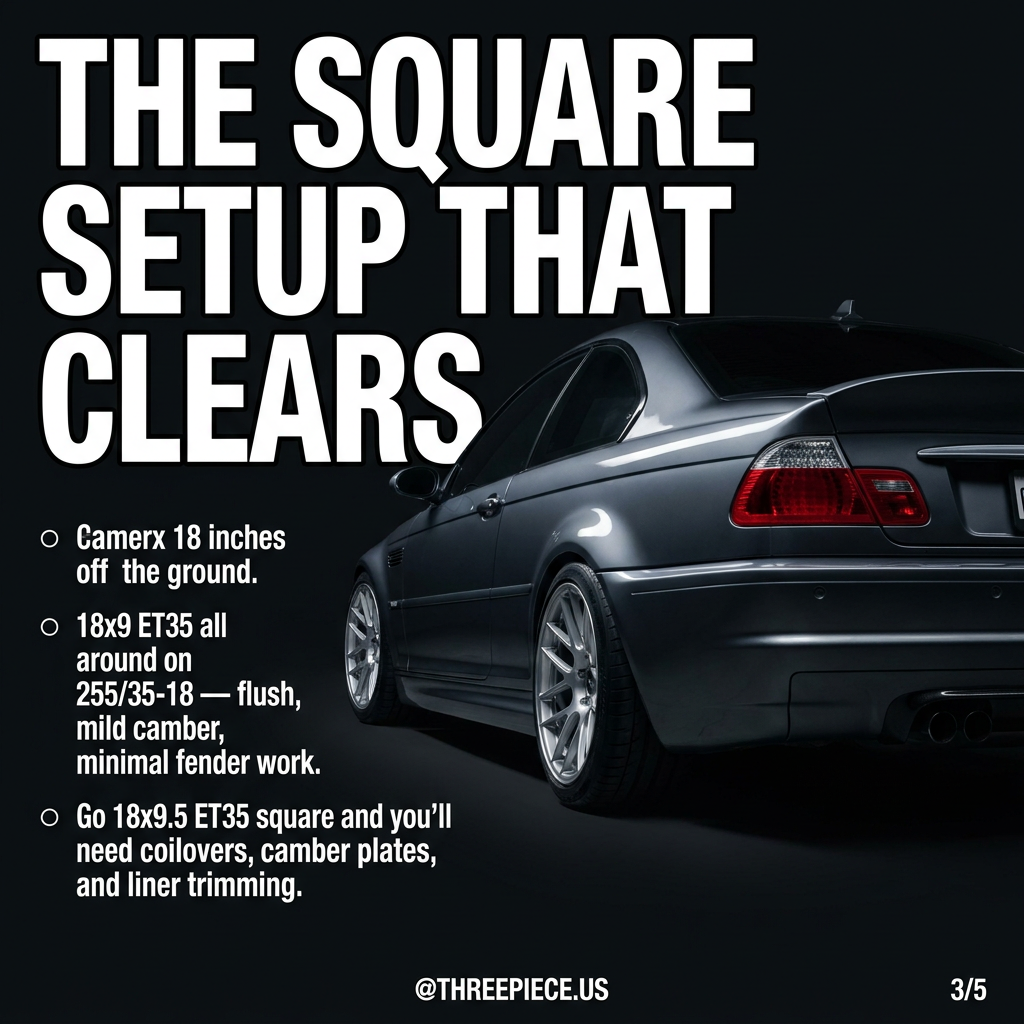
Square means the same wheel width, diameter, and offset at all four corners. The practical upside is enormous: you can rotate tires front-to-rear (doubling tread life on a car that eats rears), you buy one tire size instead of two, and the DSC system doesn't get confused by mismatched rolling diameters. The handling balance shifts toward neutral — more front grip, less built-in understeer.
The Safe Square: 18×9 ET35 · 255/35-18
This is the setup that clears on almost every E46 M3 with minimal work. 18×9 ET35 all around with 255/35-18 tires gives you a flush, filled look without fender pulling. You'll want -1.5° to -2.0° camber up front and mild negative camber in the rear. Inner liner trimming is sometimes needed at full lock, but no bodywork required. This is the daily-driver square setup — the one you run when you want the benefits of rotation without committing to a full suspension overhaul. Browse 18×9 wheels in 5×120 to see what's available in this spec.
The Track Square: 18×9.5 ET35 · 265/35-18 or 275/35-18
Step up to 18×9.5 ET35 square and you're in serious grip territory — 275/35-18 all around means the front axle finally has the same contact patch as the rear. But this setup demands more from the car. You'll need coilovers, camber plates (or adjustable upper control arms), and inner-liner trimming on the front. Rear spacers of 10-12 mm are common to push the rear wheels out and visually match the front, since ET35 on the wider rear track sits slightly inboard. Some owners run 12 mm spacers all around to bring the effective offset down to ~ET23 — just make sure you're using hubcentric rings and extended lug bolts with any spacer over 15 mm.
The Extreme Square: 18×10.5 ET25
This is the "I have camber plates, rolled fenders, and no regrets" square setup. 18×10.5 ET25 all around with 275/35-18 tires is not street-friendly without serious suspension work — adjustable control arms, fender rolling or pulling, and -2.5° to -3.0° front camber. It's a track-only proposition for most people, but the grip is staggering. If you're building an E46 M3 for time attack or endurance racing, this is where the conversation starts.
Staggered Done Right
Staggered means wider wheels and tires at the rear than the front. The E46 M3 came staggered from the factory for a reason — more rear grip means better traction out of corners and a more predictable oversteer character under power. If you're not interested in tire rotation and you want the look of a properly planted rear end, staggered is still the move. The key is getting the offsets right so you don't end up with the rear poking past the fender or the front tucked in like a stock car. For a deeper dive on how staggered fitment works across platforms, check out our BRZ/FR-S square vs staggered guide — different car, same fundamental decisions.
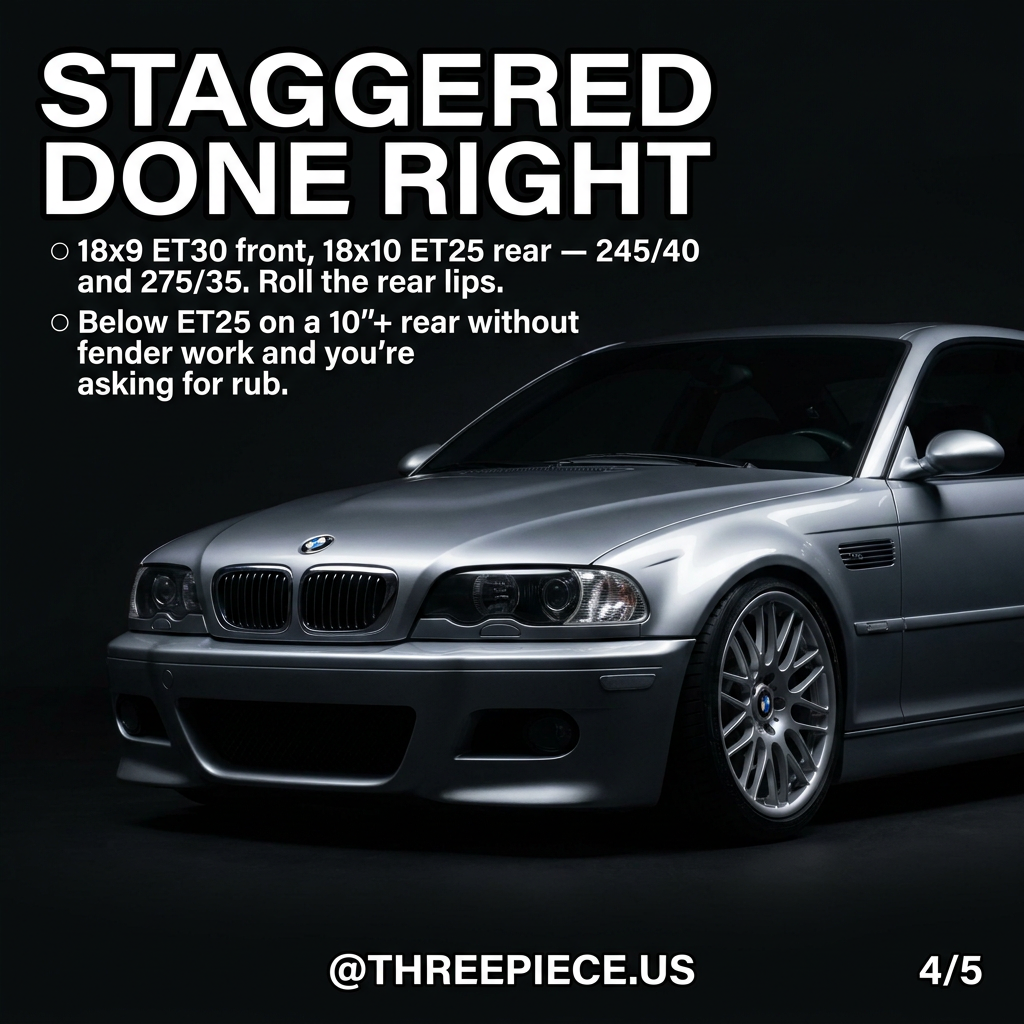
OEM+ Staggered: 18×9 ET30 Front / 18×10 ET25 Rear
This is the staggered sweet spot. 245/40-18 up front and 275/35-18 in the rear. The front gains a full inch of width over stock with a lower offset that pushes the wheel outboard for a flush look. The rear fills the fender without aggressive poke. You'll need to roll the rear fender lips — not pull, just roll — and dial in about -1.5° to -2.0° front camber and -1.75° to -2.5° rear camber. This is the setup that looks right from every angle and doesn't require you to explain your wheel choice to anyone.
Aggressive Staggered: 18×9.5 ET22 Front / 18×10.5 ET25 Rear
Now you're into stance territory. 245/40-18 front and 275/35-18 rear, but the lower offsets push everything outboard. The front at ET22 will need careful tire selection to avoid inner-liner rubbing under compression, and the rear at 10.5 inches wide needs rolled and possibly pulled fenders. Coilovers are mandatory — not optional. The visual payoff is significant, but this is a setup where every millimeter matters. Going below ET25 on a 10-inch-plus rear wheel without fender work is asking for rub, full stop.
Camber & Alignment: The Numbers That Save Your Tires
This is where E46 M3 fitment gets expensive if you ignore it and cheap if you plan for it. Wider wheels at lower offsets need negative camber to keep the tire's contact patch flat on the road and to prevent the outer edge from chewing into the fender lip under compression. Here's what real owners are running:
- Street-flush staggered (18×9 ET30 / 18×10 ET25): Front -1.5° to -2.0°, Rear -1.75° to -2.5°, rear toe at 0° or slightly toe-in
- Track square (18×9.5 ET35 all around): Front -2.5° to -3.0°, Rear -2.0° to -2.5°, with camber plates and adjustable rear control arms
- Extreme square or aggressive staggered: Front up to -3.0°, Rear -2.5°+, requiring aftermarket camber plates and rear adjustable arms
If you're pushing past -2.0° front camber, you need aftermarket camber plates — the stock E46 M3 top mounts don't offer enough adjustment range. Rear camber is adjusted via eccentric bolts on the stock rear control arms up to about -2.0°; beyond that, you need adjustable arms. The E90 335i platform shares some of this rear suspension geometry philosophy if you're cross-shopping BMW builds.
What Goes Wrong: Real Fitment Failures
Every forum thread about E46 M3 fitment has a cautionary tale buried in it. Here are the ones that keep repeating:
- ET45 on a 10.5-inch wheel: This is the classic mistake. High offset on a wide wheel means the barrel sits deep inboard, and the inner lip of the wheel contacts the coilover tower or inner fender liner under compression. You'll hear it before you see it — a grinding sound on bumps that means your wheel is eating your car from the inside. Don't do this.
- 18×9.5 ET35 square without rear spacers: The E46 M3's rear track is wider than the front, so the same offset at all four corners means the rear wheels sit slightly more inboard relative to the fender than the fronts. Owners consistently report needing 10-12 mm rear spacers to get the visual flush to match. Without them, the rear looks tucked while the front looks perfect.
- 19-inch wheels on a daily driver: Most E46 M3 owners stick with 18 inches for good reason. Going to 19 means thinner sidewalls (235/35-19 or 245/30-19), which translates to harsher ride quality, increased curb rash risk, and more susceptibility to pothole damage. The E46 M3's suspension was tuned around 18-inch wheels — 19s change the ride character in ways most people don't enjoy long-term. 20-inch wheels are almost universally avoided by the community.
- Skipping fender rolling on staggered setups: If you're running 10-inch or wider rears below ET25, the rear fender lip will contact the tire under compression. Fender rolling costs $200-$600 at a shop, or you can DIY it carefully. Skipping it means you're gambling with paint and body damage every time you hit a bump.
If you're building an S54 and want to reinforce the bottom end before pushing power, the ARP E46 M3/S54 12pt Head Stud Kit at $263.58 is the first upgrade most builders spec. Pair it with the ARP S54 Main Stud Kit at $188.32 and the ARP S54 Rod Bolt Kit at $225.78 if you're pulling the engine anyway — these are the parts that keep an S54 together at high RPM.
Wheel Picks for the E46 M3
The E46 M3 is one of those cars that looks right with almost any spoke design — mesh, split-five, deep-dish, concave. The 5×120 bolt pattern opens up the entire BMW aftermarket catalog. Here's what actually works on this platform:
For a flow-formed option that won't destroy your budget, the Work Emotion T5R starting at $396 is a proven choice on E46 M3s — lightweight, available in the right offsets, and the six-spoke design fills the fender gap without looking overdone. The Work Emotion CR Kiwami at $270 is another strong option if you want the classic five-spoke look at a lower price point.
If you're going 3-piece, the Work Emotion CR 3P at $895.50 per wheel lets you spec exact widths and offsets — which matters enormously on a platform where 5 mm of offset is the difference between flush and fender contact. The Work EMITZ at $711 brings the deep-lip aesthetic that makes an E46 M3 look like it belongs at a Wekfest booth. For the full range, browse the Work Wheels catalog and filter by your target diameter and width.
Don't forget the details — a set of 90-degree valve stems at $3.80 each makes tire pressure checks possible on deep-dish wheels where straight stems are blocked by brake calipers. And if you're running Work wheels, finishing the build with proper Work center caps is the difference between a build that looks complete and one that looks like it's waiting for parts.
For clutch feel improvement on a manual E46 — especially one that's been tracked — the Clutch Masters E46 Hydraulic Clutch Line at $40.65 eliminates the spongy stock rubber line and gives you a firmer pedal. It's one of those $40 mods that changes how the car feels every single shift.
Pick Your Lane
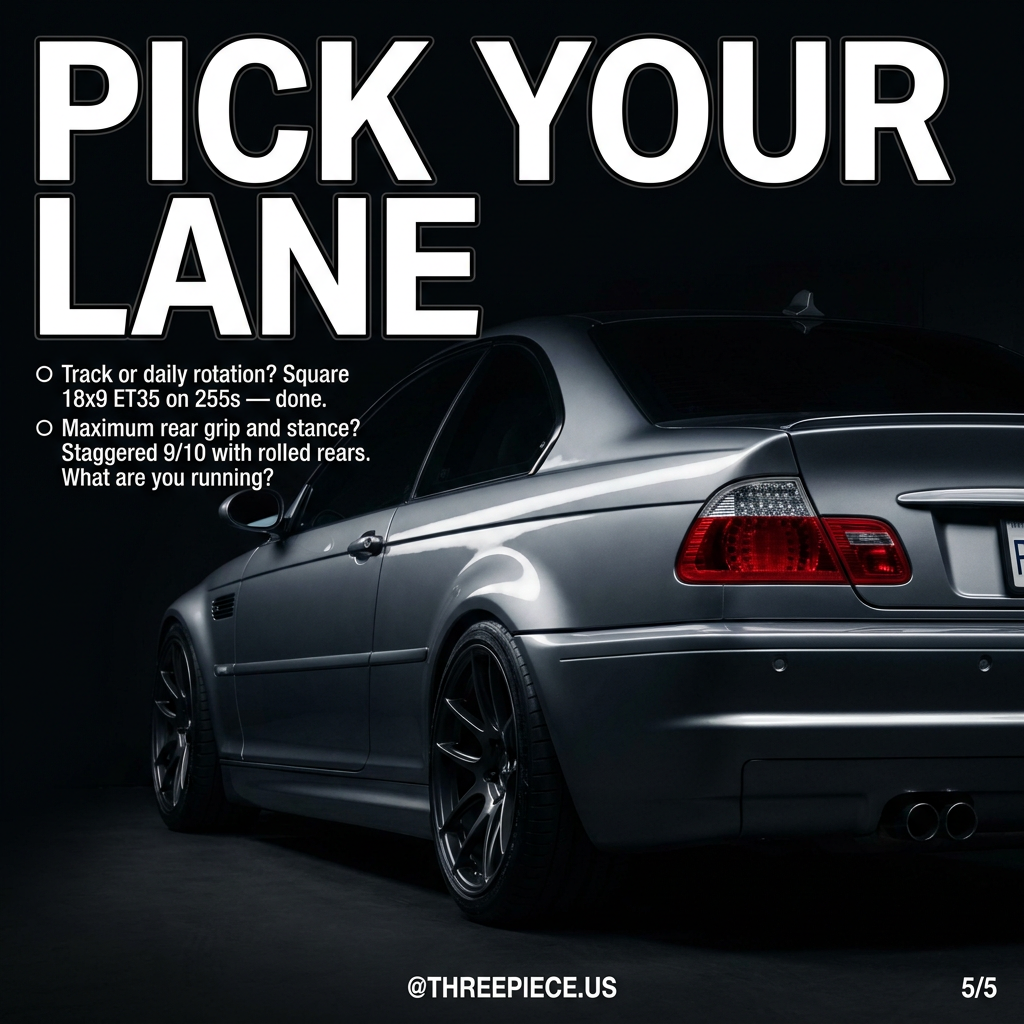
Here's the honest truth about E46 M3 fitment: most owners who start staggered end up going square after two or three tire replacements. Staggered rears wear out every 8,000-10,000 miles while the fronts still look fresh, and buying two different tire sizes gets old fast. The ones who stick with staggered have simply accepted the tire bill as a personality trait — and the look is worth it to them.
If you track the car, autocross it, or just want even tire wear and the ability to rotate: square 18×9 ET35 on 255/35-18. Done. If you want maximum rear grip, the planted stance, and you don't mind the tire logistics: staggered 18×9 ET30 front / 18×10 ET25 rear with rolled rears. Both are proven. Both clear. Both look right on an E46 M3.
Check the ThreePiece vehicle gallery for real E46 M3 builds with full specs, and browse 18-inch wheels in 5×120 to start building your setup. If you want to understand the differences between cast, flow-formed, and forged construction before you buy, our monoblock vs 3-piece breakdown covers everything you need to know.
Square or staggered — what are you running on your E46 M3, and what made you switch?