
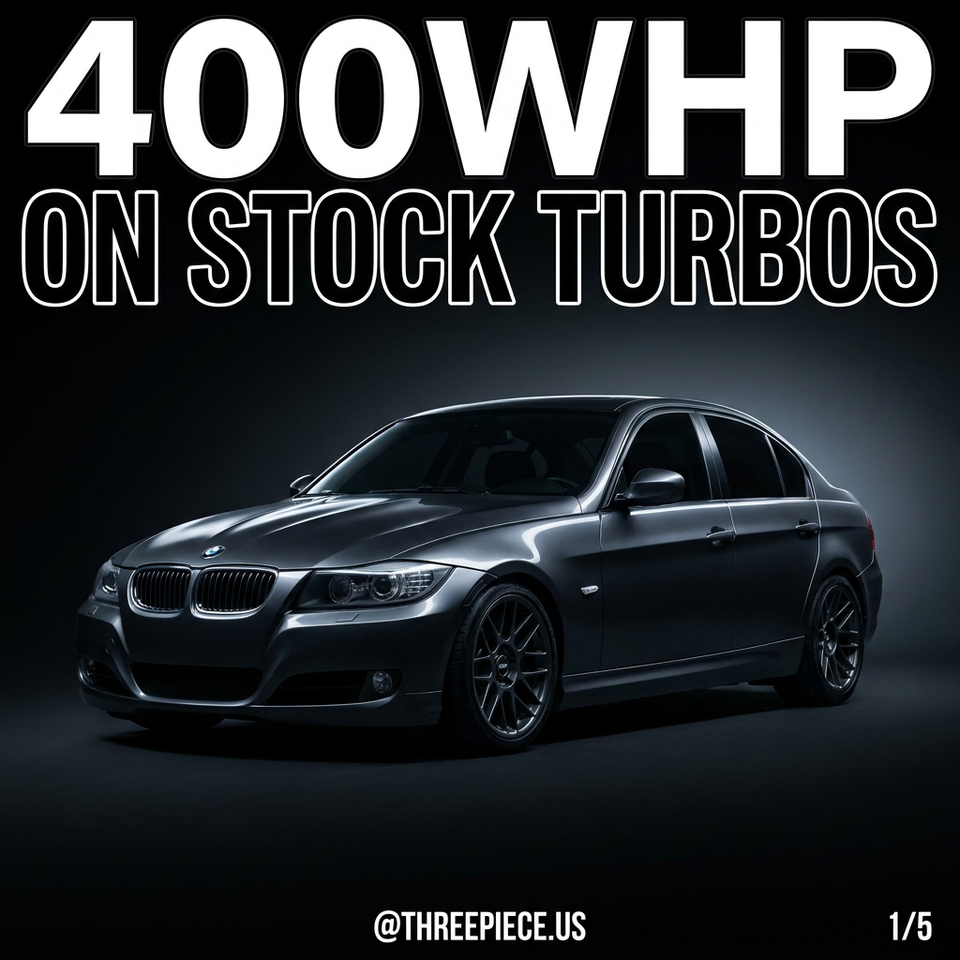
The BMW E90 335i N54 might be the most underpriced performance sedan in the game right now. Under $15k gets you a twin-turbo inline-six with a factory-conservative tune that the aftermarket has spent over a decade dismantling — and the results speak for themselves. 380–400+ whp on stock turbos, a torque curve that hits like a freight train from idle, and a community so deep that every single failure mode is documented, priced, and DIY-solved. Here's why this platform still rewards the prepared buyer harder than almost anything else at the price.
Quick links
- The N54 Was Born Undertuned — And That's the Whole Point
- It Feels Like Nothing Else in the Price Range
- Budget the Weak Spots Early and You're Golden
- Wheels and Suspension: The Build That Finishes the Car
- Stop Circling — Go Buy One
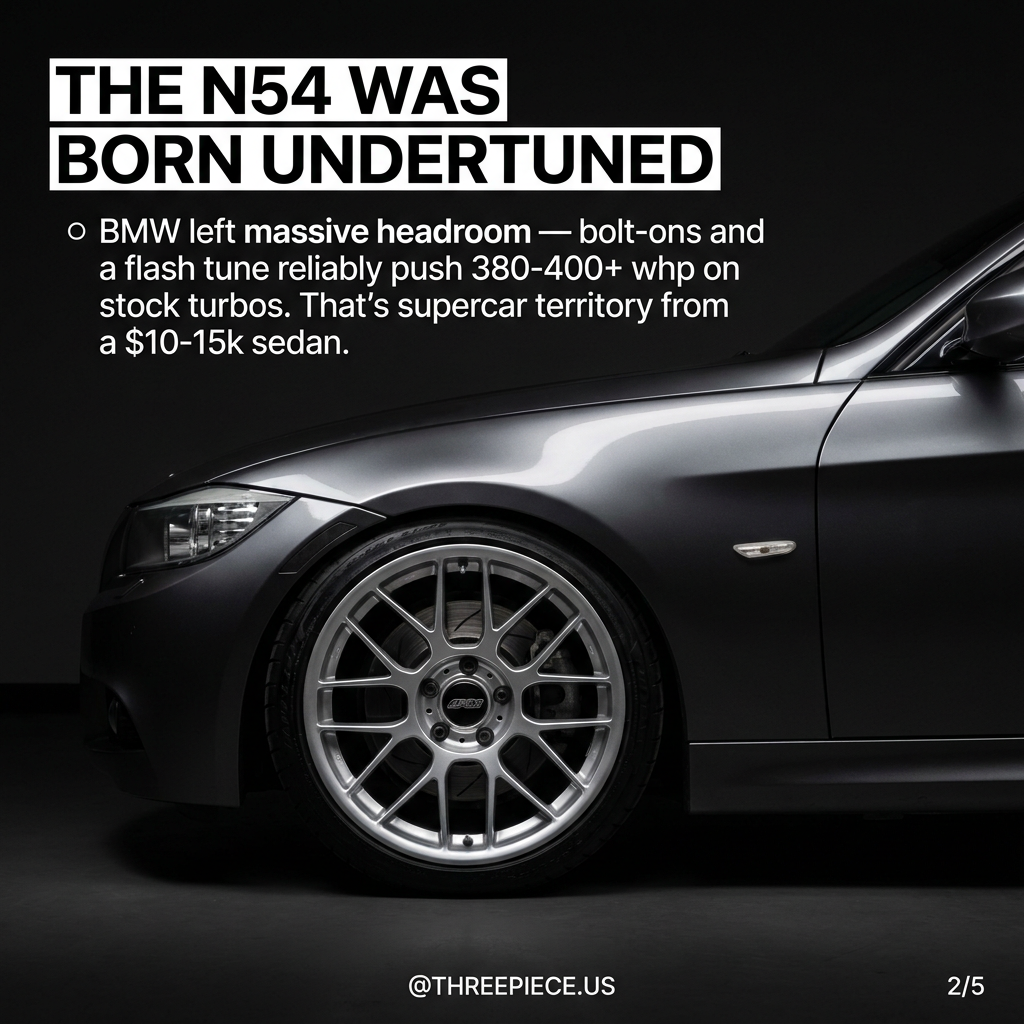
The N54 Was Born Undertuned — And That's the Whole Point
BMW left so much on the table with the N54 that the aftermarket basically treats the stock ECU map as a suggestion. The factory rating is 300 hp / 300 lb-ft, but those numbers are sandbagged. A catless downpipe, an upgraded intercooler, and a flash tune — MHD or Cobb, take your pick — reliably push 380–400+ whp on the stock twin turbos. That's supercar territory from a sedan you can find for the price of a new Civic.
The reason this works is the N54's internals. Forged crank, robust connecting rods, and a closed-deck block that was overbuilt from the factory. Compared to its successor, the N55 (single turbo, open deck), the N54 has significantly more mechanical headroom. Forum consensus is clear: if you want to push past 400 hp without touching internals, the N54 is the engine to do it on. Well-documented Stage 2+ builds running 450 whp on stock turbos for years without issue aren't unicorns — they're common enough that people argue about them on Reddit weekly.
If you're coming from the naturally aspirated side of the BMW world and want to understand how the B58 platform compares to the N54's older architecture, the lineage is direct — BMW learned a lot from the N54's tuning community when they designed its spiritual successor.
It Feels Like Nothing Else in the Price Range
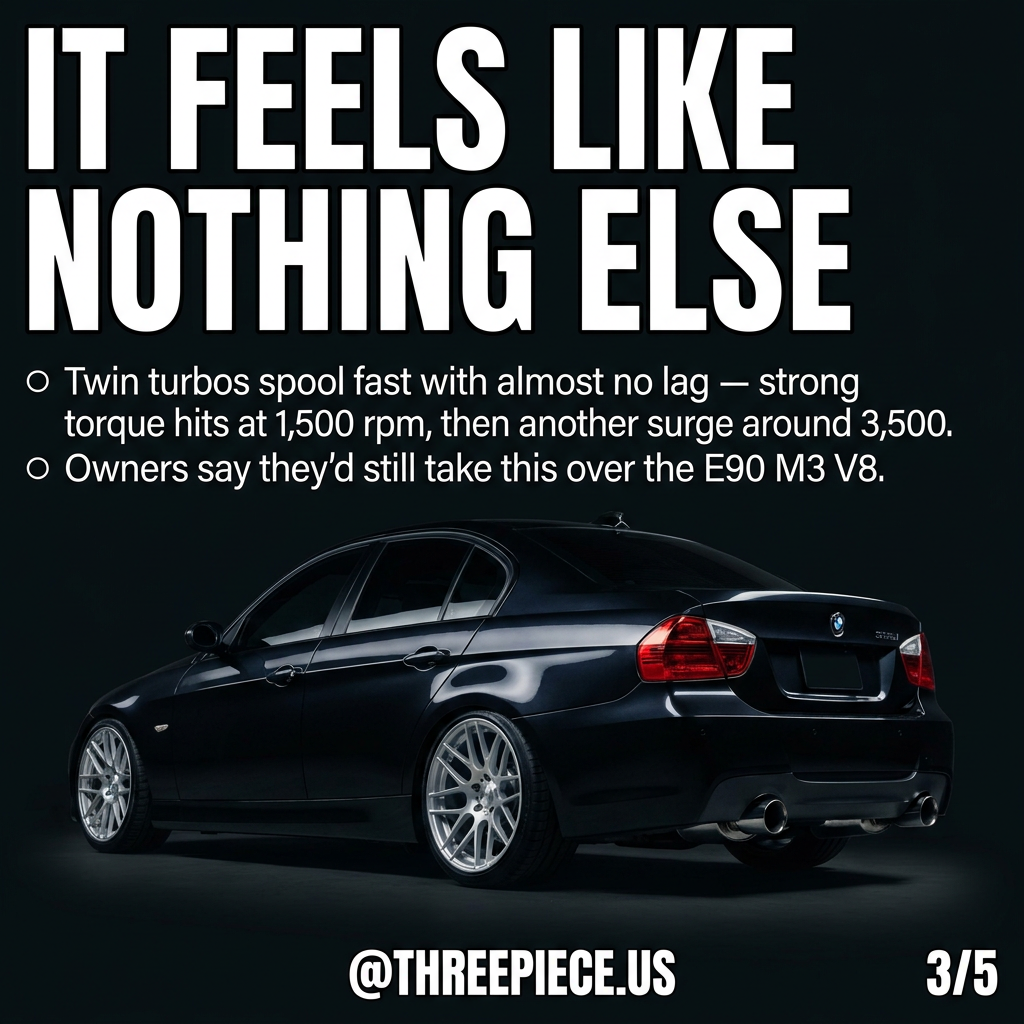
Numbers on a dyno sheet are one thing. The way the N54 delivers those numbers is something else entirely. The twin-turbo setup — two small twin-scroll units — spools fast with almost zero perceptible lag. Owners report strong, usable torque arriving at 1,500 rpm, which is absurdly low for a turbocharged engine of this era. Then around 3,500 rpm, there's a second surge where the turbos hit full stride and the car genuinely shoves you back in the seat.
German-language owner reviews on e90-forum.de describe the throttle response as so sharp that the engine barely identifies as turbocharged from behind the wheel. That's the twin-turbo advantage over a single larger unit — you get the spool characteristics of a smaller turbo with the top-end flow of a bigger one. No Valvetronic variable valve lift on the N54 either; it's all boost pressure, all the time, which is why it feels more visceral than the N55 that replaced it.
Here's the take that starts arguments: a lot of E90 335i owners say they'd take the N54 over the E90 M3's S65 V8 for daily driving. The M3 makes its power up top and needs to be wrung out. The 335i is a mid-range monster that rewards you in every gear, every stoplight, every highway on-ramp. And once you've added a tune, the gap in outright power essentially disappears — except you paid half as much for the car. The chassis is the same E90 platform with rear-wheel drive and near-perfect 50/50 weight distribution, so the driving dynamics are closer than the badge suggests.
If you're weighing the E90 335i against other undervalued sedans, the Lexus IS300 buying guide covers another inline-six platform that's appreciated for similar reasons — though the 2JZ-GE in NA form doesn't touch the N54's output.
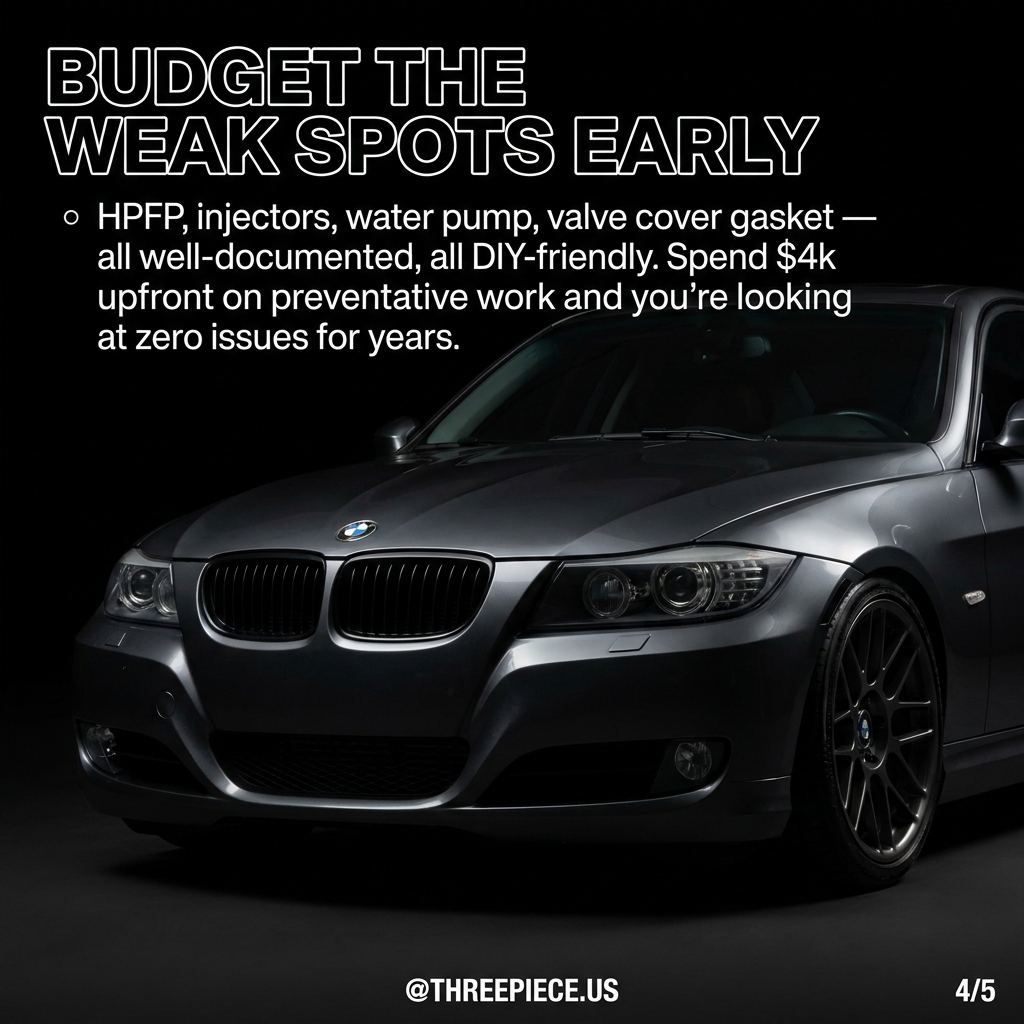
Budget the Weak Spots Early and You're Golden
This is where the conversation splits, and it's where most people talk themselves out of buying one. The N54 has a reputation for being unreliable, and that reputation is partially earned — but it's also wildly misunderstood. The engine internals are not the problem. The block, crank, and rotating assembly are robust. What fails are the ancillary components around the engine, and every single one of them is well-documented, reasonably priced, and DIY-friendly.
Here's the hit list every N54 buyer should plan for:
- High Pressure Fuel Pump (HPFP) — the single most notorious N54 failure. Revised units are available and the job is straightforward.
- Fuel injectors — index 12 injectors are the final revision. Budget for a full set of six.
- Water pump and thermostat — electric water pump failure is a when, not an if. Replace preventatively around 80–100k miles.
- Valve cover gasket — oil leaks onto the exhaust manifold are common and create smoke. Cheap part, moderate labor.
- Oil filter housing gasket (OFHG) — another common oil leak source. Often done alongside the valve cover gasket.
- Wastegate rattle — the actuator arms wear over time. Annoying but not immediately catastrophic.
- Charge pipe — the stock plastic charge pipe can blow off under boost, especially with a tune. Upgrade to aluminum immediately.
Total cost to address all of the above preventatively? Roughly $3,000–$4,000 in parts if you're doing the work yourself. That's not nothing, but context matters: you're spending $4k to bulletproof a 400 whp twin-turbo sedan that cost you $10–15k. Owners on e90post who've done this preventative sweep report 150,000–200,000+ miles with zero major engine failures afterward. One owner ran Cobb Stage 2+ for 65,000 miles and said the car pulled just as hard the day he sold it.
The N54 doesn't punish owners who wrench. It punishes owners who ignore it. There's a massive difference, and that difference is why these cars are still so cheap — people see the maintenance list and run. Their loss.
For a similar "reliability through proactive maintenance" story on a different platform, the Mazda RX-8 buying guide covers the same dynamic: a misunderstood engine that rewards the prepared buyer.
Wheels and Suspension: The Build That Finishes the Car
Once the engine is sorted, the E90 chassis deserves attention. The stock suspension is competent but soft for what this car can do with a tune. The E90 runs a 5x120 bolt pattern with a 72.6mm hub bore, which gives you access to one of the deepest wheel catalogs in the aftermarket.
The sweet spot for a street/spirited-driving E90 335i is 18x8.5 +35 front / 18x9.5 +22 rear with 225/40R18 and 255/35R18 tires respectively. That staggered setup fills the fenders without aggressive rolling and gives you meaningful rear grip for all that torque. If you're going square for track use or drift setups, 18x9.5 +22 all around with 255/35R18 is the move. Browse 18-inch wheels in 5x120 to see what fits the platform.
For suspension, the BC Racing BR-Series Coilovers for the E90/E92 at $1,195 are the go-to entry point — 30-way damping adjustment, full height adjustability, and they're proven on thousands of E90 builds. If you want the extreme-low option for stance builds, the BC Racing BR-Series Extreme for E90/E92 at the same $1,195 gives you additional drop range.
Don't sleep on sway bars either. The Eibach 28mm front and 15mm rear anti-roll kit at $590 transforms the E90's body control without destroying ride quality — it's one of the highest-value handling mods on this platform. If you only want the front bar, the Eibach 28mm front-only kit is $314 and still makes a noticeable difference in turn-in response.
For wheel choices, the Work Emotion series looks right at home on the E90's aggressive fender lines. The Work Emotion T7R starting at $432 in a concave profile gives the car posture that the stock Style 193s never could. If you want to understand the difference between cast, flow-formed, forged, and 3-piece construction before you commit, our breakdown of monoblock vs 3-piece wheels covers exactly what you're paying for at each tier.
For staggered setup guidance and why offset matters more than most people think, the G80 M3 deep dive covers the same 5x120 platform in its newer form and the fitment principles translate directly.
Stop Circling — Go Buy One
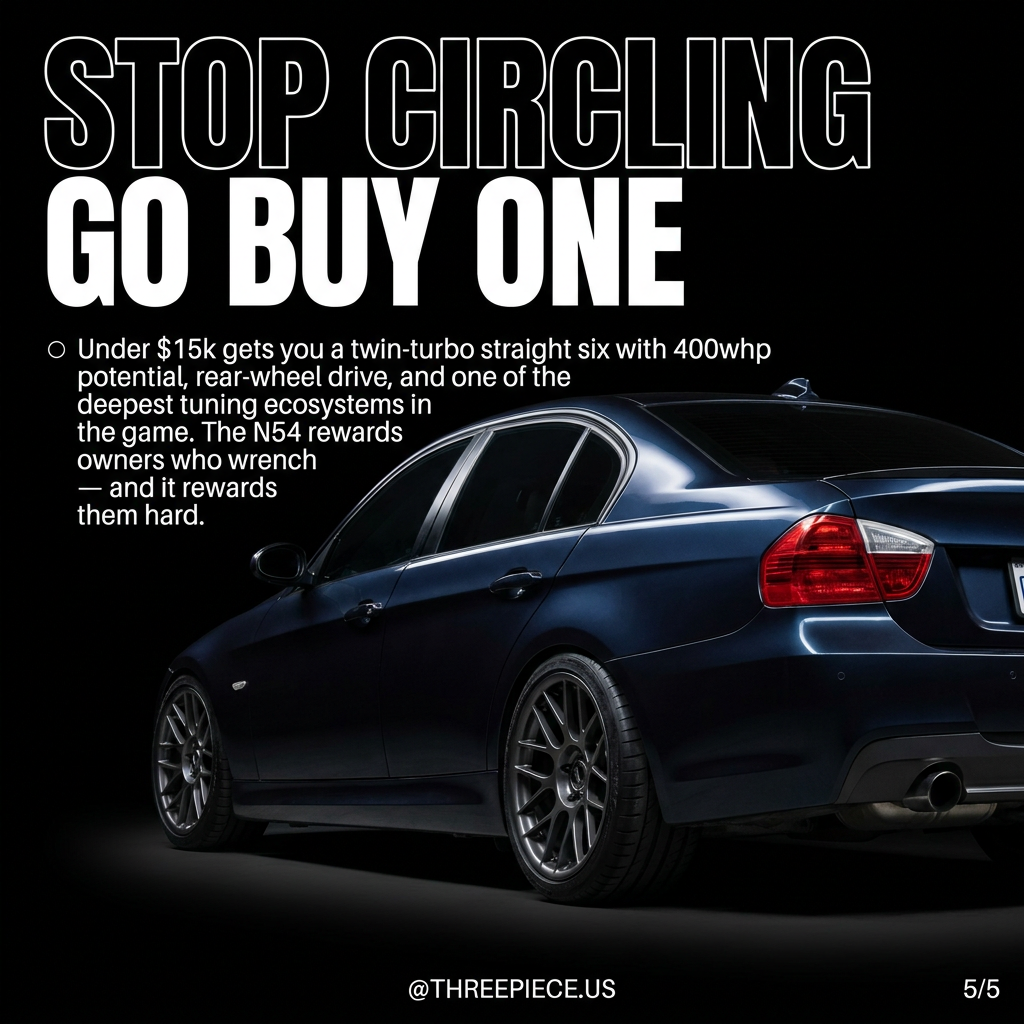
Under $15k gets you a twin-turbo straight-six with 400 whp potential on stock internals, rear-wheel drive, near-perfect weight distribution, and one of the deepest tuning ecosystems in the entire automotive world. The maintenance list scares away the unprepared, which is exactly why the prices are still this low. That won't last. The N54 335i is following the same trajectory as the Lexus IS300 and the Mk4 Supra — community knowledge matures, prices climb, and suddenly everyone wishes they'd bought one when they were cheap.
If you're building one, start with the preventative maintenance sweep, add coilovers and wheels, and flash a tune. You'll have a sedan that embarrasses cars costing three times as much — and you'll understand why N54 owners are so annoyingly evangelical about this engine. Finish the look with a ThreePiece.us license plate frame at $9.99 and check out the vehicle gallery for build inspiration across the entire 5x120 platform.
Are you team "N54 is the last great BMW turbo six" or do you think the N55/B58 made it obsolete? And if you already own one — what's the first failure that got you?