
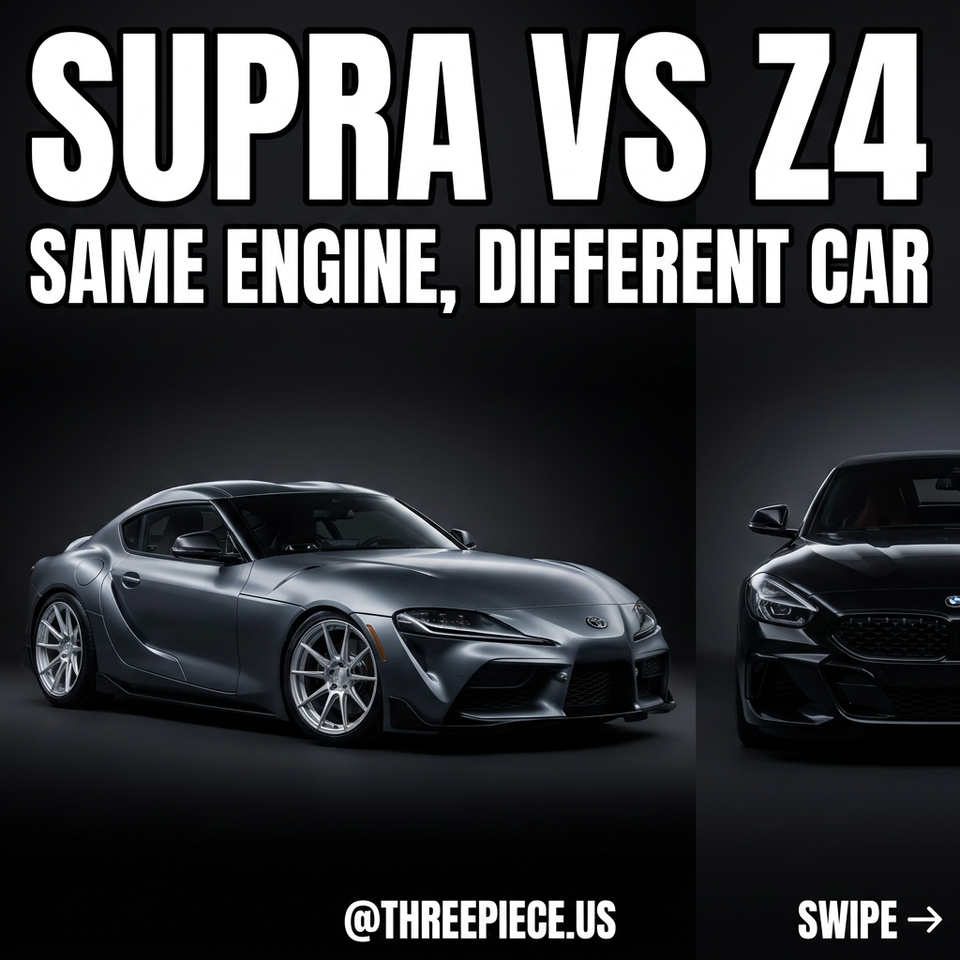
The Toyota Supra A90 and BMW Z4 M40i share BMW's B58 inline-six, the same ZF 8-speed automatic, and the same rear-wheel-drive platform — and yet they drive like two completely different cars. That's not marketing spin. Toyota took BMW's architecture and re-tuned the suspension, stiffened the chassis, and shortened the wheelbase to create something sharper. BMW kept the grand-touring personality and added a folding roof. If you're cross-shopping them right now, the answer isn't about which is "better" — it's about which experience you actually want. Here's the real breakdown, from dyno numbers to long-term ownership traps.
Quick links
- The power gap is real — but it closes fast
- Handling: coupe rigidity vs roadster compliance
- What actually breaks on each platform
- Mod path and tuning ecosystem
- Wheel fitment and sizing for both platforms
- Cost, depreciation, and the real value play
- The verdict: which one to buy
The power gap is real — but it closes fast
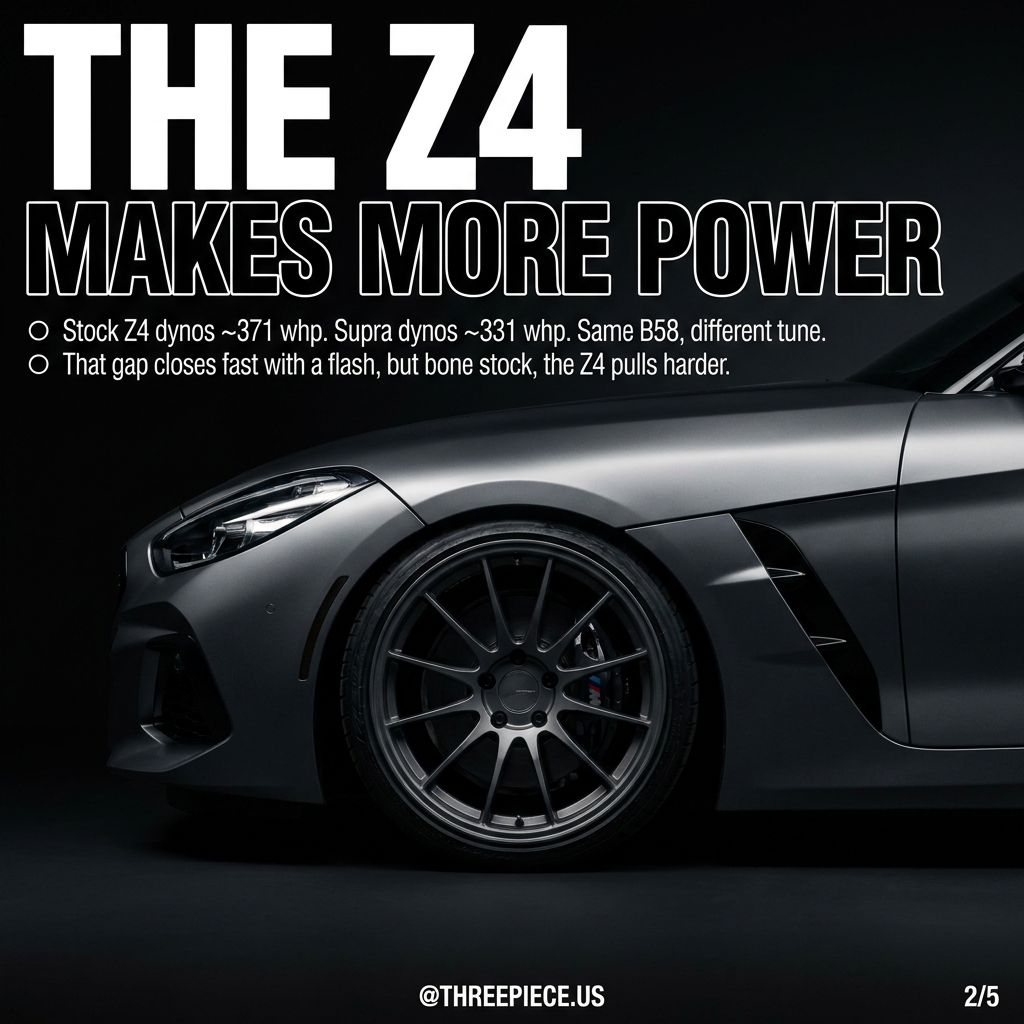
On paper, both cars run the same B58 3.0L turbo inline-six. In practice, BMW gave their own car a more aggressive tune. The Z4 M40i dynos around 371 whp while the Supra (2020 US spec) puts down roughly 331 whp. That's a 40 whp gap from the factory, and you feel it in a straight line — the Z4 pulls harder out of corners and hits 60 in about 3.9 seconds versus the Supra's ~4.1 seconds.
But here's the thing: a single flash tune erases that gap entirely. The B58 responds absurdly well to software. Bolt-on Supras with intake, downpipe, and a flash tune are reliably hitting 450-500 whp on stock internals. The Z4 follows the same path — AC Schnitzer's bolt-on package pushes it to 394 bhp and 442 lb-ft, and more aggressive European tuners like G-Power have claimed 493 hp / 516 lb-ft. The stock power difference matters if you never plan to tune. If you do, it's irrelevant within the first mod. For context on how much a tune changes the ownership equation, our G80 M3 deep dive covers the same B58 family behavior in a different chassis.
Handling: coupe rigidity vs roadster compliance
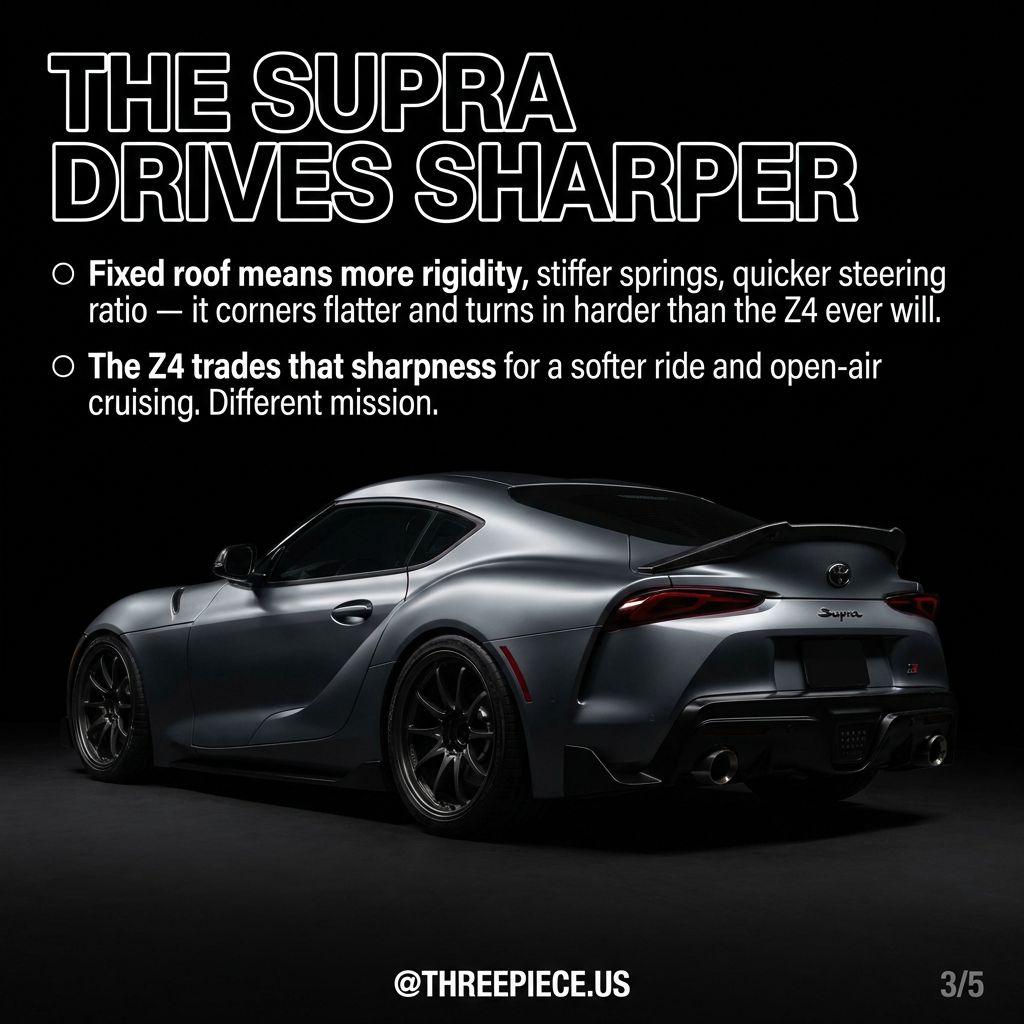
This is where the two cars diverge completely, and where Toyota's engineering choices start to make sense. The Supra's fixed roof gives it significantly higher torsional rigidity than the Z4's convertible structure. Toyota then stacked the deck further: stiffer springs, thicker anti-roll bars, a quicker steering ratio (~13.7:1 vs the Z4's ~15.4:1), stiffer hydraulic bushings, and a reinforced rear subframe. The result is a car that turns in harder, corners flatter, and communicates more through the wheel.
The Z4 trades all of that for a different mission. It rides softer, absorbs road imperfections better, and with the top down on a coastal highway, it's genuinely one of the best modern grand-touring experiences under $70K. But push it hard on a track and the convertible structure starts to show — there's more body flex under load, the steering feels vaguer in the center (a common complaint on Z4 forums, partially addressed by later software updates), and the extra 40-50 lbs from the roof mechanism and chassis reinforcement work against you. If you're upgrading suspension on either platform, the Fortune Auto 510 Series Coilovers for the A90 Supra at $2,399 are purpose-built for this chassis and offer the adjustability you need to dial in the already-stiff platform without ruining street compliance. Understanding what strut tower bars actually do (and don't do) is also worth reading before you start bolting on chassis braces.
What actually breaks on each platform
Both cars share the B58's general weak points, but each has its own platform-specific issues that real owners talk about in forums and build threads.
Supra A90 — the plastic oil pump problem
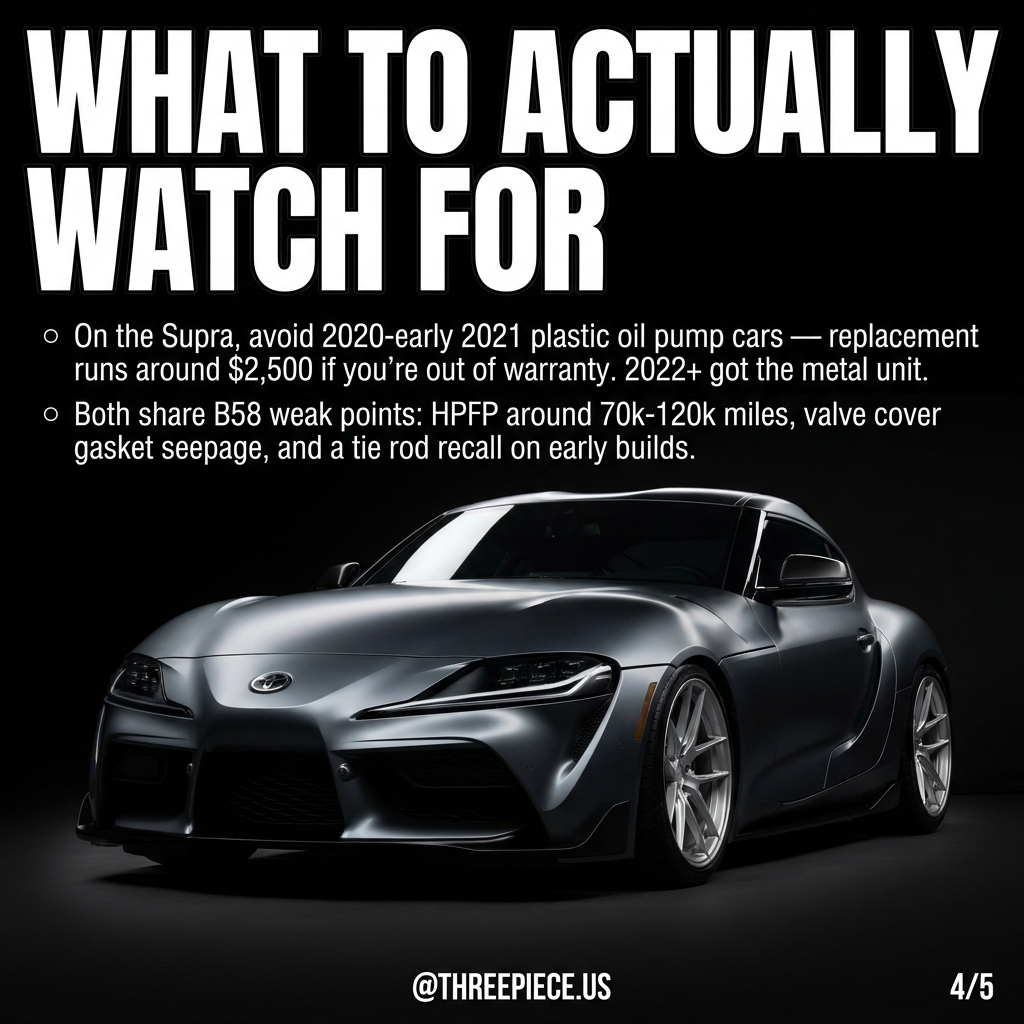
The big one: 2020 and early 2021 Supras use a plastic-ring internal oil pump that cracks over time. When it goes, you lose oil level sensor accuracy, risk low oil pressure, and face a repair bill of roughly $2,500 out of warranty. Toyota revised this to an all-metal unit for 2022+ builds. If you're buying used, this is the single most important thing to verify. Beyond the oil pump, owners report fragile drain plug threads that strip even with proper torque (requiring helicoil repair or pan replacement), and oil filter housing gasket seepage that leaks onto downpipes as the car ages.
Z4 M40i — the convertible tax
The Z4's biggest reliability concern is the roof mechanism itself. Seal leaks, wind buffeting, and noise are the most common complaints from long-term owners. Structurally, the convertible chassis flexes more under hard cornering, which accelerates wear on bushings and mounts. Maintenance costs also run higher thanks to BMW branding on consumables — brakes, sensors, and scheduled service all carry a premium over the Toyota-badged equivalent, despite sharing many of the same underlying parts.
Both platforms share the B58's known service items: HPFP attention around 70K-120K miles, valve cover gasket seepage, and a tie rod recall on early builds. If you're coming from a different BMW platform, our breakdown of hidden ownership costs on the Q50 Red Sport covers a similar pattern of "the car is cheap but the maintenance isn't."
Mod path and tuning ecosystem
The B58 is one of the most tuner-friendly modern engines, and both platforms benefit from a massive aftermarket. But the ecosystems aren't identical.
The Supra's mod path is more focused on track and grip. Most builds follow intake → downpipe → flash tune, reliably landing around 450-500 whp on stock internals. Push past 18-20 psi boost and you're into turbo upgrades and supporting mods (fuel system, cooling, upgraded charge pipe). The Supra community leans heavily on flash tuning — early ECUs were locked, but later model years opened up significantly.
The Z4 benefits from BMW's deeper tuning ecosystem. B58 tuners have been developing plug-and-play flash tunes and piggyback systems for years across the 340i, M240i, and X3 M40i. Parts availability is broader, and you'll find more off-the-shelf solutions. The trade-off is that fewer Z4-specific track parts exist — most of the aggressive aero, chassis bracing, and cooling solutions are designed for the Supra first and adapted to the Z4 second, if at all.
For either car, mod order matters more than mod choice. Doing an intake before addressing cooling or software is backwards on the B58 just like it is on any turbocharged platform. Get the tune right first, then support it.
Wheel fitment and sizing for both platforms
Both the Supra A90 and Z4 M40i run a 5x112 bolt pattern — shared with modern BMWs — which opens up a huge range of wheel options. The Supra's stock staggered setup is 19x9 +40 front / 19x10 +40 rear, and most owners building for aesthetics or track use stay in the 19" range with slightly more aggressive offsets.
A popular street setup on the Supra is 19x9.5 +22 front / 19x10.5 +25 rear, which fills the fenders properly without excessive camber. For the Z4, the slightly different fender geometry means you can run the same diameters but may need to adjust offset by a few millimeters. Browse 19" wheels in 5x112 to see what's currently available for both platforms.
If you're running a 3-piece setup, Work step lips or Work reverse lips starting at $399 let you dial in the exact width and offset you need — which matters on these cars where 2-3mm of offset is the difference between flush and rubbing. Pair with 275/35R19 rear tires for the ideal rear contact patch on either platform. For reference on how staggered sizing affects handling balance, our G80 M3 wheel fitment guide covers the same 5x112 platform with similar fender clearance concerns. And if you're considering forged multi-piece wheels, the Work Emotion series and Work VS series both offer 5x112 options that suit the aggressive lines of either car. Finish the build with 90-degree valve stems at $3.80 — essential on deep-dish setups where straight stems won't clear brake calipers. Check the vehicle gallery for real-world examples of both platforms on multi-piece wheels.
Cost, depreciation, and the real value play
The Z4 M40i typically commands a $10,000-$16,000 premium over an equivalently equipped Supra. That buys you a convertible roof, a more luxurious interior, slightly better fit and finish, and — ironically — more stock power. But it also buys you faster depreciation. The BMW badge and convertible body style mean the Z4 sheds value more aggressively in the first 3-4 years of ownership.
The Supra holds value better for two reasons: Toyota's badge carries stronger resale perception, and the coupe body style appeals to a broader buyer pool (track enthusiasts, tuners, collectors). The Supra also offers a 100,000-mile / 10-year powertrain warranty when serviced through Toyota dealers in certain markets — a significant advantage if you're buying new or CPO.
On the used market right now, 2022+ Supras with the revised oil pump are the sweet spot. You avoid the plastic pump issue, get the slightly revised suspension tuning, and benefit from the strongest resale floor. The Z4 M40i is the better buy if you find one with low miles and significant depreciation already baked in — you're getting more car for less money at that point. If you're comparing this decision to other head-to-head matchups, our Genesis Coupe vs 350Z comparison covers a similar "same segment, different philosophy" dynamic at a lower price point, and the best manual sports cars under $20K guide is worth reading if your budget is tighter.
The verdict: which one to buy
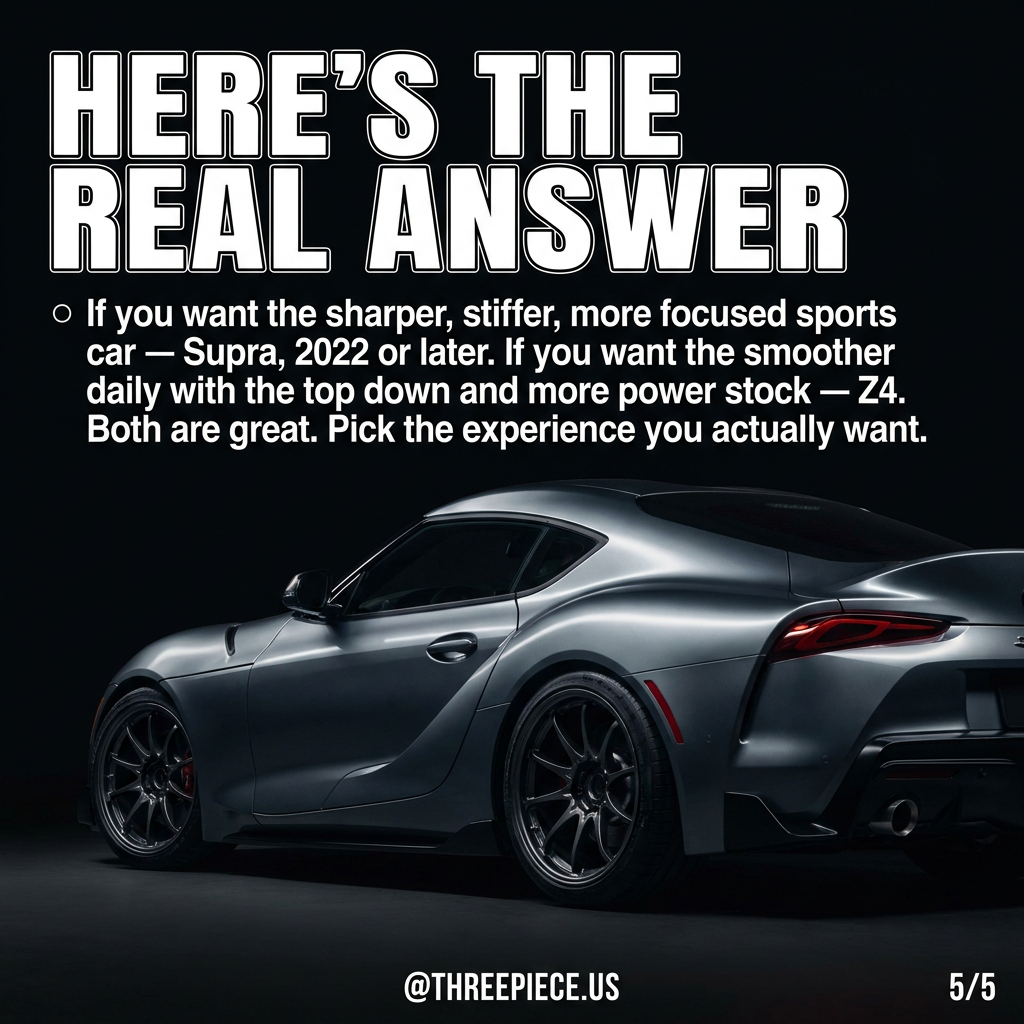
If you want the sharper, stiffer, more focused sports car — buy a Supra, 2022 or later. It's the better driver's car, the better track car, and the better long-term value play. The fixed roof gives it structural advantages the Z4 can never match, and the aftermarket is deeper for aggressive builds.
If you want the smoother daily driver with more stock power and the ability to drop the top — the Z4 M40i is genuinely underrated. It gets dismissed as the "soft" option, but it's a 370+ whp rear-drive roadster with BMW's best modern inline-six. That's not a consolation prize.
Both cars share the same heart. The question is whether you want a katana or a broadsword — and only you know which fight you're walking into. If you're building either platform, start with suspension and wheels before chasing power — the B58 already makes plenty of torque, and putting it down cleanly is what separates a fast car from a finished build.
Want to see what actually fits? Browse real Toyota Supra wheel fitments — owner setups with full specs on our fitment gallery.